Page 67 of 400

This indicator normally comes on f or
a f ew seconds when you turn the
ignition switch to the ON (II)
position. If it comes on while driving,
it indicates that one or more of your
vehicle’s tires are signif icantly low
on pressure.
If this happens, pull to the side of the
road when it is saf e, check which tire
has lost pressure, and determine the
cause. If it is because of a f lat tire,
replace the flat tire with the compact
spare (see page ), and have the
f lat tire repaired as soon as possible.
If two or more tires are underinf lated,
call a prof essional towing service
(see page ). For more
inf ormation, see page .If this indicator comes on and stays
on at any other time, or if it does not
come on when you turn the ignition
switch to the ON (II) position, there
is a problem with the TPMS. With
this indicator on, the low tire
pressure indicator will not come on
when a tire loses pressure. Take the
vehicle to your dealer to have the
system checked. For more
inf ormation, see page .
This indicator normally comes on f or
a f ew seconds when you turn the
ignition switch to the ON (II)
position.
To protect the engine f rom damage,
never drive with the tachometer in
its red zone.
This indicator shows you when the
engine speed is near the tachometer’s
red zone. When the engine speed
gets to near the red zone, the
indicator blinks. If you exceed the
maximum speed f or the gear you are
in, the indicator stays on, and you
may f eel the engine cut in and out
due to the engine speed limiter (see
page ).
339
358 284 273
285
U.S. models only U.S. models only
Tire Pressure Monitoring
System (T PMS) Indicator
Low Tire Pressure
Indicator Rev L imit Indicator
Instrument Panel Indicators
Inst rument s and Cont rols
Si model only
63
REV LIMIT INDICATOR
Main Menu
Page 77 of 400

�µ
�µ
�µ �µ
�µ
�µ
�µ
�µ �µ
�Î
�Î
Push the right lever up or down to
select a position. MIST
OFF
INT Intermittent
LO Low speed
HI High speed
Windshield washers The wipers run at high
speed until you release the lever.
The wipers are not activated.
The wipers operate every
f ew seconds.
The length of the wiper interval is
varied automatically according to the
vehicle’s speed.
Vary the delay by turning the
adjustment ring. If you turn it to the
shortest delay ( position), the
wipers change to low speed
operation when the vehicle speed
exceeds 12 mph (20 km/h).
The wipers run at low speed.
The wipers run at high speed. Pull the
wiper control lever toward you, and
hold it. The washers spray until you
release the lever. The wipers run at
low speed, then complete a f ew more
sweeps af ter you release the lever.
1.2.3.4.5.6.
On EX, EX-L and Si models in the U.S., andSE,EX-LandSimodelsinCanada
MIST
OFF INT LO HI Windshield Washer
Windshield Wipers and Washers
Inst rument s and Cont rols
73
ADJUSTMENT RING
: EX, EX-L, Si, Canadian SE
Main Menu
Page 82 of 400
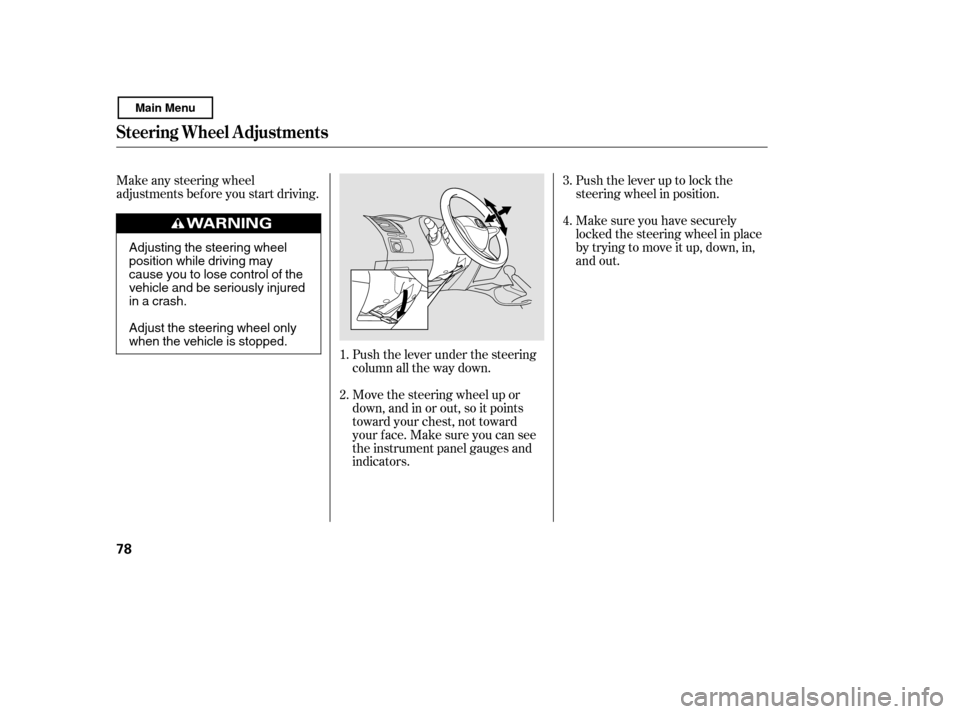
Push the lever under the steering
column all the way down.Push the lever up to lock the
steering wheel in position.
Make sure you have securely
locked the steering wheel in place
by trying to move it up, down, in,
and out.
Make any steering wheel
adjustments before you start driving.
Move the steering wheel up or
down, and in or out, so it points
toward your chest, not toward
your f ace. Make sure you can see
the instrument panel gauges and
indicators.
1. 4.
3.
2.
Steering Wheel A djustments
78
Adjusting the steering wheel
position while driving may
cause you to lose control of the
vehicle and be seriously injured
inacrash.
Adjust the steering wheel only
when the vehicle is stopped.
Main Menu
Page 259 of 400

Wait a f ew minutes af ter turning the
engine of f bef ore you check the oil.
Put your f ingers under the f ront
edge of the hood near the center.
Slide your hand to the lef t until
you f eel the hood latch handle.
Push this handle up to release it.
Lif t up the hood.
If the hood latch handle moves
stif f ly, or if you can open the hood
without lifting the handle, the
mechanism should be cleaned and
lubricated. To close the hood, lif t it up slightly
to remove the support rod f rom
the hole. Put the support rod back
into its holding clip. Lower the
hood to about a f oot (30 cm) above
the fender, then let it drop. Make
sure it is securely latched.Remove the dipstick (orange
handle).
Wipe of f the dipstick with a clean
cloth or paper towel.
Insert the dipstick all the way back
into its hole.
Holding the grip, pull the support
rod out of its clip. Insert the end
into the hole in the hood
designated by an arrow.
3.
1. 2.
3.
2.
CONT INUED
Service Station Procedures
Oil Check
Bef ore Driving
255
DIPSTICK
LATCH SUPPORT RODCLIP
GRIP
DX, DX-G, LX, SE, EX, EX-L
Main Menu
Page 268 of 400

�µ�µ�·
Steps f or Determining Correct Load
Limit Locate the statement ‘‘The
combined weight of occupants and
cargo should never exceed XXX
kg or XXX lbs.’’ on your vehicle’s
placard.
Determine the combined weight
of the driver and passengers that
will be riding in your vehicle.
Subtract the combined weight of
the driver and passengers f rom
XXX kg or XXX lbs. The resulting f igure equals the
available amount of cargo and
luggage load capacity. For
example, if the ‘‘XXX’’ amount
equals 1,400 lbs. and there will be
f ive 150 lb. passengers in your
vehicle, the amount of available
cargo and luggage load capacity is
650 lbs.
(1,400 750 (5 150) = 650 lbs.)
Determine the combined weight
of luggage and cargo being loaded
on the vehicle. That weight may
not saf ely exceed the available
cargo and luggage load capacity
calculated in Step 4.
If your vehicle will be towing a
trailer, load f rom your trailer will
be transf erred to your vehicle.
Consult this manual to determine
how this reduces the available
cargo and luggage load capacity of
your vehicle.
The maximum load f or your vehicle
is 850 lbs (385 kg) f or U.S. models
and 395 kg for Canadian models.
This f igure includes the total weight
of all occupants, cargo, and
accessories, and the tongue load if
you are towing a trailer.
Label Example
See Tire And Loading Inf ormation
label attached to the driver’s
doorjamb.
(1)
(2)
(3) (4)
(5)
(6)
Load Limits
Carrying Cargo
264
Overloading or improper
loading can affect handling and
stability and cause a crash in
which you can be hurt or killed.
Follow all load limits and other
loading guidelines in thismanual.
Main Menu
Page 271 of 400
This section gives you tips on
starting the engine under various
conditions, and how to operate the
manual and automatic transmissions.
It also includes important
information on parking your vehicle,
the braking system, the vehicle
stability assist (VSA
) system, and
the tire pressure monitoring system
(TPMS). .......................
Driving Guidelines . 268
........................
Preparing to Drive . 269
.......................
Starting the Engine . 270
...................
Manual Transmission . 271
..............
Automatic Transmission . 274
...........................................
Parking . 278
.............................
Braking System . 279
...............
Anti-lock Brakes (ABS) . 280
Vehicle Stability Assist (VSA
),
aka Electronic Stability ........
Control (ESC), System . 282
Tire Pressure Monitoring System ......................................
(TPMS) . 284
...........................
Towing a Trailer . 287
Driving
Driving
267
Main Menu
Page 282 of 400

If your vehicle has an automatic
transmission, set the parking brake
bef ore you put the transmission in
Park. This keeps the vehicle f rom
moving and putting pressure on the
parking mechanism in the
transmission.Make sure the parking brake is
f ully released bef ore driving away.
Driving with the parking brake
partially set can overheat or
damage the rear brakes.
Make sure the moonroof (if
equipped) and the windows are
closed.
Lock the doors.
Place any packages, valuables, etc.,
in the trunk or take them with you.
Turn of f the lights.
Always use the parking brake when
you park your vehicle. Make sure
the parking brake is set f irmly, or
your vehicle may roll if it is parked
on an incline.
Check the indicator on the
instrument panel to verif y that the
security system is set.
Never park over dry leaves, tall
grass, or other f lammable
materials. The hot three way
catalytic converter could cause
these materials to catch on fire.If the vehicle is f acing uphill, turn
the f ront wheels away f rom the
curb. If your vehicle has a manual
transmission, put it in f irst gear.
If the vehicle is f acing downhill,
turn the front wheels toward the
curb. If your vehicle has a manual
transmission, put it in reverse gear.
On vehicles with security system
Parking T ips
Parking
278
Never install a sunshade between the
upper and lower meters on the
instrument panel. If you do, you could
cause heat damage to the upper meter
on a very hot day.
Main Menu
Page 291 of 400
Your vehicle is not designed to tow a
trailer. Attempting to do so can void
your warranties.Your vehicle is not designed to be
towed behind a motor home. If your
vehicle needs to be towed in an
emergency, see page .
358
Towing a Trailer
Towing Your Vehicle
Driving
287
Main Menu