Page 65 of 400

This indicator normally comes on f or
a f ew seconds when you turn the
ignition switch to the ON (II)
position. If it comes on at any other
time, there is a problem with the
ABS. If this happens, have your
vehicle checked at a dealer. With
this indicator on, your vehicle still
has normal braking ability but no
anti-lock f unction. For more
inf ormation, see page .This indicator comes on brief ly when
you turn the ignition switch to the
ON (II) position. It will then go of f if
you have inserted a properly coded
ignition key. If it is not a properly
coded key, the indicator will blink,
and the engine’s f uel system will be
disabled (see page ).
The lef t or right turn signal indicator
blinks when you signal a lane change
or turn. If an indicator does not blink
or blinks rapidly, it usually means
one of the turn signal bulbs is
burned out (see pages and ).
Replace the bulb as soon as possible,
since other drivers cannot see that
you are signaling.
When you press the hazard warning
button, both turn signal indicators
and all turn signals on the outside of
the vehicle f lash.
280
80
315 316
Instrument Panel Indicators
Anti-lock Brake System
(A BS) IndicatorImmobilizer System
Indicator Turn Signal and
Hazard Warning
Indicators
Inst rument s and Cont rols
61
Main Menu
Page 95 of 400
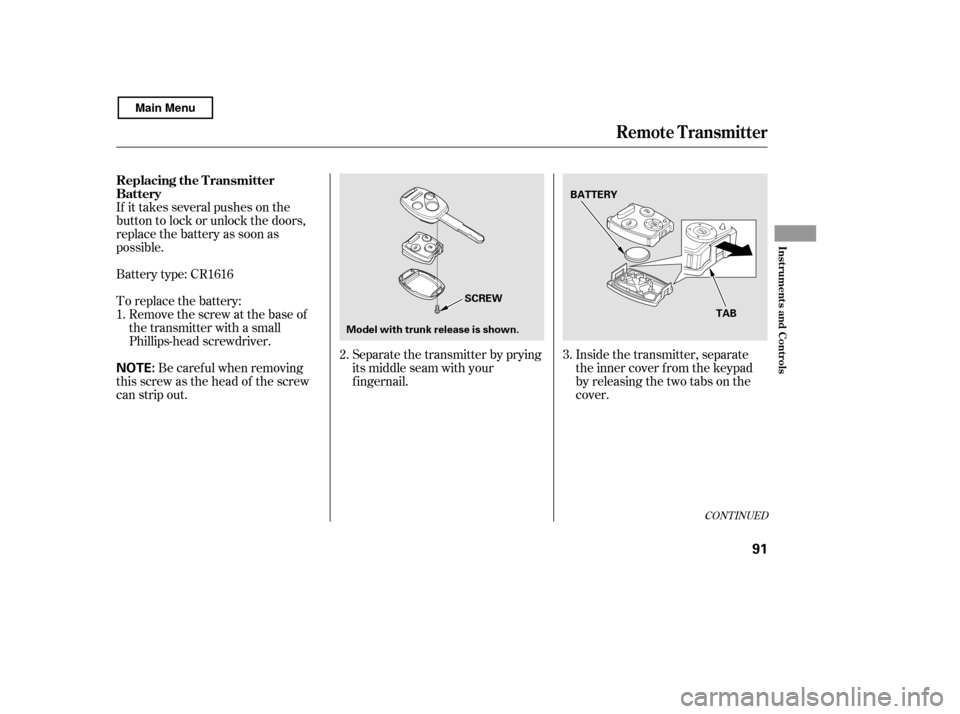
If it takes several pushes on the
button to lock or unlock the doors,
replace the battery as soon as
possible.
Battery type: CR1616Inside the transmitter, separate
the inner cover f rom the keypad
by releasing the two tabs on the
cover.
To replace the battery:
Remove the screw at the base of
the transmitter with a small
Phillips-head screwdriver. Separate the transmitter by prying
its middle seam with your
f ingernail.
Be caref ul when removing
this screw as the head of the screw
can strip out.
1.
2.3.
CONT INUED
Replacing the Transmitter
Battery
Remote Transmitter
Inst rument s and Cont rols
91
NOTE:
SCREW
Model with trunk release is shown. BATTERY
TAB
Main Menu
Page 271 of 400
This section gives you tips on
starting the engine under various
conditions, and how to operate the
manual and automatic transmissions.
It also includes important
information on parking your vehicle,
the braking system, the vehicle
stability assist (VSA
) system, and
the tire pressure monitoring system
(TPMS). .......................
Driving Guidelines . 268
........................
Preparing to Drive . 269
.......................
Starting the Engine . 270
...................
Manual Transmission . 271
..............
Automatic Transmission . 274
...........................................
Parking . 278
.............................
Braking System . 279
...............
Anti-lock Brakes (ABS) . 280
Vehicle Stability Assist (VSA
),
aka Electronic Stability ........
Control (ESC), System . 282
Tire Pressure Monitoring System ......................................
(TPMS) . 284
...........................
Towing a Trailer . 287
Driving
Driving
267
Main Menu
Page 283 of 400

Your vehicle is equipped with f ront
disc brakes. The brakes on the rear
wheels may be disc or drum,
depending on the model. A power
assist helps reduce the ef f ort needed
on the brake pedal. The anti-lock
brake system (ABS) helps you retain
steering control when braking very
hard.The hydraulic system that operates
the brakes has two separate circuits.
Each circuit works diagonally across
the vehicle (the lef t-f ront brake is
connected with the right-rear brake,
etc.). If one circuit should develop a
problem, you will still have braking
at two wheels.
If the brake pads need replacing, you
will hear a distinctive, metallic
screeching sound when you apply
the brake pedal. If you do not have
the brake pads replaced, they will
screech all the time. It is normal f or
the brakes to occasionally squeal or
squeak when you apply them.
Check the brakes after driving
through deep water. Apply the
brakes moderately to see if they f eel
normal. If not, apply them gently and
f requently until they do. Be extra
cautious in your driving.
Constant application of the brakes
when going down a long hill builds
up heat and reduces their ef f ective-
ness. Use the engine to assist the
brakes by taking your f oot of f the
accelerator and downshif ting to a
lower gear.
On vehicles with vehicle stability
assist (VSA) system, the emergency
brake assist system increases the
stopping f orce when you depress the
brake pedal hard in an emergency
situation.
Resting your f oot on the pedal keeps
the brakes applied lightly, builds up
heat, reduces their ef f ectiveness and
reduces brake pad lif e. In addition,
f uel economy can be reduced. It also
keeps your brake lights on all the
time, conf using drivers behind you.
Braking System
Braking System Design
Brake Pad Wear Indicators
Driving
279
Main Menu
Page 284 of 400

The anti-lock brake system (ABS)
helpspreventthewheelsfrom
locking up, and helps you retain
steering control by pumping the
brakes rapidly, much f aster than a
person can do it.You will f eel a pulsation in the brake
pedal when the ABS activates, and
you may hear some noise. This is
normal: it is the ABS rapidly
pumpingthebrakes.Ondry
pavement, you will need to press on
thebrakepedalveryhardbeforethe
ABS activates. However, you may
feel the ABS activate immediately if
you are trying to stop on snow or ice.If this indicator comes on, the anti-
lock f unction of the braking system
has shut down. The brakes still work
like a conventional system, but
without anti-lock. You should have
your dealer inspect your vehicle as
soon as possible.
If the indicator comes on while
driving, test the brakes as instructed
on page .
The electronic brake distribution
(EBD) system, which is part of the
ABS, also balances the f ront-to-rear
braking distribution according to
vehicle loading.
Let the ABS work f or you by always
keeping f irm, steady pressure on the
brake pedal. This is sometimes
ref erred to as ‘‘stomp and steer.’’
351
You should never pump the brake pedal.
Anti-lock Brakes (ABS)
ABS Indicator
280
Main Menu
Page 285 of 400

on loose or
uneven surf aces, such as gravel or
snow, than a vehicle without anti-
lock.
It only helps with the
steering control during braking.
such as trying to take a
corner too f ast or making a sudden
lane change. Always drive at a safe
speed f or the road and weather
conditions.
Always steer moderately
when you are braking hard. Severe
or sharp steering wheel movement
can still cause your vehicle to veer
into oncoming traffic or off the road.
If the ABS indicator and the brake
system indicator come on together,
and the parking brake is f ully
released, the EBD system may also
be shut down.
Test your brakes as instructed on
page . If the brakes f eel normal,
drive slowly and have your vehicle
repaired by your dealer as soon as
possible. Avoid sudden hard braking
which could cause the rear wheels to
lock up and possibly lead to a loss of
control.
351
Anti-lock Brakes (ABS)
A vehicle with A BS may require a
longer distance to stop
Important Saf ety Reminders
A BS does not reduce the time or
distance it takes to stop the
vehicle.
A BS will not prevent a skid that
results f rom changing direction
abruptly,
A BS cannot prevent a loss of
stability.
Driving
281
Main Menu
Page 301 of 400

�Î �Î
�Ì �Ì
�Î �Ì
Maintenance Minder
297
:
TM
If the message ‘‘SERVICE’’ does not appear more than 12 months after the
display is reset, change the engine oil every year.
Adjust the valves during services A, B, 1, 2, or 3 only if they are noisy.
Inspect idle speed every 160,000 miles (256,000 km).
See information on maintenance and emissions warranty in the center
column on page .
Independent of the maintenance messages in the information display,
replace the brake fluid every 3 years.
NOTE: :
296
Maintenance Sub Items
Rotate tires
Replace air cleaner element If you drive in dusty conditions, replace every 15,000
miles (24,000 km).
Replace dust and pollen filter If you drive primarily in urban areas that have high
concentrations of soot in the air from industry and
from diesel-powered vehicles, replace every 15,000
miles (24,000 km).
Inspect drive belt
Replace transmission fluid
Replace spark plugs
Inspect valve clearance
Replace engine coolant
Maintenance Main Items
Replace engine oil
Replace engine oil and oil filter
Inspect front and rear brakes
Check parking brake adjustment
Visually inspect these items:
Tie rod ends, steering gear box, and boots
Suspension components
Driveshaft boots
Brake hoses and line (including ABS/VSA)
All fluid levels and condition of fluids
Exhaust system
Fuel lines and connections
AB
Symbol
Symbol
12 3 4 5
Maintenance Minder
Main Menu
Page 321 of 400
If equipped
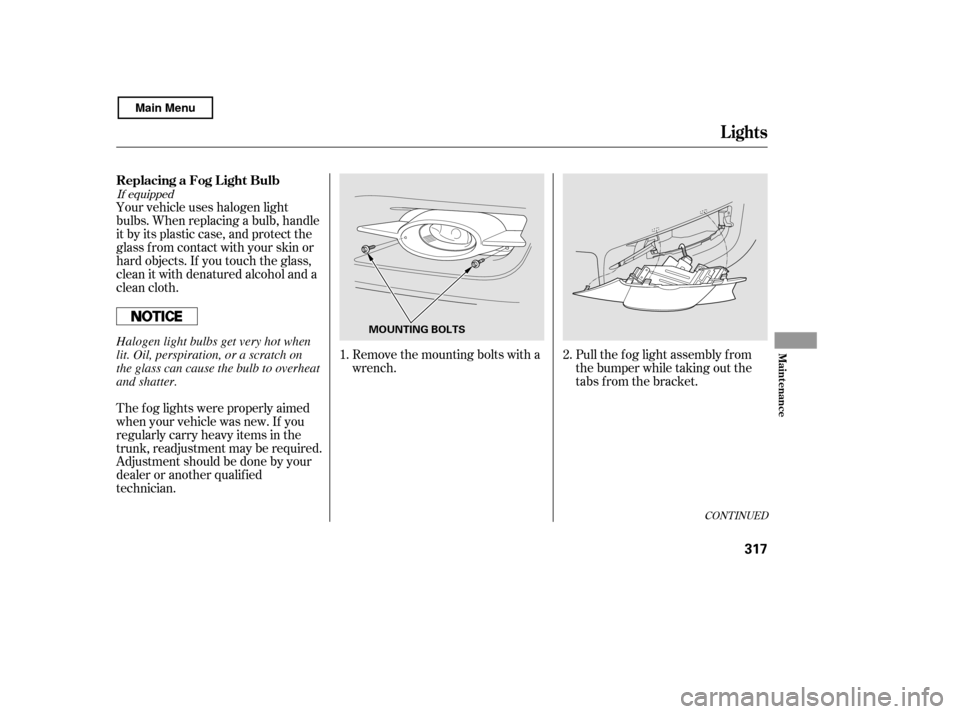
Your vehicle uses halogen light
bulbs. When replacing a bulb, handle
it by its plastic case, and protect the
glass from contact with your skin or
hard objects. If you touch the glass,
clean it with denatured alcohol and a
clean cloth.
Thefoglightswereproperlyaimed
when your vehicle was new. If you
regularly carry heavy items in the
trunk, readjustment may be required.
Adjustment should be done by your
dealer or another qualif ied
technician.Remove the mounting bolts with a
wrench.
Pull the f og light assembly f rom
the bumper while taking out the
tabs from the bracket.
1.
2.
CONT INUED
ReplacingaFogLightBulb
Lights
Maint enance
317
MOUNTING BOLTSHalogen light bulbs get very hot when
lit. Oil, perspiration, or a scratch on
the glass can cause the bulb to overheat
and shatter.
Main Menu