Page 510 of 594
Black plate (86,1)GMC Sierra Owner Manual - 2011
10-86 Vehicle Care
Tire Changing
Removing the Spare Tire and
Tools
Crew Cab
A. Wing Nut Retaining Tool Kit
B. Tool Kit
C. Wheel Blocks
D. Jack
E. Jack Knob
F. Wing Nut Retaining Wheel Blocks
Regular Cab
A. Wing Nut Retaining Tool Kit
B. Tool Kit
C. Wheel Blocks
D. Jack
E. Jack Knob
F. Wing Nut Retaining Wheel BlocksExtended Cab
A. Wing Nut Retaining Tool Kit
B. Tool Kit
C. Wheel Blocks
D. Jack
E. Jack Knob
Page 511 of 594

Black plate (87,1)GMC Sierra Owner Manual - 2011
Vehicle Care 10-87
For regular cab models, the
equipment you will need is
behind the passenger seat.
For extended and crew cab
models, the equipment is on the
shelf behind the passenger side
second row seat.
1. Turn the knob on the jackcounterclockwise to lower the
jack head to release the jack
from its holder.
2. Remove the wheel blocks and the wheel block retainer
by turning the wing nut
counterclockwise.
3. Remove the wing nut used to retain the storage bag and tools
by turning it counterclockwise.
You will use the jack handle
extensions and the wheel wrench
to remove the underbody-mounted
spare tire.
A. Spare Tire (Valve Stem Pointed Down)
B. Hoist Assembly
C. Hoist Cable
D. Tire/Wheel Retainer
E. Hoist Shaft
F. Hoist End of Extension Tool
G. Hoist Shaft Access Hole
H. Wheel Wrench
I. Jack Handle Extensions
J. Spare Tire Lock (If equipped) 1. Open the spare tire lock cover
on the bumper and use the
ignition key to remove the spare
tire lock (J). To remove the spare
tire lock, insert the ignition key
turn and pull straight out.
2. Assemble the wheel wrench (H)and the two jack handle
extensions (I) as shown.
Page 512 of 594
Black plate (88,1)GMC Sierra Owner Manual - 2011
10-88 Vehicle Care
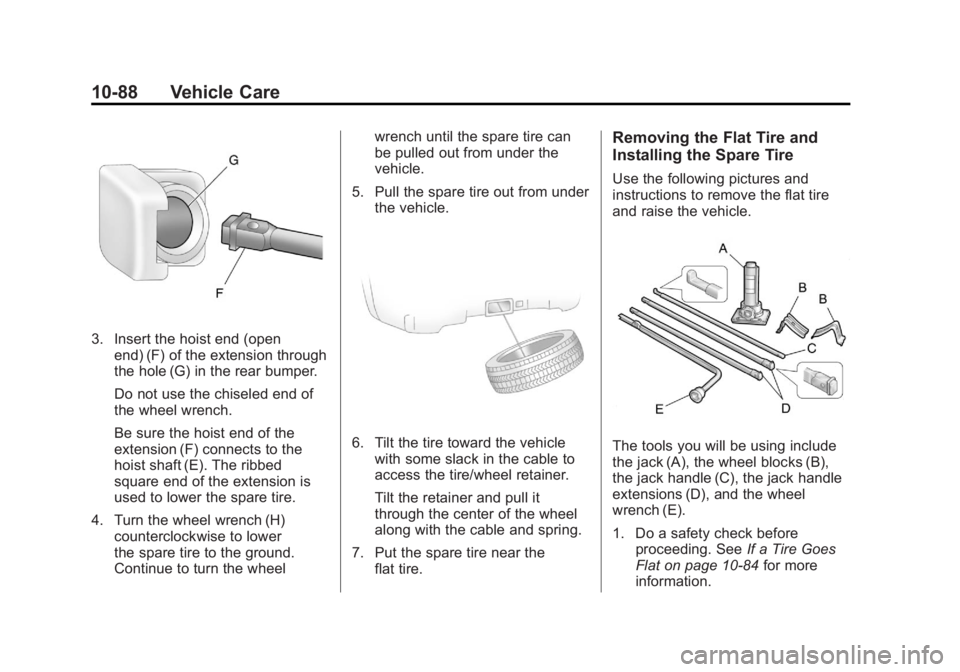
3. Insert the hoist end (openend) (F) of the extension through
the hole (G) in the rear bumper.
Do not use the chiseled end of
the wheel wrench.
Be sure the hoist end of the
extension (F) connects to the
hoist shaft (E). The ribbed
square end of the extension is
used to lower the spare tire.
4. Turn the wheel wrench (H) counterclockwise to lower
the spare tire to the ground.
Continue to turn the wheel wrench until the spare tire can
be pulled out from under the
vehicle.
5. Pull the spare tire out from under the vehicle.
6. Tilt the tire toward the vehiclewith some slack in the cable to
access the tire/wheel retainer.
Tilt the retainer and pull it
through the center of the wheel
along with the cable and spring.
7. Put the spare tire near the flat tire.
Removing the Flat Tire and
Installing the Spare Tire
Use the following pictures and
instructions to remove the flat tire
and raise the vehicle.
The tools you will be using include
the jack (A), the wheel blocks (B),
the jack handle (C), the jack handle
extensions (D), and the wheel
wrench (E).
1. Do a safety check beforeproceeding. See If a Tire Goes
Flat on page 10‑84 for more
information.
Page 515 of 594

Black plate (91,1)GMC Sierra Owner Manual - 2011
Vehicle Care 10-91
Rear Position–All Other Models
For all other models, position the
jack under the rear axle between
the spring anchor and the shock
absorber bracket.
If you have added a snow plow
to the front of your vehicle, lower
the snow plow fully before
raising the vehicle.
Make sure that the jack head is
positioned so that the rear axle
is resting securely between
the grooves that are on the
jack head.
{WARNING
Getting under a vehicle when it
is jacked up is dangerous. If the
vehicle slips off the jack, you
could be badly injured or killed.
Never get under a vehicle when
it is supported only by a jack.
{WARNING
Raising the vehicle with the
jack improperly positioned can
damage the vehicle and even
make the vehicle fall. To help
avoid personal injury and vehicle
damage, be sure to fit the jack lift
head into the proper location
before raising the vehicle. 6. Turn the wheel wrench
clockwise to raise the vehicle.
Raise the vehicle far enough off
the ground so there is enough
room for the spare tire to fit
under the wheel well.
7. Remove all the wheel nuts andtake off the flat tire.
Page 516 of 594

Black plate (92,1)GMC Sierra Owner Manual - 2011
10-92 Vehicle Care
{WARNING
Rust or dirt on a wheel, or on the
parts to which it is fastened, can
make wheel nuts become loose
after time. The wheel could come
off and cause an accident. When
changing a wheel, remove any
rust or dirt from places where the
wheel attaches to the vehicle.
In an emergency, use a cloth or
a paper towel to do this; but be
sure to use a scraper or wire
brush later, if needed, to get all
the rust or dirt off. SeeIf a Tire
Goes Flat on page 10‑84.
8. Remove any rust or dirt from the wheel bolts, mounting surfaces,
and spare wheel.
9. Install the spare tire.
{WARNING
Never use oil or grease on bolts
or nuts because the nuts might
come loose. The vehicle's wheel
could fall off, causing a crash.
10. Put the wheel nuts back on with the rounded end of the
nuts toward the wheel.
11. Tighten each wheel nut by hand. Then use the wheel
wrench to tighten the nuts
until the wheel is held against
the hub.
12. Turn the wheel wrench counterclockwise to lower
the vehicle. Lower the jack
completely.
Page 518 of 594

Black plate (94,1)GMC Sierra Owner Manual - 2011
10-94 Vehicle Care
When you reinstall the regular
wheel and tire, you must also
reinstall either the center cap,
or bolt-on hub cap, depending
on what your vehicle is equipped
with. For center caps, place the cap
on the wheel and tap it into place
until it seats flush with the wheel.
The cap only goes on one way.
Be sure to line up the tab on the
center cap with the indentation on
the wheel. For bolt-on hub caps,
align the plastic nut caps with the
wheel nuts and then tighten by
hand. Then use the wheel wrench
to tighten.Storing a Flat or Spare Tire
and Tools
{WARNING
Storing a jack, a tire, or other
equipment in the passenger
compartment of the vehicle could
cause injury. In a sudden stop or
collision, loose equipment could
strike someone. Store all these in
the proper place.
Notice: Storing an aluminum
wheel with a flat tire under your
vehicle for an extended period
of time or with the valve stem
pointing up can damage the
wheel. Always stow the wheel
with the valve stem pointing
down and have the wheel/tire
repaired as soon as possible.
Store the tire under the rear of the
vehicle in the spare tire carrier.
A. Flat or Spare Tire (Valve Stem Pointed Down)
B. Hoist Assembly
C. Hoist Cable
D. Tire/Wheel Retainer
E. Hoist Shaft
F. Hoist End of Extension Tool
G. Hoist Shaft Access Hole
H. Wheel Wrench
I. Jack Handle Extensions
J. Spare Tire Lock (If Equipped)
Page 520 of 594

Black plate (96,1)GMC Sierra Owner Manual - 2011
10-96 Vehicle Care
6. Raise the tire fully against theunderside of the vehicle by
turning the wheel wrench
clockwise until you hear two
clicks or feel it skip twice.
You cannot overtighten the
cable.
7. Make sure the tire is stored
securely. Push, pull (A), and then
try to turn (B) the tire. If the tire
moves, use the wheel wrench
to tighten the cable.
8. Reinstall the spare tire lock, if the vehicle has one. To store the jack and jack tools:
A. Wing Nut Retaining Wheel
Blocks
B. Wheel Blocks
C. Wing Nut Retaining Tool Kit
D. Wheel Wrench and Extensions
E. Tool Bag
F. Jack Mounting Bracket
G. Jack
H. Bolt Retaining Wheel Blocks 1. Put the tools (D) in the tool
bag (E) and place them in the
retaining bracket (C).
2. Tighten down the wing nut (C).
3. Assemble the wheel blocks (B) and jack (G) together with the
wing nut (A) and retaining
bolt (H).
4. Position the jack (G) in the mounting bracket (F). Position
the holes in the base of the
jack (G) onto the pin in the
mounting bracket (F).
5. Return them to their original location in the vehicle. For more
information, refer to “Removing
the Spare Tire and Tools” for
more information.
Page 521 of 594

Black plate (97,1)GMC Sierra Owner Manual - 2011
Vehicle Care 10-97
Full-Size Spare Tire
Your vehicle, when new, had a
fully-inflated spare tire. A spare
tire may lose air over time, so
check its inflation pressure regularly.
SeeTire Pressure on page 10‑66
and Vehicle Load Limits on
page 9‑25 for information regarding
proper tire inflation and loading your
vehicle. For instruction on how to
remove, install or store a spare tire,
see “Removing the Flat Tire and
Installing the Spare” and“Storing a
Flat or Spare Tire and Tools” under
Tire Changing on page 10‑86. Notice:
If the vehicle has
four-wheel drive and the different
size spare tire is installed on the
vehicle, do not drive in four-wheel
drive until you can have your
flat tire repaired and/or replaced.
You could damage the vehicle,
and the repair costs would not
be covered by your warranty.
Never use four-wheel drive when
the different size spare tire is
installed on the vehicle.
Your vehicle may have a different
size spare tire than the road tires
originally installed on your vehicle.
This spare tire was developed for
use on your vehicle, so it is all right
to drive on it. If your vehicle has
four-wheel drive and the different
size spare tire is installed, keep
the vehicle in two-wheel drive. After installing the spare tire on your
vehicle, you should stop as soon as
possible and make sure the spare
tire is correctly inflated. Have the
damaged or flat road tire repaired
or replaced as soon as you can
and installed back onto your vehicle.
This way, the spare tire will be
available in case you need it again.
Do not mix tires and wheels of
different sizes, because they will
not fit. Keep your spare tire and its
wheel together. If your vehicle has
a spare tire that does not match
your vehicle's original road tires
and wheels in size and type, do not
include the spare in the tire rotation.
