Page 349 of 406
WARNING:Do not try to pry open or push open the Easy
Fuel™ system with foreign objects. This could damage the fuel
system and its seal and cause injury to you or others.
When filling the vehicle’s fuel tank from a portable fuel container, use the
funnel included with the vehicle.
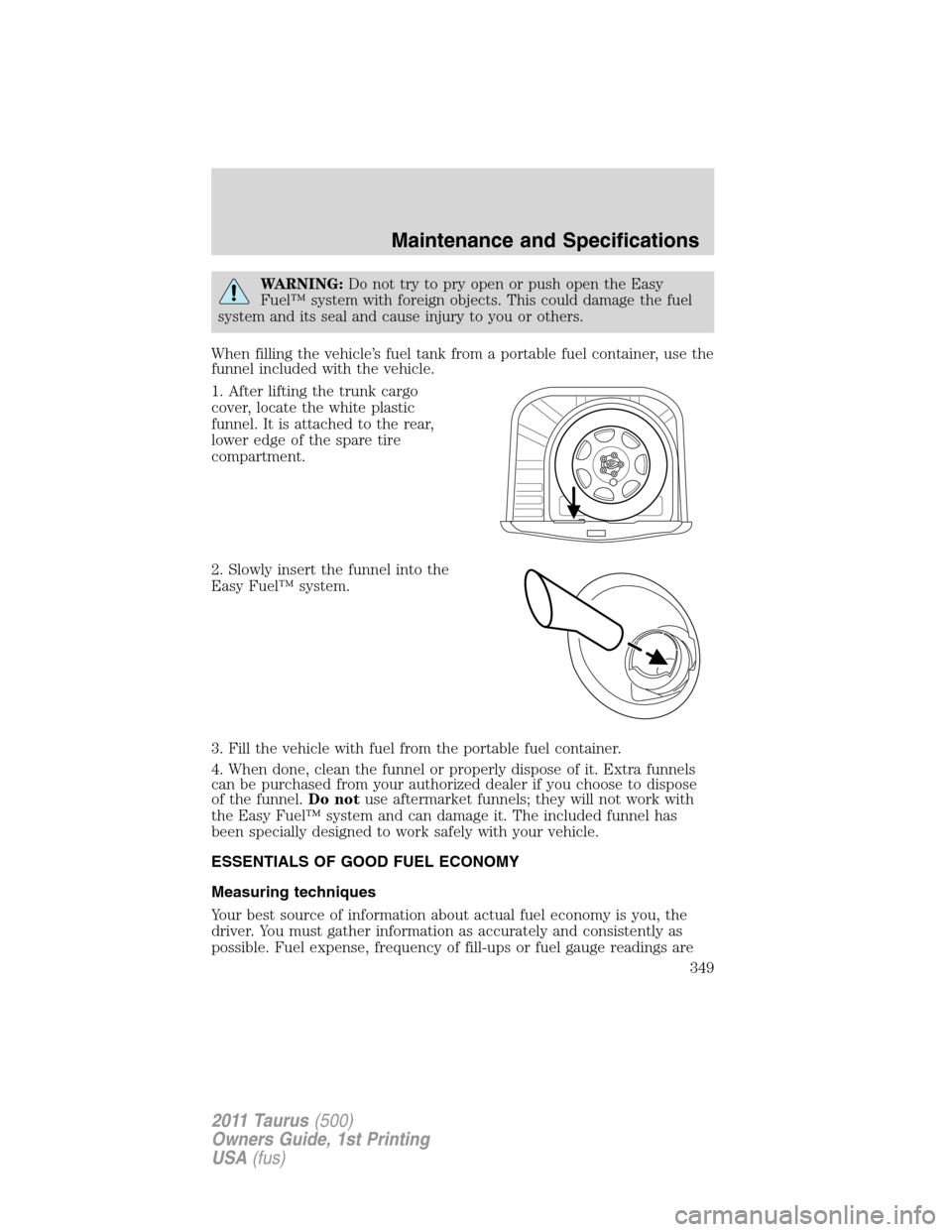
1. After lifting the trunk cargo
cover, locate the white plastic
funnel. It is attached to the rear,
lower edge of the spare tire
compartment.
2. Slowly insert the funnel into the
Easy Fuel™ system.
3. Fill the vehicle with fuel from the portable fuel container.
4. When done, clean the funnel or properly dispose of it. Extra funnels
can be purchased from your authorized dealer if you choose to dispose
of the funnel.Do notuse aftermarket funnels; they will not work with
the Easy Fuel™ system and can damage it. The included funnel has
been specially designed to work safely with your vehicle.
ESSENTIALS OF GOOD FUEL ECONOMY
Measuring techniques
Your best source of information about actual fuel economy is you, the
driver. You must gather information as accurately and consistently as
possible. Fuel expense, frequency of fill-ups or fuel gauge readings are
Maintenance and Specifications
349
2011 Taurus(500)
Owners Guide, 1st Printing
USA(fus)
Page 382 of 406
WHICH MAINTENANCE SCHEDULE SHOULD YOU FOLLOW?
Owner checks and services
Certain basic maintenance checks and inspections should be performed
by the owner or a service technician at the intervals indicated. Service
information and supporting specifications are provided in this Owner’s
Guide.
Any adverse condition should be brought to the attention of your dealer
or qualified service technician as soon as possible for the proper service
advice. The owner maintenance service checks are generally not covered
by warranties so you may be charged for labor, parts or lubricants used.
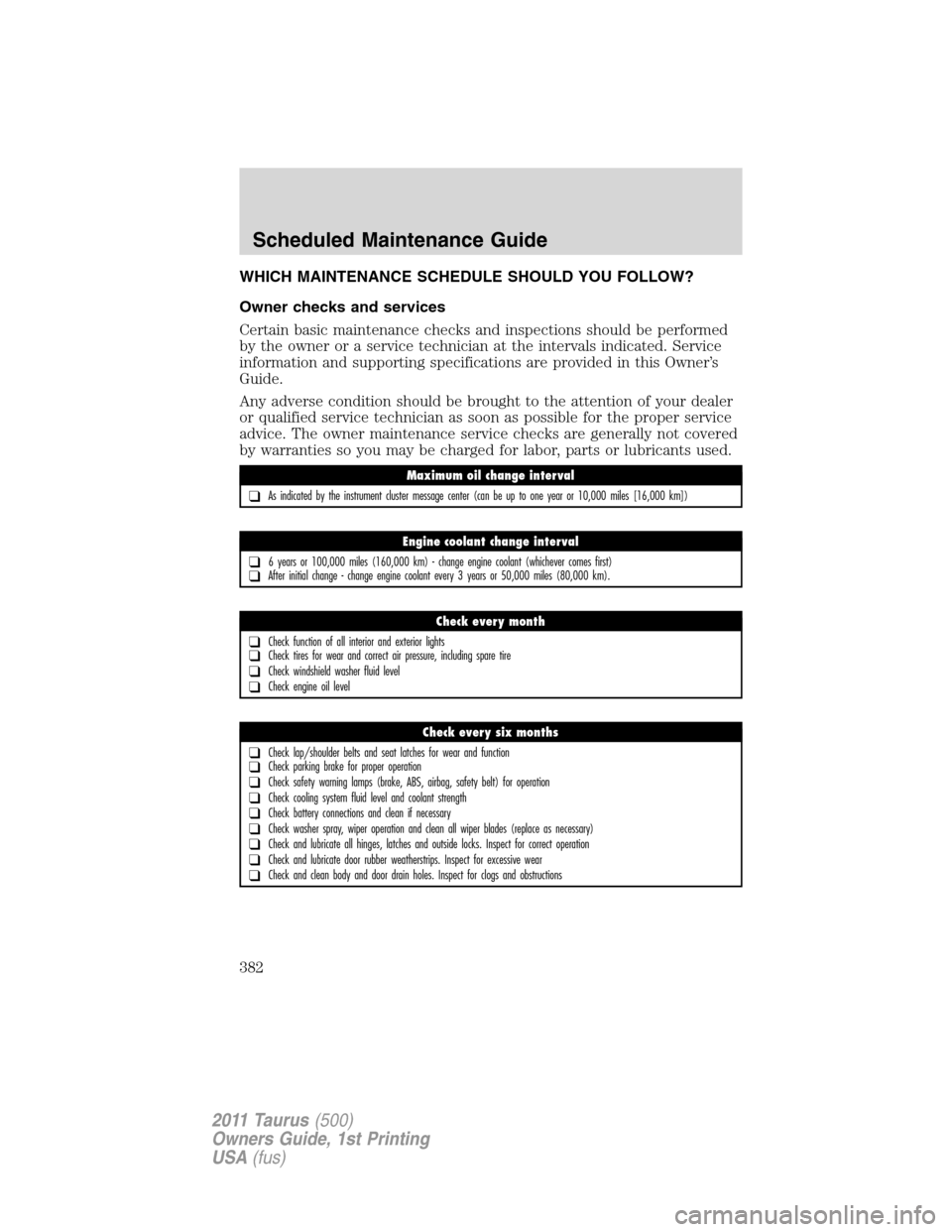
Maximum oil change interval
❑As indicated by the instrument cluster message center (can be up to one year or 10,000 miles [16,000 km])
Engine coolant change interval
❑6 years or 100,000 miles (160,000 km) - change engine coolant (whichever comes first)❑After initial change - change engine coolant every 3 years or 50,000 miles (80,000 km).
Check every month
❑Check function of all interior and exterior lights❑Check tires for wear and correct air pressure, including spare tire
❑Check windshield washer fluid level
❑Check engine oil level
Check every six months
❑Check lap/shoulder belts and seat latches for wear and function❑Check parking brake for proper operation
❑Check safety warning lamps (brake, ABS, airbag, safety belt) for operation
❑Check cooling system fluid level and coolant strength
❑Check battery connections and clean if necessary
❑Check washer spray, wiper operation and clean all wiper blades (replace as necessary)
❑Check and lubricate all hinges, latches and outside locks. Inspect for correct operation
❑Check and lubricate door rubber weatherstrips. Inspect for excessive wear
❑Check and clean body and door drain holes. Inspect for clogs and obstructions
Scheduled Maintenance Guide
382
2011 Taurus(500)
Owners Guide, 1st Printing
USA(fus)
Page 383 of 406
Multi-point inspection
In order to keep your vehicle running right, it is important to have the
systems on your vehicle checked regularly. This can help identify
potential issues and prevent major problems. Ford Motor Company
recommends the following multi-point inspection be performed at every
scheduled maintenance interval to help ensure your vehicle keeps
running great.
Be sure to ask your Ford or Lincoln Mercury dealership service advisor
or technician about the multi-point vehicle inspection. It’s a
comprehensive way to perform a thorough inspection of your vehicle. It’s
your checklist that gives you immediate feedback on the overall
condition of your vehicle. You’ll know what’s been checked, what’s okay,
as well as those things that may require future or immediate attention.
The multi-point vehicle inspection is one more way to keep your vehicle
running great!
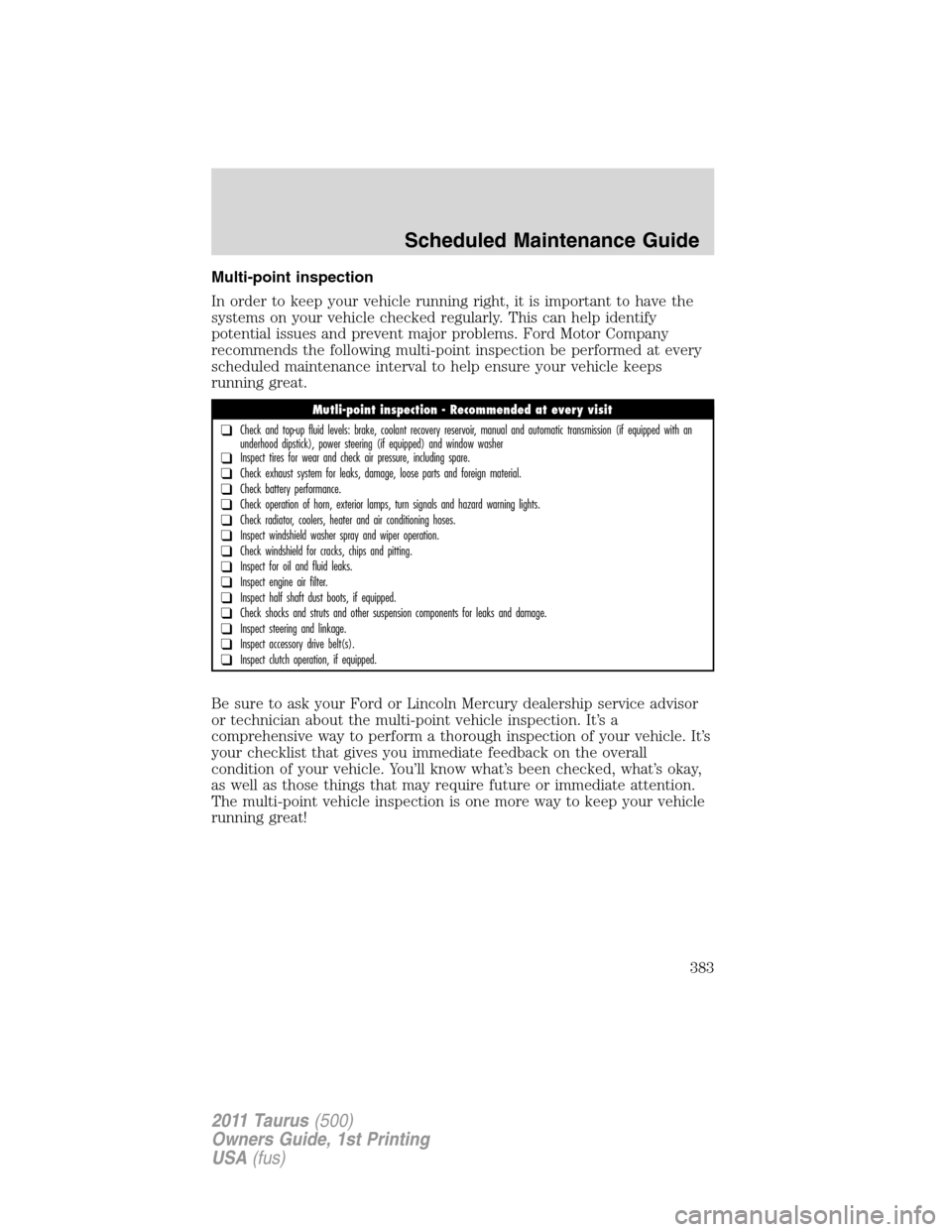
Mutli-point inspection - Recommended at every visit
❑Check and top-up fluid levels: brake, coolant recovery reservoir, manual and automatic transmission (if equipped with an
underhood dipstick), power steering (if equipped) and window washer
❑Inspect tires for wear and check air pressure, including spare.
❑Check exhaust system for leaks, damage, loose parts and foreign material.
❑Check battery performance.
❑Check operation of horn, exterior lamps, turn signals and hazard warning lights.
❑Check radiator, coolers, heater and air conditioning hoses.
❑Inspect windshield washer spray and wiper operation.
❑Check windshield for cracks, chips and pitting.
❑Inspect for oil and fluid leaks.
❑Inspect engine air filter.
❑Inspect half shaft dust boots, if equipped.
❑Check shocks and struts and other suspension components for leaks and damage.
❑Inspect steering and linkage.
❑Inspect accessory drive belt(s).
❑Inspect clutch operation, if equipped.
Scheduled Maintenance Guide
383
2011 Taurus(500)
Owners Guide, 1st Printing
USA(fus)
Page 405 of 406

for adults .................162–163, 165
for children .............................186
Occupant Classification
Sensor ......................................159
warning light
and chime ........................166–167
Safety restraints - LATCH
anchors ......................................194
Safety seats for children ..........190
Safety Compliance
Certification Label ....................370
Satellite Radio Information ........47
Scheduled Maintenance Guide
Normal Scheduled
Maintenance and Log .............385
What Maintenance Schedule
Should You Follow? ................382
Seats ..........................................138
child safety seats ....................190
cleaning ...................................323
climate control ..................54, 148
easy access/easyout
feature .....................................150
front seats .......................141, 147
heated ..............................146, 156
memory seat ...................124, 149
SecuriCode keyless entry
system ........................................129
SecuriLock passive anti-theft
system ........................................131
Servicing your vehicle ..............326
Setting the clock .........................33
SOS Post Crash Alert ...............185
Spare tire
(see Changing the Tire) ...........291
Spark plugs,
specifications .....................365, 369Specification chart,
lubricants ...................................366
Speed control ..............................88
Starting your vehicle ........235–237
jump starting ..........................305
push button start system .......238
Steering wheel
controls ......................................98
tilting .........................................77
Stereo
6-CD in dash .............................32
CD-MP3 .....................................32
SYNC�..........................................50
T
Temporary mobility kit .............295
Tilt steering wheel ......................77
Tire Pressure Monitoring
System (TPMS)
Tires, Wheels and Loading ....219
Tires ...........................203–204, 288
alignment ................................211
care ..........................................207
changing ..........................288, 291
checking the pressure ............207
inflating ...................................205
label .........................................218
replacing ..................................209
rotating ....................................212
safety practices .......................210
sidewall information ...............213
snow tires and chains ............223
spare tire .................................288
Temporary mobility kit ..........295
terminology .............................204
tire grades ...............................204
treadwear ........................203, 208
Towing .......................................231
Index
405
2011 Taurus(500)
Owners Guide, 1st Printing
USA(fus)