2011 FORD SUPER DUTY change time
[x] Cancel search: change timePage 382 of 441
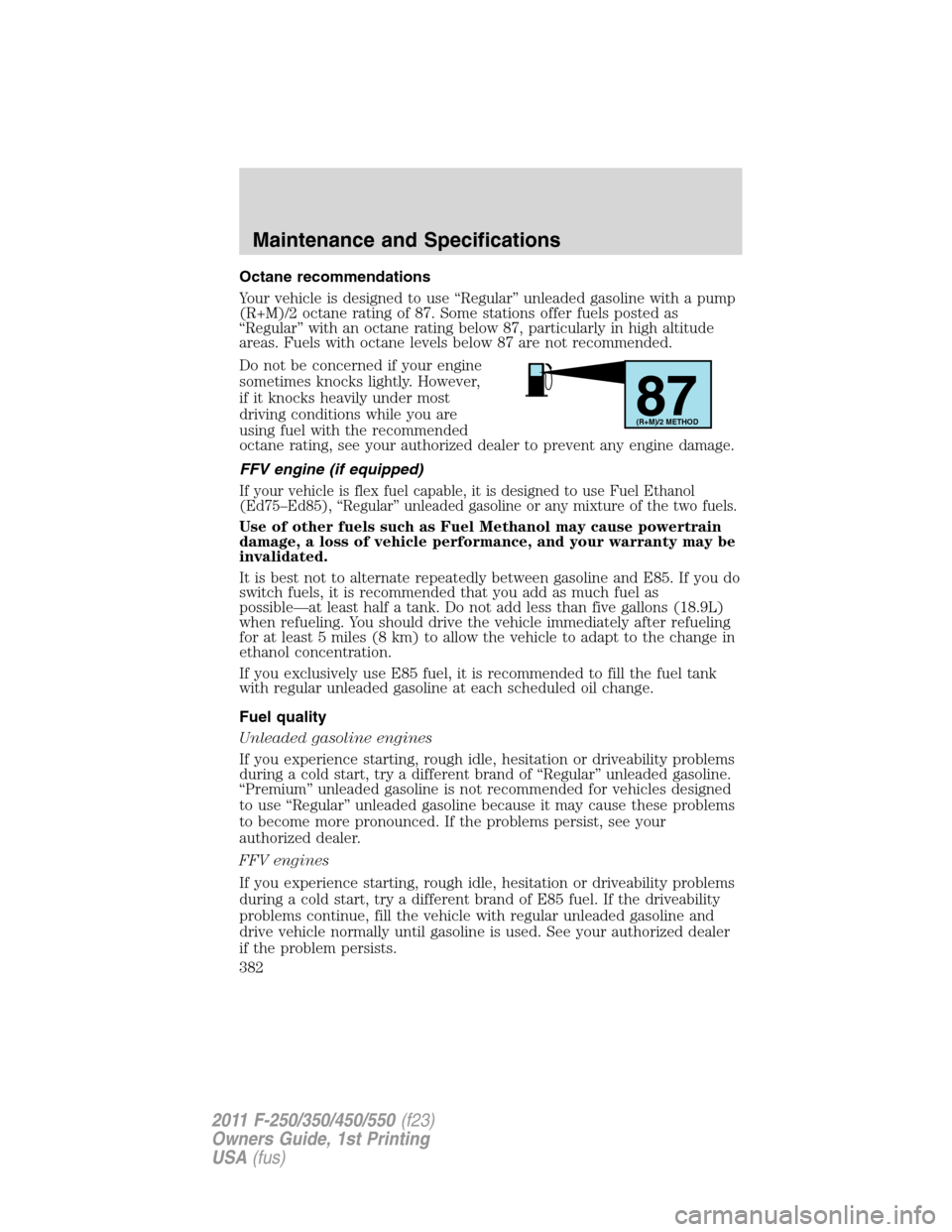
Octane recommendations
Your vehicle is designed to use “Regular” unleaded gasoline with a pump
(R+M)/2 octane rating of 87. Some stations offer fuels posted as
“Regular” with an octane rating below 87, particularly in high altitude
areas. Fuels with octane levels below 87 are not recommended.
Do not be concerned if your engine
sometimes knocks lightly. However,
if it knocks heavily under most
driving conditions while you are
using fuel with the recommended
octane rating, see your authorized dealer to prevent any engine damage.
FFV engine (if equipped)
If your vehicle is flex fuel capable, it is designed to use Fuel Ethanol
(Ed75–Ed85), “Regular” unleaded gasoline or any mixture of the two fuels.
Use of other fuels such as Fuel Methanol may cause powertrain
damage, a loss of vehicle performance, and your warranty may be
invalidated.
It is best not to alternate repeatedly between gasoline and E85. If you do
switch fuels, it is recommended that you add as much fuel as
possible—at least half a tank. Do not add less than five gallons (18.9L)
when refueling. You should drive the vehicle immediately after refueling
for at least 5 miles (8 km) to allow the vehicle to adapt to the change in
ethanol concentration.
If you exclusively use E85 fuel, it is recommended to fill the fuel tank
with regular unleaded gasoline at each scheduled oil change.
Fuel quality
Unleaded gasoline engines
If you experience starting, rough idle, hesitation or driveability problems
during a cold start, try a different brand of “Regular” unleaded gasoline.
“Premium” unleaded gasoline is not recommended for vehicles designed
to use “Regular” unleaded gasoline because it may cause these problems
to become more pronounced. If the problems persist, see your
authorized dealer.
FFV engines
If you experience starting, rough idle, hesitation or driveability problems
during a cold start, try a different brand of E85 fuel. If the driveability
problems continue, fill the vehicle with regular unleaded gasoline and
drive vehicle normally until gasoline is used. See your authorized dealer
if the problem persists.
87(R+M)/2 METHOD
Maintenance and Specifications
382
2011 F-250/350/450/550(f23)
Owners Guide, 1st Printing
USA(fus)
Page 385 of 441
Calculating fuel economy
1. Fill the fuel tank completely and record the initial odometer reading
(in miles or kilometers).
2. Each time you fill the tank, record the amount of fuel added (in
gallons or liters).
3. After at least three to five tank fill-ups, fill the fuel tank and record
the current odometer reading.
4. Subtract your initial odometer reading from the current odometer
reading.
5. Follow one of the simple calculations in order to determine fuel economy:
Calculation 1:Divide total miles traveled by total gallons used.
Calculation 2:Multiply liters used by 100, then divide by total
kilometers traveled.
Keep a record for at least one month and record the type of driving (city
or highway). This will provide an accurate estimate of the vehicle’s fuel
economy under current driving conditions. Additionally, keeping records
during summer and winter will show how temperature impacts fuel
economy. In general, lower temperatures give lower fuel economy.
Driving style — good driving and fuel economy habits
Give consideration to the lists that follow and you may be able to change
a number of variables and improve your fuel economy.
Habits
•Smooth, moderate operation can yield up to 10% savings in fuel.
•
Steady speeds without stopping will usually give the best fuel economy.
•Idling for long periods of time (greater than one minute) may waste
fuel.
•Anticipate stopping; slowing down may eliminate the need to stop.
•Sudden or hard accelerations may reduce fuel economy.
•Slow down gradually.
•Driving at reasonable speeds (traveling at 55 mph [88 km/h] uses 15%
less fuel than traveling at 65 mph [105 km/h]).
•Revving the engine before turning it off may reduce fuel economy.
•Using the air conditioner or defroster may reduce fuel economy.
•You may want to turn off the speed control in hilly terrain if
unnecessary shifting between the top gears occurs. Unnecessary
shifting of this type could result in reduced fuel economy.
Maintenance and Specifications
385
2011 F-250/350/450/550(f23)
Owners Guide, 1st Printing
USA(fus)
Page 388 of 441
Do not make any unauthorized changes to your vehicle or engine. By
law, vehicle owners and anyone who manufactures, repairs, services,
sells, leases, trades vehicles, or supervises a fleet of vehicles are not
permitted to intentionally remove an emission control device or prevent
it from working. Information about your vehicle’s emission system is on
the Vehicle Emission Control Information Decal located on or near the
engine. This decal also lists engine displacement.
Please consult yourWarranty Guidefor complete emission warranty
information.
On-board diagnostics (OBD-II)
Your vehicle is equipped with a computer that monitors the engine’s
emission control system. This system is commonly known as the
on-board diagnostics system (OBD-II). The OBD-II system protects the
environment by ensuring that your vehicle continues to meet
government emission standards. The OBD-II system also assists your
authorized dealer in properly servicing your vehicle. When the service
engine soon
indicator illuminates, the OBD-II system has detected
a malfunction. Temporary malfunctions may cause the service engine
soon
indicator to illuminate. Examples are:
1. The vehicle has run out of fuel—the engine may misfire or run poorly.
2. Poor fuel quality or water in the fuel—the engine may misfire or run
poorly.
3. The fuel cap may not have been securely tightened. SeeFuel filler
capin this chapter.
4. Driving through deep water—the electrical system may be wet.
These temporary malfunctions can be corrected by filling the fuel tank
with good quality fuel, properly tightening the fuel cap or letting the
electrical system dry out. After three driving cycles without these or any
other temporary malfunctions present, the service engine soon
indicator should stay off the next time the engine is started. A driving
cycle consists of a cold engine startup followed by mixed city/highway
driving. No additional vehicle service is required.
If the service engine soon
indicator remains on, have your vehicle
serviced at the first available opportunity. Although some malfunctions
detected by the OBD-II may not have symptoms that are apparent,
continued driving with the service engine soon
indicator on can
result in increased emissions, lower fuel economy, reduced engine and
transmission smoothness, and lead to more costly repairs.
Maintenance and Specifications
388
2011 F-250/350/450/550(f23)
Owners Guide, 1st Printing
USA(fus)
Page 414 of 441
FORD ESP EXTENDED SERVICE PLANS (CANADA ONLY)
You can get more protection for your vehicle by purchasing a Ford
Extended Service Plan (ESP). Ford ESP is the only service contract
backed by Ford Motor Company. Depending on the plan you purchase,
Ford ESP provides benefits such as:
•Rental reimbursement
•Coverage for certain maintenance and wear items
•Protection against repair costs after your New Vehicle Limited
Warranty Coverage expires
•Roadside Assistance benefits
You may purchase Ford ESP from any participating Ford Motor Company
dealership. There are several Ford ESP plans available in various time,
distance and deductible combinations. Each plan is tailored to fit your
own driving needs, including reimbursement for towing and rental.
When you purchase Ford ESP, you receive peace-of-mind protection
throughout Canada and the United States, provided by a network of Ford
Motor Company dealers.
For more information, visit your local Ford of Canada dealer or
www.ford.ca to find the Ford Extended Service Plan that is right for you.
NOTE:Repairs performed outside of Canada and the United States are
not eligible for Ford ESP coverage. This information is subject to change.
Ford Extended Service Plan
414
2011 F-250/350/450/550(f23)
Owners Guide, 1st Printing
USA(fus)
Page 432 of 441
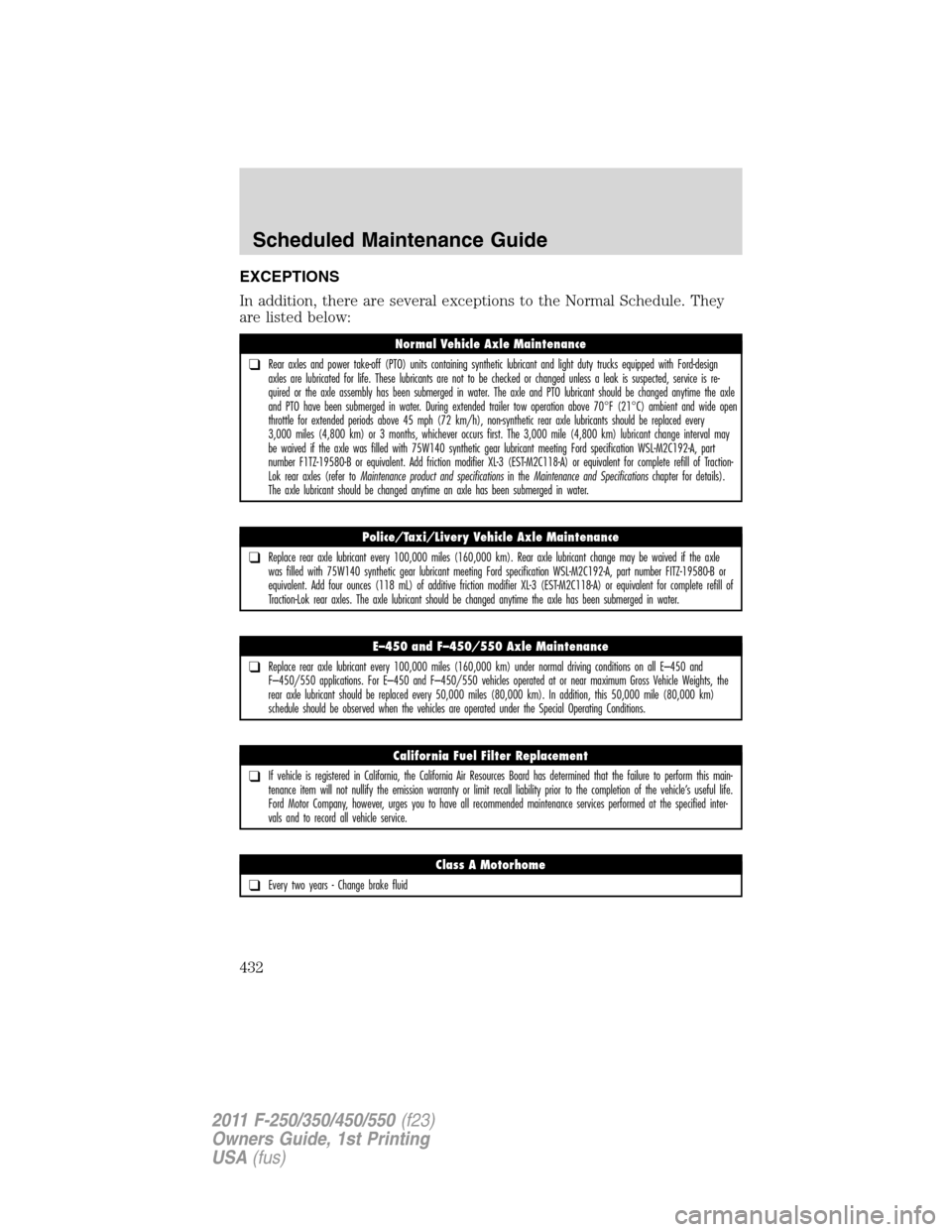
EXCEPTIONS
In addition, there are several exceptions to the Normal Schedule. They
are listed below:
Normal Vehicle Axle Maintenance
❑Rear axles and power take-off (PTO) units containing synthetic lubricant and light duty trucks equipped with Ford-design
axles are lubricated for life. These lubricants are not to be checked or changed unless a leak is suspected, service is re-
quired or the axle assembly has been submerged in water. The axle and PTO lubricant should be changed anytime the axle
and PTO have been submerged in water. During extended trailer tow operation above 70°F (21°C) ambient and wide open
throttle for extended periods above 45 mph (72 km/h), non-synthetic rear axle lubricants should be replaced every
3,000 miles (4,800 km) or 3 months, whichever occurs first. The 3,000 mile (4,800 km) lubricant change interval may
be waived if the axle was filled with 75W140 synthetic gear lubricant meeting Ford specification WSL-M2C192-A, part
number F1TZ-19580-B or equivalent. Add friction modifier XL-3 (EST-M2C118-A) or equivalent for complete refill of Traction-
Lok rear axles (refer to
Maintenance product and specificationsin theMaintenance and Specificationschapter for details).
The axle lubricant should be changed anytime an axle has been submerged in water.
Police/Taxi/Livery Vehicle Axle Maintenance
❑Replace rear axle lubricant every 100,000 miles (160,000 km). Rear axle lubricant change may be waived if the axle
was filled with 75W140 synthetic gear lubricant meeting Ford specification WSL-M2C192-A, part number FITZ-19580-B or
equivalent. Add four ounces (118 mL) of additive friction modifier XL-3 (EST-M2C118-A) or equivalent for complete refill of
Traction-Lok rear axles. The axle lubricant should be changed anytime the axle has been submerged in water.
E–450 and F–450/550 Axle Maintenance
❑Replace rear axle lubricant every 100,000 miles (160,000 km) under normal driving conditions on all E–450 and
F–450/550 applications. For E–450 and F–450/550 vehicles operated at or near maximum Gross Vehicle Weights, the
rear axle lubricant should be replaced every 50,000 miles (80,000 km). In addition, this 50,000 mile (80,000 km)
schedule should be observed when the vehicles are operated under the Special Operating Conditions.
California Fuel Filter Replacement
❑If vehicle is registered in California, the California Air Resources Board has determined that the failure to perform this main-
tenance item will not nullify the emission warranty or limit recall liability prior to the completion of the vehicle’s useful life.
Ford Motor Company, however, urges you to have all recommended maintenance services performed at the specified inter-
vals and to record all vehicle service.
Class A Motorhome
❑Every two years - Change brake fluid
Scheduled Maintenance Guide
432
2011 F-250/350/450/550(f23)
Owners Guide, 1st Printing
USA(fus)