2011 FORD SUPER DUTY warning light
[x] Cancel search: warning lightPage 6 of 90
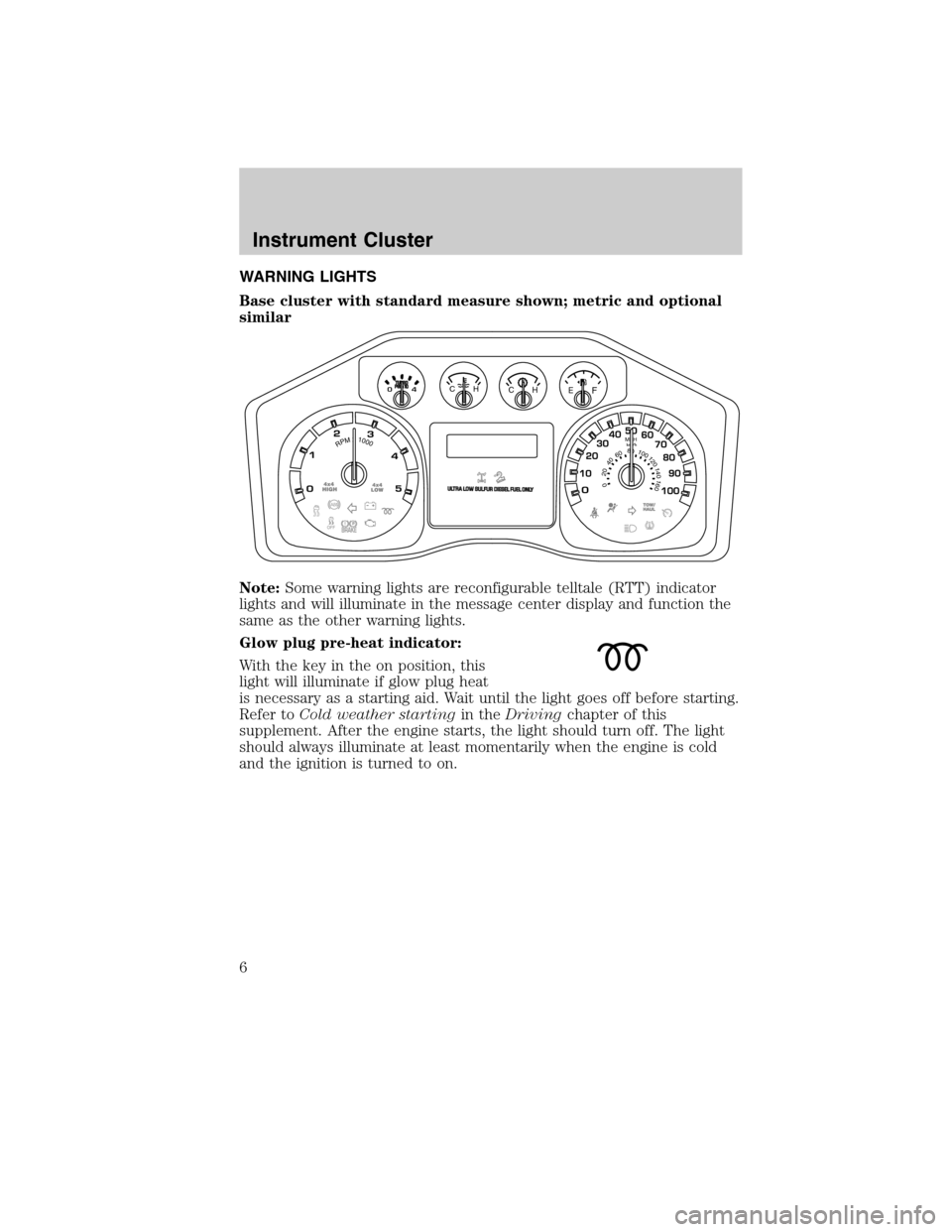
WARNING LIGHTS
Base cluster with standard measure shown; metric and optional
similar
Note:Some warning lights are reconfigurable telltale (RTT) indicator
lights and will illuminate in the message center display and function the
same as the other warning lights.
Glow plug pre-heat indicator:
With the key in the on position, this
light will illuminate if glow plug heat
is necessary as a starting aid. Wait until the light goes off before starting.
Refer toCold weather startingin theDrivingchapter of this
supplement. After the engine starts, the light should turn off. The light
should always illuminate at least momentarily when the engine is cold
and the ignition is turned to on.
04CHCHEF
RPMx1000
0204
060801001
2
01
4
0160
km/hMPH
Instrument Cluster
6
2011 Econoline(eco)
Supplement, 1st Printing
USA(fus)
Page 7 of 90
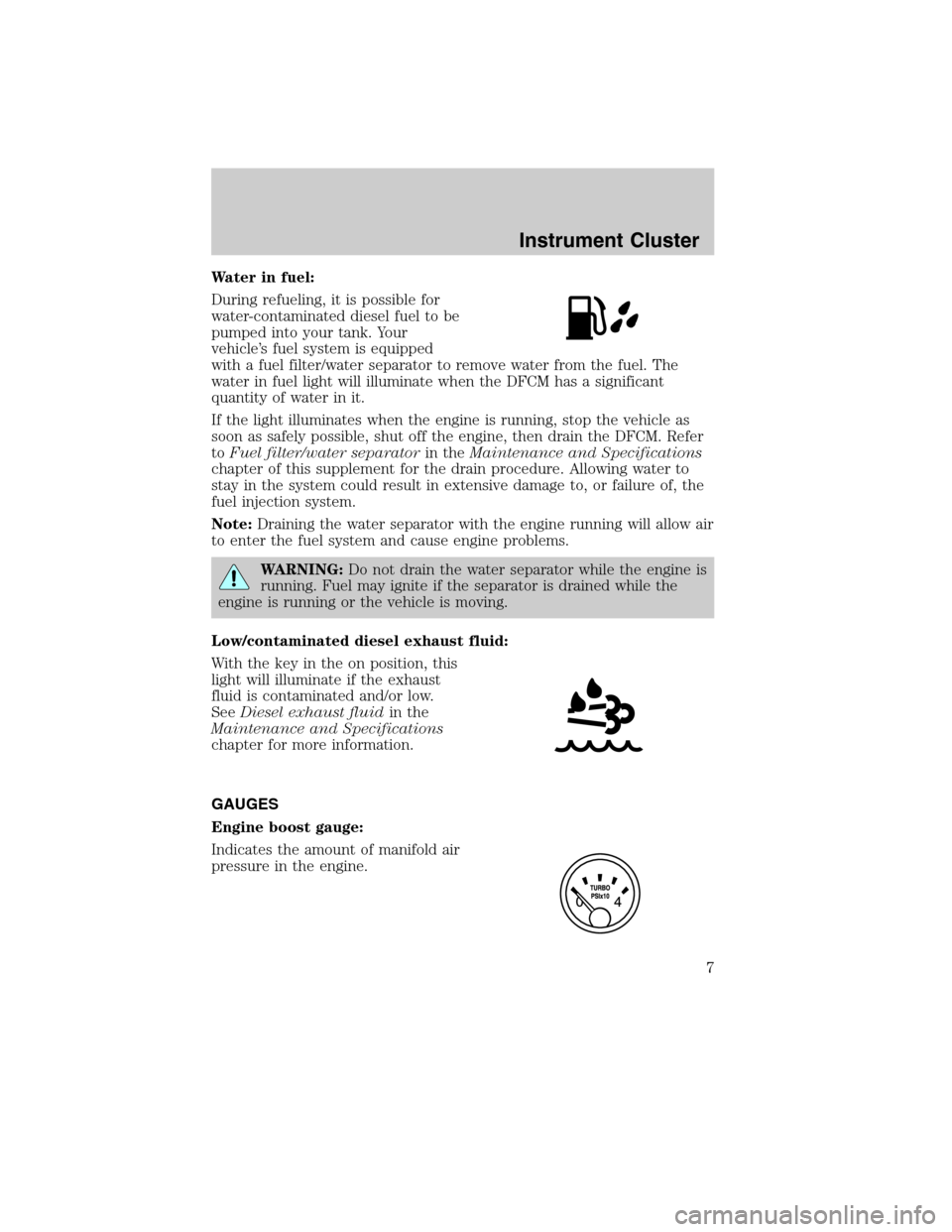
Water in fuel:
During refueling, it is possible for
water-contaminated diesel fuel to be
pumped into your tank. Your
vehicle’s fuel system is equipped
with a fuel filter/water separator to remove water from the fuel. The
water in fuel light will illuminate when the DFCM has a significant
quantity of water in it.
If the light illuminates when the engine is running, stop the vehicle as
soon as safely possible, shut off the engine, then drain the DFCM. Refer
toFuel filter/water separatorin theMaintenance and Specifications
chapter of this supplement for the drain procedure. Allowing water to
stay in the system could result in extensive damage to, or failure of, the
fuel injection system.
Note:Draining the water separator with the engine running will allow air
to enter the fuel system and cause engine problems.
WARNING:Do not drain the water separator while the engine is
running. Fuel may ignite if the separator is drained while the
engine is running or the vehicle is moving.
Low/contaminated diesel exhaust fluid:
With the key in the on position, this
light will illuminate if the exhaust
fluid is contaminated and/or low.
SeeDiesel exhaust fluidin the
Maintenance and Specifications
chapter for more information.
GAUGES
Engine boost gauge:
Indicates the amount of manifold air
pressure in the engine.
Instrument Cluster
7
2011 Econoline(eco)
Supplement, 1st Printing
USA(fus)
Page 35 of 90
•Store DEF out of direct sunlight and in temperatures between 23°F
(-5°C) — 68°F (20°C).
•DEF will freeze below 12°F (-11°C).
•Do not store DEF bottle in vehicle. If it leaks it could cause damage to
interior components or release an ammonia odor inside the vehicle.
•DEF is non-flammable, non-toxic, colorless and water-soluble liquid.
•Do not dilute DEF with water or any other liquid.
•An ammonia odor may be smelled when the cap is removed or during
refill. Refill DEF in a well ventilated area.
FUEL FILTER/WATER SEPARATOR
Diesel Fuel Conditioner Module (DFCM)
The vehicle is equipped with a diesel fuel conditioning module (DFCM)
located on the frame-rail under the driver-side floorboard near the
transmission
Water should be drained from the
module assembly whenever the
warning light comes on and the
message center directs you to drain
the water separator. This will occur when approximately 0.32 pints (150
ml) of water accumulates in the module. If water level is allowed to
exceed this level, the water may be passed through to the engine and
may cause fuel injection equipment damage.
Draining the DFCM
1. Stop the vehicle andshut offthe engine.
WARNING:The vehicle must be stopped with the engine off
when draining the DFCM. Fuel may ignite if the separator is
drained while the engine is running or vehicle is moving.
Note:Air will enter into the fuel system if the DFCM is drained while
the system is running. The engine will not operate properly if air enters
the system.
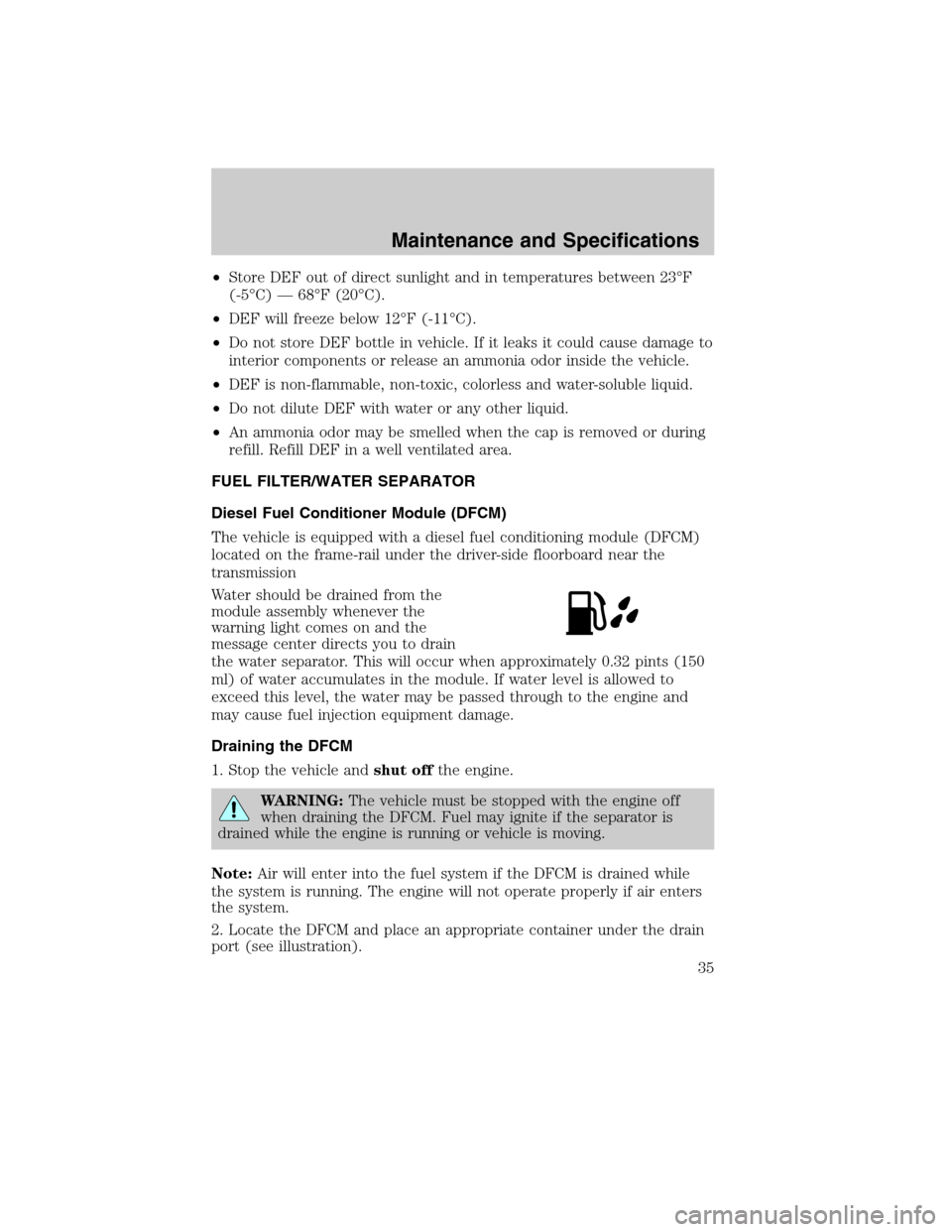
2. Locate the DFCM and place an appropriate container under the drain
port (see illustration).
Maintenance and Specifications
35
2011 Econoline(eco)
Supplement, 1st Printing
USA(fus)
Page 46 of 90
•Do not mix with recycled coolant unless from a Ford-approved
recycling process (seeUse of recycled engine coolantsection).
WARNING:To reduce the risk of personal injury, make sure the
engine is cool before unscrewing the coolant pressure relief cap.
The cooling system(s) are under pressure; steam and hot liquid can
come out forcefully when the cap is loosened slightly.
Add the proper mixture of coolant and distilled water to the cooling
system(s) by following these steps:
1. Before you remove the cap, turn the engine off and let it cool.
2. When the engine is cool, wrap a thick cloth around the cap. Slowly
turn cap counterclockwise until pressure begins to release.
3. Step back while the pressure releases.
4. When you are sure that all the pressure has been released, use the
cloth to turn it counterclockwise and remove the cap.
Engine and secondary cooling system refill procedure
The following procedure should be used when refilling the engine or
secondary cooling systems after it has been drained or become extremely
low.
1. Remove the pressure relief cap from the engine or secondary coolant
reservoir as previously outlined.
2. Slowly add a 50/50 mixture of coolant and distilled water to the
coolant reservoir until the coolant level is within the COLD FILL RANGE
as listed on the reservoir.
3. Reinstall the pressure relief cap.
4. Start and run the engine at 2,000 rpm for 2 minutes.
5. Shut engine off, and remove the pressure relief cap as previously
outlined.
6. If required, add a 50/50 mixture of coolant and distilled water to the
coolant reservoir until the coolant level is within the COLD FILL RANGE
as listed on the reservoir.
7. Engine cooling system: Repeat Step 3 until the coolant level has
stabilized (is no longer dropping after each step) AND the upper radiator
hose at the radiator is warm to the touch (indicating that the engine
thermostat is open and coolant is flowing through the radiator).
Secondary cooling system: Repeat Step 3 until the coolant level has
stabilized (is no longer dropping after each step) AND the lower
Maintenance and Specifications
46
2011 Econoline(eco)
Supplement, 1st Printing
USA(fus)
Page 57 of 90
FUELING
WARNING:Do not use starting fluid such as ether or gasoline
in the diesel air intake system. Such fluids can cause immediate
explosive damage to the engine and possible personal injury.
If you fuel your vehicle at a truck stop, you may notice that the fuel
nozzle may shut off every 5–10 seconds. This is due to the flow rates
being designed for larger heavy duty trucks. You may have to fuel at a
slower rate (don’t depress the nozzle trigger fully).
Do not run your diesel vehicle out of fuel as this will allow air to enter
the fuel system which will make restarting difficult. Longer engine
cranking time may be required once air is in the fuel system. If air enters
the fuel system (either through running the fuel tank(s) empty or during
a fuel filter change), the engine will self-purge the trapped air once it
starts running. The engine may run roughly and produce white smoke
while air is in the fuel system; this is normal and should stop after a
short time.
MINOR TROUBLESHOOTING GUIDE
Air purge procedure
Turn the key on for 30 seconds, then turn off. Repeat the procedure six
times.
If the engine won’t crank
Turn on the headlights. If the lights are dim, do not go on at all or when
the ignition is turned to START the lights become dim or go out, the
battery connections may be loose or corroded, or the battery may be
discharged. If there is a clicking or stuttering sound coming from the
engine compartment when you turn the key to START, this may also
indicate a loose or corroded battery connection.
Check the battery connections at the battery posts, cable connection to
the engine grounding point and at the starter connection.
If a discharged battery is suspected, have it checked and corrected.
WARNING:Battery posts, terminals and related accessories
contain lead and lead compounds.Wash hands after handling.
•The gearshift lever must be in P (Park) or N (Neutral) in order for
the starter to operate.
Maintenance and Specifications
57
2011 Econoline(eco)
Supplement, 1st Printing
USA(fus)
Page 66 of 90
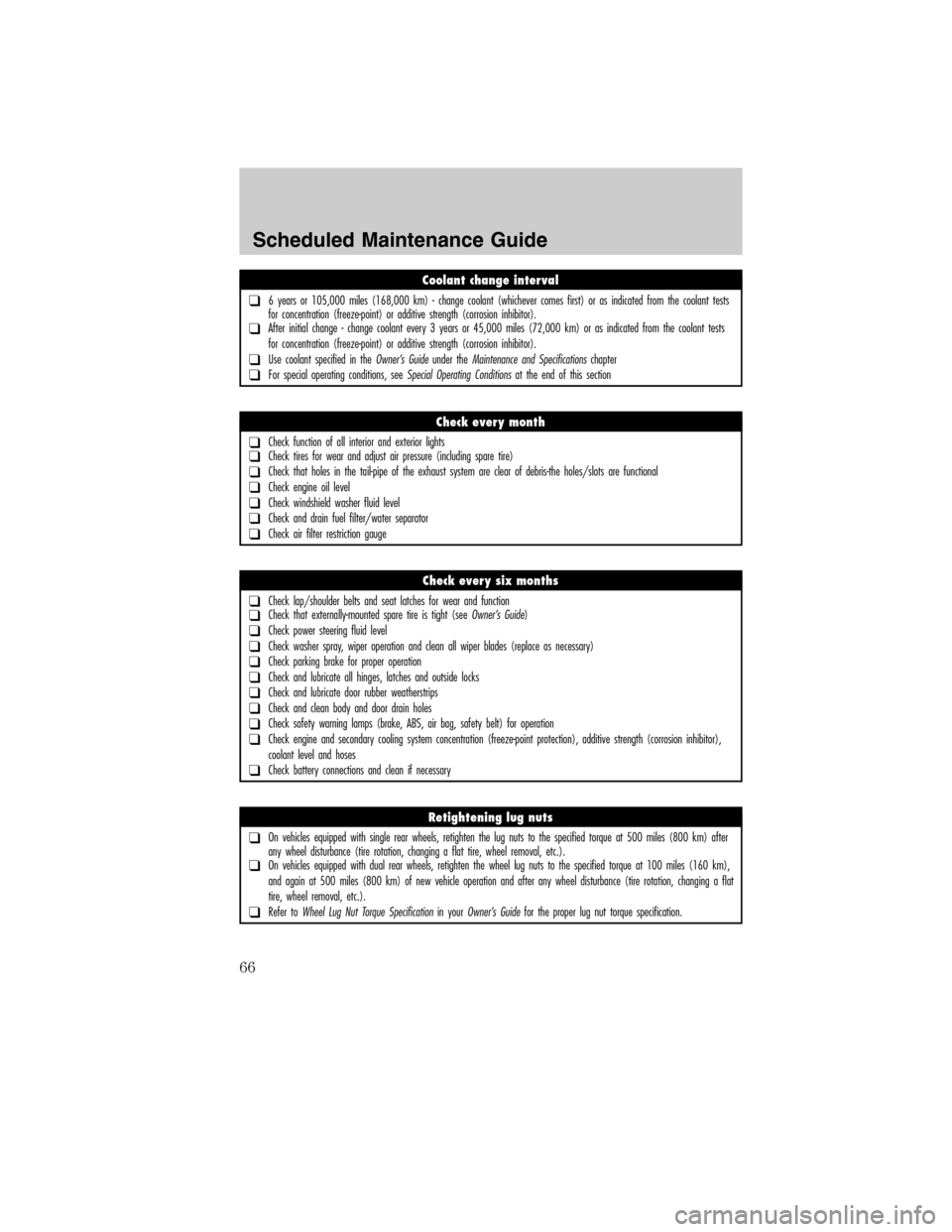
Coolant change interval
❑6 years or 105,000 miles (168,000 km) - change coolant (whichever comes first) or as indicated from the coolant tests
for concentration (freeze-point) or additive strength (corrosion inhibitor).
❑After initial change - change coolant every 3 years or 45,000 miles (72,000 km) or as indicated from the coolant tests
for concentration (freeze-point) or additive strength (corrosion inhibitor).
❑Use coolant specified in theOwner’s Guideunder theMaintenance and Specificationschapter
❑For special operating conditions, seeSpecial Operating Conditionsat the end of this section
Check every month
❑Check function of all interior and exterior lights❑Check tires for wear and adjust air pressure (including spare tire)
❑Check that holes in the tail-pipe of the exhaust system are clear of debris-the holes/slots are functional
❑Check engine oil level
❑Check windshield washer fluid level
❑Check and drain fuel filter/water separator
❑Check air filter restriction gauge
Check every six months
❑Check lap/shoulder belts and seat latches for wear and function❑Check that externally-mounted spare tire is tight (seeOwner’s Guide)
❑Check power steering fluid level
❑Check washer spray, wiper operation and clean all wiper blades (replace as necessary)
❑Check parking brake for proper operation
❑Check and lubricate all hinges, latches and outside locks
❑Check and lubricate door rubber weatherstrips
❑Check and clean body and door drain holes
❑Check safety warning lamps (brake, ABS, air bag, safety belt) for operation
❑Check engine and secondary cooling system concentration (freeze-point protection), additive strength (corrosion inhibitor),
coolant level and hoses
❑Check battery connections and clean if necessary
Retightening lug nuts
❑On vehicles equipped with single rear wheels, retighten the lug nuts to the specified torque at 500 miles (800 km) after
any wheel disturbance (tire rotation, changing a flat tire, wheel removal, etc.).
❑On vehicles equipped with dual rear wheels, retighten the wheel lug nuts to the specified torque at 100 miles (160 km),
and again at 500 miles (800 km) of new vehicle operation and after any wheel disturbance (tire rotation, changing a flat
tire, wheel removal, etc.).
❑Refer toWheel Lug Nut Torque Specificationin yourOwner’s Guidefor the proper lug nut torque specification.
Scheduled Maintenance Guide
66
2011 Econoline(eco)
Supplement, 1st Printing
USA(fus)
Page 67 of 90
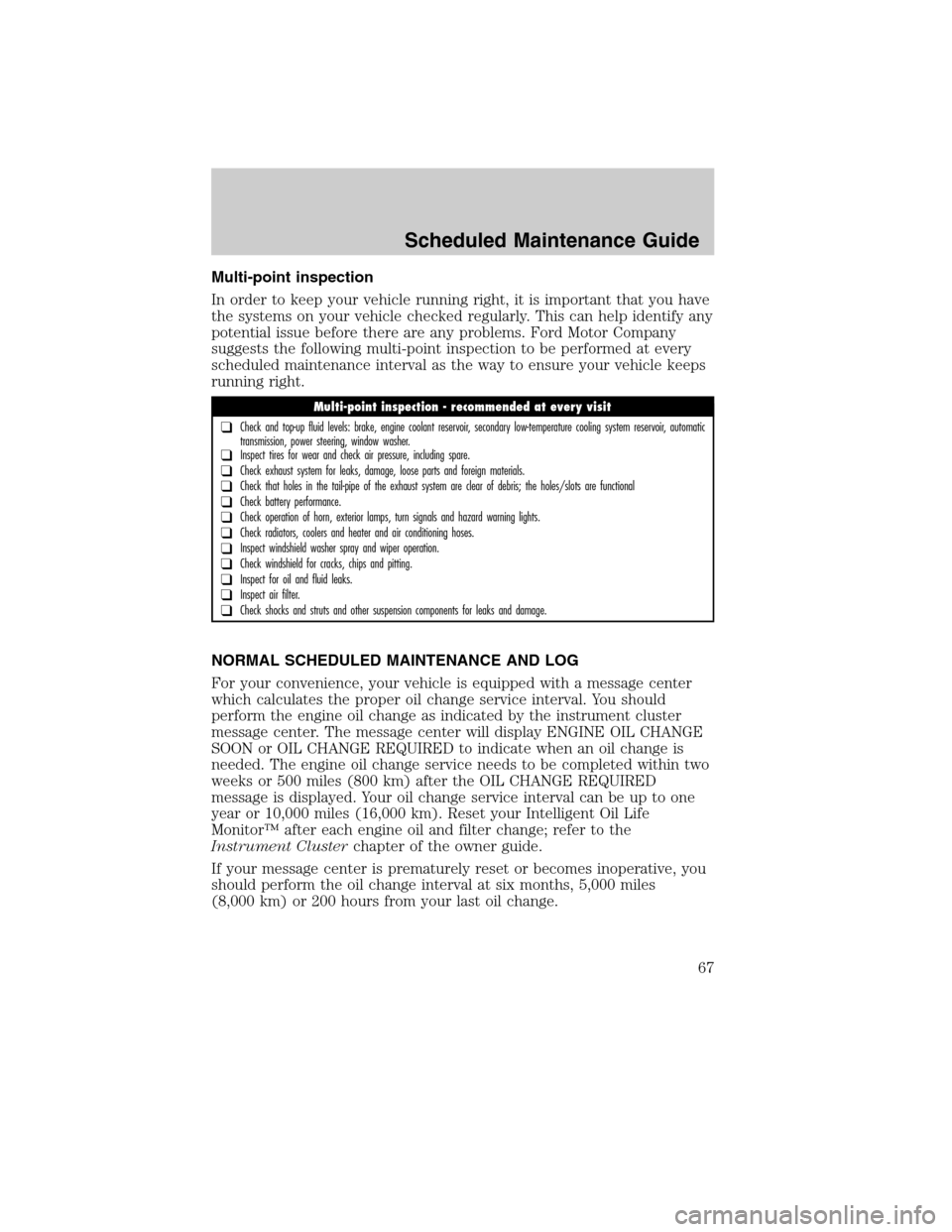
Multi-point inspection
In order to keep your vehicle running right, it is important that you have
the systems on your vehicle checked regularly. This can help identify any
potential issue before there are any problems. Ford Motor Company
suggests the following multi-point inspection to be performed at every
scheduled maintenance interval as the way to ensure your vehicle keeps
running right.
NORMAL SCHEDULED MAINTENANCE AND LOG
For your convenience, your vehicle is equipped with a message center
which calculates the proper oil change service interval. You should
perform the engine oil change as indicated by the instrument cluster
message center. The message center will display ENGINE OIL CHANGE
SOON or OIL CHANGE REQUIRED to indicate when an oil change is
needed. The engine oil change service needs to be completed within two
weeks or 500 miles (800 km) after the OIL CHANGE REQUIRED
message is displayed. Your oil change service interval can be up to one
year or 10,000 miles (16,000 km). Reset your Intelligent Oil Life
Monitor™ after each engine oil and filter change; refer to the
Instrument Clusterchapter of the owner guide.
If your message center is prematurely reset or becomes inoperative, you
should perform the oil change interval at six months, 5,000 miles
(8,000 km) or 200 hours from your last oil change.
Multi-point inspection - recommended at every visit
❑Check and top-up fluid levels: brake, engine coolant reservoir, secondary low-temperature cooling system reservoir, automatic
transmission, power steering, window washer.
❑Inspect tires for wear and check air pressure, including spare.
❑Check exhaust system for leaks, damage, loose parts and foreign materials.
❑Check that holes in the tail-pipe of the exhaust system are clear of debris; the holes/slots are functional
❑Check battery performance.
❑Check operation of horn, exterior lamps, turn signals and hazard warning lights.
❑Check radiators, coolers and heater and air conditioning hoses.
❑Inspect windshield washer spray and wiper operation.
❑Check windshield for cracks, chips and pitting.
❑Inspect for oil and fluid leaks.
❑Inspect air filter.
❑Check shocks and struts and other suspension components for leaks and damage.
Scheduled Maintenance Guide
67
2011 Econoline(eco)
Supplement, 1st Printing
USA(fus)
Page 89 of 90

A
Additive
coolant .......................................60
Air cleaner filter ...................49, 59
Air filter restriction gauge .........49
B
Battery .........................................59
auxiliary battery .......................59
jumping a disabled battery ......17
Break-in period .............................3
C
Cleaning your vehicle
engine compartment ..........18–19
Coolant ....................................5, 60
refill capacities ..........................60
Coolant additive ..........................60
Cooler ............................................5
D
Diesel exhaust fluid (DEF) .......26
Diesel Particulate Filter
(DPF) ....................................53–54
E
Emergencies, roadside
jump-starting ............................17
Emission control system ......53–55
Engine ..........................................20
cleaning ...............................18–19
coolant .......................................60
diesel .......................................2–3
refill capacities ..........................60service points ............................20
starting after a collision ...........16
Engine fan .....................................8
Engine oil ....................4, 40, 42, 60
filter, specifications ..................59
refill capacities ..........................60
specifications ......................41, 60
Exhaust Fluid ..............................26
F
Fan, Engine Cooling
.....................8
Filter
fuel
.............................................37
Fuel
........................................14, 21
cap
.............................................25
capacity
.....................................60
dual tank selector switch
.........14
filling your vehicle with fuel
....25
filter, specifications
............37, 59
fuel pump shut-off switch
.......16
Fuel pump shut-off switch
.........16
Fuel separator
.......................35, 37
G
Gas cap (see Fuel cap)
..............25
Gauges
...........................................7
J
Jump-starting your vehicle
........17
L
Lights, warning and indicator
......6
Index
89
2011 Econoline(eco)
Supplement, 1st Printing
USA(fus)