Page 185 of 302
Fuse/Relay
LocationFuse Amp
RatingPassenger Compartment Fuse
Panel Description
30 5A Power mirrors
31 20A Front park lamps, Rear park
lamps, License plate lamps,
Dimmer switch, Trailer tow park
lamps
32 5A Brake switch (logic)
33 5A Instrument cluster battery feed
(B+)
34 20A Power point
35 15A Power locks
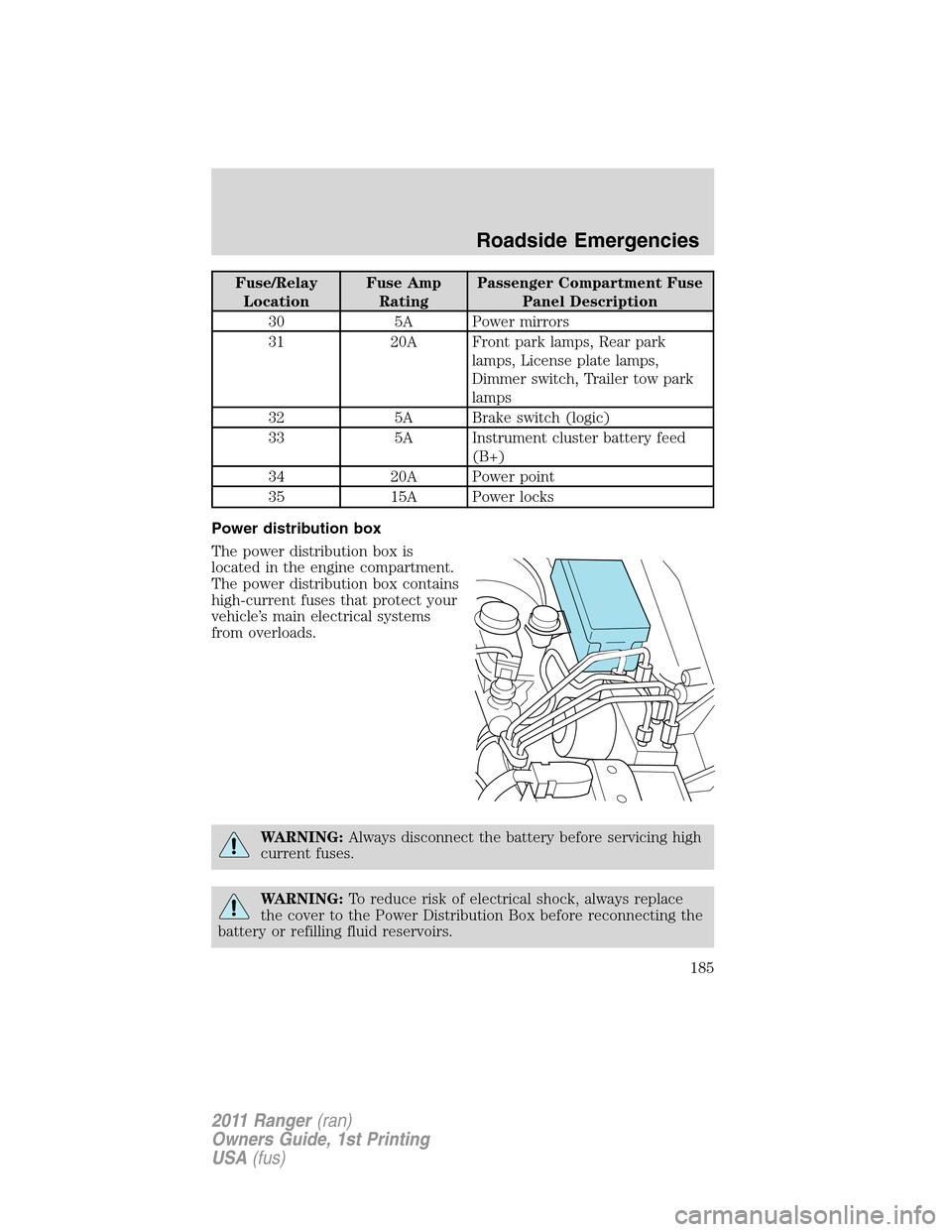
Power distribution box
The power distribution box is
located in the engine compartment.
The power distribution box contains
high-current fuses that protect your
vehicle’s main electrical systems
from overloads.
WARNING:Always disconnect the battery before servicing high
current fuses.
WARNING:To reduce risk of electrical shock, always replace
the cover to the Power Distribution Box before reconnecting the
battery or refilling fluid reservoirs.
Roadside Emergencies
185
2011 Ranger(ran)
Owners Guide, 1st Printing
USA(fus)
Page 187 of 302
Fuse/Relay
LocationFuse Amp
RatingPower Distribution Box
Description
10 — Not used
11 30A** Powertrain control module (PCM)
relay
12 — Not used
13 30A** Blower motor (climate control)
14 — Not used
15 — Not used
16 — Not used
17 40A** Anti-lock brake system (ABS)
module
18 — Not used
19 20A** Engine fan
20 — Not used
21 10A* PCM keep alive power, Canister
purge valve solenoid
22 — Not used
23 30A* Fuel pump motor, Fuel injectors
24 — Not used
25 10A* A/C clutch solenoid
26 — Not used
27 — Not used
28 — Not used
29 30A* Wipers/washer
30 — Not used
31 15A* Fog lamps
32 — Not used
33 30A* Anti-lock brake system (ABS)
module
34 — Not used
35 — Not used
36 — Not used
37 — Not used
Roadside Emergencies
187
2011 Ranger(ran)
Owners Guide, 1st Printing
USA(fus)
Page 190 of 302
Fuse/Relay
LocationFuse Amp
RatingProtected Circuits
15 — Not used
16 — Not used
17 40A** Anti-lock brake system (ABS) module
18 — Not used
19 — Not used
20 — Not used
21 10A* PCM keep alive power, Canister purge
valve solenoid
22 — Not used
23 30A* Fuel pump motor, Fuel injectors
24 — Not used
25 10A* A/C clutch solenoid
26 — Not used
27 20A* 4x4 module
28 — Not used
29 30A* Wipers/washer
30 — Not used
31 15A* Fog lamps
32 — Not used
33 30A* ABS module
34 — Not used
35 — Not used
36 — Not used
37 — Not used
38 7.5A* Trailer tow (right turn)
39 15A* PCM power
40 — Not used
41 10A* Automatic transmission
42 7.5A* Trailer tow (left turn)
Roadside Emergencies
190
2011 Ranger(ran)
Owners Guide, 1st Printing
USA(fus)
Page 194 of 302

Stopping and securing the vehicle
1. Park on a level surface, activate
hazard flashers and place gearshift
lever in P (Park) (automatic
transmission) or 1 (First) (manual
transmission).
2. Set the parking brake and turn
engine off.
Location of the spare tire and tools
The spare tire and tools for your vehicle are stowed in the following
locations:
Tool Location
Spare tire Under the vehicle, just forward of the rear
bumper
Jack, jack handle,
wheel nut wrenchRegular Cab: behind the passenger seat,
underneath the jack and tools cover on the floor
SuperCab: stowed in the passenger side rear cab
under the plastic tray inside the storage bin or
behind the jump seat in a separate tool bag
Four-door models: stowed behind the front seats,
between jump seats and underneath jack and
tools cover. The lug wrench is held in place with
a wingnut.
Key, spare tire lock
(if equipped)In the glove box
Removing the spare tire or spare tire and tether (if equipped)
1. Assemble the jack handle to the lug wrench as shown in the
illustrations.
When connecting the jack handle, assemble the following:
•One handle extension and one
typical extension. To assemble,
slide parts together. To
disconnect, press the button and
pull apart.
Roadside Emergencies
194
2011 Ranger(ran)
Owners Guide, 1st Printing
USA(fus)
Page 195 of 302
•One wheel nut wrench. Press the
button and slide together.
2. If equipped, unlock and remove
the spare tire carrier lock from the
rear access hole located just above
the rear bumper and below the
tailgate.
3. Insert the square end of the jack
handle into the rear access hole
located just above the rear bumper
and below the tailgate.
Forward motion will stop and
resistance to turning will be felt
when properly engaged.
4. Turn the handle counterclockwise
until tire is lowered to the ground
and the cable is slightly slack.
Roadside Emergencies
195
2011 Ranger(ran)
Owners Guide, 1st Printing
USA(fus)
Page 196 of 302
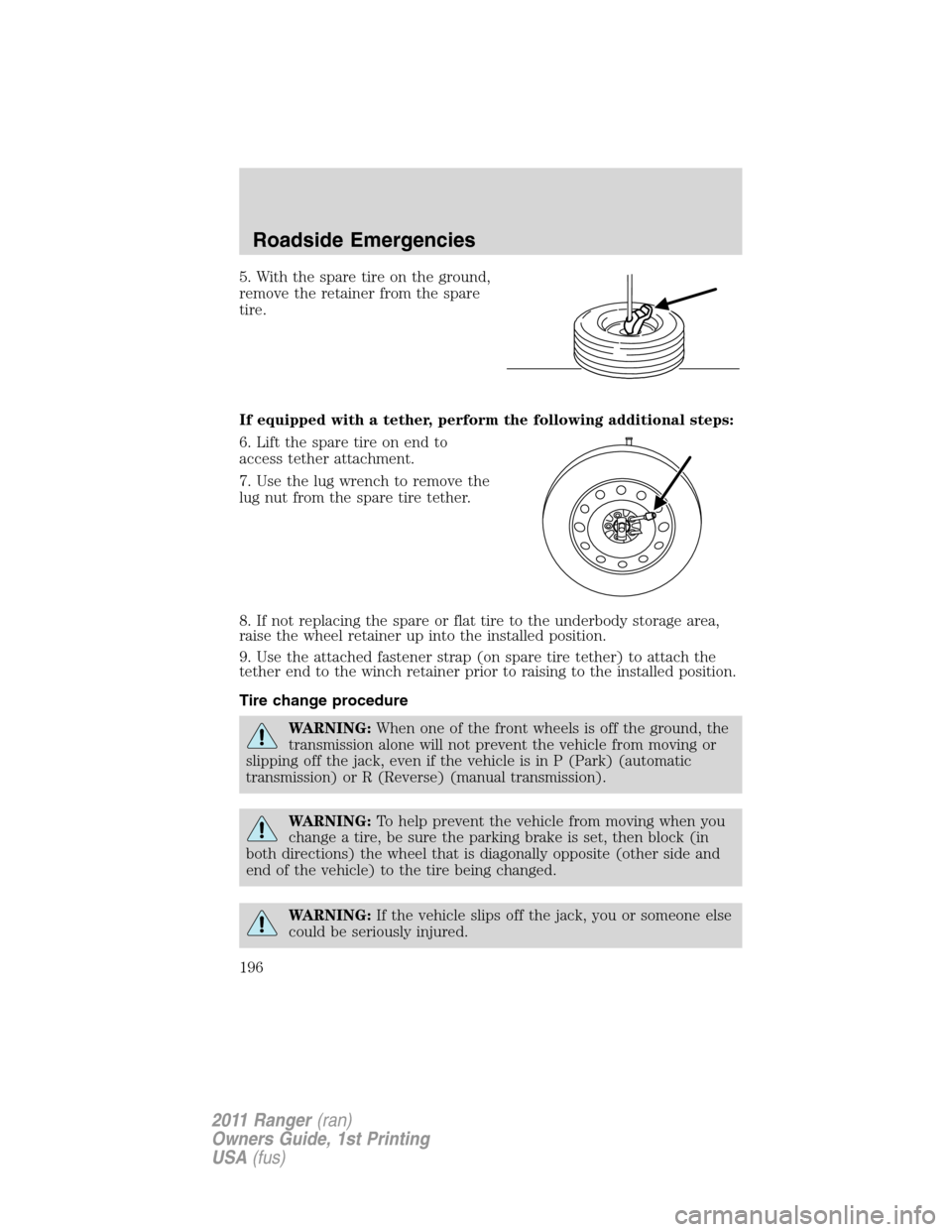
5. With the spare tire on the ground,
remove the retainer from the spare
tire.
If equipped with a tether, perform the following additional steps:
6. Lift the spare tire on end to
access tether attachment.
7. Use the lug wrench to remove the
lug nut from the spare tire tether.
8. If not replacing the spare or flat tire to the underbody storage area,
raise the wheel retainer up into the installed position.
9. Use the attached fastener strap (on spare tire tether) to attach the
tether end to the winch retainer prior to raising to the installed position.
Tire change procedure
WARNING:When one of the front wheels is off the ground, the
transmission alone will not prevent the vehicle from moving or
slipping off the jack, even if the vehicle is in P (Park) (automatic
transmission) or R (Reverse) (manual transmission).
WARNING:To help prevent the vehicle from moving when you
change a tire, be sure the parking brake is set, then block (in
both directions) the wheel that is diagonally opposite (other side and
end of the vehicle) to the tire being changed.
WARNING:If the vehicle slips off the jack, you or someone else
could be seriously injured.
Roadside Emergencies
196
2011 Ranger(ran)
Owners Guide, 1st Printing
USA(fus)
Page 197 of 302
WARNING:Do not attempt to change a tire on the side of the
vehicle close to moving traffic. Pull far enough off the road to
avoid the danger of being hit when operating the jack or changing the
wheel.
Note:Passengers should not remain in the vehicle when the vehicle is
being jacked.
1. Block the diagonally opposite
wheel.
2. Insert tapered end of the lug
wrench behind hub caps and twist
them off.
3. Loosen each wheel lug nut
one-half turn counterclockwise but
do not remove them until the wheel
is raised off the ground.
4. Position the jack according to the
following guides and turn the jack
handle clockwise until the tire is a
maximum of 1 inch (25 mm) off the ground.
•Front
Roadside Emergencies
197
2011 Ranger(ran)
Owners Guide, 1st Printing
USA(fus)
Page 198 of 302

•Rear
WARNING:To lessen the
risk of personal injury, do
not put any part of your body
under the vehicle while changing a
tire. Do not start the engine when
your vehicle is on the jack. The
jack is only meant for changing
the tire.
•Never use the differential as a jacking point.
5. Remove the wheel lug nuts with the lug wrench.
6. Replace the flat tire with the spare tire, making sure the valve stem is
facing outward. Reinstall the lug nuts until the wheel is snug against the
hub. Do not fully tighten the lug nuts until the wheel has been lowered.
7. Lower the wheel by turning the jack handle counterclockwise.
8. Remove the jack and fully tighten
the lug nuts, in the order shown.
Refer toWheel lug nut torque
specificationslater in this chapter
for the proper lug nut torque
specification.
9. Stow the flat tire. Refer to
Stowing the flat/spare tire.
10. Stow the jack and lug wrench.
Make sure the jack is fastened so it
does not rattle when you drive.
11. Unblock the wheels.
1
4 3
2 5
Roadside Emergencies
198
2011 Ranger(ran)
Owners Guide, 1st Printing
USA(fus)