2011 FORD FIESTA heater
[x] Cancel search: heaterPage 102 of 357
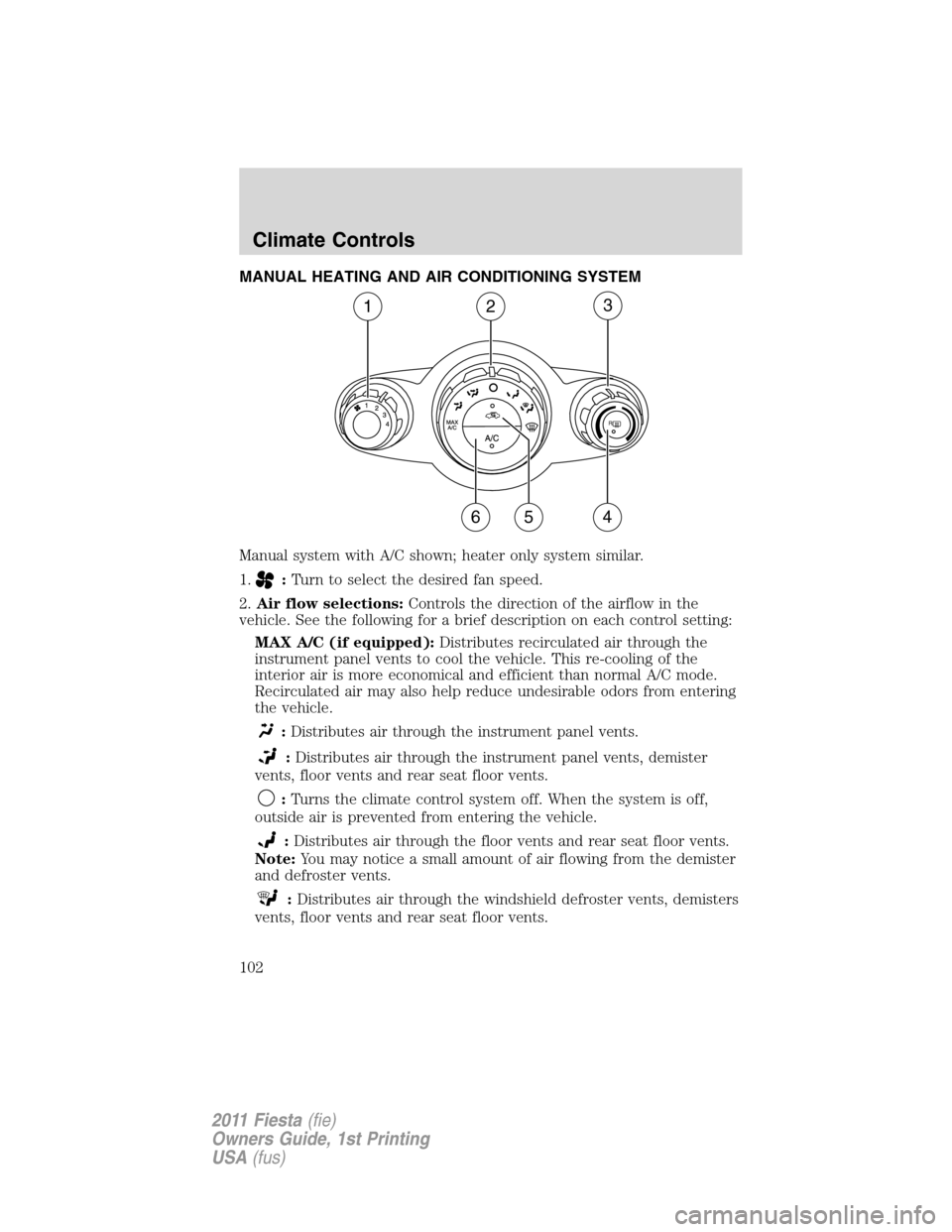
MANUAL HEATING AND AIR CONDITIONING SYSTEM
Manual system with A/C shown; heater only system similar.
1.
:Turn to select the desired fan speed.
2.Air flow selections:Controls the direction of the airflow in the
vehicle. See the following for a brief description on each control setting:
MAX A/C (if equipped):Distributes recirculated air through the
instrument panel vents to cool the vehicle. This re-cooling of the
interior air is more economical and efficient than normal A/C mode.
Recirculated air may also help reduce undesirable odors from entering
the vehicle.
:Distributes air through the instrument panel vents.
:Distributes air through the instrument panel vents, demister
vents, floor vents and rear seat floor vents.
:Turns the climate control system off. When the system is off,
outside air is prevented from entering the vehicle.
:Distributes air through the floor vents and rear seat floor vents.
Note:You may notice a small amount of air flowing from the demister
and defroster vents.
:Distributes air through the windshield defroster vents, demisters
vents, floor vents and rear seat floor vents.
R
132
645
Climate Controls
102
2011 Fiesta(fie)
Owners Guide, 1st Printing
USA(fus)
Page 148 of 357
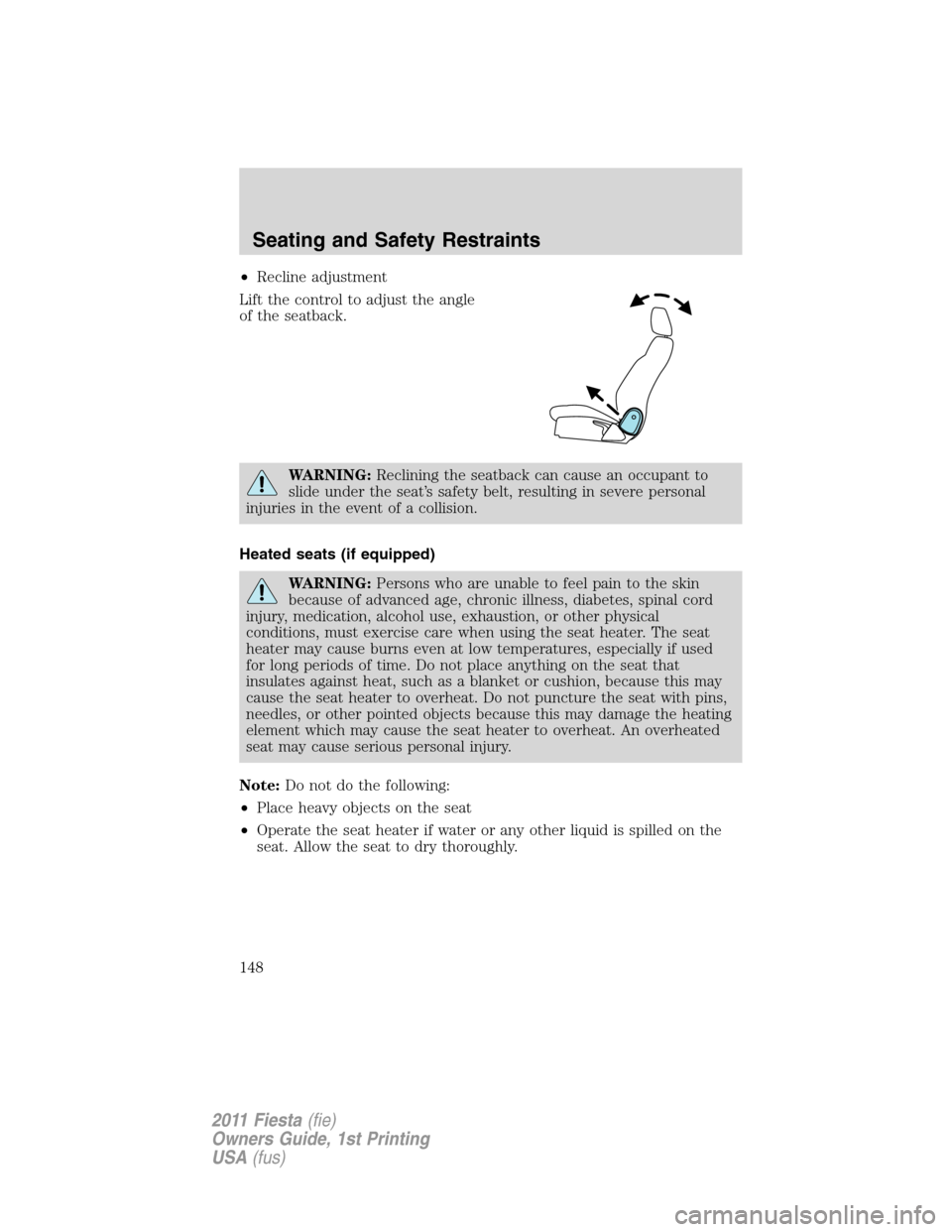
•Recline adjustment
Lift the control to adjust the angle
of the seatback.
WARNING:Reclining the seatback can cause an occupant to
slide under the seat’s safety belt, resulting in severe personal
injuries in the event of a collision.
Heated seats (if equipped)
WARNING:Persons who are unable to feel pain to the skin
because of advanced age, chronic illness, diabetes, spinal cord
injury, medication, alcohol use, exhaustion, or other physical
conditions, must exercise care when using the seat heater. The seat
heater may cause burns even at low temperatures, especially if used
for long periods of time. Do not place anything on the seat that
insulates against heat, such as a blanket or cushion, because this may
cause the seat heater to overheat. Do not puncture the seat with pins,
needles, or other pointed objects because this may damage the heating
element which may cause the seat heater to overheat. An overheated
seat may cause serious personal injury.
Note:Do not do the following:
•Place heavy objects on the seat
•Operate the seat heater if water or any other liquid is spilled on the
seat. Allow the seat to dry thoroughly.
Seating and Safety Restraints
148
2011 Fiesta(fie)
Owners Guide, 1st Printing
USA(fus)
Page 233 of 357

ENGINE BLOCK HEATER (IF EQUIPPED)
An engine block heater warms the engine coolant which aids in starting
and allows the heater/defroster system to respond quickly. If your vehicle
is equipped with this system, your equipment includes a heater element
which is installed in your engine block and a wire harness which allows
the user to connect the system to a grounded 120 volt A/C electrical
source. The block heater system is most effective when outdoor
temperatures reach below 0°F (-18°C).
WARNING:Failure to follow engine block heater instructions
could result in property damage or physical injury.
WARNING:To reduce the risk of electrical shock, do not use
your heater with ungrounded electrical systems or two-pronged
(cheater) adapters.
Prior to using the engine block heater, follow these recommendations for
proper and safe operation:
•For your safety, use an outdoor extension cord that is product
certified by Underwriter’s Laboratory (UL) or Canadian Standards
Association (CSA). Use only an extension cord that can be used
outdoors, in cold temperatures, and is clearly marked “Suitable for Use
with Outdoor Appliances.” Never use an indoor extension cord
outdoors; it could result in an electric shock or fire hazard.
•Use a 16-gauge outdoor extension cord, minimum.
•Use as short an extension cord as possible.
•Do not use multiple extension cords. Instead, use one extension cord
which is long enough to reach from the engine block heater cord to
the outlet without stretching.
•Make certain that the extension cord is in excellent condition (not
patched or spliced). Store your extension cord indoors at
temperatures above 32°F (0°C). Outdoor conditions can deteriorate
extension cords over a period of time.
•To reduce the risk of electrical shock, do not use your heater with
ungrounded electrical systems or two pronged (cheater) adapters.
Also ensure that the block heater, especially the cord, is in good
condition before use.
•Make sure that when in operation, the extension cord plug/engine
block heater cord plug connection is free and clear of water in order
to prevent possible shock or fire.
Driving
233
2011 Fiesta(fie)
Owners Guide, 1st Printing
USA(fus)
Page 234 of 357

•Be sure that areas where the vehicle is parked are clean and clear of
all combustibles such as petroleum products, dust, rags, paper and
similar items.
•Be sure that the engine block heater, heater cord and extension cord
are solidly connected. A poor connection can cause the cord to
become very hot and may result in an electrical shock or fire. Be sure
to check for heat anywhere in the electrical hookup once the system
has been operating for approximately a half hour.
•Finally, have the engine block heater system checked during your fall
tune-up to be sure it’s in good working order.
How to use the engine block heater
Ensure the receptacle terminals are clean and dry prior to use. To clean
them, use a dry cloth.
Depending on the type of factory installed equipment, your engine block
heater will use .4 to 1.0 kilowatt-hours of energy per hour of use. Your
factory installed block heater system does not have a thermostat;
however, maximum temperature is attained after approximately three
hours of operation. Block heater operation longer than three hours will
not improve system performance and will unnecessarily use additional
electricity.
Make sure system is unplugged and properly stowed before driving the
vehicle. While not in use, make sure the protective cover seals the
prongs of the engine block heater cord plug.
BRAKES
Occasional brake noise is normal. If a metal-to-metal, continuous grinding
or continuous squeal sound is present, the brake linings may be worn-out
and should be inspected by an authorized dealer. If the vehicle has
continuous vibration or shudder in the steering wheel while braking, the
vehicle should be inspected by an authorized dealer.
Refer toWarning lights and
chimesin theInstrument Cluster
chapter for information on the brake
system warning light.
Driving
234
2011 Fiesta(fie)
Owners Guide, 1st Printing
USA(fus)
Page 257 of 357

To remove a fuse, use the fuse puller tool provided on the inside of the
passenger compartment fuse panel cover.
The high-current fuses are coded as follows:
Fuse/Relay
LocationFuse Amp
RatingProtected circuits
F1 40A* Anti-lock brake system (ABS)
pump
F2 50A* Transmission control module
(TCM)
F3 40A* Engine cooling fan relay
F4 40A* Heater blower relay, Climate
controls
F5 60A* Passenger compartment fuse
panel
F6 30A* Body control module (BCM) –
door locks
F22
F6 F1
F2
F3
F4
F5
F7
F8
F9
F10
F11
F12
F13
F14
F15
F16
F17
F18
F19
F20
F21F23F24
F25
F26
F27
F28
F29
F30
F31
F32
F33
F34
F35
F36
F37
F38 F39 F40
R7
R1
R2
R3R8
R9
R10
R11
R6 R5 R4
R12
R13
Roadside Emergencies
257
2011 Fiesta(fie)
Owners Guide, 1st Printing
USA(fus)
Page 259 of 357
Fuse/Relay
LocationFuse Amp
RatingProtected circuits
F29 10A** A/C clutch solenoid and relay
F30 30A** Not used (spare)
F31 20A** Low beam relay
F32 20A** BCM – battery saver, horn
F33 30A** BCM – rear window defroster
F34 — Not used
F35 — Not used
F36 — Not used
F37 — Not used
F38 — Not used
F39 — Not used
F40 — Not used
R1 — Not used
R2 — Not used
R3 — Not used
R4 — High beam relay
R5 — PCM relay
R6 — Daytime running lamp
R7 — Engine cooling fan relay
R8 — Starter inhibit relay
R9 — A/C clutch relay
R10 — Reverse light relay
R11 — Coil pack relay
R12 — Low beam relay
R13 — Heater blower relay
*Cartridge fuses **Mini fuses
Roadside Emergencies
259
2011 Fiesta(fie)
Owners Guide, 1st Printing
USA(fus)
Page 267 of 357
Preparing your vehicle
When the battery is disconnected or a new battery is installed, the
automatic transmission must relearn its shift strategy. As a result, the
transmission may have firm and/or soft shifts. This operation is
considered normal and will not affect function or durability of the
transmission. Over time, the adaptive learning process will fully update
transmission operation.
1.Use only a 12–volt supply to start your vehicle.
2. Do not disconnect the battery of the disabled vehicle as this could
damage the vehicle’s electrical system.
3. Park the booster vehicle close to the hood of the disabled vehicle
making sure the two vehiclesdo nottouch. Set the parking brake on
both vehicles and stay clear of the engine cooling fan and other moving
parts.
4. Check all battery terminals and remove any excessive corrosion before
you attach the battery cables. Ensure that vent caps are tight and level.
5. Turn the heater fan on in both vehicles to protect from any electrical
surges. Turn all other accessories off.
Connecting the jumper cables
Note:In the illustration, the vehicle on the bottom is used to designate
the assisting (boosting) battery.
Roadside Emergencies
267
2011 Fiesta(fie)
Owners Guide, 1st Printing
USA(fus)
Page 335 of 357

Be sure to ask your Ford or Lincoln Mercury dealership service advisor
or technician about the multi-point vehicle inspection. It’s a
comprehensive way to perform a thorough inspection of your vehicle. It’s
your checklist that gives you immediate feedback on the overall
condition of your vehicle. You’ll know what’s been checked, what’s okay,
as well as those things that may require future or immediate attention.
The multi-point vehicle inspection is one more way to keep your vehicle
running great!
Mutli-point inspection - Recommended at every visit
❑Check and top-up fluid levels: brake, coolant recovery reservoir, manual and automatic transmission (if equipped with an
underhood dipstick), power steering (if equipped) and window washer
❑Inspect tires for wear and check air pressure, including spare.
❑Check exhaust system for leaks, damage, loose parts and foreign material.
❑Check battery performance.
❑Check operation of horn, exterior lamps, turn signals and hazard warning lights.
❑Check radiator, coolers, heater and air conditioning hoses.
❑Inspect windshield washer spray and wiper operation.
❑Check windshield for cracks, chips and pitting.
❑Inspect for oil and fluid leaks.
❑Inspect engine air filter.
❑Inspect half shaft dust boots, if equipped.
❑Check shocks and struts and other suspension components for leaks and damage.
❑Inspect steering and linkage.
❑Inspect accessory drive belt(s).
❑Inspect clutch operation, if equipped.
Scheduled Maintenance Guide
335
2011 Fiesta(fie)
Owners Guide, 1st Printing
USA(fus)