2011 FORD FIESTA warning
[x] Cancel search: warningPage 135 of 357
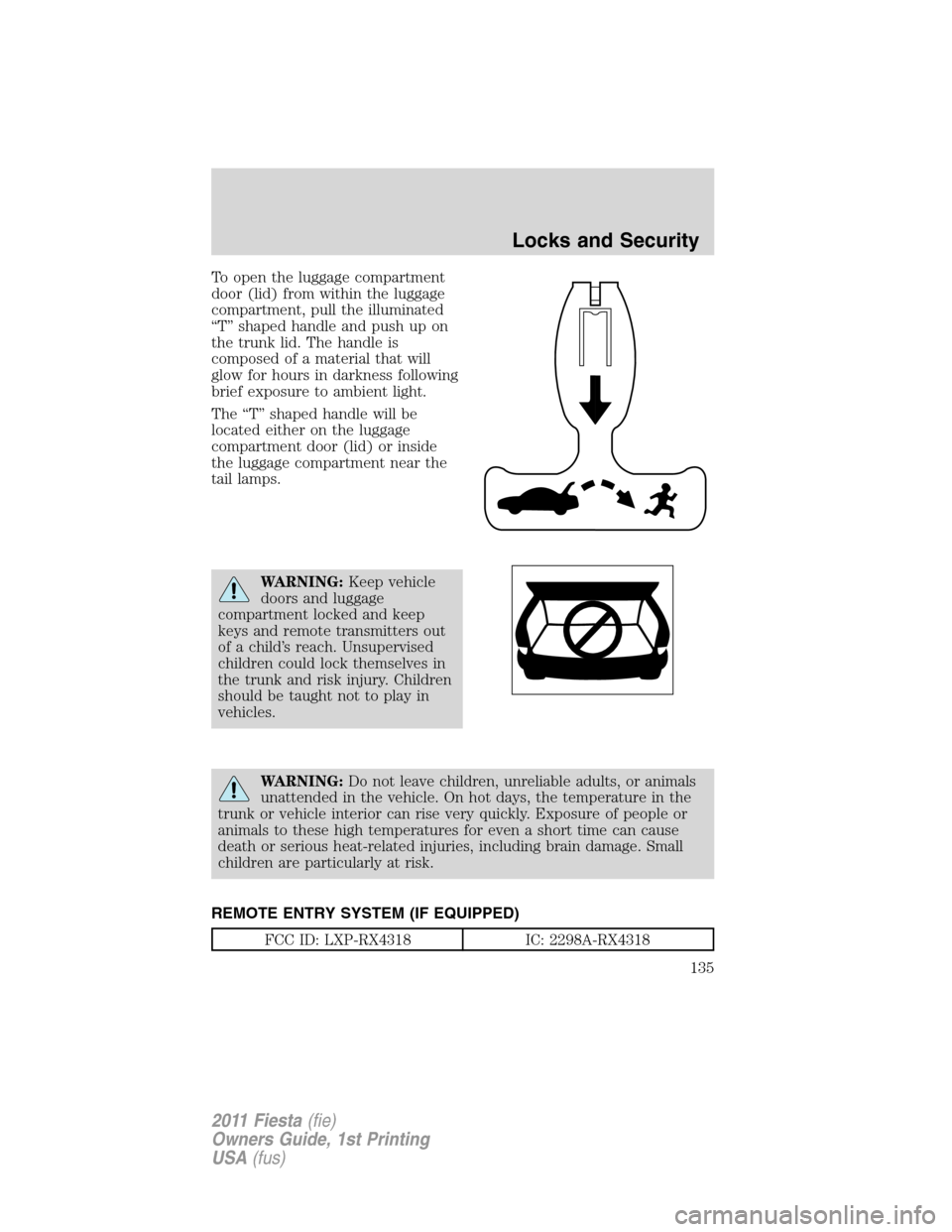
To open the luggage compartment
door (lid) from within the luggage
compartment, pull the illuminated
“T” shaped handle and push up on
the trunk lid. The handle is
composed of a material that will
glow for hours in darkness following
brief exposure to ambient light.
The “T” shaped handle will be
located either on the luggage
compartment door (lid) or inside
the luggage compartment near the
tail lamps.
WARNING:Keep vehicle
doors and luggage
compartment locked and keep
keys and remote transmitters out
of a child’s reach. Unsupervised
children could lock themselves in
the trunk and risk injury. Children
should be taught not to play in
vehicles.
WARNING:Do not leave children, unreliable adults, or animals
unattended in the vehicle. On hot days, the temperature in the
trunk or vehicle interior can rise very quickly. Exposure of people or
animals to these high temperatures for even a short time can cause
death or serious heat-related injuries, including brain damage. Small
children are particularly at risk.
REMOTE ENTRY SYSTEM (IF EQUIPPED)
FCC ID: LXP-RX4318 IC: 2298A-RX4318
Locks and Security
135
2011 Fiesta(fie)
Owners Guide, 1st Printing
USA(fus)
Page 137 of 357
•arm and disarm the perimeter anti-theft system.
•operate the illuminated entry feature.
The remote entry lock/unlock feature operates in any ignition position
except when the engine is running and vehicle speed is more than 4 mph
(7 km/h).
If there are problems with the remote entry system, make sure to take
ALL integrated keyhead transmitters or intelligent access keys
with you to the authorized dealer in order to aid in troubleshooting the
problem.
Intelligent Access (if equipped)
WARNING:Radio waves from the intelligent access system
transmitters in the vehicle may affect certain implanted medical
devices such as pacemakers or cardiac defibrillators. People having
such implanted medical devices should ask the medical device
manufacturer or their physician whether the intelligent access system
may affect the equipment before coming into close proximity with a
vehicle equipped with intelligent access. Failure to do so may result in
interference with the medical device, which could result in serious
injury.
Your vehicle will allow you to unlock and enter your vehicle without
actively using a key or transmitter. You can use the intelligent access
feature at the driver door, passenger front door or at the trunk. You can
activate the intelligent access feature as long as you have one of your
intelligent access keys within range of the driver door, passenger front
door or the trunk.
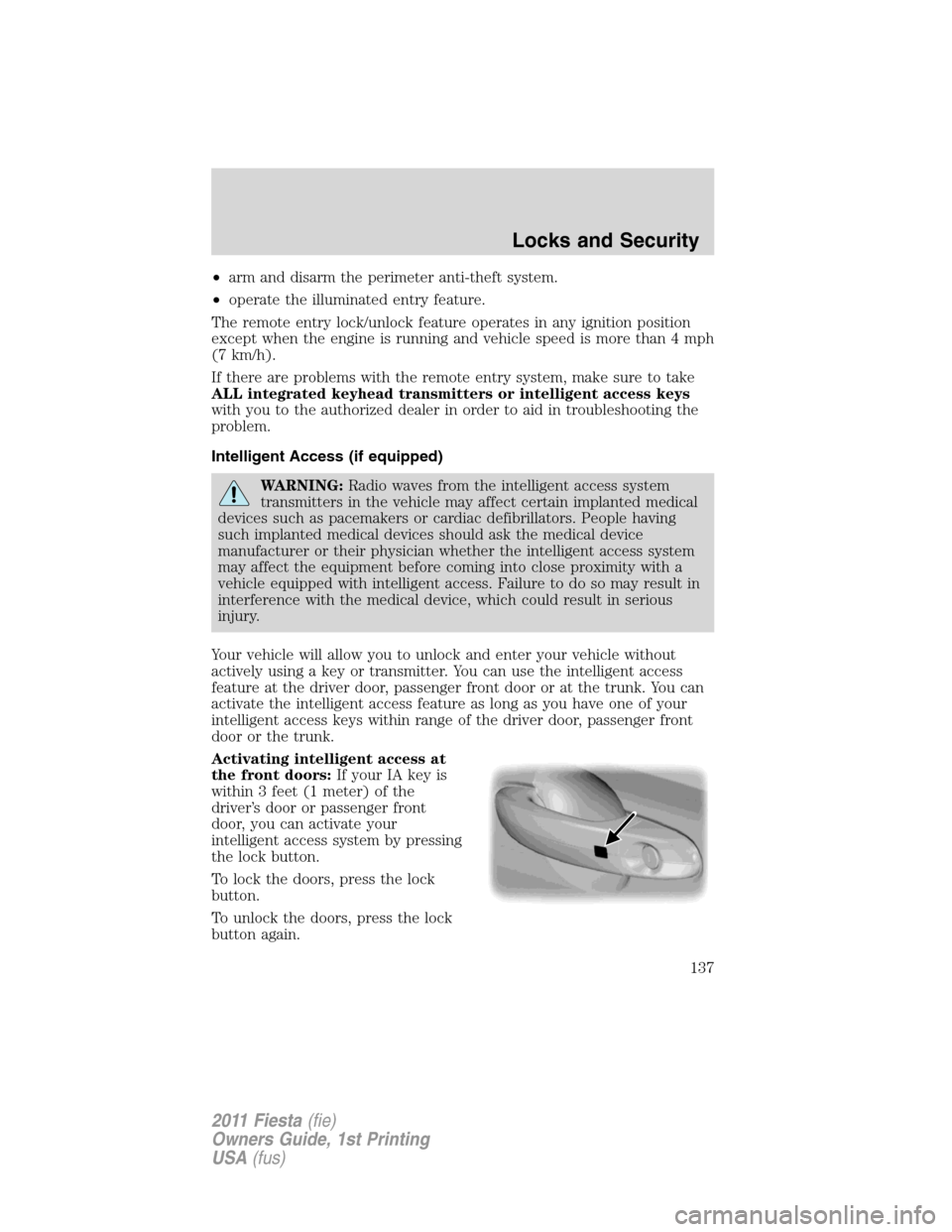
Activating intelligent access at
the front doors:If your IA key is
within 3 feet (1 meter) of the
driver’s door or passenger front
door, you can activate your
intelligent access system by pressing
the lock button.
To lock the doors, press the lock
button.
To unlock the doors, press the lock
button again.
Locks and Security
137
2011 Fiesta(fie)
Owners Guide, 1st Printing
USA(fus)
Page 145 of 357
FRONT SEATING
WARNING:Reclining the seatback can cause an occupant to
slide under the seat’s safety belt, resulting in severe personal
injuries in the event of a collision.
WARNING:Do not pile cargo higher than the seatbacks to
reduce the risk of injury in a collision or sudden stop.
WARNING:Before returning the seatback to its original
position, make sure that cargo or any objects are not trapped
behind the seatback. After returning the seatback to its original
position, pull on the seatback to ensure that it has fully latched. An
unlatched seat may become dangerous in the event of a sudden stop or
collision.
Adjustable head restraints
Your vehicle is equipped with front row outboard head restraints that are
vertically adjustable.
WARNING:To minimize the risk of neck injury in the event of a
crash, the driver and passenger occupants should not sit in
and/or operate the vehicle, until the head restraint is placed in its
proper position. The driver should never adjust the head restraint
while the vehicle is in motion.
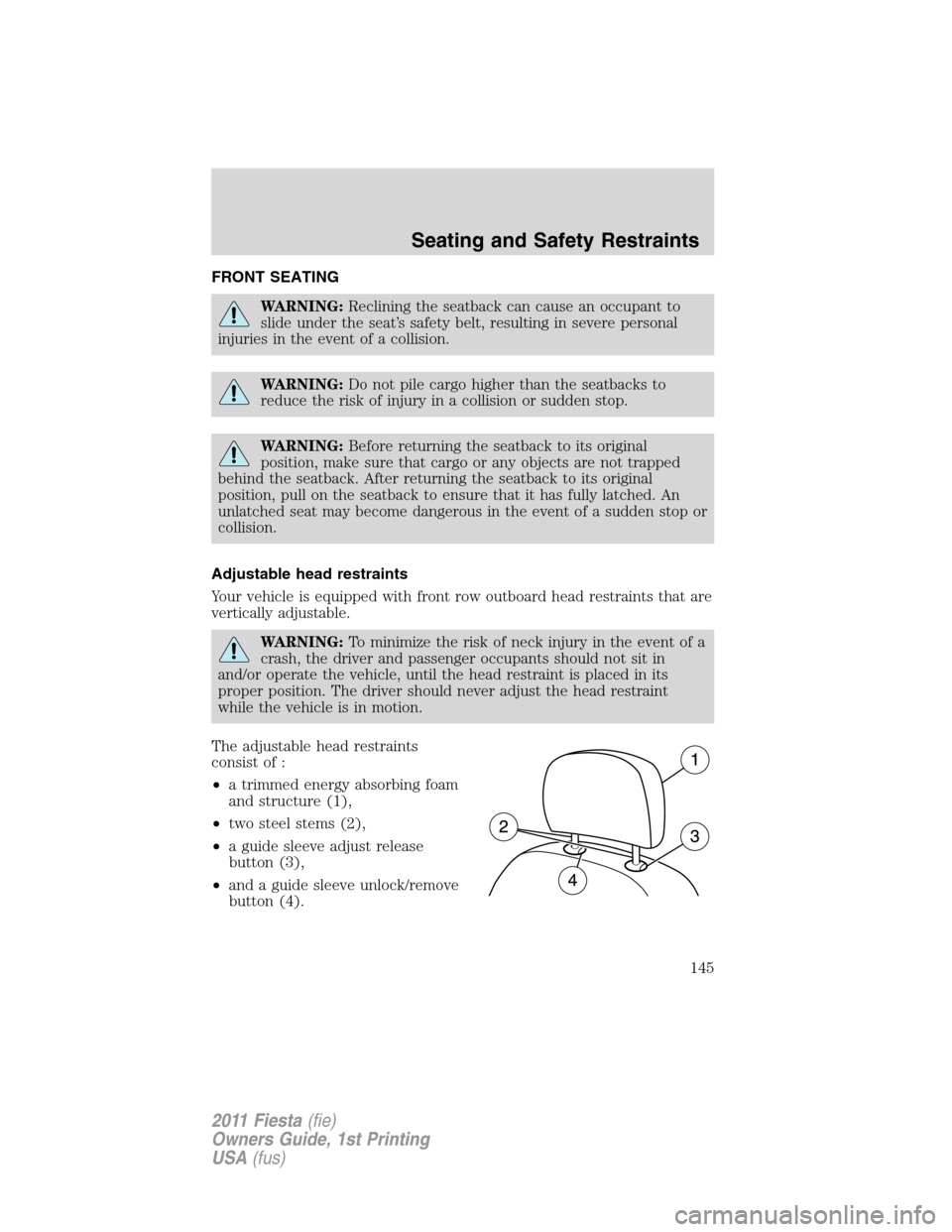
The adjustable head restraints
consist of :
•a trimmed energy absorbing foam
and structure (1),
•two steel stems (2),
•a guide sleeve adjust release
button (3),
•and a guide sleeve unlock/remove
button (4).
Seating and Safety Restraints
145
2011 Fiesta(fie)
Owners Guide, 1st Printing
USA(fus)
Page 146 of 357
To adjust the head restraint, do the following:
1. Adjust the seatback to an upright driving/riding position.
2. Raise the head restraint by pulling up on the head restraint (1).
3. Lower the head restraint by pressing and holding the guide sleeve
adjust release button (3) and pushing down on the head restraint (1).
Properly adjust the head restraint so that the top of the head restraint is
even with the top of your head and positioned as close as possible to the
back of your head. For occupants of extremely tall stature, adjust the
head restraint to its full up position.
WARNING:The adjustable head restraint is a safety device.
Whenever possible it should be installed and properly adjusted
when the seat is occupied.
To remove the adjustable head restraint, do the following:
1. Pull up the head restraint until it reaches the highest adjustment
position.
2. Simultaneously press and hold both the adjust/release button (3) and
the unlock/remove button (4), then pull up on the head restraint.
To reinstall the adjustable head restraint, do the following:
1. Insert the two stems into the guide sleeve collars.
2. Push the head restraint down until it locks.
Properly adjust the head restraint so that the top of the head restraint is
even with the top of your head and positioned as close as possible to the
back of your head. For occupants of extremely tall stature, adjust the
head restraint to its full up position.
WARNING:To minimize the risk of neck injury in the event of a
crash, head restraints must be installed properly.
Adjusting the front manual seat
WARNING:Sitting improperly out of position or with the seat
back reclined too far can take off weight from the seat cushion
and affect the decision of the passenger sensing system, resulting in
serious injury or death in a crash. Always sit upright against your
seatback, with your feet on the floor.
Seating and Safety Restraints
146
2011 Fiesta(fie)
Owners Guide, 1st Printing
USA(fus)
Page 147 of 357
WARNING:To reduce the risk of possible serious injury: Do not
hang objects off seat back or stow objects in map pocket (if
equipped) when a child is in the front passenger seat. Do not place
objects underneath the front passenger seat or between the seat and
the center console (if equipped). Check the “passenger airbag off” or
“pass airbag off” indicator lamp for proper airbag status. Refer toFront
passenger sensing systemchapter for additional details. Failure to
follow these instructions may interfere with the front passenger seat
sensing system.
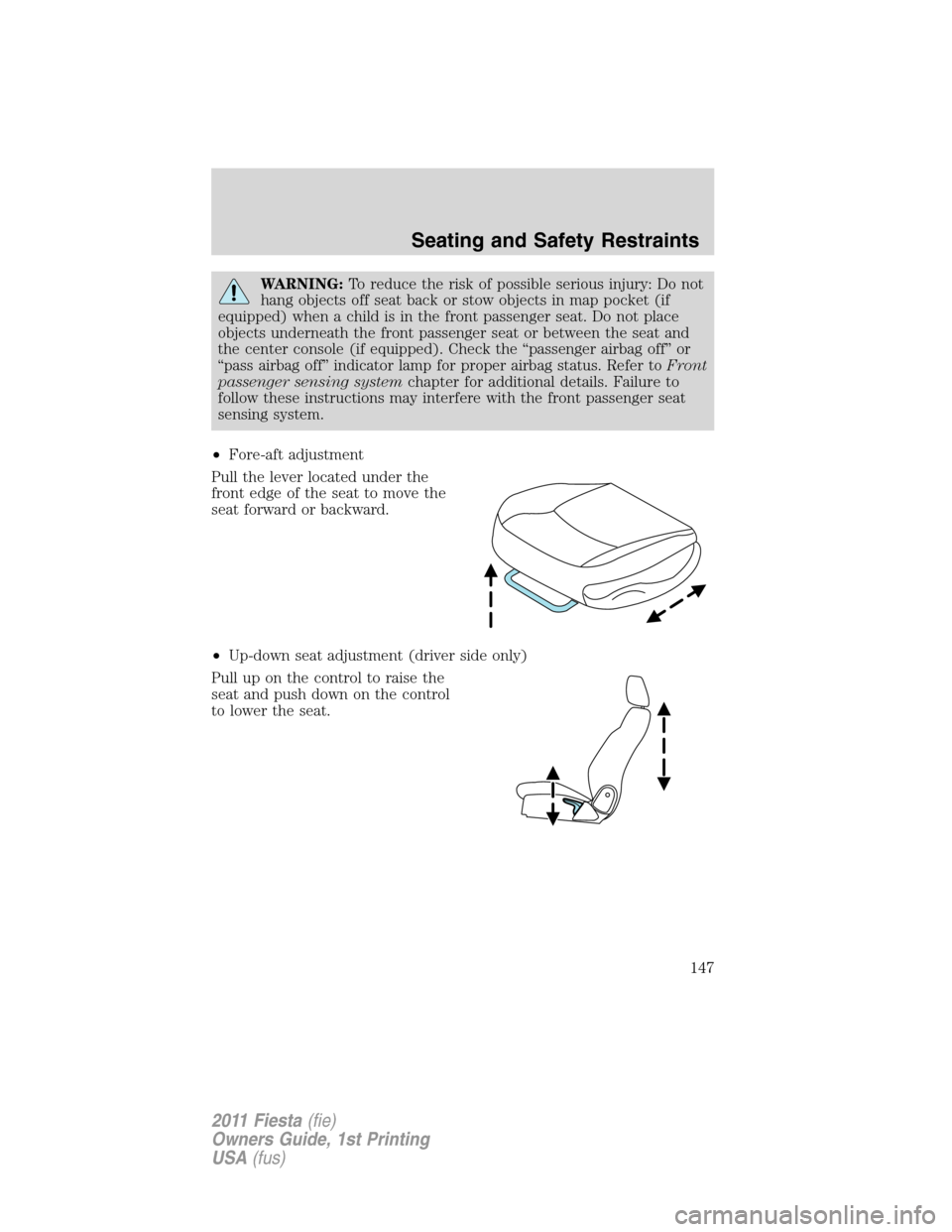
•Fore-aft adjustment
Pull the lever located under the
front edge of the seat to move the
seat forward or backward.
•Up-down seat adjustment (driver side only)
Pull up on the control to raise the
seat and push down on the control
to lower the seat.
Seating and Safety Restraints
147
2011 Fiesta(fie)
Owners Guide, 1st Printing
USA(fus)
Page 148 of 357
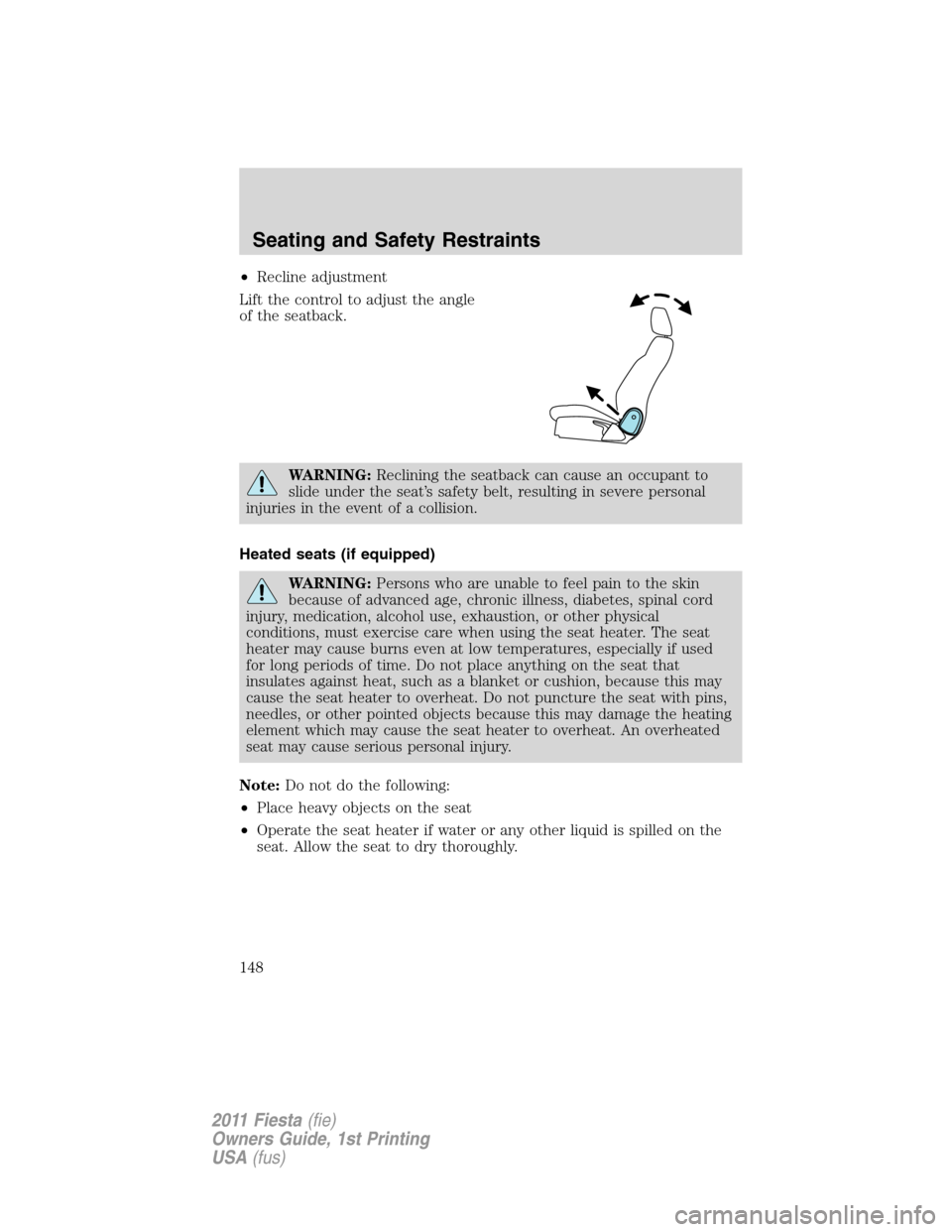
•Recline adjustment
Lift the control to adjust the angle
of the seatback.
WARNING:Reclining the seatback can cause an occupant to
slide under the seat’s safety belt, resulting in severe personal
injuries in the event of a collision.
Heated seats (if equipped)
WARNING:Persons who are unable to feel pain to the skin
because of advanced age, chronic illness, diabetes, spinal cord
injury, medication, alcohol use, exhaustion, or other physical
conditions, must exercise care when using the seat heater. The seat
heater may cause burns even at low temperatures, especially if used
for long periods of time. Do not place anything on the seat that
insulates against heat, such as a blanket or cushion, because this may
cause the seat heater to overheat. Do not puncture the seat with pins,
needles, or other pointed objects because this may damage the heating
element which may cause the seat heater to overheat. An overheated
seat may cause serious personal injury.
Note:Do not do the following:
•Place heavy objects on the seat
•Operate the seat heater if water or any other liquid is spilled on the
seat. Allow the seat to dry thoroughly.
Seating and Safety Restraints
148
2011 Fiesta(fie)
Owners Guide, 1st Printing
USA(fus)
Page 149 of 357
To operate the heated seats:
•Press the button located on the
instrument panel to activate.
•Press again to deactivate.
The heated seats will activate when the ignition is in the on position and
the engine is running.
REAR SEATS
Second row head restraints
Your vehicle is equipped with rear seat outboard and center head
restraints that look differently than the front head restraints, but
function similarly.
WARNING:To minimize the risk of neck injury in the event of a
crash, the driver and passenger occupants should not sit in
and/or operate the vehicle, until the head restraint is placed in its
proper position. The driver should never adjust the head restraint
while the vehicle is in motion.
For details about how to raise, lower and remove the second row head
restraints, refer toAdjustable head restraintsat the beginning of this
chapter.
Folding down the rear seat
One or both rear seatbacks can be folded down to provide additional
cargo space.
Note:Before lowering the seatbacks, lower, or remove, the outboard
head restraints to the lowest position.
Seating and Safety Restraints
149
2011 Fiesta(fie)
Owners Guide, 1st Printing
USA(fus)
Page 151 of 357
WARNING:Before returning the seatback to its original
position, make sure that cargo or any objects are not trapped
behind the seatback. Make sure that the safety belt is not laying on the
seat latch. After returning the seatback to its original position, pull on
the seatback to ensure that it has fully latched. An unlatched seat may
become dangerous in the event of a sudden stop or collision.
SAFETY RESTRAINTS
Personal Safety System™
The Personal Safety System provides an improved overall level of frontal
crash protection to front seat occupants and is designed to help further
reduce the risk of airbag-related injuries. The system is able to analyze
different occupant conditions and crash severity before activating the
appropriate safety devices to help better protect a range of occupants in
a variety of frontal crash situations.
Your vehicle’s Personal Safety System consists of:
•Driver and passenger dual-stage airbag supplemental restraints.
•Front safety belts with pretensioners, energy management retractors,
and safety belt usage sensors.
•Driver’s seat position sensor.
•Front crash severity sensor.
•Front passenger sensing system.
•“Passenger airbag off” or “pass airbag off” indicator lamp.
•Restraints Control Module (RCM) with impact and safing sensors.
•Restraint system warning light and back-up tone.
•The electrical wiring for the airbags, crash sensor(s), safety belt
pretensioners, front safety belt usage sensors, driver seat position
sensor, and indicator lights.
How does the Personal Safety System work?
The Personal Safety System can adapt the deployment strategy of your
vehicle’s safety devices according to crash severity and conditions. A
collection of crash sensors provides information to the Restraints Control
Module (RCM). During a crash, the RCM may activate the safety belt
pretensioners and/or either none, one, or both stages of the dual-stage
airbag supplemental restraints based on crash severity and conditions.
Seating and Safety Restraints
151
2011 Fiesta(fie)
Owners Guide, 1st Printing
USA(fus)