2011 FORD FIESTA ESP
[x] Cancel search: ESPPage 181 of 357
WARNING:All children are shaped differently. The
Recommendations for Safety Restraints are based on probable
child height, age and weight thresholds from NHTSA and other safety
organizations or are the minimum requirements of law. Ford
recommends checking with a NHTSA Certified Child Passenger Safety
Technician (CPST) and consult your pediatrician to make sure your
child seat is appropriate for your child, and is compatible with and
properly installed in the vehicle. To locate a child seat fitting station
and CPST contact the NHTSA toll free at 1-888-327-4236 or on the
internet at http://www.nhtsa.dot.gov. In Canada, check with your local
St. John Ambulance office for referral to a CPST or for further
information, contact your provincial ministry of transportation, your
local St. John Ambulance office at http://www.sfa.ca, or Transport
Canada at 1–800–333–0371 (http://www.tc.gc.ca). Failure to properly
restrain children in safety seats made especially for their height, age,
and weight may result in an increased risk of serious injury or death to
your child.
Recommendations for Safety Restraints for Children
Child size, height, weight, or ageRecommended
restraint type
Infants or
toddlersChildren weighing 40 lb (18 kg) or less
(generally age four or younger)Use a child safety
seat (sometimes
called an infant
carrier,
convertible seat,
or toddler seat).
Small
childrenChildren who have outgrown or no
longer properly fit in a child safety
seat (generally children who are less
than 4 feet 9 inches (1.45 meters) tall,
are greater than age four (4) and less
than age twelve (12), and between
40 lb (18 kg) and 80 lb (36 kg) and
upward to 100 lb (45 kg) if
recommended by your child restraint
manufacturer)Use a
belt-positioning
booster seat.
Seating and Safety Restraints
181
2011 Fiesta(fie)
Owners Guide, 1st Printing
USA(fus)
Page 200 of 357
WARNING:The traction grade assigned to this tire is based on
straight-ahead braking traction tests, and does not include
acceleration, cornering, hydroplaning or peak traction characteristics.
Temperature A B C
The temperature grades are A (the highest), B and C, representing the
tire’s resistance to the generation of heat and its ability to dissipate heat
when tested under controlled conditions on a specified indoor laboratory
test wheel. Sustained high temperature can cause the material of the tire
to degenerate and reduce tire life, and excessive temperature can lead to
sudden tire failure. The grade C corresponds to a level of performance
which all passenger car tires must meet under the Federal Motor Vehicle
Safety Standard No. 139. Grades B and A represent higher levels of
performance on the laboratory test wheel than the minimum required by
law.
WARNING:The temperature grade for this tire is established
for a tire that is properly inflated and not overloaded. Excessive
speed, underinflation, or excessive loading, either separately or in
combination, can cause heat buildup and possible tire failure.
TIRES
Tires are designed to give many thousands of miles of service, but they
must be maintained in order to get the maximum benefit from them.
Glossary of tire terminology
•Tire label:A label showing the OE (Original Equipment) tire sizes,
recommended inflation pressure and the maximum weight the vehicle
can carry.
•Tire Identification Number (TIN):A number on the sidewall of
each tire providing information about the tire brand and
manufacturing plant, tire size and date of manufacture. Also referred
to as DOT code.
•Inflation pressure:A measure of the amount of air in a tire.
•Standard load:A class of P-metric or Metric tires designed to carry a
maximum load at 35 psi [37 psi (2.5 bar) for Metric tires]. Increasing
the inflation pressure beyond this pressure will not increase the tire’s
load carrying capability.
•Extra load:A class of P-metric or Metric tires designed to carry a
heavier maximum load at 41 psi [43 psi (2.9 bar) for Metric tires].
Tires, Wheels and Loading
200
2011 Fiesta(fie)
Owners Guide, 1st Printing
USA(fus)
Page 202 of 357
WARNING:Under-inflation is the most common cause of tire
failures and may result in severe tire cracking, tread separation
or “blowout”, with unexpected loss of vehicle control and increased
risk of injury. Under-inflation increases sidewall flexing and rolling
resistance, resulting in heat buildup and internal damage to the tire. It
also may result in unnecessary tire stress, irregular wear, loss of
vehicle control and accidents. A tire can lose up to half of its air
pressure and not appear to be flat!
Always inflate your tires to the Ford recommended inflation pressure
even if it is less than the maximum inflation pressure information found
on the tire. The Ford recommended tire inflation pressure is found on
the Safety Compliance Certification Label or Tire Label which is located
on the B-Pillar or the edge of the driver’s door. Failure to follow the tire
pressure recommendations can cause uneven treadwear patterns and
adversely affect the way your vehicle handles.
Maximum Permissible Inflation Pressureis the tire manufacturer’s
maximum permissible pressure and/or the pressure at which the
maximum load can be carried by the tire. This pressure is normally
higher than the manufacturer’s recommended cold inflation pressure
which can be found on the Safety Compliance Certification Label or Tire
Label which is located on the B-Pillar or the edge of the driver’s door.
The cold inflation pressure should never be set lower than the
recommended pressure on the Safety Compliance Certification Label or
Tire Label.
When weather temperature changes occur, tire inflation pressures also
change. A 10°F (6°C) temperature drop can cause a corresponding drop
of 1 psi (7 kPa) in inflation pressure. Check your tire pressures
frequently and adjust them to the proper pressure which can be found
on the Safety Compliance Certification Label or Tire Label.
To check the pressure in your tire(s):
1. Make sure the tires are cool, meaning they are not hot from driving
even a mile.
If you are checking tire pressure when the tire is hot, (i.e. driven more
than 1 mile [1.6 km]), never “bleed” or reduce air pressure. The tires are
hot from driving and it is normal for pressures to increase above
recommended cold pressures. A hot tire at or below recommended cold
inflation pressure could be significantly under-inflated.
Tires, Wheels and Loading
202
2011 Fiesta(fie)
Owners Guide, 1st Printing
USA(fus)
Page 214 of 357
TIRE PRESSURE MONITORING SYSTEM (TPMS)
Each tire, including the spare (if
provided), should be checked
monthly when cold and inflated to
the inflation pressure recommended
by the vehicle manufacturer on the
vehicle placard or tire inflation pressure label. (If your vehicle has tires
of a different size than the size indicated on the vehicle placard or tire
inflation pressure label, you should determine the proper tire inflation
pressure for those tires.)
As an added safety feature, your vehicle has been equipped with a tire
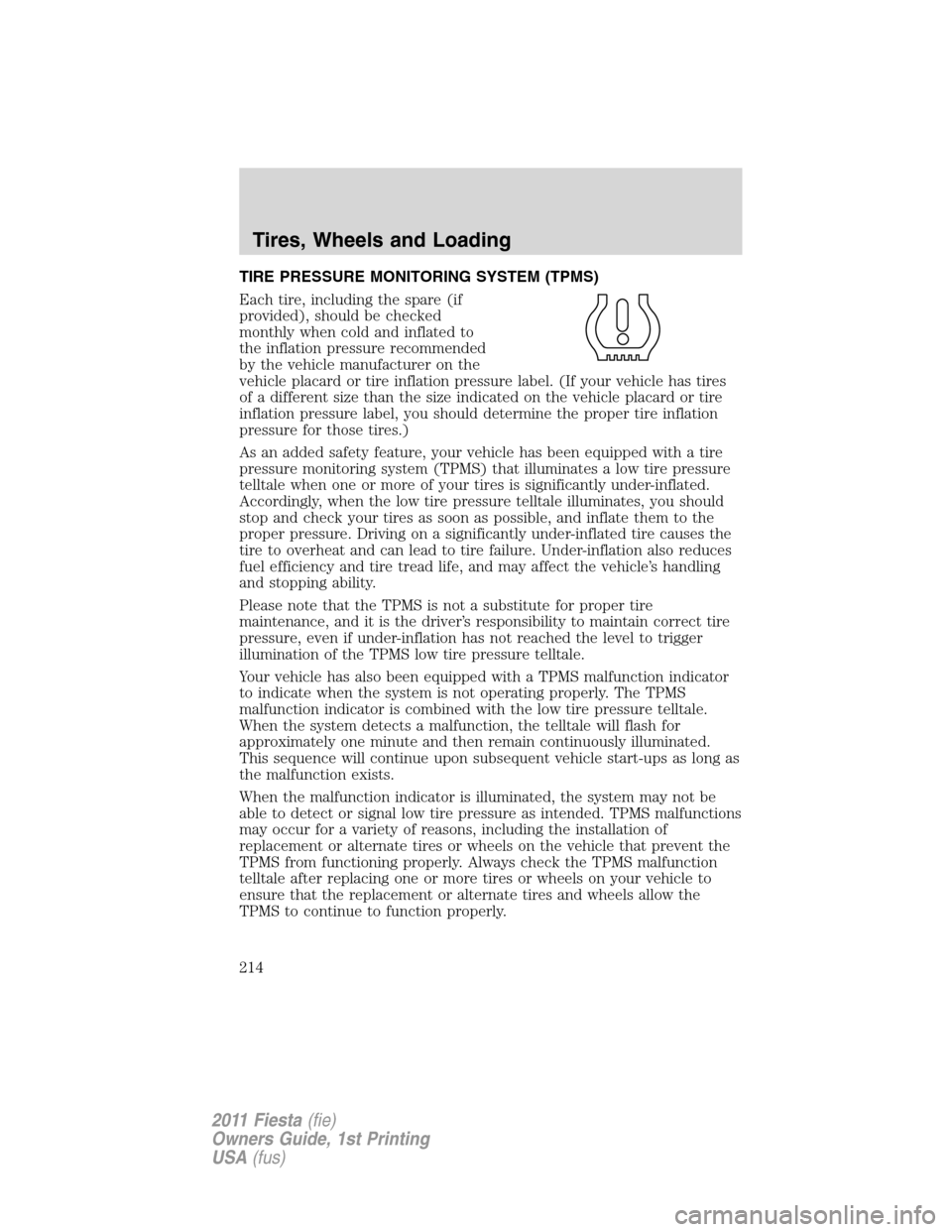
pressure monitoring system (TPMS) that illuminates a low tire pressure
telltale when one or more of your tires is significantly under-inflated.
Accordingly, when the low tire pressure telltale illuminates, you should
stop and check your tires as soon as possible, and inflate them to the
proper pressure. Driving on a significantly under-inflated tire causes the
tire to overheat and can lead to tire failure. Under-inflation also reduces
fuel efficiency and tire tread life, and may affect the vehicle’s handling
and stopping ability.
Please note that the TPMS is not a substitute for proper tire
maintenance, and it is the driver’s responsibility to maintain correct tire
pressure, even if under-inflation has not reached the level to trigger
illumination of the TPMS low tire pressure telltale.
Your vehicle has also been equipped with a TPMS malfunction indicator
to indicate when the system is not operating properly. The TPMS
malfunction indicator is combined with the low tire pressure telltale.
When the system detects a malfunction, the telltale will flash for
approximately one minute and then remain continuously illuminated.
This sequence will continue upon subsequent vehicle start-ups as long as
the malfunction exists.
When the malfunction indicator is illuminated, the system may not be
able to detect or signal low tire pressure as intended. TPMS malfunctions
may occur for a variety of reasons, including the installation of
replacement or alternate tires or wheels on the vehicle that prevent the
TPMS from functioning properly. Always check the TPMS malfunction
telltale after replacing one or more tires or wheels on your vehicle to
ensure that the replacement or alternate tires and wheels allow the
TPMS to continue to function properly.
Tires, Wheels and Loading
214
2011 Fiesta(fie)
Owners Guide, 1st Printing
USA(fus)
Page 218 of 357
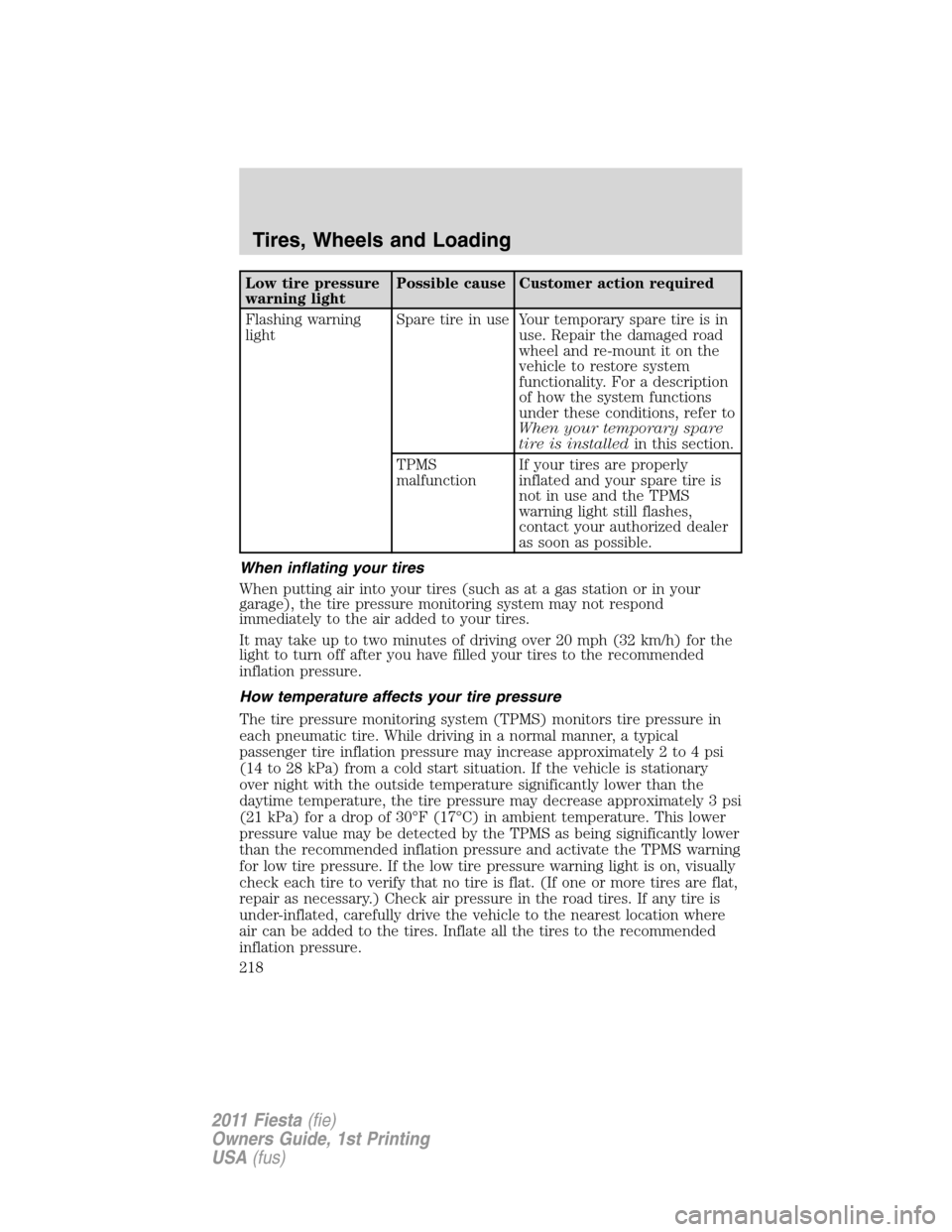
Low tire pressure
warning lightPossible cause Customer action required
Flashing warning
lightSpare tire in use Your temporary spare tire is in
use. Repair the damaged road
wheel and re-mount it on the
vehicle to restore system
functionality. For a description
of how the system functions
under these conditions, refer to
When your temporary spare
tire is installedin this section.
TPMS
malfunctionIf your tires are properly
inflated and your spare tire is
not in use and the TPMS
warning light still flashes,
contact your authorized dealer
as soon as possible.
When inflating your tires
When putting air into your tires (such as at a gas station or in your
garage), the tire pressure monitoring system may not respond
immediately to the air added to your tires.
It may take up to two minutes of driving over 20 mph (32 km/h) for the
light to turn off after you have filled your tires to the recommended
inflation pressure.
How temperature affects your tire pressure
The tire pressure monitoring system (TPMS) monitors tire pressure in
each pneumatic tire. While driving in a normal manner, a typical
passenger tire inflation pressure may increase approximately 2 to 4 psi
(14 to 28 kPa) from a cold start situation. If the vehicle is stationary
over night with the outside temperature significantly lower than the
daytime temperature, the tire pressure may decrease approximately 3 psi
(21 kPa) for a drop of 30°F (17°C) in ambient temperature. This lower
pressure value may be detected by the TPMS as being significantly lower
than the recommended inflation pressure and activate the TPMS warning
for low tire pressure. If the low tire pressure warning light is on, visually
check each tire to verify that no tire is flat. (If one or more tires are flat,
repair as necessary.) Check air pressure in the road tires. If any tire is
under-inflated, carefully drive the vehicle to the nearest location where
air can be added to the tires. Inflate all the tires to the recommended
inflation pressure.
Tires, Wheels and Loading
218
2011 Fiesta(fie)
Owners Guide, 1st Printing
USA(fus)
Page 231 of 357

and release of the START/STOP button will not switch off the engine. In
order to switch off the engine while the vehicle is in motion, press and
hold the START/STOP button for at least one second.
2. On — press the START/STOP button without applying the brake pedal
(automatic transmission) or clutch pedal (manual transmission). This will
power your vehicle’s electrical system and the warning lights in the
instrument cluster will illuminate, but the engine will remain off.
3. Start — press the START/STOP button (for any length of time) while
applying the brake pedal (automatic transmission) or clutch pedal
(manual transmission).Note:The indicator light on the start button will
illuminate when the vehicle is in on mode and when the engine is
started.
There may be areas inside your vehicle where the IA key is not detected.
If the message KEY NOT DETECTED appears on your multifunction
display when you press the START/STOP button, it may be necessary to
move your IA key to another area within the vehicle. The IA key may not
be detected near the roof (between the driver or passenger sunvisor and
the roof, or in the overhead console area) or in the extreme corners of
the rear package tray, near your audio speakers. It is not recommended
that you stow the IA key in these locations. If you move the IA key to a
location where it has been detected before and you still see the KEY
NOT DETECTED message, your IA key’s battery may be low or you may
be in an area with excessive radio frequency interference. If this occurs,
you can use the backup method to start your vehicle (see below).
Backup method of starting:Your
IA key uses a radio frequency signal
to communicate with your vehicle
and authorize your vehicle to start
when you press the START/STOP
button and apply the brake pedal or
clutch pedal. If excessive radio
frequency interference is present in
the area, or if the battery in your IA
key is low, it may be necessary to
start your car by holding the IA key
to the backup location near the steering column. After holding the IA
key to the backup location, use the START/STOP button and brake pedal
(automatic transmission) or clutch pedal (manual transmission) to start
your vehicle as usual. The vehicle should respond normally as long as the
IA key is at the backup location on the steering column. Once the vehicle
is started, the IA key can be moved from the backup location, if desired.
Driving
231
2011 Fiesta(fie)
Owners Guide, 1st Printing
USA(fus)
Page 233 of 357

ENGINE BLOCK HEATER (IF EQUIPPED)
An engine block heater warms the engine coolant which aids in starting
and allows the heater/defroster system to respond quickly. If your vehicle
is equipped with this system, your equipment includes a heater element
which is installed in your engine block and a wire harness which allows
the user to connect the system to a grounded 120 volt A/C electrical
source. The block heater system is most effective when outdoor
temperatures reach below 0°F (-18°C).
WARNING:Failure to follow engine block heater instructions
could result in property damage or physical injury.
WARNING:To reduce the risk of electrical shock, do not use
your heater with ungrounded electrical systems or two-pronged
(cheater) adapters.
Prior to using the engine block heater, follow these recommendations for
proper and safe operation:
•For your safety, use an outdoor extension cord that is product
certified by Underwriter’s Laboratory (UL) or Canadian Standards
Association (CSA). Use only an extension cord that can be used
outdoors, in cold temperatures, and is clearly marked “Suitable for Use
with Outdoor Appliances.” Never use an indoor extension cord
outdoors; it could result in an electric shock or fire hazard.
•Use a 16-gauge outdoor extension cord, minimum.
•Use as short an extension cord as possible.
•Do not use multiple extension cords. Instead, use one extension cord
which is long enough to reach from the engine block heater cord to
the outlet without stretching.
•Make certain that the extension cord is in excellent condition (not
patched or spliced). Store your extension cord indoors at
temperatures above 32°F (0°C). Outdoor conditions can deteriorate
extension cords over a period of time.
•To reduce the risk of electrical shock, do not use your heater with
ungrounded electrical systems or two pronged (cheater) adapters.
Also ensure that the block heater, especially the cord, is in good
condition before use.
•Make sure that when in operation, the extension cord plug/engine
block heater cord plug connection is free and clear of water in order
to prevent possible shock or fire.
Driving
233
2011 Fiesta(fie)
Owners Guide, 1st Printing
USA(fus)
Page 245 of 357

WARNING:During all times you are responsible for controlling
the vehicle, supervising the HSA system and intervening, if
required.
Activating HSA
1. Press the brake pedal to bring the vehicle to a complete standstill.
Keep the brake pedal pressed.
2. If the sensors detect that the vehicle is on a slope, the HSA system
will be activated automatically in D (Drive) uphill or R (Reverse)
downhill.
3. When you remove your foot from the brake pedal, the vehicle will
remain on the slope without rolling away for approximately two to three
seconds. This hold time will automatically be extended if you are in the
process of driving off.
4. Drive off in the normal manner. The brakes will be released
automatically.
Note:If the engine is revved excessively, HSA will be deactivated.
Deactivating hill start assist
To deactivate HSA, perform one of the following:
•Apply the parking brake.
•Drive off uphill without re-applying the brake.
•Wait for two to three seconds until the HSA system deactivates
automatically.
•If hill start assist is active in D (Drive), select R (Reverse).
•If hill start assist is active in R (Reverse), select N (Neutral).
Note:The HSA warning lamp in the
instrument cluster momentarily
illuminates when the ignition is
turned on. If a malfunction is
detected in the HSA system, HSA will be deactivated and this warning
lamp will appear on the instrument cluster.
If your vehicle gets stuck in mud or snow
If your vehicle gets stuck in mud or snow, it may be rocked out by
shifting between forward and reverse gears, stopping between shifts in a
steady pattern. Press lightly on the accelerator in each gear.
Do not rock the vehicle if the engine is not at normal operating
temperature or damage to the transmission may occur.
Driving
245
2011 Fiesta(fie)
Owners Guide, 1st Printing
USA(fus)