2011 FORD F150 ECU
[x] Cancel search: ECUPage 214 of 461
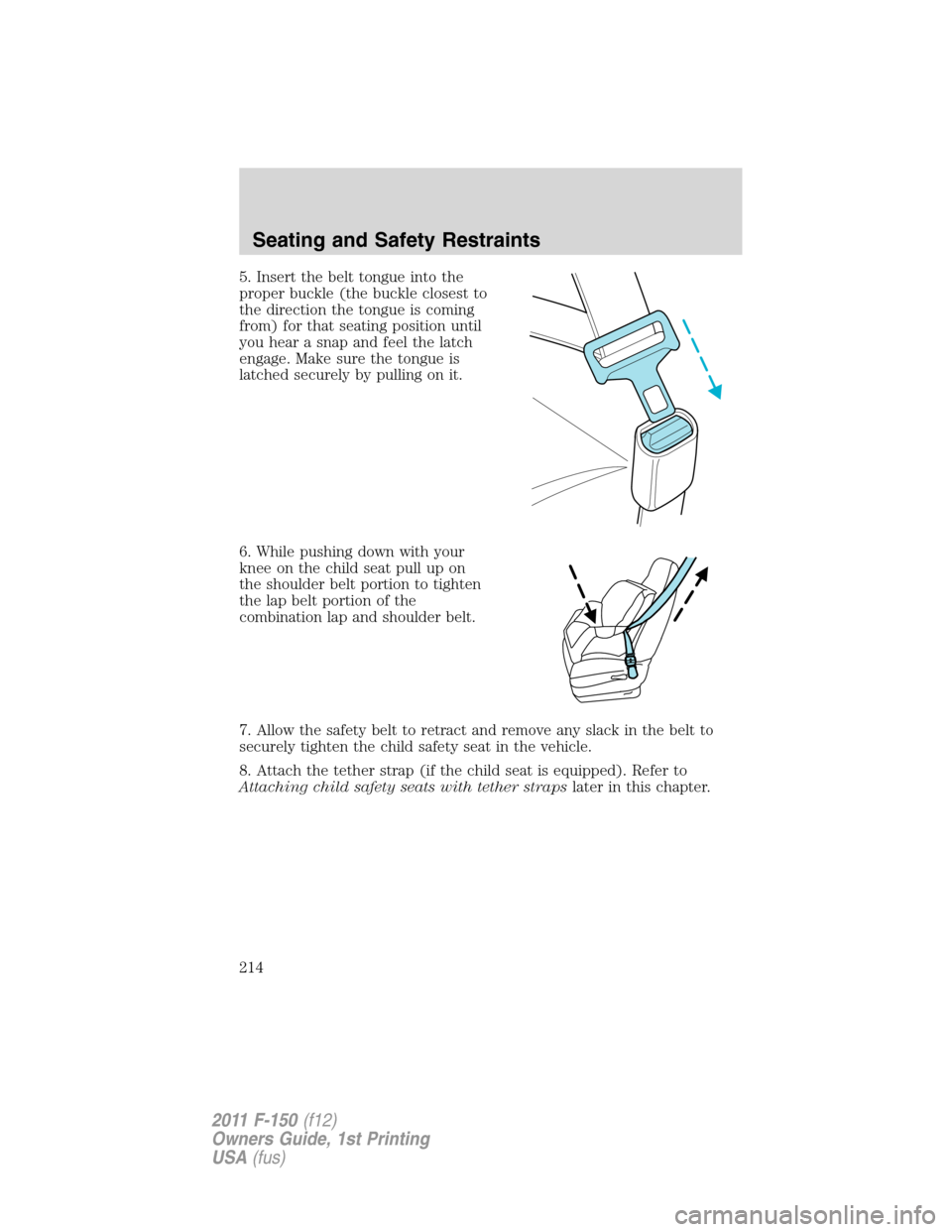
5. Insert the belt tongue into the
proper buckle (the buckle closest to
the direction the tongue is coming
from) for that seating position until
you hear a snap and feel the latch
engage. Make sure the tongue is
latched securely by pulling on it.
6. While pushing down with your
knee on the child seat pull up on
the shoulder belt portion to tighten
the lap belt portion of the
combination lap and shoulder belt.
7. Allow the safety belt to retract and remove any slack in the belt to
securely tighten the child safety seat in the vehicle.
8. Attach the tether strap (if the child seat is equipped). Refer to
Attaching child safety seats with tether strapslater in this chapter.
Seating and Safety Restraints
214
2011 F-150(f12)
Owners Guide, 1st Printing
USA(fus)
Page 215 of 461
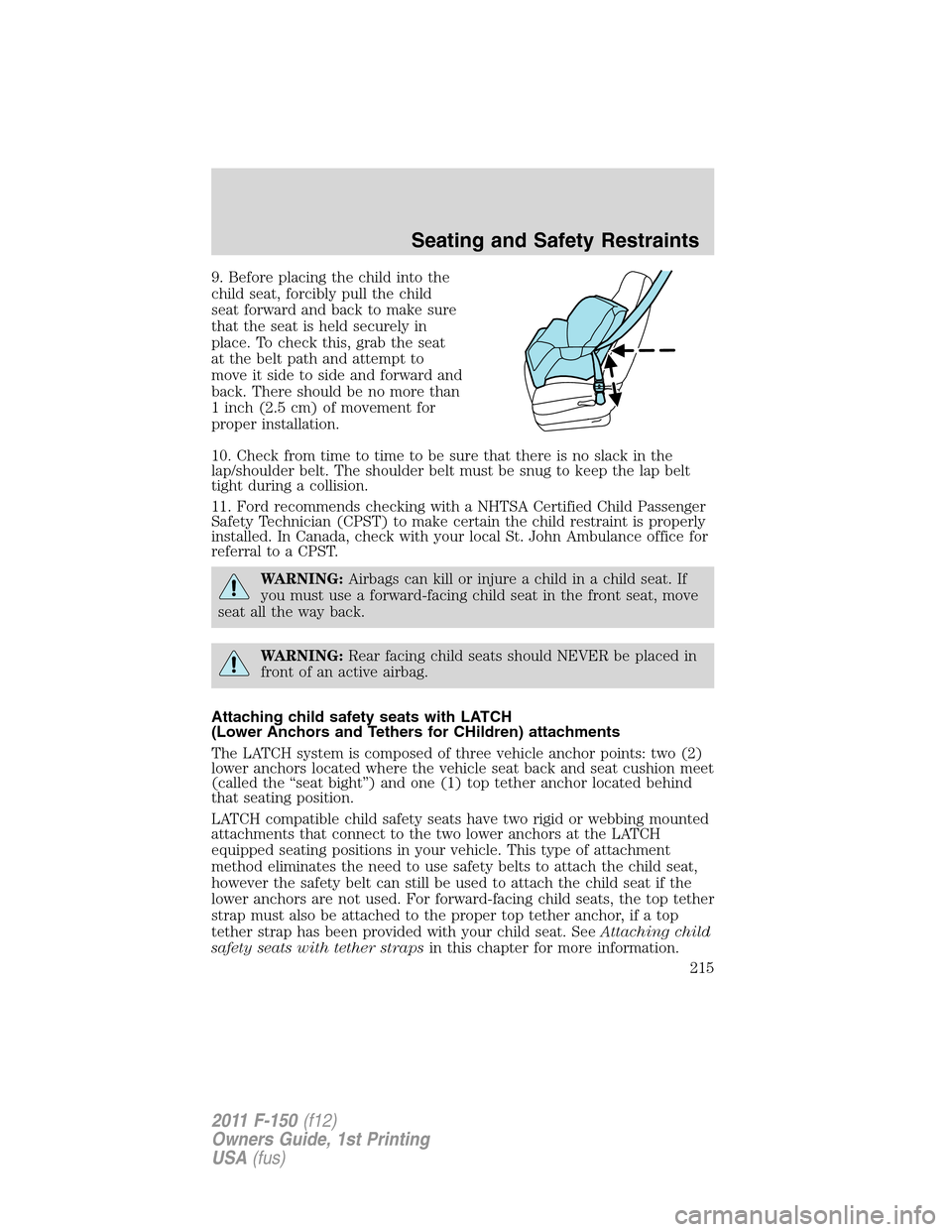
9. Before placing the child into the
child seat, forcibly pull the child
seat forward and back to make sure
that the seat is held securely in
place. To check this, grab the seat
at the belt path and attempt to
move it side to side and forward and
back. There should be no more than
1 inch (2.5 cm) of movement for
proper installation.
10. Check from time to time to be sure that there is no slack in the
lap/shoulder belt. The shoulder belt must be snug to keep the lap belt
tight during a collision.
11. Ford recommends checking with a NHTSA Certified Child Passenger
Safety Technician (CPST) to make certain the child restraint is properly
installed. In Canada, check with your local St. John Ambulance office for
referral to a CPST.
WARNING:Airbags can kill or injure a child in a child seat. If
you must use a forward-facing child seat in the front seat, move
seat all the way back.
WARNING:Rear facing child seats should NEVER be placed in
front of an active airbag.
Attaching child safety seats with LATCH
(Lower Anchors and Tethers for CHildren) attachments
The LATCH system is composed of three vehicle anchor points: two (2)
lower anchors located where the vehicle seat back and seat cushion meet
(called the “seat bight”) and one (1) top tether anchor located behind
that seating position.
LATCH compatible child safety seats have two rigid or webbing mounted
attachments that connect to the two lower anchors at the LATCH
equipped seating positions in your vehicle. This type of attachment
method eliminates the need to use safety belts to attach the child seat,
however the safety belt can still be used to attach the child seat if the
lower anchors are not used. For forward-facing child seats, the top tether
strap must also be attached to the proper top tether anchor, if a top
tether strap has been provided with your child seat. SeeAttaching child
safety seats with tether strapsin this chapter for more information.
Seating and Safety Restraints
215
2011 F-150(f12)
Owners Guide, 1st Printing
USA(fus)
Page 216 of 461
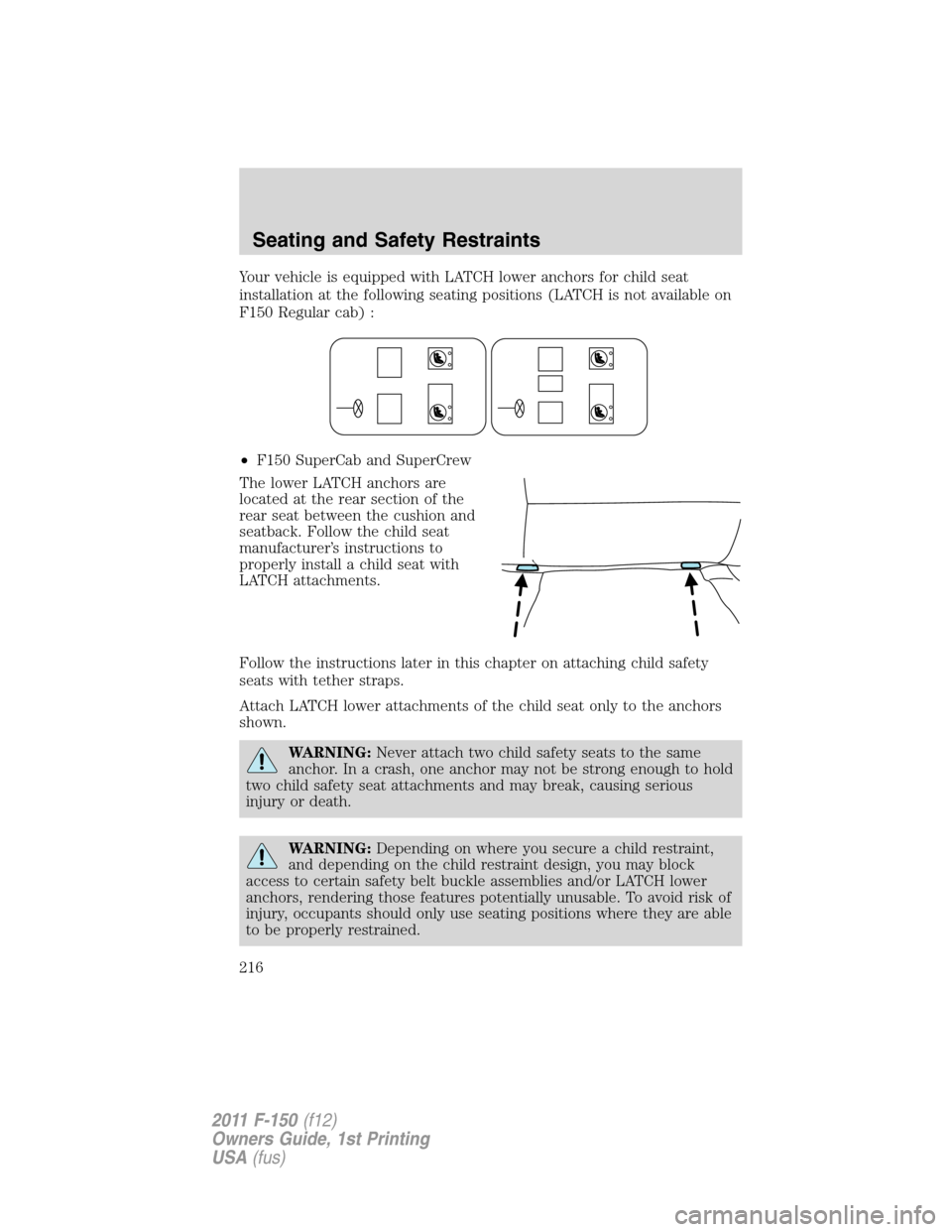
Your vehicle is equipped with LATCH lower anchors for child seat
installation at the following seating positions (LATCH is not available on
F150 Regular cab) :
•F150 SuperCab and SuperCrew
The lower LATCH anchors are
located at the rear section of the
rear seat between the cushion and
seatback. Follow the child seat
manufacturer’s instructions to
properly install a child seat with
LATCH attachments.
Follow the instructions later in this chapter on attaching child safety
seats with tether straps.
Attach LATCH lower attachments of the child seat only to the anchors
shown.
WARNING:Never attach two child safety seats to the same
anchor. In a crash, one anchor may not be strong enough to hold
two child safety seat attachments and may break, causing serious
injury or death.
WARNING:Depending on where you secure a child restraint,
and depending on the child restraint design, you may block
access to certain safety belt buckle assemblies and/or LATCH lower
anchors, rendering those features potentially unusable. To avoid risk of
injury, occupants should only use seating positions where they are able
to be properly restrained.
Seating and Safety Restraints
216
2011 F-150(f12)
Owners Guide, 1st Printing
USA(fus)
Page 217 of 461
Use of inboard lower anchors from the outboard seating positions
(center seating use)
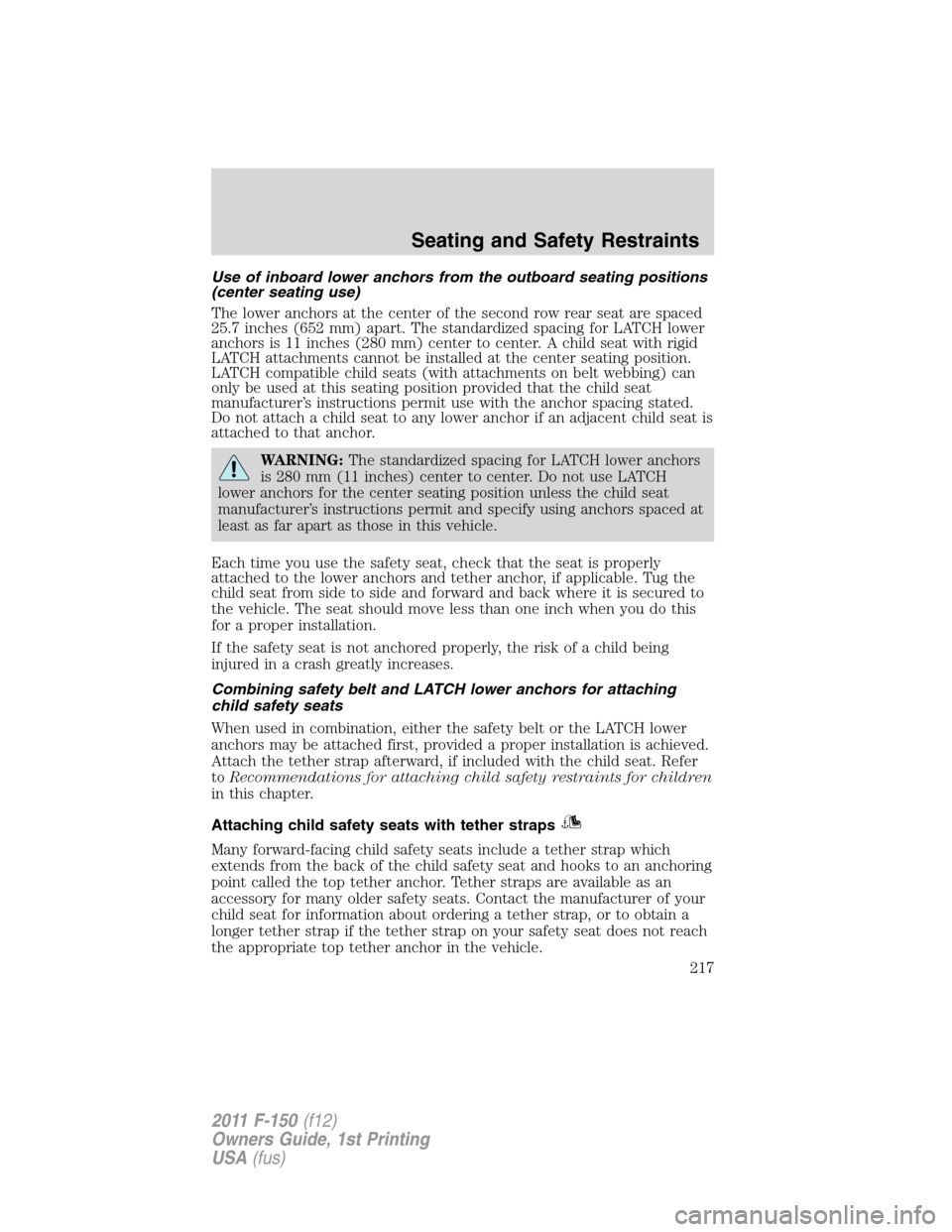
The lower anchors at the center of the second row rear seat are spaced
25.7 inches (652 mm) apart. The standardized spacing for LATCH lower
anchors is 11 inches (280 mm) center to center. A child seat with rigid
LATCH attachments cannot be installed at the center seating position.
LATCH compatible child seats (with attachments on belt webbing) can
only be used at this seating position provided that the child seat
manufacturer’s instructions permit use with the anchor spacing stated.
Do not attach a child seat to any lower anchor if an adjacent child seat is
attached to that anchor.
WARNING:The standardized spacing for LATCH lower anchors
is 280 mm (11 inches) center to center. Do not use LATCH
lower anchors for the center seating position unless the child seat
manufacturer’s instructions permit and specify using anchors spaced at
least as far apart as those in this vehicle.
Each time you use the safety seat, check that the seat is properly
attached to the lower anchors and tether anchor, if applicable. Tug the
child seat from side to side and forward and back where it is secured to
the vehicle. The seat should move less than one inch when you do this
for a proper installation.
If the safety seat is not anchored properly, the risk of a child being
injured in a crash greatly increases.
Combining safety belt and LATCH lower anchors for attaching
child safety seats
When used in combination, either the safety belt or the LATCH lower
anchors may be attached first, provided a proper installation is achieved.
Attach the tether strap afterward, if included with the child seat. Refer
toRecommendations for attaching child safety restraints for children
in this chapter.
Attaching child safety seats with tether straps
Many forward-facing child safety seats include a tether strap which
extends from the back of the child safety seat and hooks to an anchoring
point called the top tether anchor. Tether straps are available as an
accessory for many older safety seats. Contact the manufacturer of your
child seat for information about ordering a tether strap, or to obtain a
longer tether strap if the tether strap on your safety seat does not reach
the appropriate top tether anchor in the vehicle.
Seating and Safety Restraints
217
2011 F-150(f12)
Owners Guide, 1st Printing
USA(fus)
Page 221 of 461
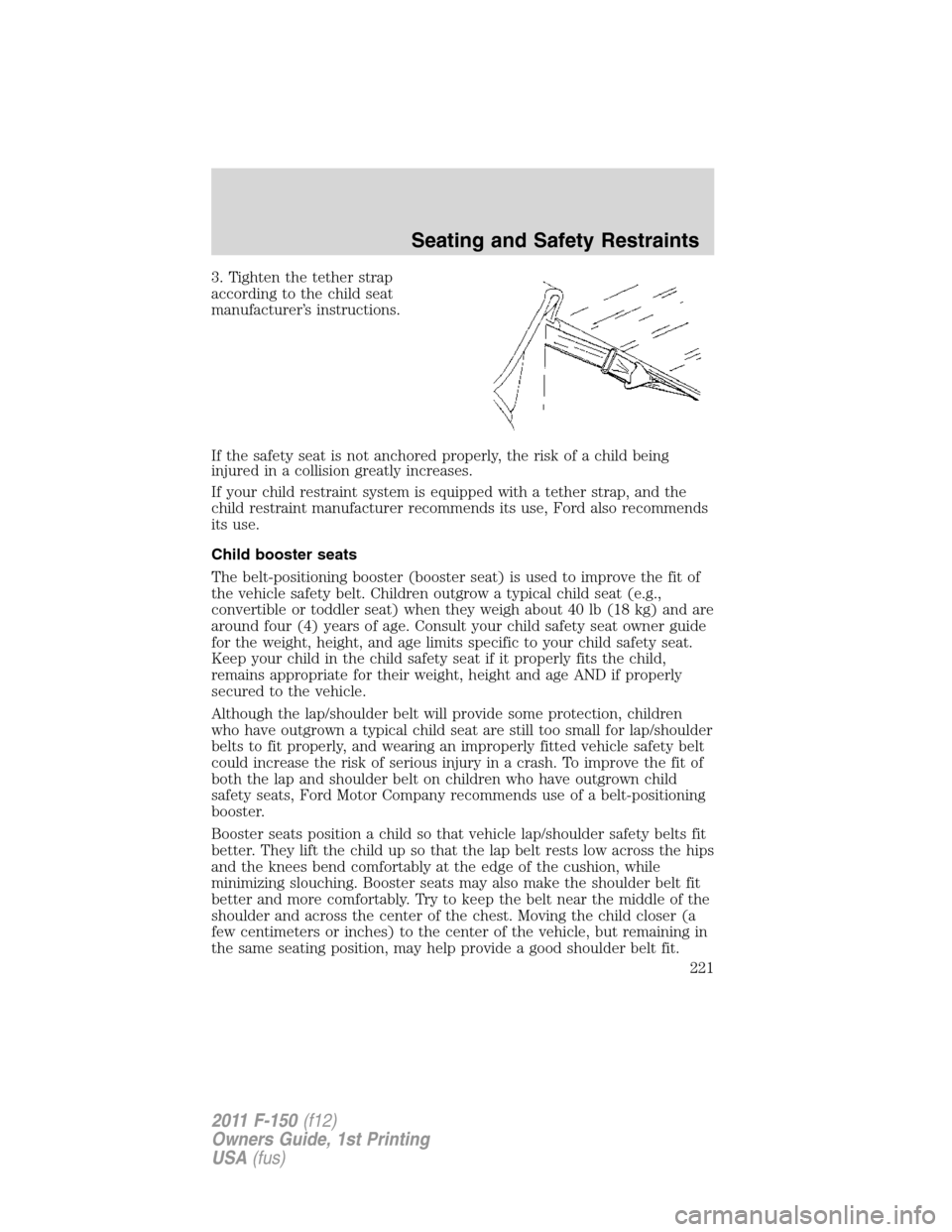
3. Tighten the tether strap
according to the child seat
manufacturer’s instructions.
If the safety seat is not anchored properly, the risk of a child being
injured in a collision greatly increases.
If your child restraint system is equipped with a tether strap, and the
child restraint manufacturer recommends its use, Ford also recommends
its use.
Child booster seats
The belt-positioning booster (booster seat) is used to improve the fit of
the vehicle safety belt. Children outgrow a typical child seat (e.g.,
convertible or toddler seat) when they weigh about 40 lb (18 kg) and are
around four (4) years of age. Consult your child safety seat owner guide
for the weight, height, and age limits specific to your child safety seat.
Keep your child in the child safety seat if it properly fits the child,
remains appropriate for their weight, height and age AND if properly
secured to the vehicle.
Although the lap/shoulder belt will provide some protection, children
who have outgrown a typical child seat are still too small for lap/shoulder
belts to fit properly, and wearing an improperly fitted vehicle safety belt
could increase the risk of serious injury in a crash. To improve the fit of
both the lap and shoulder belt on children who have outgrown child
safety seats, Ford Motor Company recommends use of a belt-positioning
booster.
Booster seats position a child so that vehicle lap/shoulder safety belts fit
better. They lift the child up so that the lap belt rests low across the hips
and the knees bend comfortably at the edge of the cushion, while
minimizing slouching. Booster seats may also make the shoulder belt fit
better and more comfortably. Try to keep the belt near the middle of the
shoulder and across the center of the chest. Moving the child closer (a
few centimeters or inches) to the center of the vehicle, but remaining in
the same seating position, may help provide a good shoulder belt fit.
Seating and Safety Restraints
221
2011 F-150(f12)
Owners Guide, 1st Printing
USA(fus)
Page 246 of 461

To restore the full functionality of the tire pressure monitoring system,
have the damaged road wheel/tire repaired and remounted on your
vehicle. For additional information, refer toChanging tires with a
TPMSin this section.
When you believe your system is not operating properly
The main function of the tire pressure monitoring system is to warn you
when your tires need air. It can also warn you in the event the system is
no longer capable of functioning as intended. Please refer to the
following chart for information concerning your tire pressure monitoring
system:
Low tire
pressure
warning
lightPossible
causeCustomer action required
Solid warning
lightTire(s)
under-
inflated1. Check your tire pressure to ensure tires
are properly inflated; refer toInflating
your tiresin this chapter.
2. After inflating your tires to the manufac-
turer’s recommended inflation pressure as
shown on the Tire Label (located on the
edge of driver’s door or the B-Pillar), the
vehicle must be driven for at least two min-
utes over 20 mph (32 km/h) before the
light will turn off.
Spare tire
in useYour temporary spare tire is in use. Repair
the damaged road wheel/tire and reinstall it
on the vehicle to restore system functional-
ity. For a description on how the system
functions, refer toWhen your temporary
spare tire is installedin this section.
TPMS mal-
functionIf your tires are properly inflated and your
spare tire is not in use and the light re-
mains on, have the system inspected by
your authorized dealer.
Tire rota-
tion with-
out sensor
trainingOn vehicles with different front and rear
tire pressures, the TPMS system must be
retrained following every tire rotation. Re-
fer toTire rotationin this chapter.
Tires, Wheels and Loading
246
2011 F-150(f12)
Owners Guide, 1st Printing
USA(fus)
Page 247 of 461
Low tire
pressure
warning
lightPossible
causeCustomer action required
Flashing
warning lightSpare tire
in useYour temporary spare tire is in use. Repair
the damaged road wheel and re-mount it on
the vehicle to restore system functionality.
For a description of how the system func-
tions under these conditions, refer toWhen
your temporary spare tire is installedin
this section.
TPMS mal-
functionIf your tires are properly inflated and your
spare tire is not in use and the TPMS warn-
ing light still flashes, have the system in-
spected by your authorized dealer.
When inflating your tires
When putting air into your tires (such as at a gas station or in your
garage), the tire pressure monitoring system may not respond
immediately to the air added to your tires.
It may take up to two minutes of driving over 20 mph (32 km/h) for the
light to turn off after you have filled your tires to the recommended
inflation pressure.
How temperature affects your tire pressure
The tire pressure monitoring system (TPMS) monitors tire pressure in
each pneumatic tire. While driving in a normal manner, a typical
passenger tire inflation pressure may increase approximately 2 to 4 psi
(14 to 28 kPa) from a cold start situation. If the vehicle is stationary
overnight with the outside temperature significantly lower than the
daytime temperature, the tire pressure may decrease approximately 3 psi
(21 kPa) for a drop of 30°F (17°C) in ambient temperature. This lower
pressure value may be detected by the TPMS as being significantly lower
than the recommended inflation pressure and activate the TPMS warning
light for low tire pressure. If the low tire pressure warning light is on,
visually check each tire to verify that no tire is flat. (If one or more tires
are flat, repair as necessary.) Check air pressure in the road tires. If any
tire is under-inflated, carefully drive the vehicle to the nearest location
where air can be added to the tires. Inflate all the tires to the
recommended inflation pressure.
Tires, Wheels and Loading
247
2011 F-150(f12)
Owners Guide, 1st Printing
USA(fus)
Page 251 of 461
Follow these guidelines when using snow tires and chains:
•If possible, avoid fully loading your vehicle.
•Use only SAE Class S chains.
•Install chains securely, verifying that the chains do not touch any
wiring, brake lines or fuel lines.
•Drive cautiously. If you hear the chains rub or bang against your
vehicle, stop and retighten the chains. If this does not work, remove
the chains to prevent damage to your vehicle.
•Remove the tire chains when they are no longer needed. Do not use
tire chains on dry roads.
VEHICLE LOADING – WITH AND WITHOUT A TRAILER
This section will guide you in the proper loading of your vehicle and/or
trailer, to keep your loaded vehicle weight within its design rating
capability, with or without a trailer. Properly loading your vehicle will
provide maximum return of vehicle design performance. Before loading
your vehicle, familiarize yourself with the following terms for determining
your vehicle’s weight ratings, with or without a trailer, from the vehicle’s
Tire Label or Safety Compliance Certification Label:
Base Curb Weight– is the weight of the vehicle including a full tank of
fuel and all standard equipment. It does not include passengers, cargo, or
optional equipment.
Vehicle Curb Weight– is the weight of your new vehicle when you
picked it up from your authorized dealer plus any aftermarket
equipment.
Tires, Wheels and Loading
251
2011 F-150(f12)
Owners Guide, 1st Printing
USA(fus)