2011 FORD F150 warning
[x] Cancel search: warningPage 305 of 461
•If the image is not clear, then check if there is anything covering the
lens such as dirt, mud, ice, snow, etc. If the image is still not clear
after cleaning, have your system inspected by your authorized dealer.
BLIND SPOT MIRRORS (IF EQUIPPED)
Blind spot mirrors have a convex spotter mirror built into the upper
outboard corner of the outside mirrors. They are designed to assist the
driver by increasing visibility along the side of the vehicle. This vehicle is
equipped with a spotter mirror on the driver side only. The addition of
this spotter mirror on the passenger side would not increase that mirror’s
field of view.
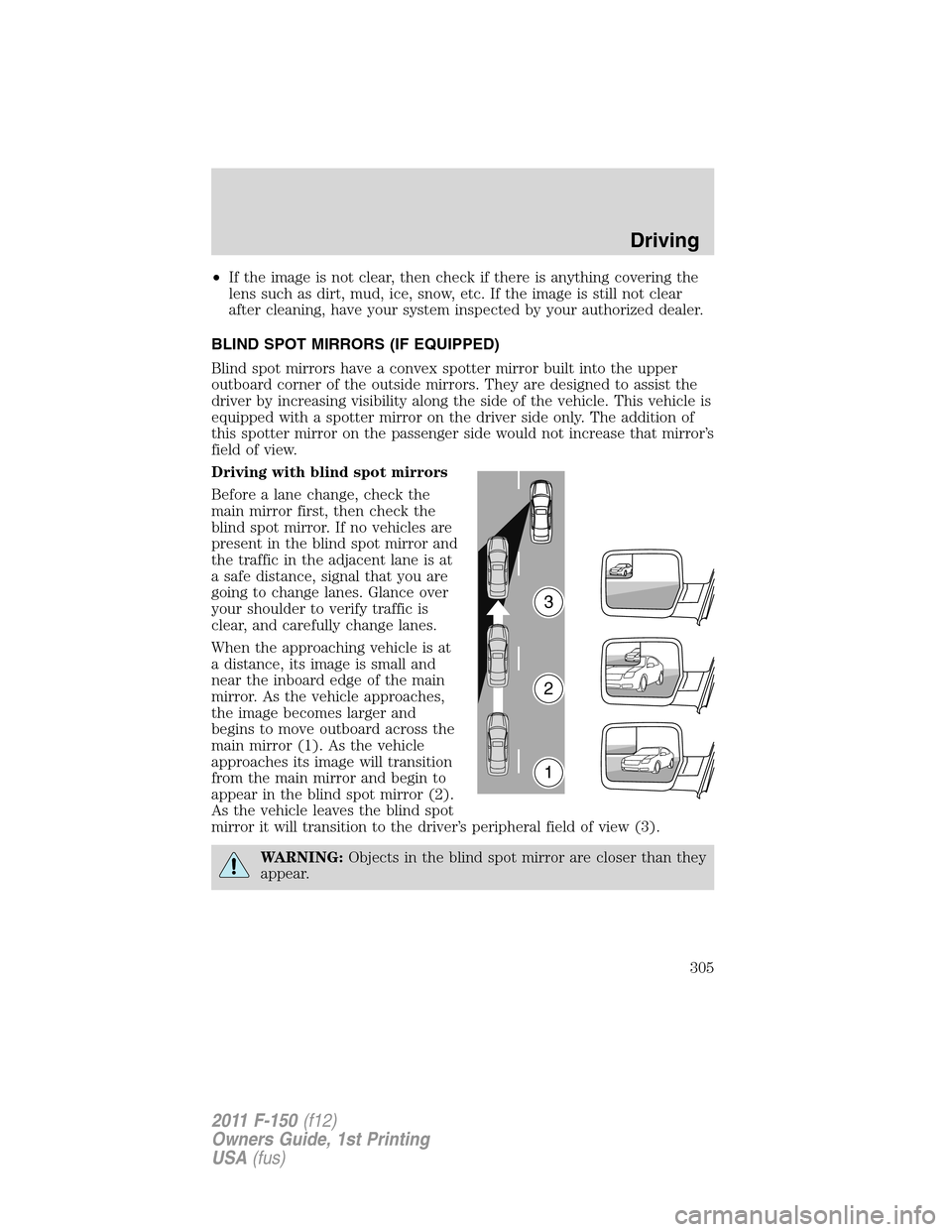
Driving with blind spot mirrors
Before a lane change, check the
main mirror first, then check the
blind spot mirror. If no vehicles are
present in the blind spot mirror and
the traffic in the adjacent lane is at
a safe distance, signal that you are
going to change lanes. Glance over
your shoulder to verify traffic is
clear, and carefully change lanes.
When the approaching vehicle is at
a distance, its image is small and
near the inboard edge of the main
mirror. As the vehicle approaches,
the image becomes larger and
begins to move outboard across the
main mirror (1). As the vehicle
approaches its image will transition
from the main mirror and begin to
appear in the blind spot mirror (2).
As the vehicle leaves the blind spot
mirror it will transition to the driver’s peripheral field of view (3).
WARNING:Objects in the blind spot mirror are closer than they
appear.
3
2
1
Driving
305
2011 F-150(f12)
Owners Guide, 1st Printing
USA(fus)
Page 306 of 461
FOUR-WHEEL DRIVE (4WD) OPERATION (IF EQUIPPED)
WARNING:For important information regarding safe operation
of this type of vehicle, seePreparing to drive your vehiclein
this chapter.
Four–wheel drive (4WD) supplies power to all four wheels. 4WD should
not be operated on dry pavement; driveline damage may occur.
If equipped with the electronic shift 4WD system, and 4X4 low is
selected while the vehicle is moving above 3 mph (5 km/h), the
4WD system will not perform a shift. This is normal and should be
no reason for concern.Refer toShifting to/from 4L (4X4 Low)for
proper operation.
4WD indicator lights
The indicator lights illuminate in the message center in the
reconfigurable telltale (RTT) location under the following conditions.
Refer toWarning lights and chimesin theInstrument Clusterchapter.
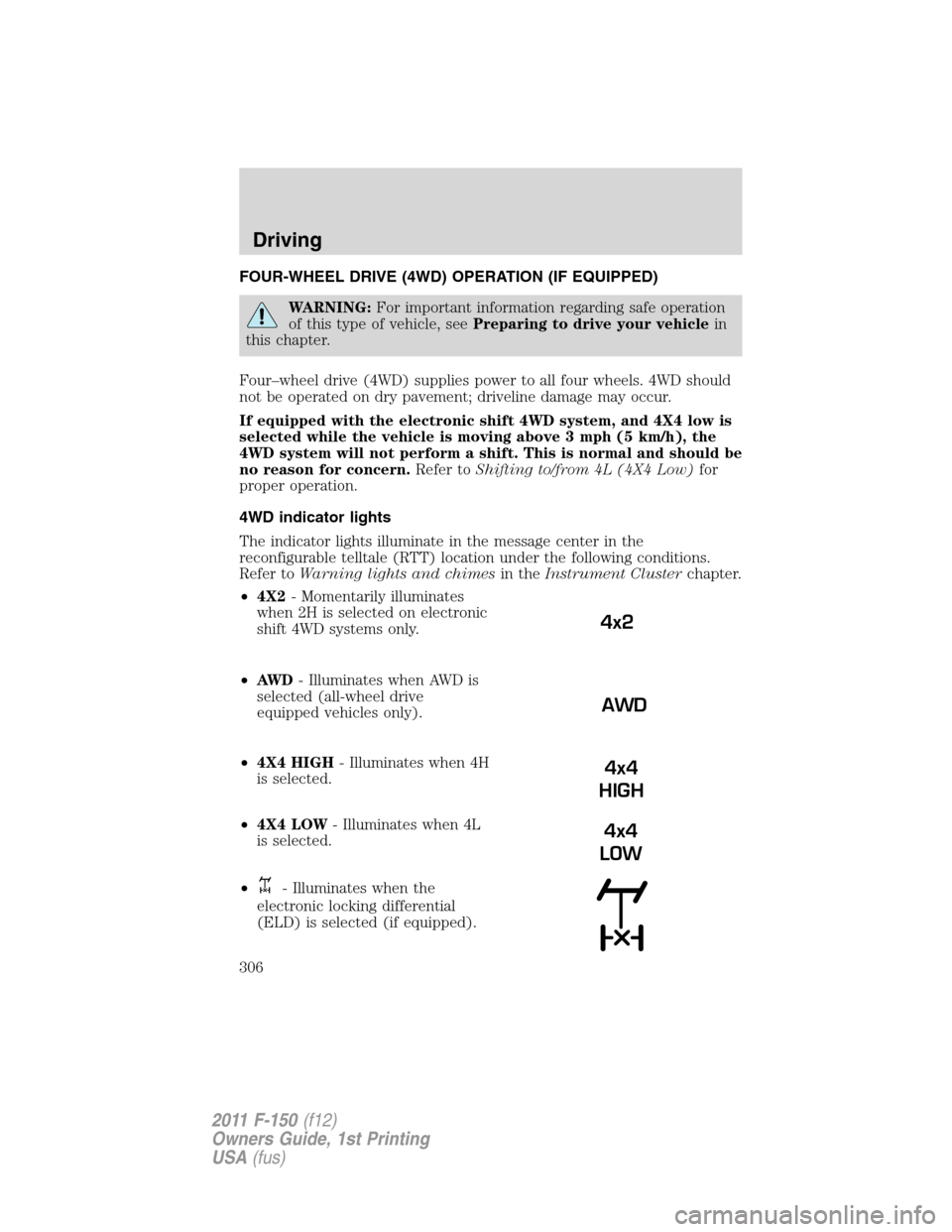
•4X2- Momentarily illuminates
when 2H is selected on electronic
shift 4WD systems only.
•AW D- Illuminates when AWD is
selected (all-wheel drive
equipped vehicles only).
•4X4 HIGH- Illuminates when 4H
is selected.
•4X4 LOW- Illuminates when 4L
is selected.
•
- Illuminates when the
electronic locking differential
(ELD) is selected (if equipped).
4x2
AWD
4x4
HIGH
4x4
LOW
Driving
306
2011 F-150(f12)
Owners Guide, 1st Printing
USA(fus)
Page 307 of 461
•CHECK 4X4- Displays when a
4X4 fault is present.
Note:When a 4X4 system fault is present, the system will typically
remain in whichever 4X4 mode was selected prior to the fault condition
occurring. It will not default to 4X2 in all circumstances. When this
warning is displayed, have your vehicle serviced by an authorized dealer.
Using a manual 4WD system (if equipped)
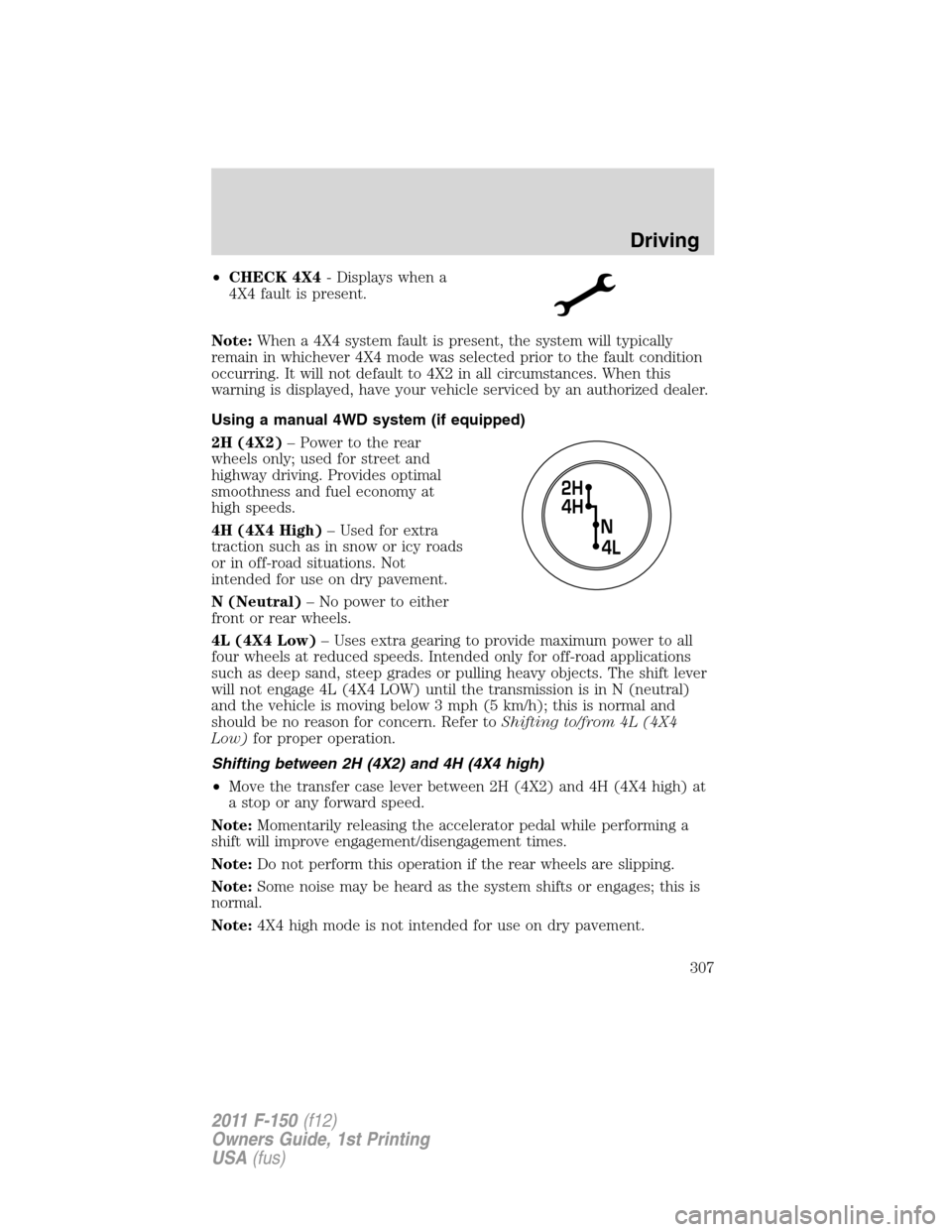
2H (4X2)– Power to the rear
wheels only; used for street and
highway driving. Provides optimal
smoothness and fuel economy at
high speeds.
4H (4X4 High)– Used for extra
traction such as in snow or icy roads
or in off-road situations. Not
intended for use on dry pavement.
N (Neutral)– No power to either
front or rear wheels.
4L (4X4 Low)– Uses extra gearing to provide maximum power to all
four wheels at reduced speeds. Intended only for off-road applications
such as deep sand, steep grades or pulling heavy objects. The shift lever
will not engage 4L (4X4 LOW) until the transmission is in N (neutral)
and the vehicle is moving below 3 mph (5 km/h); this is normal and
should be no reason for concern. Refer toShifting to/from 4L (4X4
Low)for proper operation.
Shifting between 2H (4X2) and 4H (4X4 high)
•Move the transfer case lever between 2H (4X2) and 4H (4X4 high) at
a stop or any forward speed.
Note:Momentarily releasing the accelerator pedal while performing a
shift will improve engagement/disengagement times.
Note:Do not perform this operation if the rear wheels are slipping.
Note:Some noise may be heard as the system shifts or engages; this is
normal.
Note:4X4 high mode is not intended for use on dry pavement.
Driving
307
2011 F-150(f12)
Owners Guide, 1st Printing
USA(fus)
Page 308 of 461
Shifting to/from 4L (4X4 low)
1. Bring the vehicle to a speed of 3 mph (5 km/h) or less.
2. Place the transmission in N (Neutral).
3. Move the transfer case lever through N (Neutral) directly to the
desired position.
•If the transfer casewill notengage into 4L (4X4 low)do not force
the lever.Allow the vehicle to coast at a speed below 3 mph
(5 km/h), then repeat Steps 2 and 3.
Note:Some noise may be heard as the system shifts or engages; this is
normal.
Note:4X4 low mode is not intended for use on dry pavement.
Note:For proper operation in 4X4 low, ensure the transfer case shift
lever is moved entirely rearward in to the 4L (4X4 Low) position and
that the 4x4 Low light is displayed in the message center.
Note:Ideal 4L (4X4 low) shift conditions occur when the vehicle is
rolling at a speed below 3 mph (5 km/h) and the transmission is in N
(Neutral).
Using the N (Neutral) position
The transfer case N (Neutral) position overrides the transmission
and puts the vehicle in neutral regardless of transmission
gearshift lever position. The vehicle can move forward or
backward.
This position should only be used when towing the vehicle.
WARNING:Do not leave the vehicle unattended with the
transfer case in the N (Neutral) position. Always set the parking
brake fully and turn off the ignition when leaving the vehicle.
Driving
308
2011 F-150(f12)
Owners Guide, 1st Printing
USA(fus)
Page 314 of 461

•It may be safer to stay on the apron or shoulder of the road and slow
down gradually before returning to the pavement. You may lose
control if you do not slow down or if you turn the steering wheel too
sharply or abruptly.
•It often may be less risky to strike small objects, such as highway
reflectors, with minor damage to your vehicle rather than attempt a
sudden return to the pavement which could cause the vehicle to slide
sideways out of control or roll over. Remember, your safety and the
safety of others should be your primary concern.
WARNING:Vehicles with a higher center of gravity such as
utility and four-wheel drive vehicles handle differently than
vehicles with a lower center of gravity. Utility and four-wheel drive
vehicles arenotdesigned for cornering at speeds as high as passenger
cars any more than low-slung sports cars are designed to perform
satisfactorily under off-road conditions. Avoid sharp turns, excessive
speed and abrupt maneuvers in these vehicles. Failure to drive
cautiously could result in an increased risk of loss of vehicle control,
vehicle rollover, personal injury and death.
If your vehicle gets stuck
If your vehicle gets stuck in mud or snow it may be rocked out by
shifting between forward and reverse gears, stopping between shifts, in a
steady pattern. Press lightly on the accelerator in each gear.
Do not rock the vehicle if the engine is not at normal operating
temperature or damage to the transmission may occur.
Do not rock the vehicle for more than a few minutes or damage
to the transmission and tires may occur or the engine may
overheat.
WARNING:Do not spin the wheels at over 35 mph (56 km/h).
The tires may fail and injure a passenger or bystander.
Emergency maneuvers
•In an unavoidable emergency situation where a sudden sharp turn
must be made, remember to avoid “over-driving” your vehicle, i.e.,
turn the steering wheel only as rapidly and as far as required to avoid
the emergency. Excessive steering will result in less vehicle control,
not more. Additionally, smooth variations of the accelerator and/or
brake pedal pressure should be utilized if changes in vehicle speed are
Driving
314
2011 F-150(f12)
Owners Guide, 1st Printing
USA(fus)
Page 315 of 461
called for. Avoid abrupt steering, acceleration or braking which could
result in an increased risk of loss of vehicle control, vehicle rollover
and/or personal injury. Use all available road surface to return the
vehicle to a safe direction of travel.
•In the event of an emergency stop, avoid skidding the tires and do not
attempt any sharp steering wheel movements.
WARNING:Vehicles with a higher center of gravity such as
utility and four-wheel drive vehicles handle differently than
vehicles with a lower center of gravity. Utility and four-wheel drive
vehicles arenotdesigned for cornering at speeds as high as passenger
cars any more than low-slung sports cars are designed to perform
satisfactorily under off-road conditions. Avoid sharp turns, excessive
speed and abrupt maneuvers in these vehicles. Failure to drive
cautiously could result in an increased risk of loss of vehicle control,
vehicle rollover, personal injury and death.
•If the vehicle goes from one type of surface to another (i.e., from
concrete to gravel) there will be a change in the way the vehicle
responds to a maneuver (steering, acceleration or braking). Again,
avoid these abrupt inputs.
Parking
On some 4WD vehicles, when the transfer case is in the N (Neutral)
position, the engine and transmission are disconnected from the rest of
the driveline. Therefore, the vehicle is free to roll even if the automatic
transmission is in P (Park) or the manual transmission is in gear. Do not
leave the vehicle unattended with the transfer case in the N (Neutral)
position. Always set the parking brake fully and turn off the ignition
when leaving the vehicle.
WARNING:Always set the parking brake fully and make sure
the gearshift is latched in P (Park). Turn the ignition to the off
position and remove the key whenever you leave your vehicle.
WARNING:If the parking brake is fully released, but the brake
warning lamp remains illuminated, the brakes may not be
working properly. See your authorized dealer.
4WD systems
4WD (when you select a 4WD mode) uses all four wheels to power the
vehicle. This increases traction, enabling you to drive over terrain and
road conditions that a conventional two-wheel drive vehicle cannot.
Driving
315
2011 F-150(f12)
Owners Guide, 1st Printing
USA(fus)
Page 319 of 461

WARNING:If you are driving in slippery conditions that require
tire chains or cables, then it is critical that you drive cautiously.
Keep speeds down, allow for longer stopping distances and avoid
aggressive steering to reduce the chances of a loss of vehicle control
which can lead to serious injury or death. If the rear end of the vehicle
slides while cornering, steer in the direction of the slide until you
regain control of the vehicle.
Maintenance and modifications
The suspension and steering systems on your vehicle have been designed
and tested to provide predictable performance whether loaded or empty
and durable load carrying capability. For this reason, Ford Motor
Company strongly recommends that you do not make modifications such
as adding or removing parts (such as lift kits or stabilizer bars) or by
using replacement parts not equivalent to the original factory equipment.
Snow plow restriction
WARNING:Ford does not recommend the use of any F-150
model to be upfitted and equipped with snow plow hardware for
use as a snow plow vehicle.
Any modifications to a vehicle that raise the center of gravity can make
it more likely the vehicle will roll over as a result of a loss of control.
Ford Motor Company recommends that caution be used with any vehicle
equipped with a high load or device (such as ladder racks or pickup box
cover).
Failure to maintain your vehicle properly may void the warranty, increase
your repair cost, reduce vehicle performance and operational capabilities
and adversely affect driver and passenger safety. Frequent inspection of
vehicle chassis components is recommended if the vehicle is subjected to
heavy off-road usage.
Driving
319
2011 F-150(f12)
Owners Guide, 1st Printing
USA(fus)
Page 323 of 461

FUEL PUMP SHUT-OFF
In the event of a moderate to severe collision, this vehicle is equipped
with a fuel pump shut-off feature that stops the flow of fuel to the
engine. Not every impact will cause a shut-off.
Should your vehicle shut off after a collision due to this feature, you may
restart your vehicle by doing the following:
1. Turn the ignition switch to the off position.
2. Turn the ignition switch to the on position.
In some instances the vehicle may not restart the first time you try to
restart and may take one additional attempt.
WARNING:Failure to inspect and if necessary repair fuel leaks
after a collision may increase the risk of fire and serious injury.
Ford Motor Company recommends that the fuel system be inspected
by an authorized dealer after any collision.
FUSES AND RELAYS
Fuses
If electrical components in the
vehicle are not working, a fuse may
have blown. Blown fuses are
identified by a broken wire within
the fuse. Check the appropriate
fuses before replacing any electrical
components.
Note:Always replace a fuse with one that has the specified amperage
rating. Using a fuse with a higher amperage rating can cause severe wire
damage and could start a fire.
15
Roadside Emergencies
323
2011 F-150(f12)
Owners Guide, 1st Printing
USA(fus)