Page 338 of 449
Dissimilar spare tire/wheel information
WARNING:Failure to follow these guidelines could result in an
increased risk of loss of vehicle control, injury or death.
If you have a dissimilar spare tire/wheel, then it is intended for
temporary use only. This means that if you need to use it, you should
replace it as soon as possible with a road tire/wheel that is the same size
and type as the road tires and wheels that were originally provided by
Ford. If the dissimilar spare tire or wheel is damaged, it should be
replaced rather than repaired.
A dissimilar spare tire/wheel is defined as a spare tire and/or wheel that
is different in brand, size or appearance from the road tires and wheels
and can be one of three types:
1.T-type mini-spare:This spare tire begins with the letter “T” for tire
size and may have “Temporary Use Only” molded in the sidewall
2.Full-size dissimilar spare with label on wheel:This spare tire has
a label on the wheel that states: “THIS TIRE AND WHEEL FOR
TEMPORARY USE ONLY”
When driving with one of the dissimilar spare tires listed above,do not:
•Exceed 50 mph (80 km/h)
•Load the vehicle beyond maximum vehicle load rating listed on the
Safety Compliance Label
•Tow a trailer
•Use snow chains on the end of the vehicle with the dissimilar spare
tire
•Use more than one dissimilar spare tire at a time
•Use commercial car washing equipment
•Try to repair the dissimilar spare tire
Use of one of the dissimilar spare tires listed above at any one wheel
location can lead to impairment of the following:
•Handling, stability and braking performance
•Comfort and noise
•Ground clearance and parking at curbs
•Winter weather driving capability
•Wet weather driving capability
Roadside Emergencies
337
2011 Explorer(exp)
Owners Guide, 1st Printing
USA(fus)
Page 339 of 449

3.Full-size dissimilar spare without label on wheel
When driving with the full-size dissimilar spare tire/wheel,do not:
•Exceed 70 mph (113 km/h)
•Use more than one dissimilar spare tire/wheel at a time
•Use commercial car washing equipment
•Use snow chains on the end of the vehicle with the dissimilar spare
tire/wheel
The usage of a full-size dissimilar spare tire/wheel can lead to
impairment of the following:
•Handling, stability and braking performance
•Comfort and noise
•Ground clearance and parking at curbs
•Winter weather driving capability
•Wet weather driving capability
•All-Wheel driving capability (if applicable)
•Load leveling adjustment (if applicable)
When driving with the full-size dissimilar spare tire/wheel additional
caution should be given to:
•Towing a trailer
•Driving vehicles equipped with a camper body
•Driving vehicles with a load on the cargo rack
Drive cautiously when using a full-size dissimilar spare tire/wheel and
seek service as soon as possible.
Roadside Emergencies
338
2011 Explorer(exp)
Owners Guide, 1st Printing
USA(fus)
Page 340 of 449
Stopping and securing the vehicle
1. Park on a level surface, set the
parking brake and activate hazard
flashers.
2. Place gearshift lever in P (Park)
and turn engine off.
Removing the spare tire and jack
If the 3rd row seat is stowed in the floor, you will need to unstow it (raised
position) to access the spare tire and jack. Refer toUnstowing the third
row seatin theSeating and Safety Restraintschapter for this procedure.
1. Remove the floor filler and
carpeted floor panel located in the
rear of the vehicle.
2. Remove the wing nut that secures
the spare tire by turning it
counterclockwise.
3. Lift and remove the spare tire
from the spare tire well.
Roadside Emergencies
339
2011 Explorer(exp)
Owners Guide, 1st Printing
USA(fus)
Page 341 of 449
4. Remove the wing bolt that
secures the jack kit by turning it
counterclockwise.
5. Remove the jack kit which
includes jack (4), wheel wrench (lug
wrench) (3), wheel chock (5),
L-shaped bolt (1) and tow recovery
hook (2).
6. Remove the jack, wrench and
wheel chock from the foam tray.
7. Turn the lead screw (where the
lug wrench attaches) of the jack by
hand to release the wheel wrench
from the jack. Press the button on
the wrench to extend the handle.
Fold down the wrench socket.
25
43
1
Roadside Emergencies
340
2011 Explorer(exp)
Owners Guide, 1st Printing
USA(fus)
Page 343 of 449
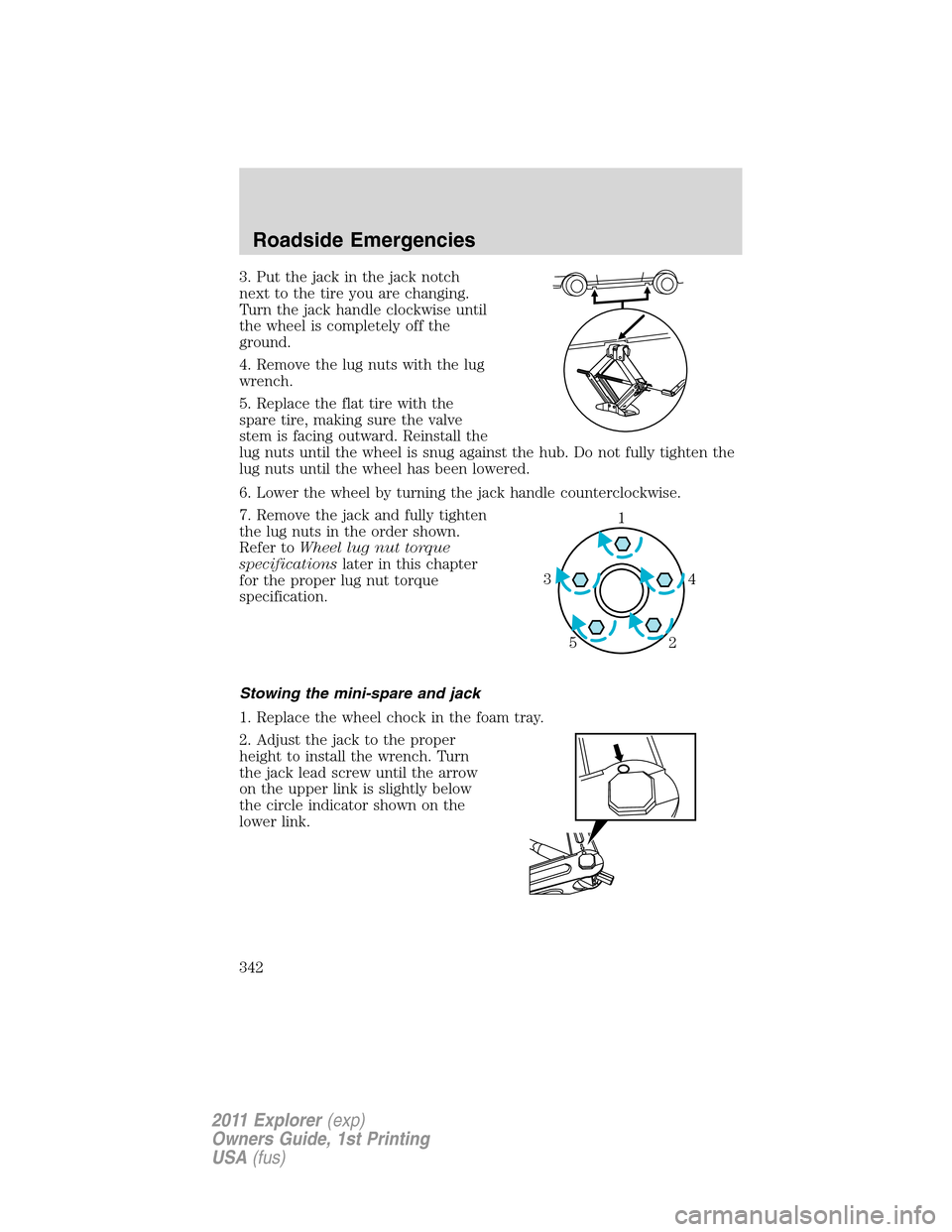
3. Put the jack in the jack notch
next to the tire you are changing.
Turn the jack handle clockwise until
the wheel is completely off the
ground.
4. Remove the lug nuts with the lug
wrench.
5. Replace the flat tire with the
spare tire, making sure the valve
stem is facing outward. Reinstall the
lug nuts until the wheel is snug against the hub. Do not fully tighten the
lug nuts until the wheel has been lowered.
6. Lower the wheel by turning the jack handle counterclockwise.
7. Remove the jack and fully tighten
the lug nuts in the order shown.
Refer toWheel lug nut torque
specificationslater in this chapter
for the proper lug nut torque
specification.
Stowing the mini-spare and jack
1. Replace the wheel chock in the foam tray.
2. Adjust the jack to the proper
height to install the wrench. Turn
the jack lead screw until the arrow
on the upper link is slightly below
the circle indicator shown on the
lower link.
1
4 3
2 5
Roadside Emergencies
342
2011 Explorer(exp)
Owners Guide, 1st Printing
USA(fus)
Page 344 of 449

Push the button (1) to retract the
wrench handle and place the
wrench over the raised tab on the
lower link and drop the tang (2)
through the hole in the diagonally
opposite upper link. Turn lead screw
of jack clockwise until the arrow
aligns with the circle indicator to
secure the wrench onto the jack.
3. Place the jack in the foam tray and secure it with the attached strap.
4. Place the foam tray over the mounting bracket on the floor of the
spare tire well.
5. Replace the mini-spare over the jack and secure with wing nut. .
Stowing the flat tire
1. Place the 3rd row seat in the
raised position.
2. Secure the jack kit in the
alternate position by inserting the
L-shaped bolt through the hole in
the side of jack channel as shown.
Note:The L-shaped bolt is located in the foam tray near the wheel
chock.
3. Stand the flat tire vertically in the
mini-spare tub with the tire’s valve
stem facing rearward toward the
rear lift gate back panel.
4. Fasten the flat tire to the rear lift
gate back panel by inserting the
wing bolt through one of the lug
bolt holes in the wheel.
5. Turn the wing bolt clockwise into
the threaded hole in the rear lift
gate back panel until the tire is secured.1
2
Roadside Emergencies
343
2011 Explorer(exp)
Owners Guide, 1st Printing
USA(fus)
Page 345 of 449
TEMPORARY MOBILITY KIT (IF EQUIPPED)
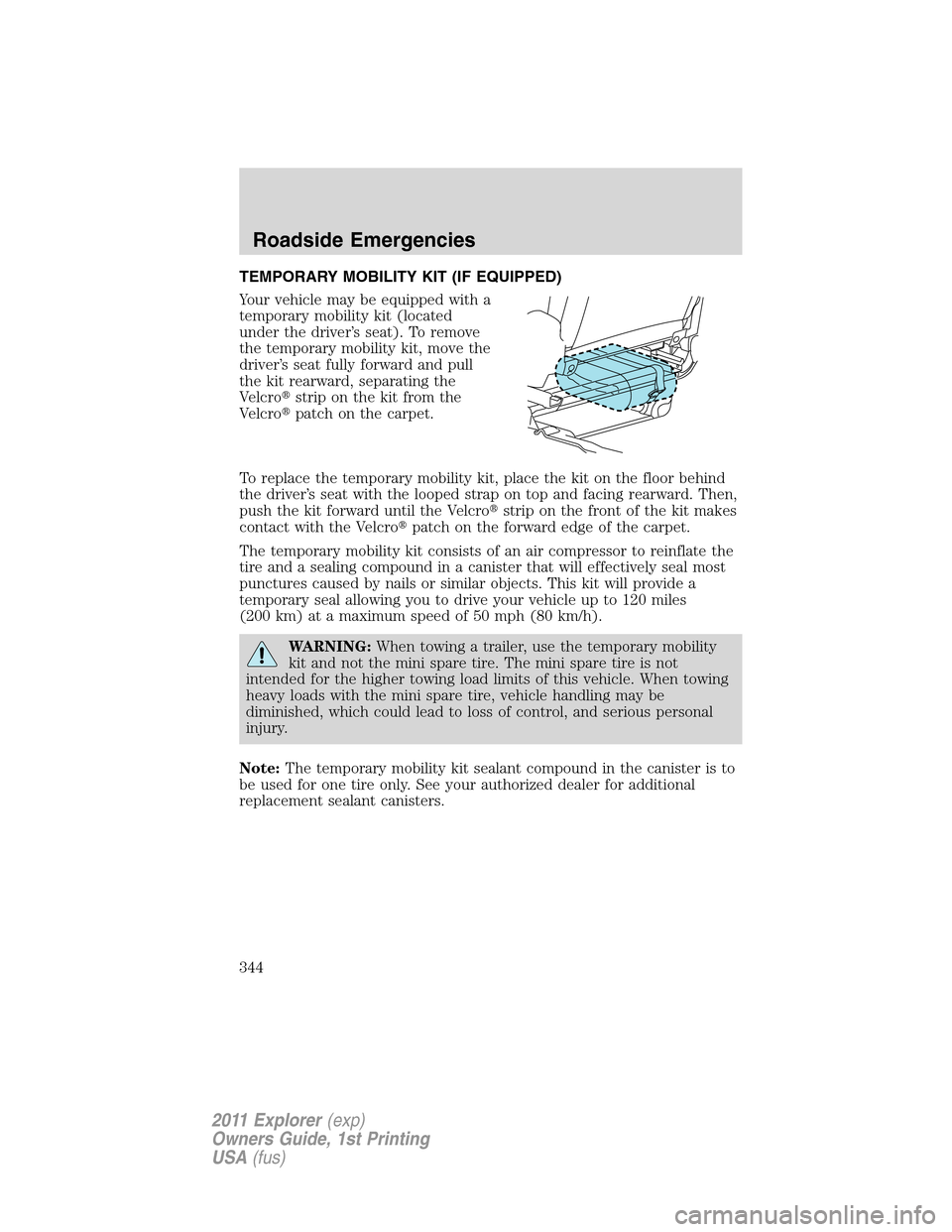
Your vehicle may be equipped with a
temporary mobility kit (located
under the driver’s seat). To remove
the temporary mobility kit, move the
driver’s seat fully forward and pull
the kit rearward, separating the
Velcro�strip on the kit from the
Velcro�patch on the carpet.
To replace the temporary mobility kit, place the kit on the floor behind
the driver’s seat with the looped strap on top and facing rearward. Then,
push the kit forward until the Velcro�strip on the front of the kit makes
contact with the Velcro�patch on the forward edge of the carpet.
The temporary mobility kit consists of an air compressor to reinflate the
tire and a sealing compound in a canister that will effectively seal most
punctures caused by nails or similar objects. This kit will provide a
temporary seal allowing you to drive your vehicle up to 120 miles
(200 km) at a maximum speed of 50 mph (80 km/h).
WARNING:When towing a trailer, use the temporary mobility
kit and not the mini spare tire. The mini spare tire is not
intended for the higher towing load limits of this vehicle. When towing
heavy loads with the mini spare tire, vehicle handling may be
diminished, which could lead to loss of control, and serious personal
injury.
Note:The temporary mobility kit sealant compound in the canister is to
be used for one tire only. See your authorized dealer for additional
replacement sealant canisters.
Roadside Emergencies
344
2011 Explorer(exp)
Owners Guide, 1st Printing
USA(fus)
Page 346 of 449
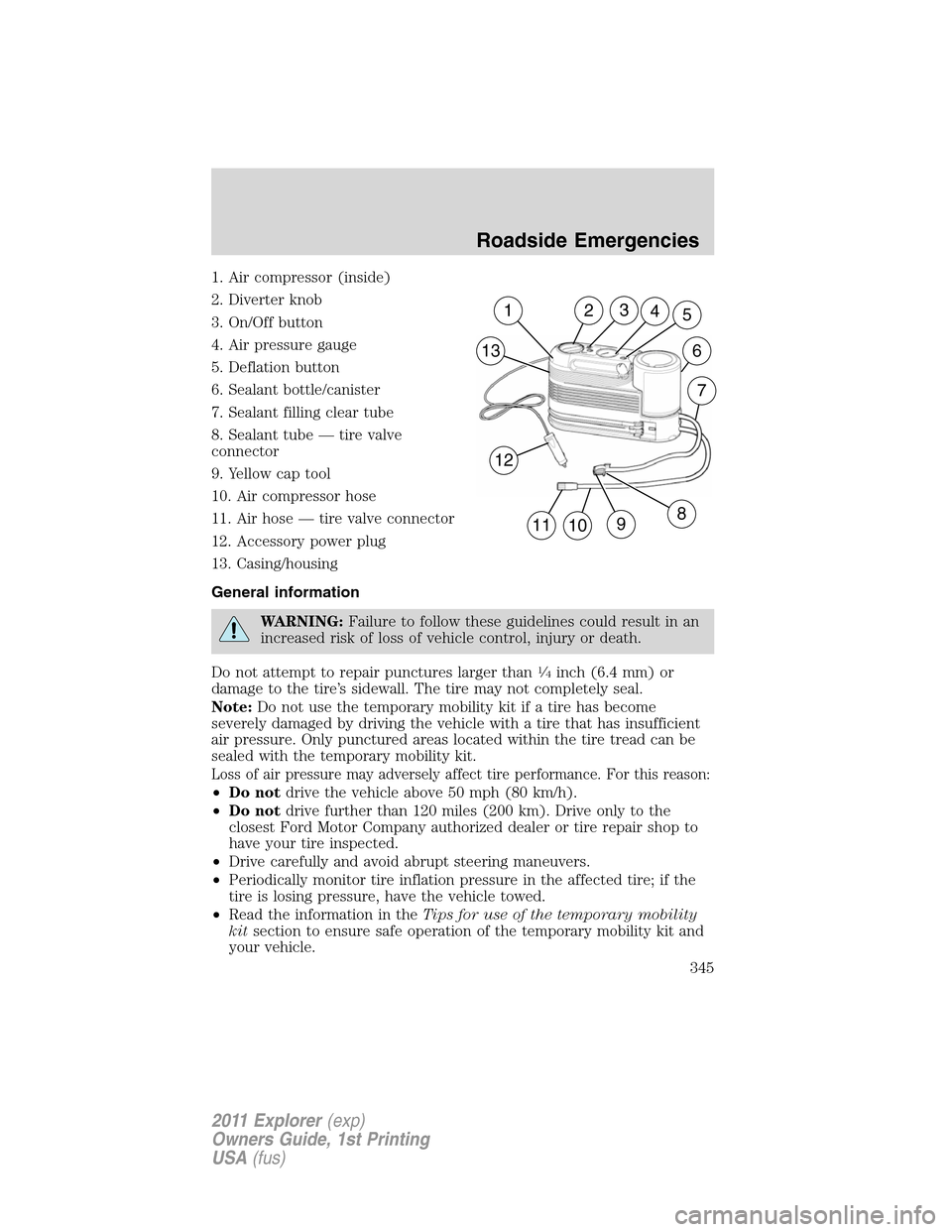
1. Air compressor (inside)
2. Diverter knob
3. On/Off button
4. Air pressure gauge
5. Deflation button
6. Sealant bottle/canister
7. Sealant filling clear tube
8. Sealant tube — tire valve
connector
9. Yellow cap tool
10. Air compressor hose
11. Air hose — tire valve connector
12. Accessory power plug
13. Casing/housing
General information
WARNING:Failure to follow these guidelines could result in an
increased risk of loss of vehicle control, injury or death.
Do not attempt to repair punctures larger than
14inch (6.4 mm) or
damage to the tire’s sidewall. The tire may not completely seal.
Note:Do not use the temporary mobility kit if a tire has become
severely damaged by driving the vehicle with a tire that has insufficient
air pressure. Only punctured areas located within the tire tread can be
sealed with the temporary mobility kit.
Loss of air pressure may adversely affect tire performance. For this reason:
•Do notdrive the vehicle above 50 mph (80 km/h).
•Do notdrive further than 120 miles (200 km). Drive only to the
closest Ford Motor Company authorized dealer or tire repair shop to
have your tire inspected.
•Drive carefully and avoid abrupt steering maneuvers.
•Periodically monitor tire inflation pressure in the affected tire; if the
tire is losing pressure, have the vehicle towed.
•Read the information in theTips for use of the temporary mobility
kitsection to ensure safe operation of the temporary mobility kit and
your vehicle.
1245
6
7
12
11108
3
9
13
Roadside Emergencies
345
2011 Explorer(exp)
Owners Guide, 1st Printing
USA(fus)

