Page 272 of 363
Removing the jumper cables
Remove the jumper cables in the reverse order that they were
connected.
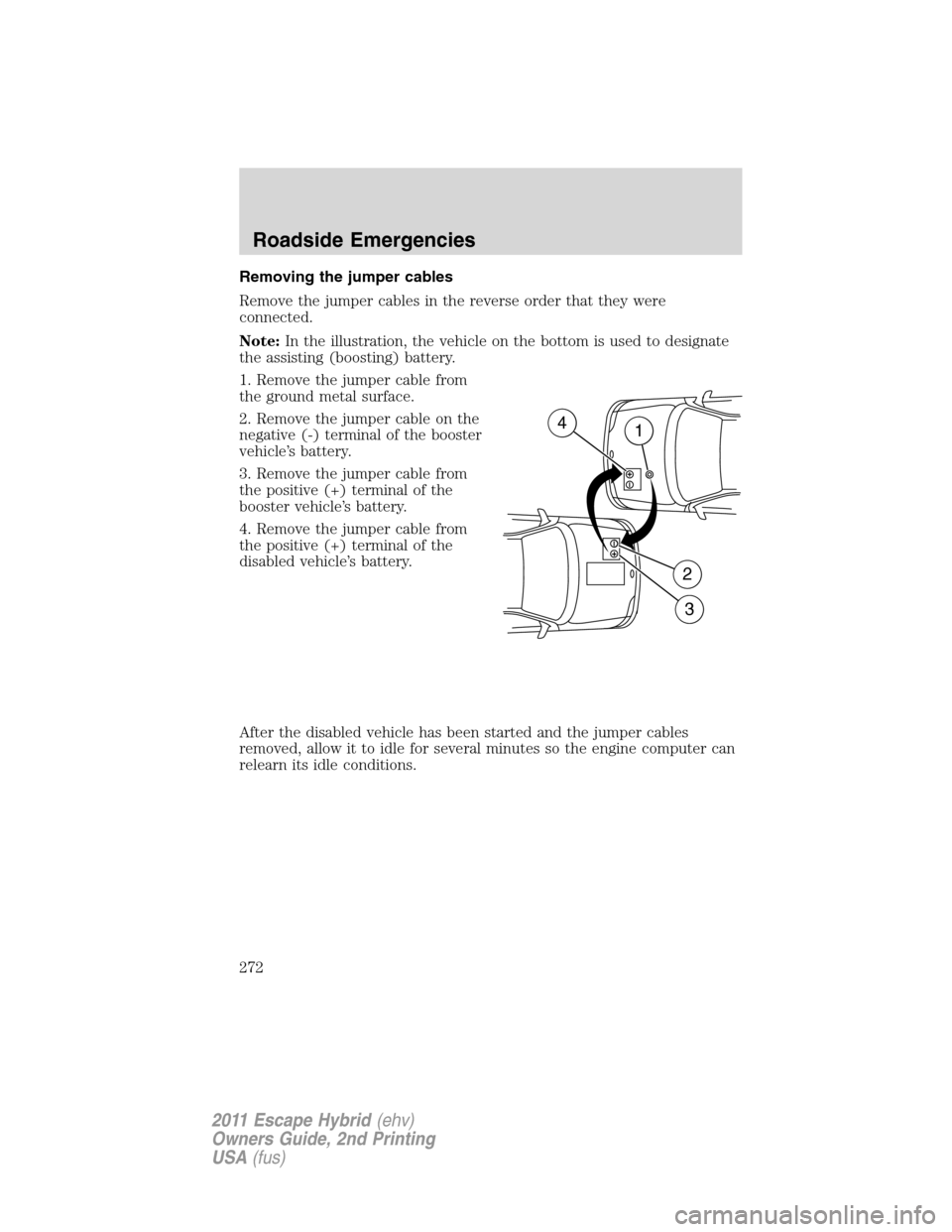
Note:In the illustration, the vehicle on the bottom is used to designate
the assisting (boosting) battery.
1. Remove the jumper cable from
the ground metal surface.
2. Remove the jumper cable on the
negative (-) terminal of the booster
vehicle’s battery.
3. Remove the jumper cable from
the positive (+) terminal of the
booster vehicle’s battery.
4. Remove the jumper cable from
the positive (+) terminal of the
disabled vehicle’s battery.
After the disabled vehicle has been started and the jumper cables
removed, allow it to idle for several minutes so the engine computer can
relearn its idle conditions.
+–
+–
DA
B
C
4D1
2
3
Roadside Emergencies
272
2011 Escape Hybrid(ehv)
Owners Guide, 2nd Printing
USA(fus)
Page 291 of 363
SERVICE RECOMMENDATIONS
To help you service your vehicle, we providescheduled maintenance
informationwhich makes tracking routine service easy.
If your vehicle requires professional service, your authorized dealer can
provide the necessary parts and service. Check yourWarranty Guideto
find out which parts and services are covered.
Use only recommended fuels, lubricants, fluids and service parts
conforming to specifications. Motorcraft�parts are designed and built to
provide the best performance in your vehicle.
PRECAUTIONS WHEN SERVICING YOUR VEHICLE
•Do not work on a hot engine.
•Make sure that nothing gets caught in moving parts.
•Do not work on a vehicle with the engine running in an enclosed
space, unless you are sure you have enough ventilation.
•Keep all open flames and other burning material (such as cigarettes)
away from the battery and all fuel related parts.
High voltage information
WARNING:Exposure to high voltage may result in severe
personal injury or death. High voltage components must be
serviced by a trained service technician.
Your vehicle consists of various high voltage components and wiring. All
of the high voltage power flows through specific wiring assemblies which
are labeled as such and/or are covered with a solid orange convolute or
orange stripe tape. Do not come in contact with these components.
Maintenance and Specifications
291
2011 Escape Hybrid(ehv)
Owners Guide, 2nd Printing
USA(fus)
Page 292 of 363
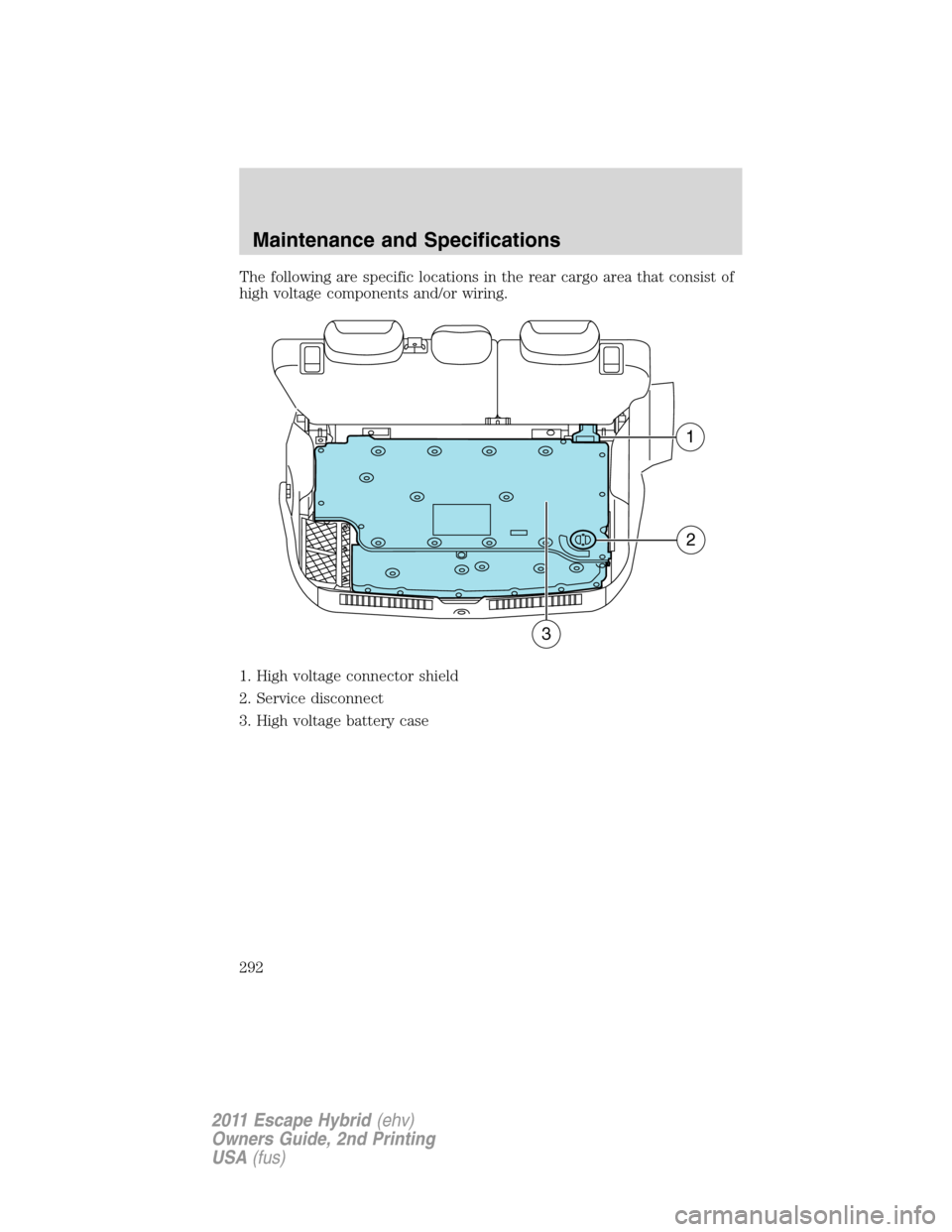
The following are specific locations in the rear cargo area that consist of
high voltage components and/or wiring.
1. High voltage connector shield
2. Service disconnect
3. High voltage battery case
1
2
3
Maintenance and Specifications
292
2011 Escape Hybrid(ehv)
Owners Guide, 2nd Printing
USA(fus)
Page 294 of 363
IDENTIFYING COMPONENTS IN THE ENGINE COMPARTMENT
1. Engine coolant reservoir
2. Motor/Electronics (M/E) coolant reservoir
3. Engine oil filler cap
4. Brake fluid reservoir
5. Power distribution box
6. Low voltage (underhood) battery
7. Engine air filter assembly
8. Engine oil dipstick
9. Windshield washer fluid reservoir
Maintenance and Specifications
294
2011 Escape Hybrid(ehv)
Owners Guide, 2nd Printing
USA(fus)
Page 300 of 363
It is recommended you use the appropriate Motorcraft�oil filter or
another with equivalent performance for your engine application.
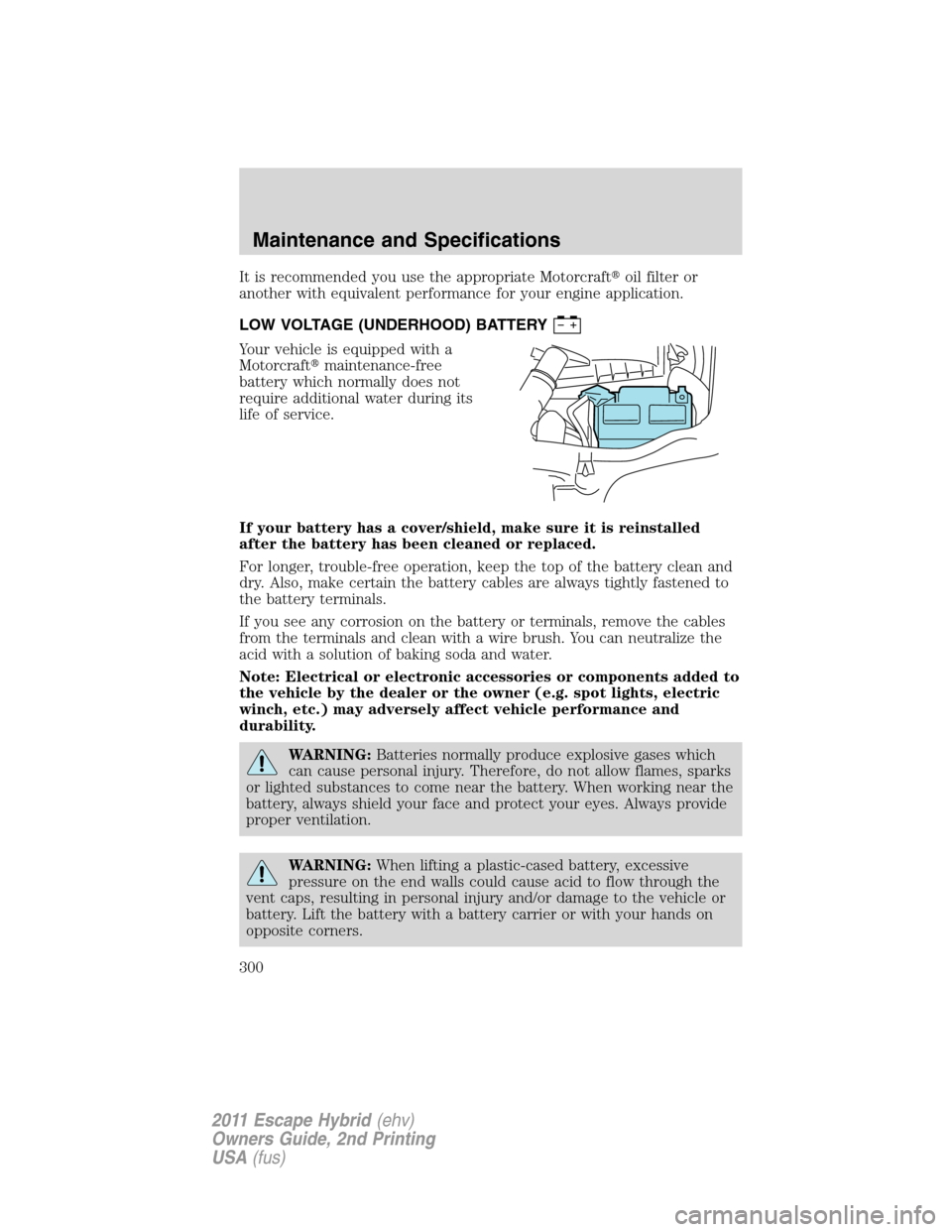
LOW VOLTAGE (UNDERHOOD) BATTERY
Your vehicle is equipped with a
Motorcraft�maintenance-free
battery which normally does not
require additional water during its
life of service.
If your battery has a cover/shield, make sure it is reinstalled
after the battery has been cleaned or replaced.
For longer, trouble-free operation, keep the top of the battery clean and
dry. Also, make certain the battery cables are always tightly fastened to
the battery terminals.
If you see any corrosion on the battery or terminals, remove the cables
from the terminals and clean with a wire brush. You can neutralize the
acid with a solution of baking soda and water.
Note: Electrical or electronic accessories or components added to
the vehicle by the dealer or the owner (e.g. spot lights, electric
winch, etc.) may adversely affect vehicle performance and
durability.
WARNING:Batteries normally produce explosive gases which
can cause personal injury. Therefore, do not allow flames, sparks
or lighted substances to come near the battery. When working near the
battery, always shield your face and protect your eyes. Always provide
proper ventilation.
WARNING:When lifting a plastic-cased battery, excessive
pressure on the end walls could cause acid to flow through the
vent caps, resulting in personal injury and/or damage to the vehicle or
battery. Lift the battery with a battery carrier or with your hands on
opposite corners.
Maintenance and Specifications
300
2011 Escape Hybrid(ehv)
Owners Guide, 2nd Printing
USA(fus)
Page 301 of 363
WARNING:Keep batteries out of reach of children. Batteries
contain sulfuric acid. Avoid contact with skin, eyes or clothing.
Shield your eyes when working near the battery to protect against
possible splashing of acid solution. In case of acid contact with skin or
eyes, flush immediately with water for a minimum of 15 minutes and
get prompt medical attention. If acid is swallowed, call a physician
immediately.
WARNING:Battery posts, terminals and related accessories
contain lead and lead compounds.Wash hands after handling.
Because your vehicle’s engine is electronically-controlled by a computer,
some control conditions are maintained by power from the battery. When
the battery is disconnected or a new battery is installed, the engine must
relearn its idle and fuel trim strategy for optimum driveability and
performance. To begin this process:
1. With the vehicle at a complete stop, set the parking brake.
2. Put the gearshift in P (Park), turn off all accessories and start the
vehicle. Step on the accelerator to start the engine.
3. Run the vehicle until the engine reaches normal operating
temperature.
4. Allow the engine to idle for at least one minute.
5. Step on the accelerator to start the engine. While the engine is
running, shift the vehicle to neutral.
6. Allow the vehicle to run for at least one minute by pressing on the
accelerator pedal.
7. Drive the vehicle to complete the relearning process.
•The vehicle may need to be driven 10 miles (16 km) or more to
relearn the idle and fuel trim strategy.
•If you do not allow the engine to relearn its idle trim, the idle
quality of your vehicle may be adversely affected until the idle
trim is eventually relearned.
If the battery has been disconnected or a new battery has been installed,
the clock and the preset radio stations must be reset once the battery is
reconnected.
Maintenance and Specifications
301
2011 Escape Hybrid(ehv)
Owners Guide, 2nd Printing
USA(fus)
Page 302 of 363
•Always dispose of automotive
batteries in a responsible manner.
Follow your local authorized
standards for disposal. Call your
local authorized recycling center
to find out more about recycling
automotive batteries.
Low and high voltage battery – storage
Your vehicle must be started and run for a minimum of 10 minutes once
a month in order to maintain the high voltage battery charge. This will
maintain the high voltage battery but it is not enough to maintain the
low voltage (underhood) battery and additional low voltage (underhood)
battery charging may be required after 60 days.
If your vehicle is to be stored for 30 days or longer, the low voltage
(underhood) battery negative terminal must be disconnected. Failure to
do this could damage your vehicle’s batteries.
ENGINE COOLANT AND MOTOR/ELECTRONICS COOLANT
Your vehicle is equipped with two separate coolant systems. One is for
engine cooling and the other is for various electric motors and other
components that are specific to the hybrid operating systems.
LEAD
RETURN
RECYCLE
Maintenance and Specifications
302
2011 Escape Hybrid(ehv)
Owners Guide, 2nd Printing
USA(fus)
Page 316 of 363
Driving style — good driving and fuel economy habits
Since it is able to operate in electric mode and to collect braking energy,
your hybrid vehicle may get better fuel economy in city driving than on
the highway. This is contrary to conventional vehicles. However, many of
the same actions that improve fuel economy in a conventional vehicle
will also improve fuel economy in this vehicle.
Give consideration to the lists that follow and you may be able to
improve your fuel economy.
Habits
•Avoid aggressive driving. Quick acceleration and deceleration decrease
fuel economy.
•Drive at a smooth, constant speed. Excessive variation in pedal input
causes more operating mode changes and reduces efficiency.
•Drive at reasonable speeds. Traveling at 60 mph (96 km/h) uses
approximately 20% less fuel than traveling at 70 mph (113 km/h).
•Minimize A/C and defroster usage. Your vehicle is equipped with an
electric A/C system, which can provide cooling for passenger comfort
or defrost without running the engine. However, the A/C system uses
battery energy when the engine is off, which reduces fuel economy.
Using Auto mode, minimizing use of defrost and Max A/C, and
choosing a higher temperature setting when cooling can help reduce
energy usage. See theClimate Controlchapter for more information.
•Minimize temperature extremes when the vehicle is parked, for
example by storing in a garage to avoid extreme cold in winter and
extreme sun loads in summer. The high voltage battery operates more
efficiently in moderate temperatures, and less energy will be spent
returning the passenger compartment to a comfortable temperature.
•Combine errands. Your vehicle is more fuel efficient when the engine
is warm. Driving to your farthest destination first will warm the engine
more quickly and may improve fuel economy for the rest of the trip.
Maintenance
•Keep tires properly inflated and use only recommended size.
•Keep wheels properly aligned.
•Use recommended engine oil. Refer toMaintenance product
specifications and capacitiesin this chapter.
•Perform all regularly scheduled maintenance items. Follow the
recommended maintenance schedule and owner maintenance checks
found inscheduled maintenance information.
Maintenance and Specifications
316
2011 Escape Hybrid(ehv)
Owners Guide, 2nd Printing
USA(fus)