Page 316 of 363
Driving style — good driving and fuel economy habits
Since it is able to operate in electric mode and to collect braking energy,
your hybrid vehicle may get better fuel economy in city driving than on
the highway. This is contrary to conventional vehicles. However, many of
the same actions that improve fuel economy in a conventional vehicle
will also improve fuel economy in this vehicle.
Give consideration to the lists that follow and you may be able to
improve your fuel economy.
Habits
•Avoid aggressive driving. Quick acceleration and deceleration decrease
fuel economy.
•Drive at a smooth, constant speed. Excessive variation in pedal input
causes more operating mode changes and reduces efficiency.
•Drive at reasonable speeds. Traveling at 60 mph (96 km/h) uses
approximately 20% less fuel than traveling at 70 mph (113 km/h).
•Minimize A/C and defroster usage. Your vehicle is equipped with an
electric A/C system, which can provide cooling for passenger comfort
or defrost without running the engine. However, the A/C system uses
battery energy when the engine is off, which reduces fuel economy.
Using Auto mode, minimizing use of defrost and Max A/C, and
choosing a higher temperature setting when cooling can help reduce
energy usage. See theClimate Controlchapter for more information.
•Minimize temperature extremes when the vehicle is parked, for
example by storing in a garage to avoid extreme cold in winter and
extreme sun loads in summer. The high voltage battery operates more
efficiently in moderate temperatures, and less energy will be spent
returning the passenger compartment to a comfortable temperature.
•Combine errands. Your vehicle is more fuel efficient when the engine
is warm. Driving to your farthest destination first will warm the engine
more quickly and may improve fuel economy for the rest of the trip.
Maintenance
•Keep tires properly inflated and use only recommended size.
•Keep wheels properly aligned.
•Use recommended engine oil. Refer toMaintenance product
specifications and capacitiesin this chapter.
•Perform all regularly scheduled maintenance items. Follow the
recommended maintenance schedule and owner maintenance checks
found inscheduled maintenance information.
Maintenance and Specifications
316
2011 Escape Hybrid(ehv)
Owners Guide, 2nd Printing
USA(fus)
Page 323 of 363
Cooling system
•Protect against freezing temperatures.
•When removing vehicle from storage, check coolant fluid level.
Confirm there are no cooling system leaks, and fluid is at the
recommended level.
Battery
•Check and recharge as necessary. Keep connections clean.
•If storing your vehicle for more than 30 days without recharging the
battery, it may be advisable to disconnect the battery cables to ensure
battery charge is maintained for quick starting.
Note:If battery cables are disconnected, it will be necessary to reset
memory features.
Brakes
•Make sure brakes and parking brake are fully released.
Tires
•Maintain recommended air pressure.
Miscellaneous
•Make sure all linkages, cables, levers and pins under vehicle are
covered with grease to prevent rust.
•Move vehicles at least 25 feet (8 m) every 15 days to lubricate
working parts and prevent corrosion.
Removing vehicle from storage
When your vehicle is ready to come out of storage, do the following:
•Wash your vehicle to remove any dirt or grease film build-up on
window surfaces.
•Check windshield wipers for any deterioration.
•Check under the hood for any foreign material that may have collected
during storage (mice/squirrel nests).
•Check the exhaust for any foreign material that may have collected
during storage.
•Check tire pressures and set tire inflation per the Tire Label.
•Check brake pedal operation. Drive the vehicle 15 ft (4.5 meters) back
and forth to remove rust build up.
•Check fluid levels (including coolant, oil and gas) to make sure there
are no leaks, and fluids are at recommended levels.
Maintenance and Specifications
323
2011 Escape Hybrid(ehv)
Owners Guide, 2nd Printing
USA(fus)
Page 341 of 363
Multi-point inspection
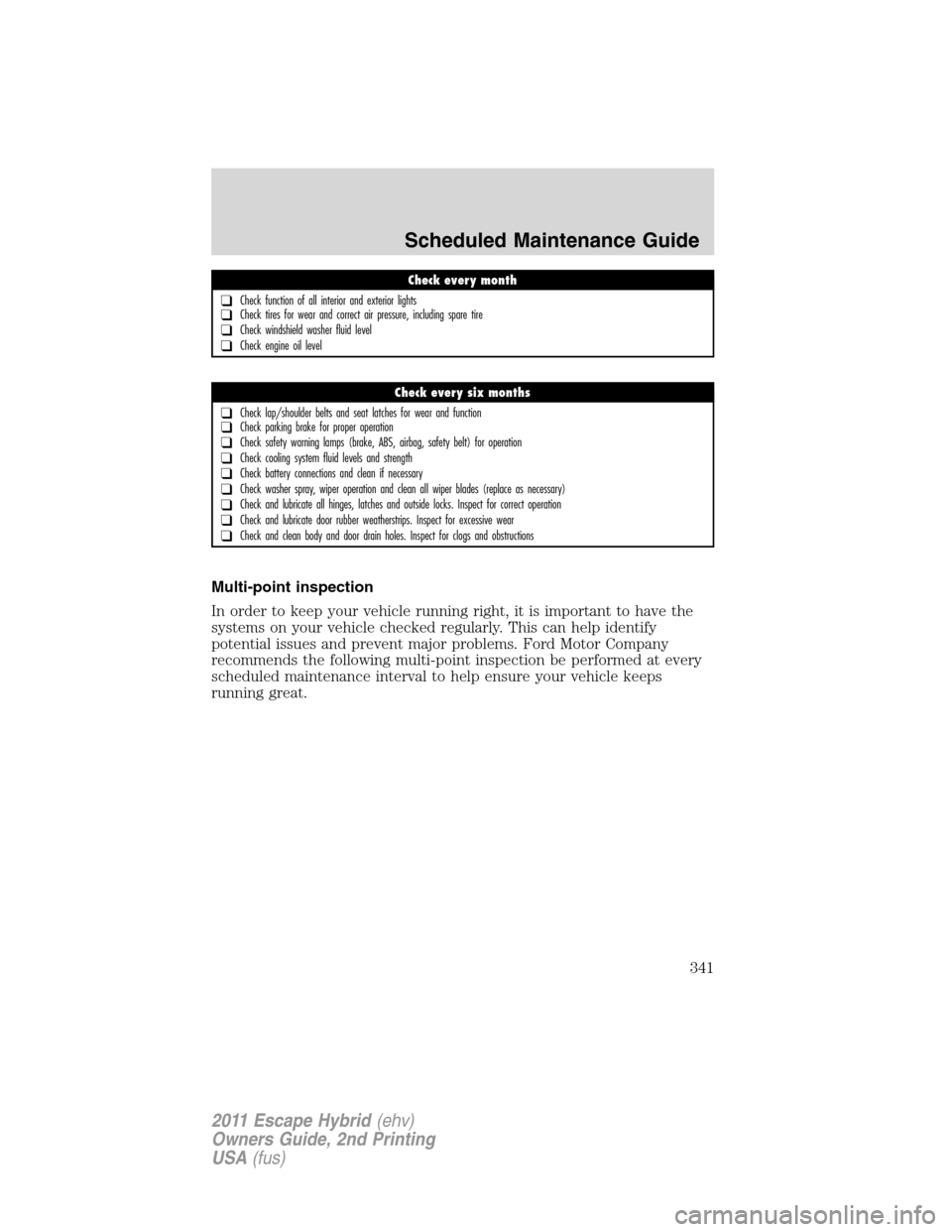
In order to keep your vehicle running right, it is important to have the
systems on your vehicle checked regularly. This can help identify
potential issues and prevent major problems. Ford Motor Company
recommends the following multi-point inspection be performed at every
scheduled maintenance interval to help ensure your vehicle keeps
running great.
Check every month
❑Check function of all interior and exterior lights❑Check tires for wear and correct air pressure, including spare tire
❑Check windshield washer fluid level
❑Check engine oil level
Check every six months
❑Check lap/shoulder belts and seat latches for wear and function❑Check parking brake for proper operation
❑Check safety warning lamps (brake, ABS, airbag, safety belt) for operation
❑Check cooling system fluid levels and strength
❑Check battery connections and clean if necessary
❑Check washer spray, wiper operation and clean all wiper blades (replace as necessary)
❑Check and lubricate all hinges, latches and outside locks. Inspect for correct operation
❑Check and lubricate door rubber weatherstrips. Inspect for excessive wear
❑Check and clean body and door drain holes. Inspect for clogs and obstructions
Scheduled Maintenance Guide
341
2011 Escape Hybrid(ehv)
Owners Guide, 2nd Printing
USA(fus)
Page 345 of 363
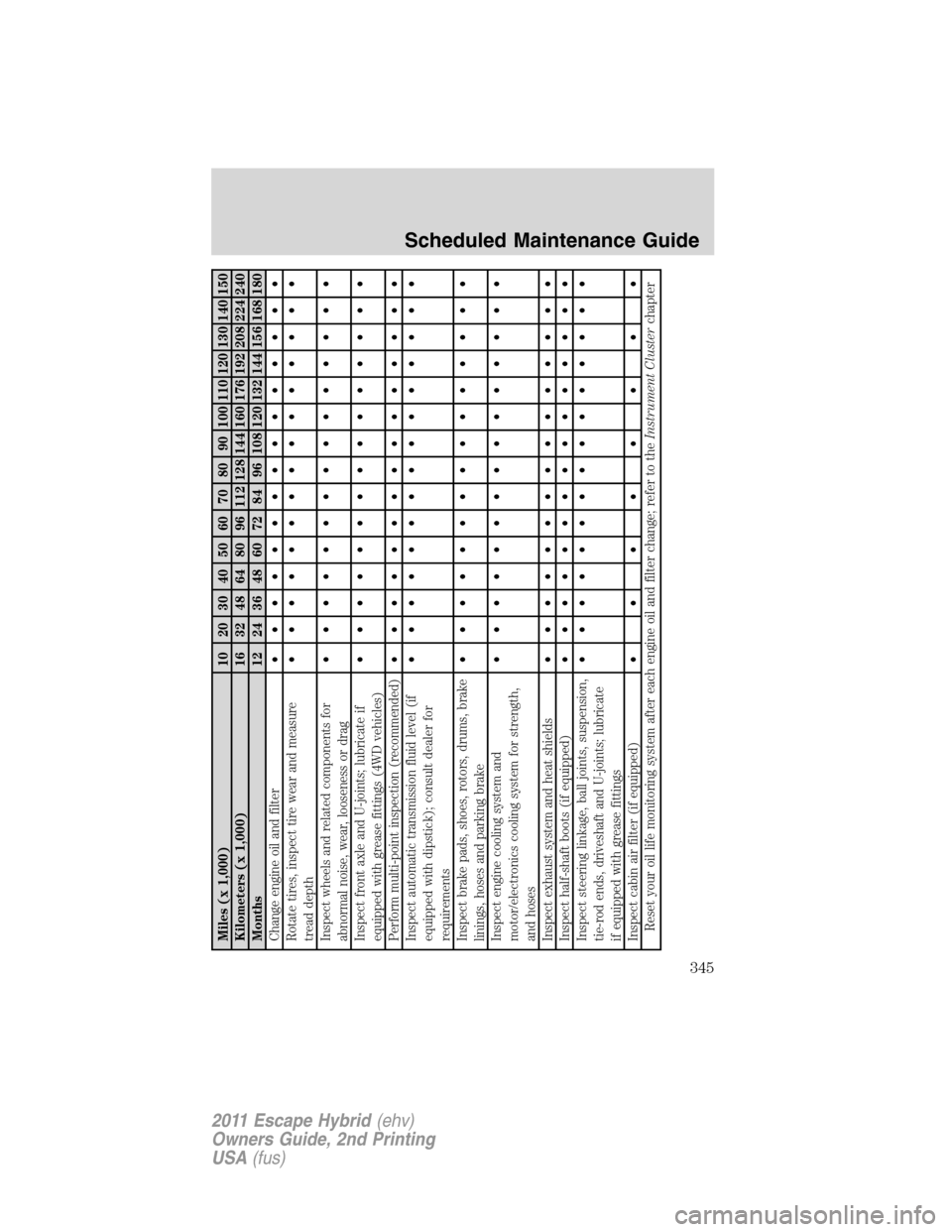
Miles (x 1,000) 10 20 30 40 50 60 70 80 90 100 110 120 130 140 150
Kilometers (x 1,000) 16 32 48 64 80 96 112 128 144 160 176 192 208 224 240
Months 12 24 36 48 60 72 84 96 108 120 132 144 156 168 180
Change engine oil and filter• ••••••••••••••
Rotate tires, inspect tire wear and measure
tread depth• ••••••••••••••
Inspect wheels and related components for
abnormal noise, wear, looseness or drag• ••••••••••••••
Inspect front axle and U-joints; lubricate if
equipped with grease fittings (4WD vehicles)• ••••••••••••••
Perform multi-point inspection (recommended)• ••••••••••••••
Inspect automatic transmission fluid level (if
equipped with dipstick); consult dealer for
requirements• ••••••••••••••
Inspect brake pads, shoes, rotors, drums, brake
linings, hoses and parking brake• ••••••••••••••
Inspect engine cooling system and
motor/electronics cooling system for strength,
and hoses• ••••••••••••••
Inspect exhaust system and heat shields• ••••••••••••••
Inspect half-shaft boots (if equipped)• ••••••••••••••
Inspect steering linkage, ball joints, suspension,
tie-rod ends, driveshaft and U-joints; lubricate
if equipped with grease fittings• ••••••••••••••
Inspect cabin air filter (if equipped)• •••••••
Reset your oil life monitoring system after each engine oil and filter change; refer to theInstrument Clusterchapter
Scheduled Maintenance Guide
345
2011 Escape Hybrid(ehv)
Owners Guide, 2nd Printing
USA(fus)
Page:
< prev 1-8 9-16 17-24