2011 FORD ESCAPE HYBRID cooling
[x] Cancel search: coolingPage 270 of 363
Preparing your vehicle
If your low voltage (underhood) battery becomes disconnected or
disabled for any reason, the vehicle controller must relearn the engine’s
operating characteristics in order to operate it at maximum efficiency.
This relearning process occurs the first time the vehicle is driven after
reconnecting the low voltage battery. If the learning procedure does not
have time to complete during the drive, the engine will continue to
operate for 3-5 seconds after you turn the ignition off to complete the
relearning process. This is a normal condition and will not re-occur until
the low voltage battery is disconnected again. Refer toLow voltage
(underhood) batteryin theMaintenance and Specificationchapter
for more information.
1.Use only a 12–volt supply to start your vehicle.
2. Do not disconnect the battery of the disabled vehicle as this could
damage the vehicle’s electrical system.
3. Park the booster vehicle close to the hood of the disabled vehicle
making sure the two vehiclesdo nottouch. Set the parking brake on
both vehicles and stay clear of the engine cooling fan and other moving
parts.
4. Check all battery terminals and remove any excessive corrosion before
you attach the battery cables. Ensure that vent caps are tight and level.
5. Turn the heater fan on in both vehicles to protect from any electrical
surges. Turn all other accessories off.
Connecting the jumper cables
Note:In the illustration, the vehicle on the bottom is used to designate
the assisting (boosting) battery.
Roadside Emergencies
270
2011 Escape Hybrid(ehv)
Owners Guide, 2nd Printing
USA(fus)
Page 295 of 363

WINDSHIELD WASHER FLUID
Add fluid to fill the reservoir if the
level is low. In very cold weather, do
not fill the reservoir completely.
Only use a washer fluid that meets Ford specifications. Do not use any
special washer fluid such as windshield water repellent type fluid or bug
wash. They may cause squeaking, chatter noise, streaking and smearing.
Refer to theMaintenance product specifications and capacities
section in this chapter.
State or local regulations on volatile organic compounds may restrict the
use of methanol, a common windshield washer antifreeze additive.
Washer fluids containing non-methanol antifreeze agents should be used
only if they provide cold weather protection without damaging the
vehicle’s paint finish, wiper blades or washer system.
WARNING:If you operate your vehicle in temperatures below
40°F (5°C), use washer fluid with antifreeze protection. Failure
to use washer fluid with antifreeze protection in cold weather could
result in impaired windshield vision and increase the risk of injury or
accident.
Note:Do not put washer fluid in the engine coolant reservoir. Washer
fluid placed in the cooling system may harm engine and cooling system
components.
Checking and adding washer fluid for the liftgate
Washer fluid for the liftgate is supplied by the same reservoir as the
windshield.
Maintenance and Specifications
295
2011 Escape Hybrid(ehv)
Owners Guide, 2nd Printing
USA(fus)
Page 302 of 363
•Always dispose of automotive
batteries in a responsible manner.
Follow your local authorized
standards for disposal. Call your
local authorized recycling center
to find out more about recycling
automotive batteries.
Low and high voltage battery – storage
Your vehicle must be started and run for a minimum of 10 minutes once
a month in order to maintain the high voltage battery charge. This will
maintain the high voltage battery but it is not enough to maintain the
low voltage (underhood) battery and additional low voltage (underhood)
battery charging may be required after 60 days.
If your vehicle is to be stored for 30 days or longer, the low voltage
(underhood) battery negative terminal must be disconnected. Failure to
do this could damage your vehicle’s batteries.
ENGINE COOLANT AND MOTOR/ELECTRONICS COOLANT
Your vehicle is equipped with two separate coolant systems. One is for
engine cooling and the other is for various electric motors and other
components that are specific to the hybrid operating systems.
LEAD
RETURN
RECYCLE
Maintenance and Specifications
302
2011 Escape Hybrid(ehv)
Owners Guide, 2nd Printing
USA(fus)
Page 304 of 363
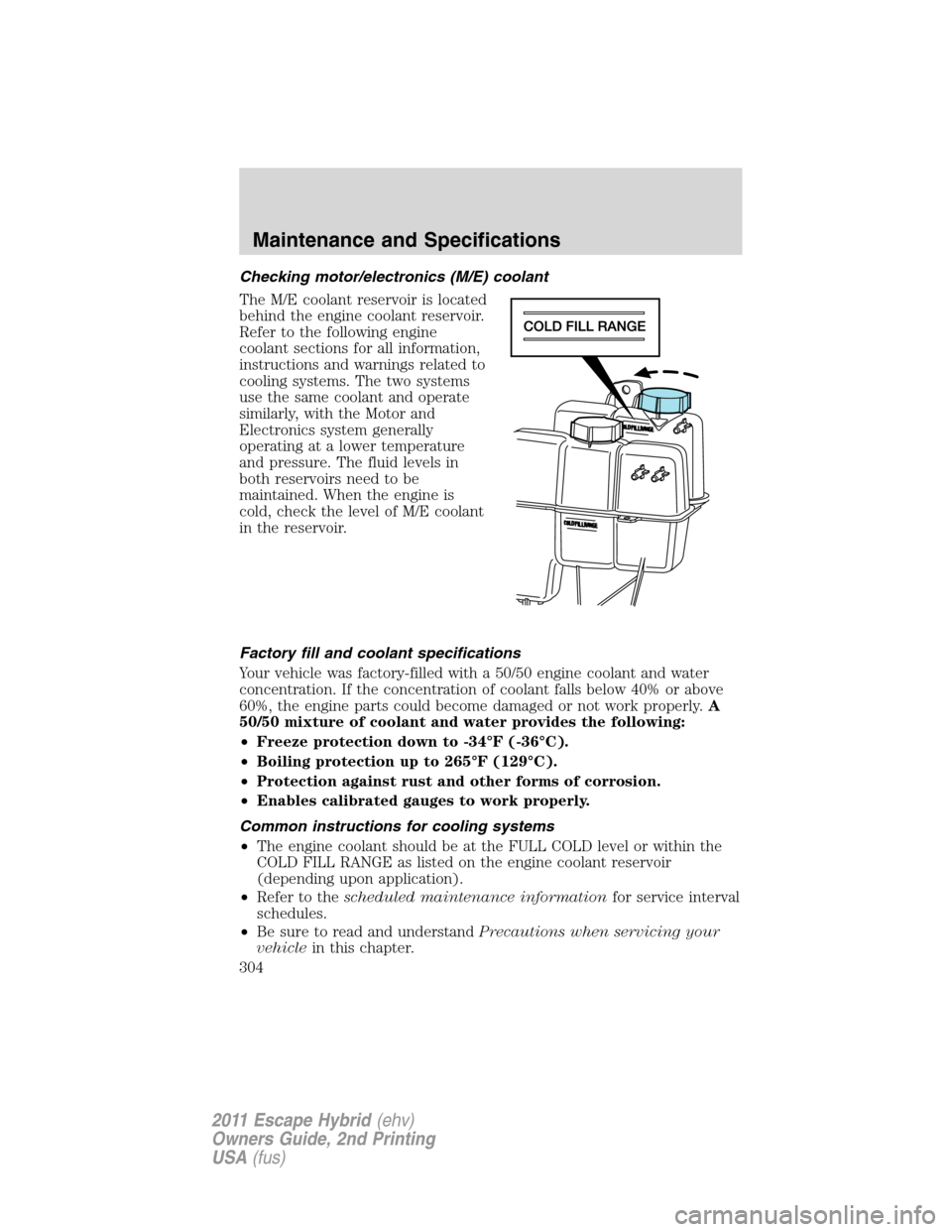
Checking motor/electronics (M/E) coolant
The M/E coolant reservoir is located
behind the engine coolant reservoir.
Refer to the following engine
coolant sections for all information,
instructions and warnings related to
cooling systems. The two systems
use the same coolant and operate
similarly, with the Motor and
Electronics system generally
operating at a lower temperature
and pressure. The fluid levels in
both reservoirs need to be
maintained. When the engine is
cold, check the level of M/E coolant
in the reservoir.
Factory fill and coolant specifications
Your vehicle was factory-filled with a 50/50 engine coolant and water
concentration. If the concentration of coolant falls below 40% or above
60%, the engine parts could become damaged or not work properly.A
50/50 mixture of coolant and water provides the following:
•Freeze protection down to -34°F (-36°C).
•Boiling protection up to 265°F (129°C).
•Protection against rust and other forms of corrosion.
•Enables calibrated gauges to work properly.
Common instructions for cooling systems
•The engine coolant should be at the FULL COLD level or within the
COLD FILL RANGE as listed on the engine coolant reservoir
(depending upon application).
•Refer to thescheduled maintenance informationfor service interval
schedules.
•Be sure to read and understandPrecautions when servicing your
vehiclein this chapter.
Maintenance and Specifications
304
2011 Escape Hybrid(ehv)
Owners Guide, 2nd Printing
USA(fus)
Page 305 of 363
If the engine coolant has not been checked at the recommended interval,
the engine coolant reservoir may become low or empty. If the reservoir is
low or empty, add engine coolant to the reservoir. Refer toAdding
engine coolantin this chapter.
Note:Automotive fluids are not interchangeable; do not use engine
coolant/antifreeze or windshield washer fluid outside of its specified
function and vehicle location.
Adding engine coolant
When adding coolant, make sure it is a 50/50 mixture of engine coolant
and distilled water. Add the mixture to the coolant reservoir,when the
engine is cool,until the appropriate fill level is obtained. If coolant is
filled to the COLD FILL RANGE or FULL COLD level when the engine is
not cool, the system will remain underfilled.
WARNING:Do not add engine coolant when the engine is hot.
Steam and scalding liquids released from a hot cooling system
can burn you badly. Also, you can be burned if you spill coolant on hot
engine parts.
WARNING:Do not put engine coolant in the windshield washer
fluid container. If sprayed on the windshield, engine coolant
could make it difficult to see through the windshield.
•DO NOT MIXdifferent colors or types of coolant in your vehicle.
Make sure the correct coolant is used.DO NOT MIXrecycled coolant
and new (unused) coolant together in the vehicle. Mixing of engine
coolants may harm your engine’s cooling system. The use of an
improper coolant may harm engine and cooling system components
and may void the warranty. Refer toMaintenance product
specifications and capacitiesin this chapter.
•A large amount of water without engine coolant may be added, in case
of emergency, to reach a vehicle service location. In this instance, the
cooling system must be drained and refilled with a 50/50 mixture of
engine coolant and distilled water as soon as possible. Water alone
(without engine coolant) can cause engine damage from corrosion,
overheating or freezing.
•Do not use alcohol, methanol, brine or any engine coolants
mixed with alcohol or methanol antifreeze (coolant).Alcohol
and other liquids can cause engine damage from overheating or
freezing.
Maintenance and Specifications
305
2011 Escape Hybrid(ehv)
Owners Guide, 2nd Printing
USA(fus)
Page 306 of 363
•Do not add extra inhibitors or additives to the coolant.These
can be harmful and compromise the corrosion protection of the engine
coolant.
For vehicles with overflow coolant systems with a non-pressurized cap
on the coolant recovery system, add coolant to the coolant recovery
reservoir when the engine is cool. Add the proper mixture of coolant and
distilled water to the FULL COLD level. For all other vehicles which have
a coolant degas system with a pressurized cap, or if it is necessary to
remove the coolant pressure relief cap on the radiator of a vehicle with
an overflow system, follow these steps to add engine coolant.
WARNING:To reduce the risk of personal injury, make sure the
engine is cool before unscrewing the coolant pressure relief cap.
The cooling system is under pressure; steam and hot liquid can come
out forcefully when the cap is loosened slightly.
Add the proper mixture of coolant and water to the cooling system by
following these steps:
1. Before you begin, turn the engine off and let it cool.
2. When the engine is cool, wrap a thick cloth around the coolant
pressure relief cap on the coolant reservoir (a translucent plastic bottle).
Slowly turn cap counterclockwise (left) until pressure begins to release.
3. Step back while the pressure releases.
4. When you are sure that all the pressure has been released, use the
cloth to turn it counterclockwise and remove the cap.
5. Fill the coolant reservoir slowly with the proper coolant mixture, to
within the COLD FILL RANGE or the FULL COLD level on the reservoir.
If you removed the radiator cap in an overflow system, fill the radiator
until the coolant is visible and radiator is almost full.
6. Replace the cap. Turn until tightly installed. Cap must be tightly
installed to prevent coolant loss.
After any coolant has been added, check the coolant concentration (refer
toChecking engine coolant). If the concentration is not 50/50
(protection to –34°F/–36°C), drain some coolant and adjust the
concentration. It may take several drains and additions to obtain a 50/50
coolant concentration.
Whenever coolant has been added, the coolant level in the coolant
reservoir should be checked the next few times you drive the vehicle. If
necessary, add enough 50/50 concentration of engine coolant and
distilled water to bring the liquid level to the proper level.
Maintenance and Specifications
306
2011 Escape Hybrid(ehv)
Owners Guide, 2nd Printing
USA(fus)
Page 307 of 363
If you have to add more than 1.0 quart (1.0 liter) of engine coolant per
month, have your authorized dealer check the engine cooling system.
Your cooling system may have a leak. Operating an engine with a low
level of coolant can result in engine overheating and possible engine
damage.
Recycled engine coolant
Ford Motor Company does NOT recommend the use of recycled engine
coolant since a Ford-approved recycling process is not yet available.
Used engine coolant should be disposed of in an appropriate
manner. Follow your community’s regulations and standards for recycling
and disposing of automotive fluids.
Coolant refill capacity
To find out how much fluid your vehicle’s cooling system can hold, refer
toMaintenance product specifications and capacitiesin this chapter.
Fill your engine coolant reservoir as outlined inAdding engine coolant
in this section.
Severe climates
If you drive in extremely cold climates (less than –34°F [–36°C]):
•It may be necessary to increase the coolant concentration
above 50%.
•NEVER increase the coolant concentration above 60%.
•A coolant concentration of 60% will provide freeze point
protection down to -62°F [-52°C]. Increased engine coolant
concentrations above 60% will decrease the overheat
protection characteristics of the engine coolant and may cause
engine damage.
•If available, refer to the chart on the coolant container to
ensure the coolant concentration in your vehicle will provide
adequate freeze protection at the temperatures in which you
drive in the winter months.
If you drive in extremely hot climates:
•It is still necessary to maintain the coolant concentration
above 40%.
•NEVER decrease the coolant concentration below 40%.
Maintenance and Specifications
307
2011 Escape Hybrid(ehv)
Owners Guide, 2nd Printing
USA(fus)
Page 308 of 363
![FORD ESCAPE HYBRID 2011 2.G Owners Manual •A coolant concentration of 40% will provide freeze point
protection down to -12°F [-24°C]. Decreased engine coolant
concentrations below 40% will decrease the corrosion/freeze
protection characte](/manual-img/11/4886/w960_4886-307.png "FORD ESCAPE HYBRID 2011 2.G Owners Manual •A coolant concentration of 40% will provide freeze point
protection down to -12°F [-24°C]. Decreased engine coolant
concentrations below 40% will decrease the corrosion/freeze
protection characte")
•A coolant concentration of 40% will provide freeze point
protection down to -12°F [-24°C]. Decreased engine coolant
concentrations below 40% will decrease the corrosion/freeze
protection characteristics of the engine coolant and may cause
engine damage.
•If available, refer to the chart on the coolant container to
ensure the coolant concentration in your vehicle will provide
adequate protection at the temperatures in which you drive.
Vehicles driven year-round in non-extreme climates should use a 50/50
mixture of engine coolant and distilled water for optimum cooling system
and engine protection.
FUEL FILTER
Your vehicle is equipped with a lifetime fuel filter that is integrated with
the fuel tank. Regular maintenance or replacement is not needed.
WHAT YOU SHOULD KNOW ABOUT AUTOMOTIVE FUELS
Important safety precautions
WARNING:Do not overfill the fuel tank. The pressure in an
overfilled tank may cause leakage and lead to fuel spray and fire.
WARNING:The fuel system may be under pressure. If you hear
a hissing sound near the fuel filler door (Easy Fuel™ “no cap”
fuel system), do not refuel until the sound stops. Otherwise, fuel may
spray out, which could cause serious personal injury.
WARNING:Automotive fuels can cause serious injury or death
if misused or mishandled.
WARNING:Gasoline may contain benzene, which is a
cancer-causing agent.
Maintenance and Specifications
308
2011 Escape Hybrid(ehv)
Owners Guide, 2nd Printing
USA(fus)