Page 307 of 363
If you have to add more than 1.0 quart (1.0 liter) of engine coolant per
month, have your authorized dealer check the engine cooling system.
Your cooling system may have a leak. Operating an engine with a low
level of coolant can result in engine overheating and possible engine
damage.
Recycled engine coolant
Ford Motor Company does NOT recommend the use of recycled engine
coolant since a Ford-approved recycling process is not yet available.
Used engine coolant should be disposed of in an appropriate
manner. Follow your community’s regulations and standards for recycling
and disposing of automotive fluids.
Coolant refill capacity
To find out how much fluid your vehicle’s cooling system can hold, refer
toMaintenance product specifications and capacitiesin this chapter.
Fill your engine coolant reservoir as outlined inAdding engine coolant
in this section.
Severe climates
If you drive in extremely cold climates (less than –34°F [–36°C]):
•It may be necessary to increase the coolant concentration
above 50%.
•NEVER increase the coolant concentration above 60%.
•A coolant concentration of 60% will provide freeze point
protection down to -62°F [-52°C]. Increased engine coolant
concentrations above 60% will decrease the overheat
protection characteristics of the engine coolant and may cause
engine damage.
•If available, refer to the chart on the coolant container to
ensure the coolant concentration in your vehicle will provide
adequate freeze protection at the temperatures in which you
drive in the winter months.
If you drive in extremely hot climates:
•It is still necessary to maintain the coolant concentration
above 40%.
•NEVER decrease the coolant concentration below 40%.
Maintenance and Specifications
307
2011 Escape Hybrid(ehv)
Owners Guide, 2nd Printing
USA(fus)
Page 323 of 363
Cooling system
•Protect against freezing temperatures.
•When removing vehicle from storage, check coolant fluid level.
Confirm there are no cooling system leaks, and fluid is at the
recommended level.
Battery
•Check and recharge as necessary. Keep connections clean.
•If storing your vehicle for more than 30 days without recharging the
battery, it may be advisable to disconnect the battery cables to ensure
battery charge is maintained for quick starting.
Note:If battery cables are disconnected, it will be necessary to reset
memory features.
Brakes
•Make sure brakes and parking brake are fully released.
Tires
•Maintain recommended air pressure.
Miscellaneous
•Make sure all linkages, cables, levers and pins under vehicle are
covered with grease to prevent rust.
•Move vehicles at least 25 feet (8 m) every 15 days to lubricate
working parts and prevent corrosion.
Removing vehicle from storage
When your vehicle is ready to come out of storage, do the following:
•Wash your vehicle to remove any dirt or grease film build-up on
window surfaces.
•Check windshield wipers for any deterioration.
•Check under the hood for any foreign material that may have collected
during storage (mice/squirrel nests).
•Check the exhaust for any foreign material that may have collected
during storage.
•Check tire pressures and set tire inflation per the Tire Label.
•Check brake pedal operation. Drive the vehicle 15 ft (4.5 meters) back
and forth to remove rust build up.
•Check fluid levels (including coolant, oil and gas) to make sure there
are no leaks, and fluids are at recommended levels.
Maintenance and Specifications
323
2011 Escape Hybrid(ehv)
Owners Guide, 2nd Printing
USA(fus)
Page 327 of 363
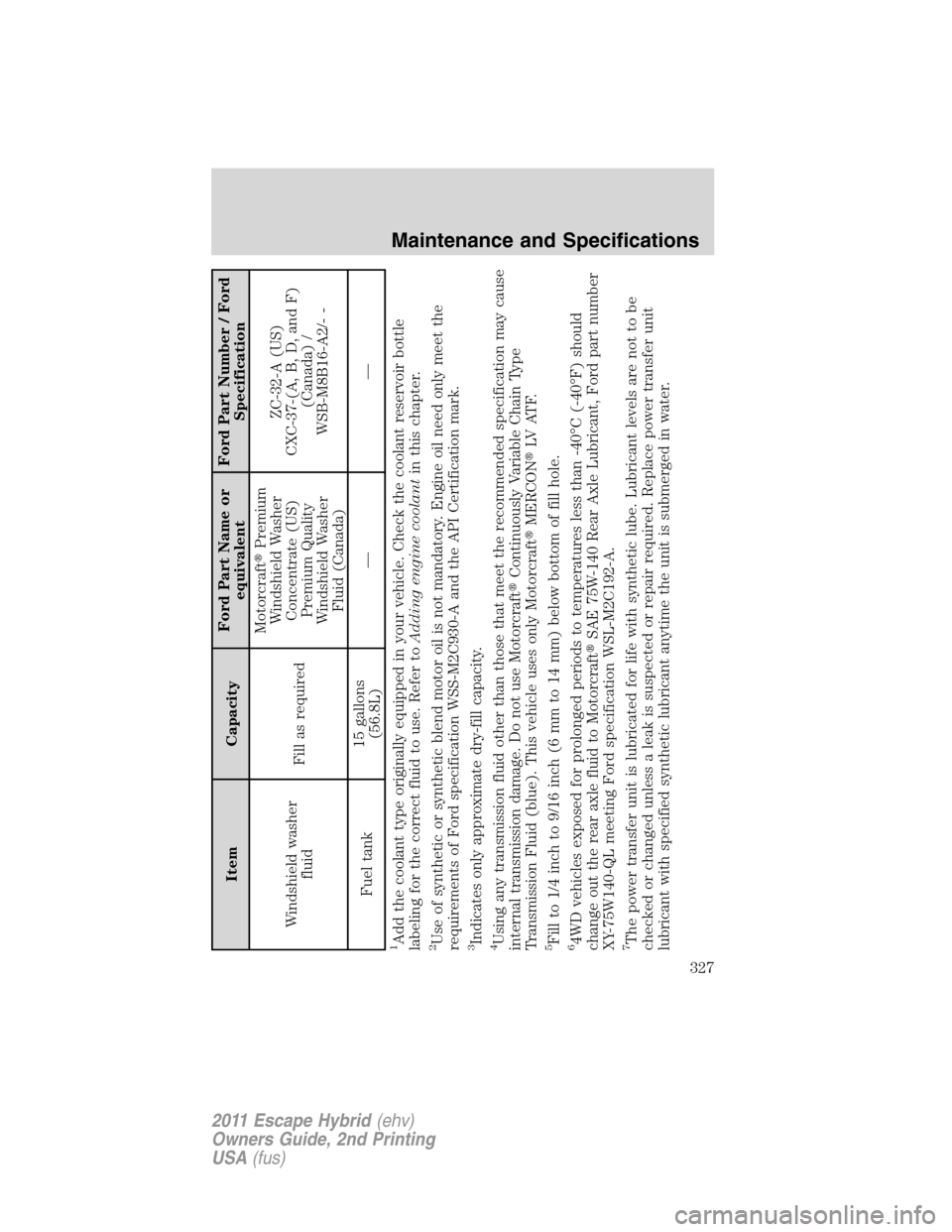
Item CapacityFord Part Name or
equivalentFord Part Number / Ford
Specification
Windshield washer
fluidFill as requiredMotorcraft�Premium
Windshield Washer
Concentrate (US)
Premium Quality
Windshield Washer
Fluid (Canada)ZC-32-A (US)
CXC-37-(A, B, D, and F)
(Canada) /
WSB-M8B16-A2/- -
Fuel tank15 gallons
(56.8L)——
1Add the coolant type originally equipped in your vehicle. Check the coolant reservoir bottle
labeling for the correct fluid to use. Refer toAdding engine coolantin this chapter.2Use of synthetic or synthetic blend motor oil is not mandatory. Engine oil need only meet the
requirements of Ford specification WSS-M2C930-A and the API Certification mark.3Indicates only approximate dry-fill capacity.4Using any transmission fluid other than those that meet the recommended specification may cause
internal transmission damage. Do not use Motorcraft�Continuously Variable Chain Type
Transmission Fluid (blue). This vehicle uses only Motorcraft�MERCON�LV AT F.5Fill to 1/4 inch to 9/16 inch (6 mm to 14 mm) below bottom of fill hole.64WD vehicles exposed for prolonged periods to temperatures less than -40°C (-40°F) should
change out the rear axle fluid to Motorcraft�SAE 75W-140 Rear Axle Lubricant, Ford part number
XY-75W140-QL meeting Ford specification WSL-M2C192-A.7The power transfer unit is lubricated for life with synthetic lube. Lubricant levels are not to be
checked or changed unless a leak is suspected or repair required. Replace power transfer unit
lubricant with specified synthetic lubricant anytime the unit is submerged in water.
Maintenance and Specifications
327
2011 Escape Hybrid(ehv)
Owners Guide, 2nd Printing
USA(fus)
Page 342 of 363
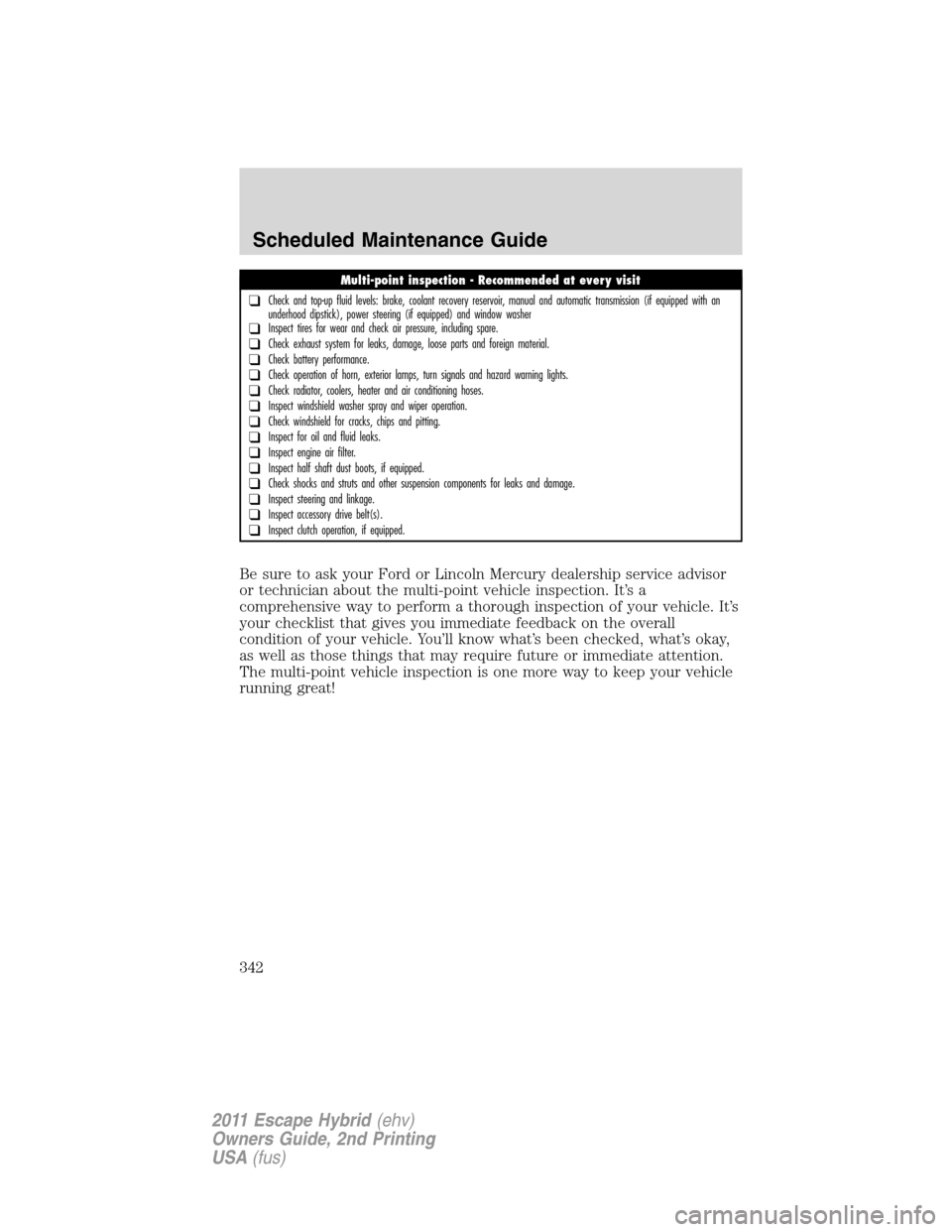
Be sure to ask your Ford or Lincoln Mercury dealership service advisor
or technician about the multi-point vehicle inspection. It’s a
comprehensive way to perform a thorough inspection of your vehicle. It’s
your checklist that gives you immediate feedback on the overall
condition of your vehicle. You’ll know what’s been checked, what’s okay,
as well as those things that may require future or immediate attention.
The multi-point vehicle inspection is one more way to keep your vehicle
running great!
Multi-point inspection - Recommended at every visit
❑Check and top-up fluid levels: brake, coolant recovery reservoir, manual and automatic transmission (if equipped with an
underhood dipstick), power steering (if equipped) and window washer
❑Inspect tires for wear and check air pressure, including spare.
❑Check exhaust system for leaks, damage, loose parts and foreign material.
❑Check battery performance.
❑Check operation of horn, exterior lamps, turn signals and hazard warning lights.
❑Check radiator, coolers, heater and air conditioning hoses.
❑Inspect windshield washer spray and wiper operation.
❑Check windshield for cracks, chips and pitting.
❑Inspect for oil and fluid leaks.
❑Inspect engine air filter.
❑Inspect half shaft dust boots, if equipped.
❑Check shocks and struts and other suspension components for leaks and damage.
❑Inspect steering and linkage.
❑Inspect accessory drive belt(s).
❑Inspect clutch operation, if equipped.
Scheduled Maintenance Guide
342
2011 Escape Hybrid(ehv)
Owners Guide, 2nd Printing
USA(fus)