Page 209 of 337

VEHICLE USED AS A STATIONARY POWER SOURCE
Auxiliary equipment called power take-off or PTO, is often added to the
engine or transmission to operate utility equipment. Examples include a
wheel-lift for tow trucks, cranes, tools for construction or tire service and
pumping fluids. PTO applications draw auxiliary horsepower from the
powertrain, often while the vehicle is stationary. In this condition, there
is limited cooling air flow through the radiator and around the vehicle
that normally occurs when a vehicle is moving. The aftermarket PTO
system installer, having the most knowledge of the final application, is
responsible for determining whether additional chassis heat protection or
powertrain cooling is required, and alerting the user to the safe and
proper operation.
Your vehicle is qualified for use as a stationary power source, within
limits detailed in theFord Truck Body Builders Layout Book,found at
www.fleet.ford.com/truckbbas, and through the Ford Truck Body Builders
Advisory Service.
Gas engine vehicles are qualified for up to 10 minutes of continuous
operation as a stationary power source, due to the potential for the
normal venting of fuel vapors. Further consult your aftermarket PTO
installer, since the duration of operation limit for the aftermarket PTO
may be less than the vehicle is capable of.
DRIVING THROUGH WATER
If driving through deep or standing
water is unavoidable, proceed very
slowly especially when the depth is
not known. Never drive through
water that is higher than the bottom
of the wheel rims (for cars) or the
bottom of the hubs (for trucks).
When driving through water, traction or brake capability may be limited.
Also, water may enter your engine’s air intake and severely damage your
engine or your vehicle may stall.Driving through deep water where
the transmission vent tube is submerged may allow water into the
transmission and cause internal transmission damage.
Once through the water, always dry the brakes by moving your
vehicle slowly while applying light pressure on the brake pedal.
Wet brakes do not stop the vehicle as quickly as dry brakes.
Driving
209
2011 Econoline(eco)
Owners Guide, 1st Printing
USA(fus)
Page 215 of 337
Passenger compartment fuse panel
The fuse panel is located to the left of the brake pedal and mounted
onto the lower left cowl panel. Remove the fuse panel cover to access
the fuses.
WARNING:Always disconnect the battery before servicing high
current fuses.
If your vehicle is equipped with an auxiliary battery,
disconnecting the primary under-hood battery DOES NOT remove
power from all circuits.
To remove a fuse use the fuse puller tool provided on the inside of the
fuse panel cover.
Roadside Emergencies
215
2011 Econoline(eco)
Owners Guide, 1st Printing
USA(fus)
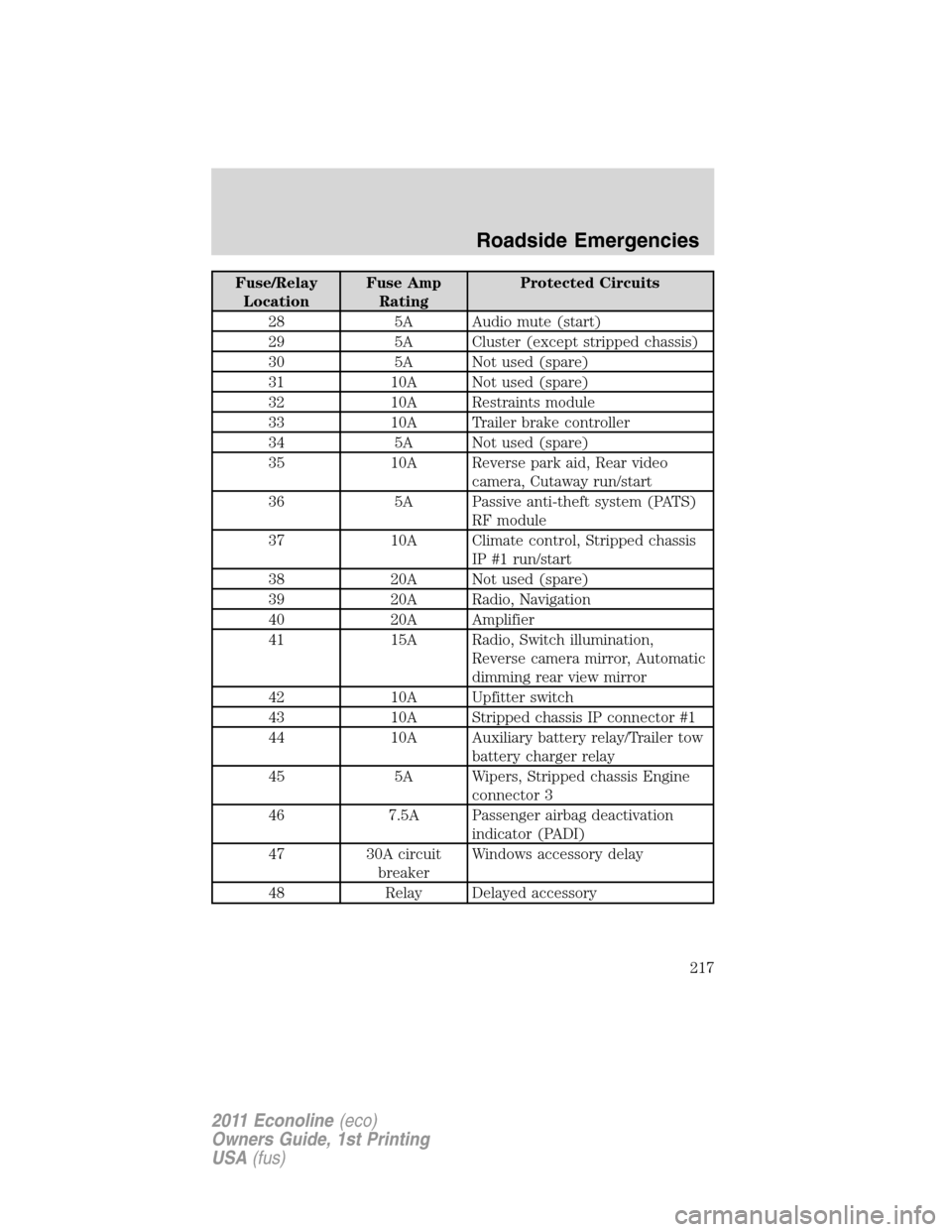
Page 217 of 337
Fuse/Relay
LocationFuse Amp
RatingProtected Circuits
28 5A Audio mute (start)
29 5A Cluster (except stripped chassis)
30 5A Not used (spare)
31 10A Not used (spare)
32 10A Restraints module
33 10A Trailer brake controller
34 5A Not used (spare)
35 10A Reverse park aid, Rear video
camera, Cutaway run/start
36 5A Passive anti-theft system (PATS)
RF module
37 10A Climate control, Stripped chassis
IP #1 run/start
38 20A Not used (spare)
39 20A Radio, Navigation
40 20A Amplifier
41 15A Radio, Switch illumination,
Reverse camera mirror, Automatic
dimming rear view mirror
42 10A Upfitter switch
43 10A Stripped chassis IP connector #1
44 10A Auxiliary battery relay/Trailer tow
battery charger relay
45 5A Wipers, Stripped chassis Engine
connector 3
46 7.5A Passenger airbag deactivation
indicator (PADI)
47 30A circuit
breakerWindows accessory delay
48 Relay Delayed accessory
Roadside Emergencies
217
2011 Econoline(eco)
Owners Guide, 1st Printing
USA(fus)
Page 218 of 337

Power distribution box
The power distribution box is located in the engine compartment. The
power distribution box contains high-current fuses that protect your
vehicle’s main electrical systems from overloads.
WARNING:Always disconnect the battery before servicing high
current fuses.
WARNING:To reduce risk of electrical shock, always replace
the cover to the Power Distribution Box before reconnecting the
battery or refilling fluid reservoirs.
If your vehicle is equipped with an auxiliary battery,
disconnecting the primary under-hood battery DOES NOT remove
power from all circuits.
If the battery has been disconnected and reconnected, refer to the
Batterysection of theMaintenance and Specificationschapter.
The high-current fuses are coded as follows.
Fuse/Relay
LocationFuse Amp
RatingProtected Circuits
1 HC Micro Relay Powertrain control module (PCM)
2 HC Micro Relay Starter solenoid
3 HC Micro Relay Wiper
Roadside Emergencies
218
2011 Econoline(eco)
Owners Guide, 1st Printing
USA(fus)
Page 219 of 337

Fuse/Relay
LocationFuse Amp
RatingProtected Circuits
4 HC Micro Relay Trailer tow battery charge
5 HC Micro Relay Fuel pump
6 HC Micro Relay Trailer tow park lamp
7 HC Micro Relay Upfitter #4
8 HC Micro Relay Upfitter #3
9 HC Micro Relay Modified vehicle and stripped chassis
run/start
10 — Not used
11 — Not used
12 40A** Modified vehicle and stripped chassis
run/start
13 30A** Starter solenoid relay
14 40A** Run start relay
15 40A** Modified vehicle and stripped chassis
battery
16 50A** Auxiliary A/C blower
17 50A** Auxiliary battery feed, Trailer tow
battery charge, trailer tow park feed
18 30A** Electric trailer brake, Trailer brake
controller
19 30A** Upfitter #1
20 30A** Upfitter #2
21 — Not used
22 — Not used
23 G8VA relay A/C clutch
24 G8VA relay Horn relay (stripped chassis)
25 HC Micro relay Run/start
26 — Not used
27 — Not used
28 20A* Back up lamp
29 10A* A/C clutch
30 10A* Brake on/off (BOO) switch
Roadside Emergencies
219
2011 Econoline(eco)
Owners Guide, 1st Printing
USA(fus)
Page 221 of 337
Fuse/Relay
LocationFuse Amp
RatingProtected Circuits
59 — Not used
60 — One touch integrated start (OTIS)
(diode)
61 — Auxiliary battery (diode)
62 HC Micro relay Upfitter #2
63 30A** Trailer tow battery charge
64 — Not used
65 20A** Power point 2 (glove box)
66 20A** Power point 3 (left-hand B-pillar)
67 20A** Power point 1 (instrument panel)
68 50A** Modified vehicle
69 — Not used
70 30A** Stripped chassis
71 — Not used
72 20A** Cigar lighter
73 — Not used
74 30A** Power seat
75 20A* Vehicle power (VPWR) 1, PCM
power
76 20A* VPWR 2, PCM – emission related
powertrain components
77 10A* VPWR 3, PCM – general powertrain
components
78 15A* VPWR 4, Fuel pump relay coil
79 10A* VPWR 5, Transmission
80 10A* Cluster run/start (stripped chassis)
81 — Not used
82 — Not used
83 — Fuel pump (diode)
84 — Not used
85 HC Micro relay Upfitter #1
* Mini fuses ** A1S fuses
Roadside Emergencies
221
2011 Econoline(eco)
Owners Guide, 1st Printing
USA(fus)
Page 255 of 337
OPENING THE HOOD
1. Inside the vehicle, pull the hood
release handle located under the
bottom left corner of the instrument
panel.
2. Go to the front of the vehicle and push the auxiliary latch, located in
the center top of the grille, to the left to release the hood.
3. Lift the hood and secure it with the prop rod.
HOOD
Maintenance and Specifications
255
2011 Econoline(eco)
Owners Guide, 1st Printing
USA(fus)
Page 262 of 337

Auxiliary battery (if equipped)
Your vehicle may be equipped with a frame-mounted auxiliary battery
located on the passenger side frame rail, behind the front passenger
door. This auxiliary battery is connected to the auxiliary battery relay, so
it is not used to start the vehicle.
Battery relearn
Because your vehicle’s engine is electronically controlled by a computer,
some control conditions are maintained by power from the battery. When
the battery is disconnected or a new battery is installed, the engine must
relearn its idle and fuel trim strategy for optimum driveability and
performance. Flexible fuel vehicles (FFV) must also relearn the ethanol
content of the fuel for optimum driveability and performance. To begin
this process:
1. With the vehicle at a complete stop, set the parking brake.
2. Put the gearshift in P (Park), turn off all accessories and start the
engine.
3. Run the engine until it reaches normal operating temperature.
4. Allow the engine to idle for at least one minute.
5. Turn the A/C on and allow the engine to idle for at least one minute.
6. Release the parking brake. With your foot on the brake pedal and with
the A/C on, put the vehicle in D (Drive) and allow the engine to idle for
at least one minute.
7. Drive the vehicle to complete the relearning process.
•The vehicle may need to be driven 10 miles (16 km) or more to
relearn the idle and fuel trim strategy along with the ethanol content
for flexible fuel vehicles.
•If you do not allow the engine to relearn its idle trim, the idle quality
of your vehicle may be adversely affected until the idle trim is
eventually relearned.
•For flexible fuel vehicles, if you are operating on E85, you may
experience poor starts or an inability to start the engine and
driveability problems until the fuel trim and ethanol content have been
relearned.
If the battery has been disconnected or a new battery has been installed,
the clock and radio settings must be reset once the battery is
reconnected.
Maintenance and Specifications
262
2011 Econoline(eco)
Owners Guide, 1st Printing
USA(fus)