2011 FORD CROWN VICTORIA E85
[x] Cancel search: E85Page 178 of 333
ENGINE BLOCK HEATER (IF EQUIPPED)
An engine block heater warms the engine coolant which aids in starting
and allows the heater/defroster system to respond quickly. If your vehicle
is equipped with this system, your equipment includes a heater element
which is installed in your engine block and a wire harness which allows
the user to connect the system to a grounded 120 volt A/C electrical
source. The block heater system is most effective when outdoor
temperatures reach below 0°F (-18°C).
For flexible fuel vehicles, if operating with E85 ethanol, an engine block
heater must be used if ambient temperature is below 0°F (-18°C).
SeeCold weather startingearlier in this chapter for more information
on starting with ethanol.
WARNING:Failure to follow engine block heater instructions
could result in property damage or physical injury.
WARNING:To reduce the risk of electrical shock, do not use
your heater with ungrounded electrical systems or two-pronged
(cheater) adapters.
Prior to using the engine block heater, follow these recommendations for
proper and safe operation:
•For your safety, use an outdoor extension cord that is product
certified by Underwriter’s Laboratory (UL) or Canadian Standards
Association (CSA). Use only an extension cord that can be used
outdoors, in cold temperatures, and is clearly marked “Suitable for Use
with Outdoor Appliances.” Never use an indoor extension cord
outdoors; it could result in an electric shock or fire hazard.
•Use a 16 gauge outdoor extension cord, minimum.
•Use as short an extension cord as possible.
•Do not use multiple extension cords. Instead, use one extension cord
which is long enough to reach from the engine block heater cord to
the outlet without stretching.
•Make certain that the extension cord is in excellent condition (not
patched or spliced). Store your extension cord indoors at
temperatures above 32°F (0°C). Outdoor conditions can deteriorate
extension cords over a period of time.
Driving
178
2011 Crown Victoria(cro)
Owners Guide, 3rd Printing
USA(fus)
Page 237 of 333
WARNING:Keep batteries out of reach of children. Batteries
contain sulfuric acid. Avoid contact with skin, eyes or clothing.
Shield your eyes when working near the battery to protect against
possible splashing of acid solution. In case of acid contact with skin or
eyes, flush immediately with water for a minimum of 15 minutes and
get prompt medical attention. If acid is swallowed, call a physician
immediately.
WARNING:Battery posts, terminals and related accessories
contain lead and lead compounds.Wash hands after handling.
Because your vehicle’s engine is electronically controlled by a computer,
some control conditions are maintained by power from the battery. When
the battery is disconnected or a new battery is installed, the engine must
relearn its idle and fuel trim strategy for optimum driveability and
performance. Flexible fuel vehicles (FFV) must also relearn the ethanol
content of the fuel for optimum driveability and performance. To begin
this process:
1. With the vehicle at a complete stop, set the parking brake.
2. Put the gearshift in P (Park), turn off all accessories and start the
engine.
3. Run the engine until it reaches normal operating temperature.
4. Allow the engine to idle for at least one minute.
5. Turn the A/C on and allow the engine to idle for at least one minute.
6. Release the parking brake. With your foot on the brake pedal and with
the A/C on, put the vehicle in D (Drive) and allow the engine to idle for
at least one minute.
7. Drive the vehicle to complete the relearning process.
•The vehicle may need to be driven 10 miles (16 km) or more to
relearn the idle and fuel trim strategy along with the ethanol content
for flexible fuel vehicles.
•If you do not allow the engine to relearn its idle trim, the idle
quality of your vehicle may be adversely affected until the idle
trim is eventually relearned.
•For flexible fuel vehicles, if you are operating on E85, you may
experience poor starts or an inability to start the engine and
driveability problems until the fuel trim and ethanol content have been
relearned.
Maintenance and Specifications
237
2011 Crown Victoria(cro)
Owners Guide, 3rd Printing
USA(fus)
Page 245 of 333
Observe the following guidelines when handling automotive fuel:
•Extinguish all smoking materials
and any open flames before
fueling your vehicle.
•Always turn off the vehicle before
fueling.
•Automotive fuels can be harmful
or fatal if swallowed. Fuels such as gasoline and ethanol are highly
toxic and if swallowed can cause death or permanent injury. If fuel is
swallowed, call a physician immediately, even if no symptoms are
immediately apparent. The toxic effects of fuel may not be visible for
hours.
•Avoid inhaling fuel vapors. Inhaling too much fuel vapor of any kind
can lead to eye and respiratory tract irritation. In severe cases,
excessive or prolonged breathing of fuel vapor can cause serious
illness and permanent injury.
•Avoid getting fuel liquid in your eyes. If fuel is splashed in the eyes,
remove contact lenses (if worn), flush with water for 15 minutes and
seek medical attention. Failure to seek proper medical attention could
lead to permanent injury.
•Fuels can also be harmful if absorbed through the skin. If fuel is
splashed on the skin and/or clothing, promptly remove contaminated
clothing and wash skin thoroughly with soap and water. Repeated or
prolonged skin contact with fuel liquid or vapor causes skin irritation.
•Be particularly careful if you are taking “Antabuse” or other forms of
disulfiram for the treatment of alcoholism. Breathing gasoline and/or
ethanol vapors, or skin contact could cause an adverse reaction. In
sensitive individuals, serious personal injury or sickness may result. If
fuel is splashed on the skin, promptly wash skin thoroughly with soap
and water. Consult a physician immediately if you experience an
adverse reaction.
•FFV fuel tanks may contain zero to 85% ethanol. Any fuel blends
containing gasoline and ethanol should be treated the same as “Fuel
Ethanol.” To identify if your vehicle is an FFV, it may be equipped
with a yellow fuel cap with the text “E85/Gasoline”, or check if there
is a label on the fuel filler door.
Maintenance and Specifications
245
2011 Crown Victoria(cro)
Owners Guide, 3rd Printing
USA(fus)
Page 248 of 333
At the next opportunity, safely pull off of the road, remove the fuel filler
cap, align the cap properly and reinstall it. The check fuel cap
light
or CHECK FUEL CAP message may not reset immediately; it
may take several driving cycles for the check fuel cap light
or CHECK
FUEL CAP message to turn off. A driving cycle consists of an engine
start-up (after four or more hours with the engine off) followed by city
and highway driving.
Continuing to drive with the check fuel cap light
or CHECK FUEL
CAP message on may cause the
light to turn on as well.
If you must replace the fuel filler cap, replace it with a fuel filler
cap that is designed for your vehicle. The customer warranty may
be void for any damage to the fuel tank or fuel system if the
correct genuine Ford, Motorcraft or other certified fuel filler cap
is not used.
WARNING:The fuel system may be under pressure. If the fuel
filler cap is venting vapor or if you hear a hissing sound, wait
until it stops before completely removing the fuel filler cap. Otherwise,
fuel may spray out and injure you or others.
WARNING:If you do not use the proper fuel filler cap,
excessive vacuum in the fuel tank may damage the fuel system
or cause the fuel cap to disengage in a collision, which may result in
personal injury.
FFV (Flex Fuel Vehicle) fuel cap
If your vehicle is FFV capable, it will have a yellow colored fuel cap.
Choosing the right fuel
If your vehicle is a flexible fuel vehicle (FFV), use only UNLEADED
FUEL and FUEL ETHANOL (Ed75–Ed85).
If your vehicle is not a flexible fuel vehicle (FFV), then only use
UNLEADED fuel or UNLEADED fuel blended with a maximum of 10%
ethanol. Do not use fuel ethanol (E85), diesel, methanol, leaded fuel or
any other fuel.
The use of leaded fuel is prohibited by law and could damage your
vehicle.
Your vehicle was not designed to use fuel or fuel additives with metallic
compounds, including manganese-based additives.
Maintenance and Specifications
248
2011 Crown Victoria(cro)
Owners Guide, 3rd Printing
USA(fus)
Page 249 of 333
Note:Use of any fuel other than those recommended may cause
powertrain damage, a loss of vehicle performance, and repairs may not
be covered under warranty.
Cleaner air
Ford endorses the use of reformulated “cleaner-burning” gasolines to
improve air quality, per the recommendations in theChoosing the right
fuelsection.
Octane recommendations
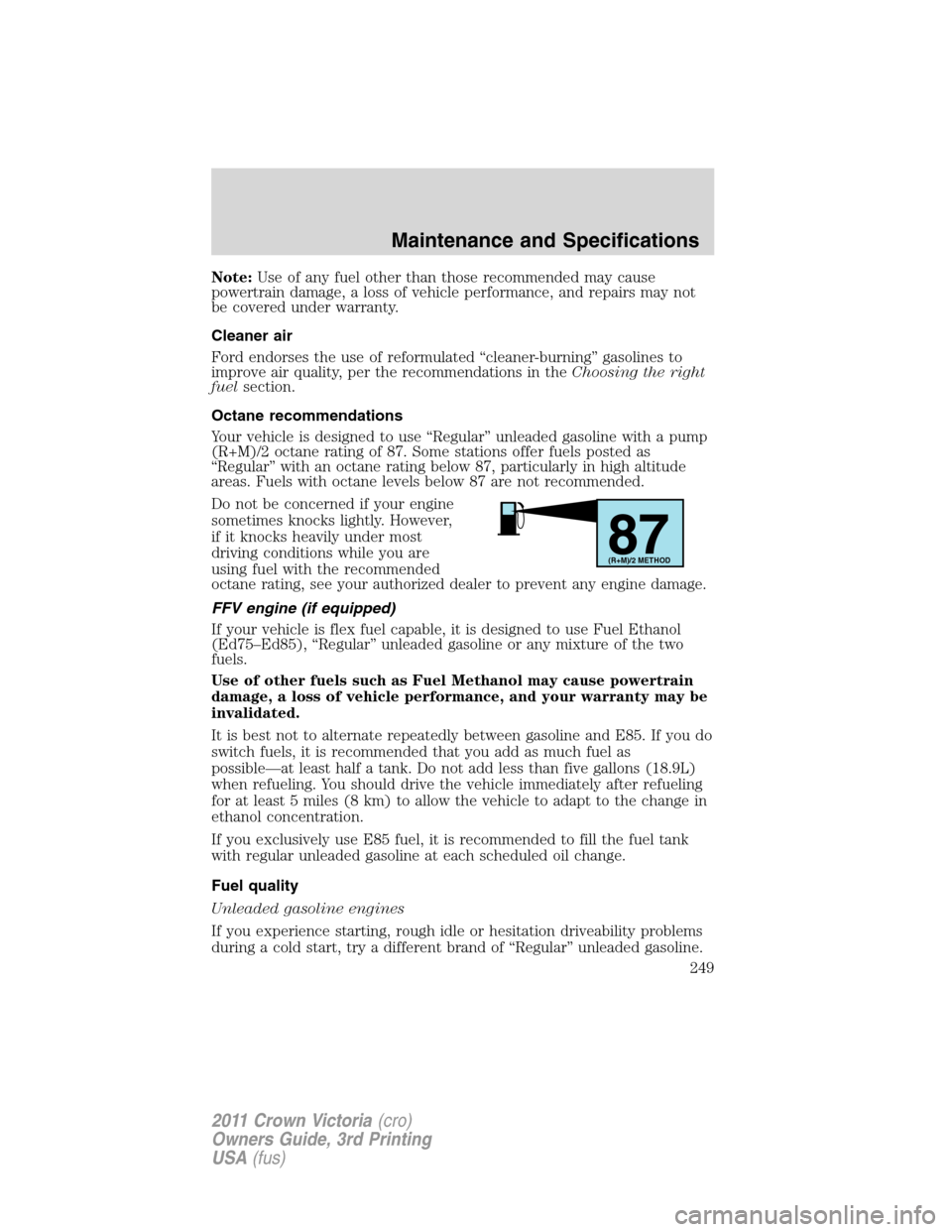
Your vehicle is designed to use “Regular” unleaded gasoline with a pump
(R+M)/2 octane rating of 87. Some stations offer fuels posted as
“Regular” with an octane rating below 87, particularly in high altitude
areas. Fuels with octane levels below 87 are not recommended.
Do not be concerned if your engine
sometimes knocks lightly. However,
if it knocks heavily under most
driving conditions while you are
using fuel with the recommended
octane rating, see your authorized dealer to prevent any engine damage.
FFV engine (if equipped)
If your vehicle is flex fuel capable, it is designed to use Fuel Ethanol
(Ed75–Ed85), “Regular” unleaded gasoline or any mixture of the two
fuels.
Use of other fuels such as Fuel Methanol may cause powertrain
damage, a loss of vehicle performance, and your warranty may be
invalidated.
It is best not to alternate repeatedly between gasoline and E85. If you do
switch fuels, it is recommended that you add as much fuel as
possible—at least half a tank. Do not add less than five gallons (18.9L)
when refueling. You should drive the vehicle immediately after refueling
for at least 5 miles (8 km) to allow the vehicle to adapt to the change in
ethanol concentration.
If you exclusively use E85 fuel, it is recommended to fill the fuel tank
with regular unleaded gasoline at each scheduled oil change.
Fuel quality
Unleaded gasoline engines
If you experience starting, rough idle or hesitation driveability problems
during a cold start, try a different brand of “Regular” unleaded gasoline.
87(R+M)/2 METHOD
Maintenance and Specifications
249
2011 Crown Victoria(cro)
Owners Guide, 3rd Printing
USA(fus)
Page 250 of 333
“Premium” unleaded gasoline is not recommended for vehicles designed
to use “Regular” unleaded gasoline because it may cause these problems
to become more pronounced. If the problems persist, see your
authorized dealer.
FFV engines
If you experience starting, rough idle or hesitation driveability problems
during a cold start, try a different brand of E85 fuel. If the driveability
problems continue, fill the vehicle with regular unleaded gasoline and
drive vehicle normally until gasoline is used. See your authorized dealer
if the problem persists.
Do not add aftermarket fuel additive products to your fuel tank. It
should not be necessary to add any aftermarket products to your fuel
tank if you continue to use high quality fuel of the recommended octane
rating. These products have not been approved for your engine and
could cause damage to the fuel system. Repairs to correct the effects of
using an aftermarket product in your fuel may not be covered by your
warranty.
Many of the world’s automakers approved the World-Wide Fuel Charter
that recommends gasoline specifications to provide improved
performance and emission control system protection for your vehicle.
Gasolines that meet the World-Wide Fuel Charter should be used when
available. Ask your fuel supplier about gasolines that meet the
World-Wide Fuel Charter.
Running out of fuel
Avoid running out of fuel because this situation may have an adverse
effect on powertrain components.
If you have run out of fuel:
•You may need to cycle the ignition from off to on several times after
refueling to allow the fuel system to pump the fuel from the tank to
the engine. On restarting, cranking time will take a few seconds longer
than normal.
•Normally, adding 1 gallon (3.8L) of fuel is enough to restart the
engine. If the vehicle is out of fuel and on a steep grade, more than
1 gallon (3.8L) may be required.
•The service engine soon
indicator may come on. For more
information on the service engine soon
indicator, refer to
Warning lights and chimesin theInstrument Clusterchapter.
Maintenance and Specifications
250
2011 Crown Victoria(cro)
Owners Guide, 3rd Printing
USA(fus)
Page 267 of 333
ENGINE DATA
Engine 4.6L V8 engine 4.6L FFV V8 engine
Cubic inches 281 281
Required fuel Minimum 87 octane Minimum 87 octane or
Ethanol (E85)
Firing order 1-3-7-2-6-5-4-8 1-3-7-2-6-5-4-8
Ignition system Coil on plug Coil on plug
Spark plug gap 0.052–0.056 inch
(1.32–1.42 mm)0.041–0.047 inch
(1.04–1.20 mm)
Compression ratio 9.4:1 9.4:1
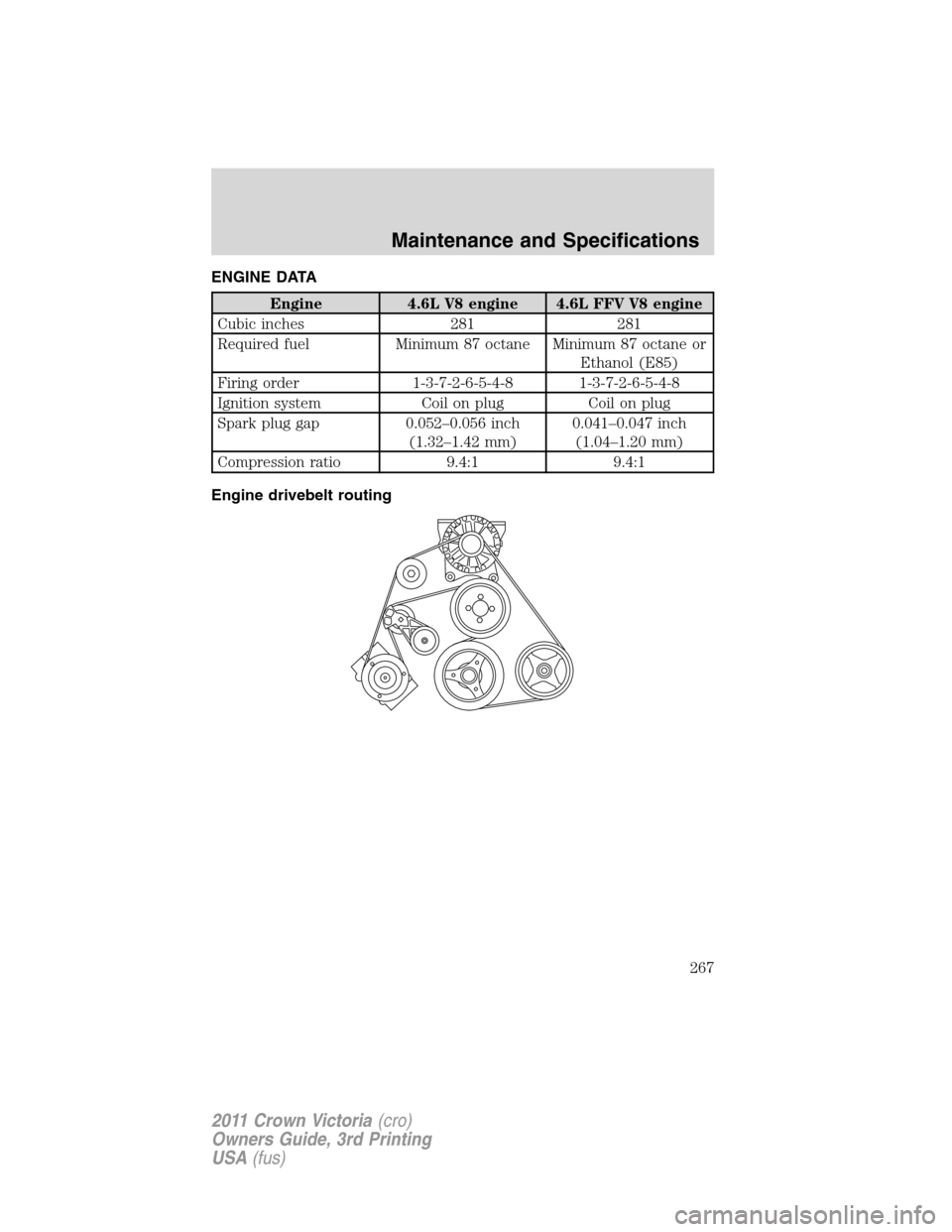
Engine drivebelt routing
Maintenance and Specifications
267
2011 Crown Victoria(cro)
Owners Guide, 3rd Printing
USA(fus)
Page 322 of 333
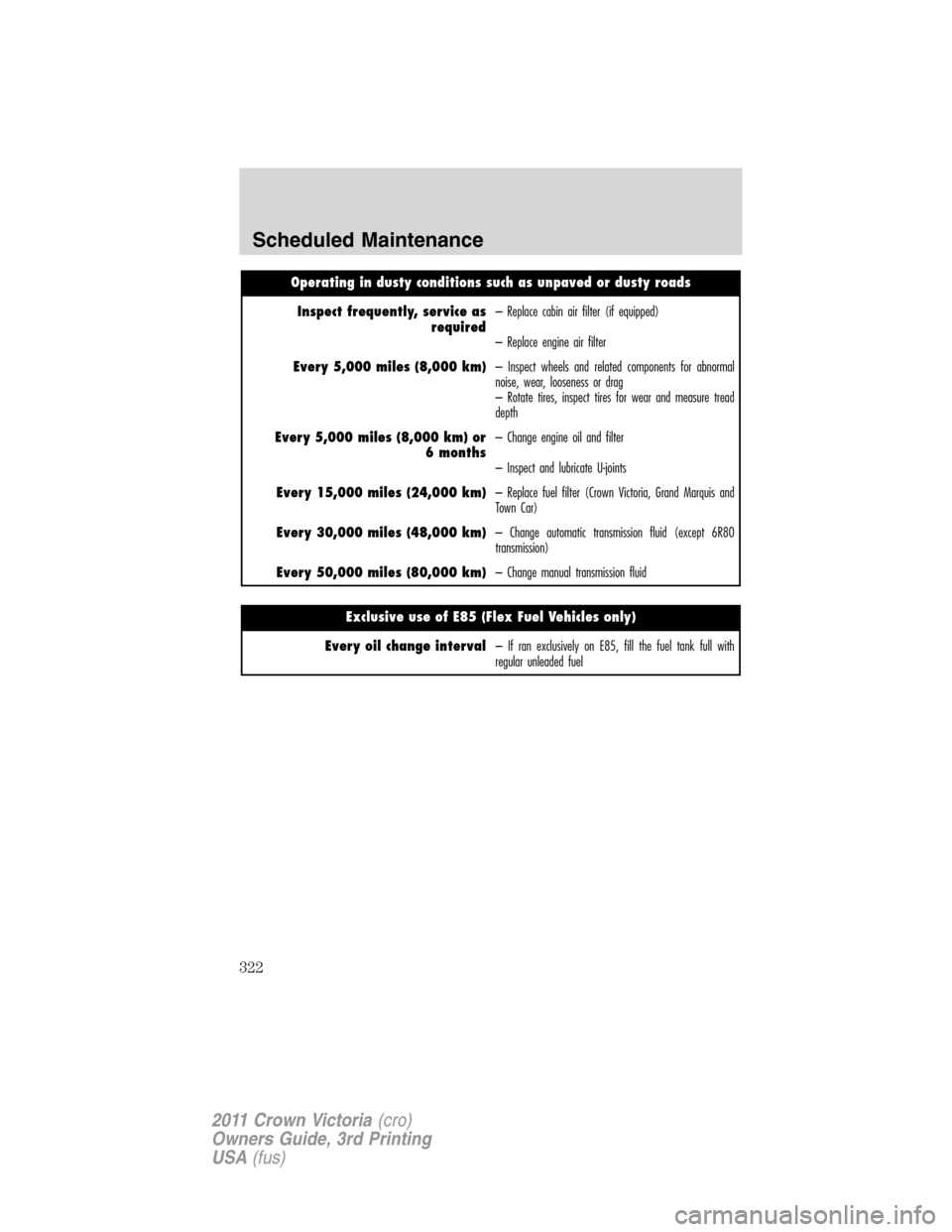
Operating in dusty conditions such as unpaved or dusty roads
Inspect frequently, service as
required– Replace cabin air filter (if equipped)
– Replace engine air filter
Every 5,000 miles (8,000 km)– Inspect wheels and related components for abnormal
noise, wear, looseness or drag
– Rotate tires, inspect tires for wear and measure tread
depth
Every 5,000 miles (8,000 km) or
6 months– Change engine oil and filter
– Inspect and lubricate U-joints
Every 15,000 miles (24,000 km)– Replace fuel filter (Crown Victoria, Grand Marquis and
Town Car)
Every 30,000 miles (48,000 km)– Change automatic transmission fluid (except 6R80
transmission)
Every 50,000 miles (80,000 km)– Change manual transmission fluid
Exclusive use of E85 (Flex Fuel Vehicles only)
Every oil change interval– If ran exclusively on E85, fill the fuel tank full with
regular unleaded fuel
Scheduled Maintenance
322
2011 Crown Victoria(cro)
Owners Guide, 3rd Printing
USA(fus)