Page 246 of 333
Pure ethanol is the alcohol which is the intoxicating agent in liquor, beer
and wine. It is distilled from the fermentation of plants such as field corn
and sugar cane. When ethanol is produced for use in motor fuels, a small
amount of gasoline is added to make it unfit for beverage use. The
resulting ethanol blend is called denatured fuel ethanol meaning that it is
denatured with 2% to 5% gasoline and is suitable for automotive use.
During the summer season, fuel ethanol may contain a maximum of 85%
denatured ethanol (Ed85) and 15% unleaded gasoline. The fuel ethanol
has a higher octane rating than unleaded regular or premium gasoline
and this allows the design of engines with greater efficiency and power.
Winter blends may contain up to 75% denatured ethanol (Ed75) and up
to 25% unleaded gasoline to enhance cold engine starts. Severely cold
weather may require additional measures for reliable starting. Refer to
Startingin theDrivingchapter.
Ethanol is more chemically active than gasoline. It corrodes some metals
and causes some plastic and rubber components to swell, break down or
become brittle and crack, especially when mixed with gasoline. Special
materials and procedures have been developed for flexible fuel vehicles
and the dispensers used by ethanol fuel providers.
WARNING:Flexible fuel components and standard unleaded
gasoline fuel components are not interchangeable. If your vehicle
is not serviced in accordance with flexible fuel vehicles procedures,
damage may occur and your warranty may be invalidated.
WARNING:When refueling always shut the engine off and
never allow sparks or open flames near the filler neck. Never
smoke while refueling. Fuel vapor is extremely hazardous under certain
conditions. Care should be taken to avoid inhaling excess fumes.
WARNING:The flow of fuel through a fuel pump nozzle can
produce static electricity, which can cause a fire if fuel is
pumped into an ungrounded fuel container.
Maintenance and Specifications
246
2011 Crown Victoria(cro)
Owners Guide, 3rd Printing
USA(fus)
Page 248 of 333
At the next opportunity, safely pull off of the road, remove the fuel filler
cap, align the cap properly and reinstall it. The check fuel cap
light
or CHECK FUEL CAP message may not reset immediately; it
may take several driving cycles for the check fuel cap light
or CHECK
FUEL CAP message to turn off. A driving cycle consists of an engine
start-up (after four or more hours with the engine off) followed by city
and highway driving.
Continuing to drive with the check fuel cap light
or CHECK FUEL
CAP message on may cause the
light to turn on as well.
If you must replace the fuel filler cap, replace it with a fuel filler
cap that is designed for your vehicle. The customer warranty may
be void for any damage to the fuel tank or fuel system if the
correct genuine Ford, Motorcraft or other certified fuel filler cap
is not used.
WARNING:The fuel system may be under pressure. If the fuel
filler cap is venting vapor or if you hear a hissing sound, wait
until it stops before completely removing the fuel filler cap. Otherwise,
fuel may spray out and injure you or others.
WARNING:If you do not use the proper fuel filler cap,
excessive vacuum in the fuel tank may damage the fuel system
or cause the fuel cap to disengage in a collision, which may result in
personal injury.
FFV (Flex Fuel Vehicle) fuel cap
If your vehicle is FFV capable, it will have a yellow colored fuel cap.
Choosing the right fuel
If your vehicle is a flexible fuel vehicle (FFV), use only UNLEADED
FUEL and FUEL ETHANOL (Ed75–Ed85).
If your vehicle is not a flexible fuel vehicle (FFV), then only use
UNLEADED fuel or UNLEADED fuel blended with a maximum of 10%
ethanol. Do not use fuel ethanol (E85), diesel, methanol, leaded fuel or
any other fuel.
The use of leaded fuel is prohibited by law and could damage your
vehicle.
Your vehicle was not designed to use fuel or fuel additives with metallic
compounds, including manganese-based additives.
Maintenance and Specifications
248
2011 Crown Victoria(cro)
Owners Guide, 3rd Printing
USA(fus)
Page 249 of 333
Note:Use of any fuel other than those recommended may cause
powertrain damage, a loss of vehicle performance, and repairs may not
be covered under warranty.
Cleaner air
Ford endorses the use of reformulated “cleaner-burning” gasolines to
improve air quality, per the recommendations in theChoosing the right
fuelsection.
Octane recommendations
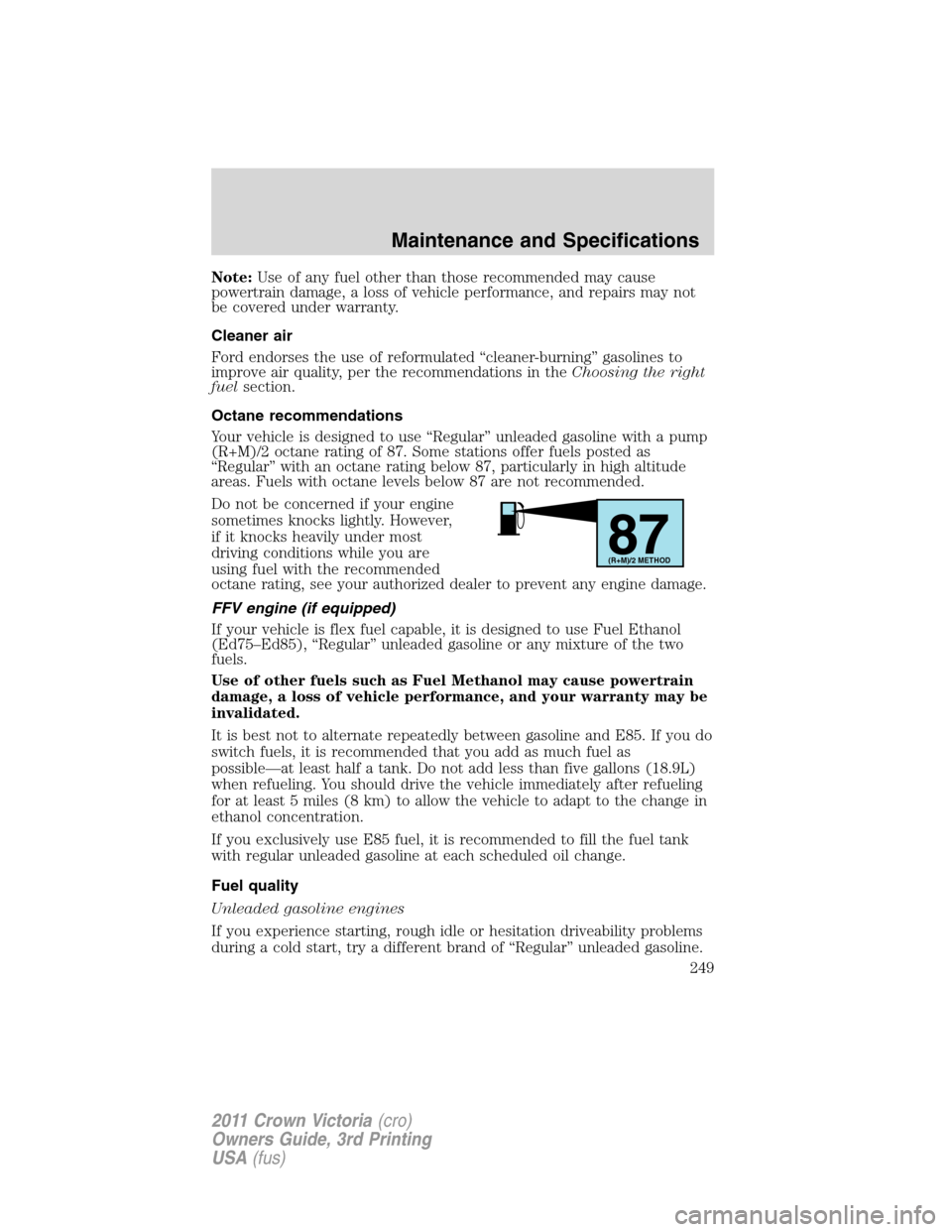
Your vehicle is designed to use “Regular” unleaded gasoline with a pump
(R+M)/2 octane rating of 87. Some stations offer fuels posted as
“Regular” with an octane rating below 87, particularly in high altitude
areas. Fuels with octane levels below 87 are not recommended.
Do not be concerned if your engine
sometimes knocks lightly. However,
if it knocks heavily under most
driving conditions while you are
using fuel with the recommended
octane rating, see your authorized dealer to prevent any engine damage.
FFV engine (if equipped)
If your vehicle is flex fuel capable, it is designed to use Fuel Ethanol
(Ed75–Ed85), “Regular” unleaded gasoline or any mixture of the two
fuels.
Use of other fuels such as Fuel Methanol may cause powertrain
damage, a loss of vehicle performance, and your warranty may be
invalidated.
It is best not to alternate repeatedly between gasoline and E85. If you do
switch fuels, it is recommended that you add as much fuel as
possible—at least half a tank. Do not add less than five gallons (18.9L)
when refueling. You should drive the vehicle immediately after refueling
for at least 5 miles (8 km) to allow the vehicle to adapt to the change in
ethanol concentration.
If you exclusively use E85 fuel, it is recommended to fill the fuel tank
with regular unleaded gasoline at each scheduled oil change.
Fuel quality
Unleaded gasoline engines
If you experience starting, rough idle or hesitation driveability problems
during a cold start, try a different brand of “Regular” unleaded gasoline.
87(R+M)/2 METHOD
Maintenance and Specifications
249
2011 Crown Victoria(cro)
Owners Guide, 3rd Printing
USA(fus)
Page 267 of 333
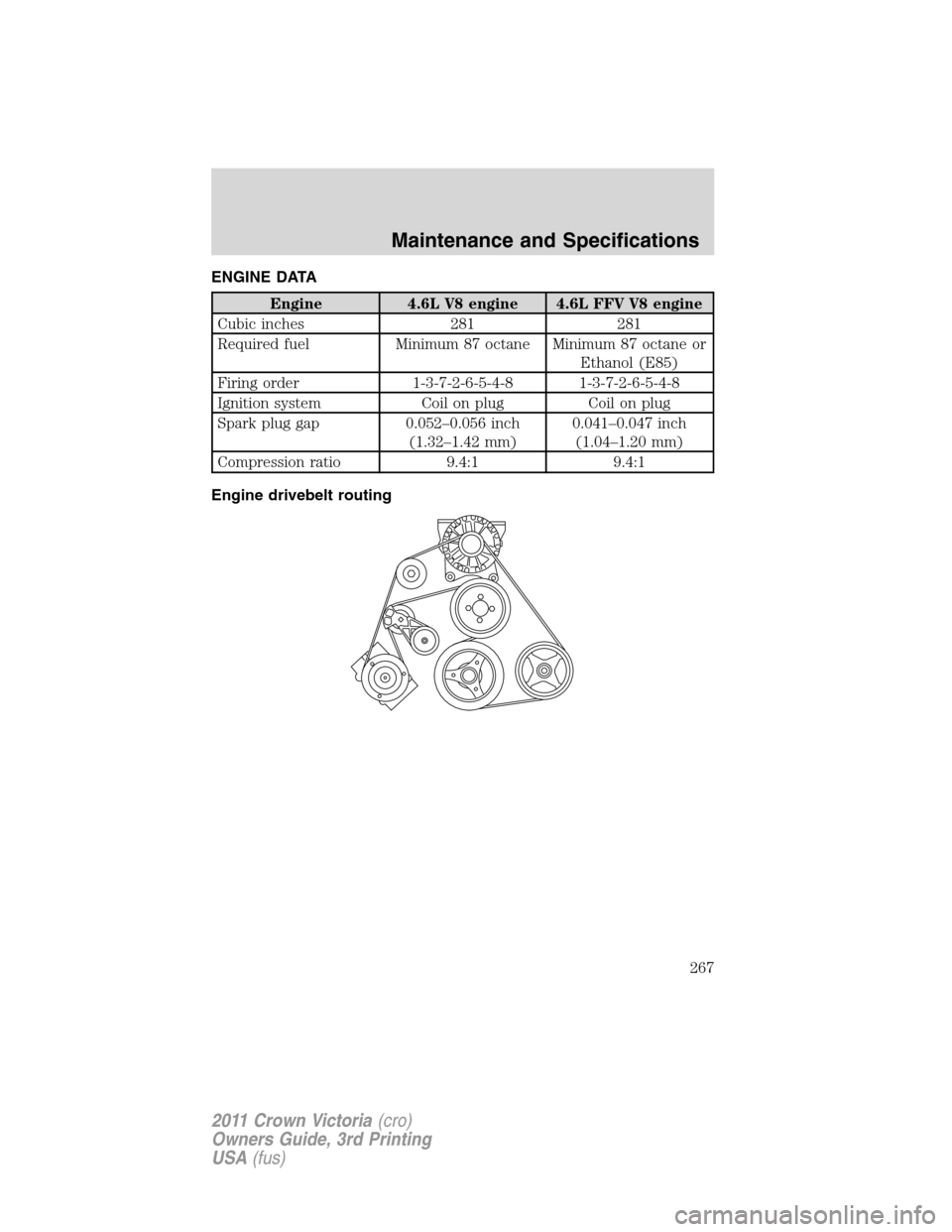
ENGINE DATA
Engine 4.6L V8 engine 4.6L FFV V8 engine
Cubic inches 281 281
Required fuel Minimum 87 octane Minimum 87 octane or
Ethanol (E85)
Firing order 1-3-7-2-6-5-4-8 1-3-7-2-6-5-4-8
Ignition system Coil on plug Coil on plug
Spark plug gap 0.052–0.056 inch
(1.32–1.42 mm)0.041–0.047 inch
(1.04–1.20 mm)
Compression ratio 9.4:1 9.4:1
Engine drivebelt routing
Maintenance and Specifications
267
2011 Crown Victoria(cro)
Owners Guide, 3rd Printing
USA(fus)