2011 FIAT FREEMONT flat tire
[x] Cancel search: flat tirePage 201 of 267
3. Set the parking brake.
4. Place the shift lever in PARK.
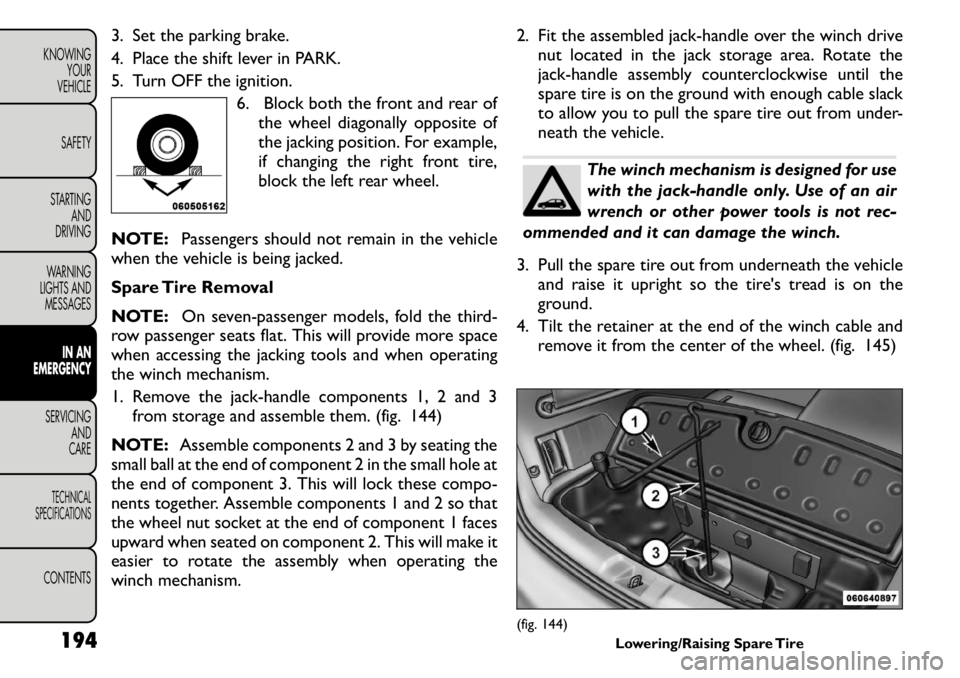
5. Turn OFF the ignition.6. Block both the front and rear ofthe wheel diagonally opposite of
the jacking position. For example,
if changing the right front tire,
block the left rear wheel.
NOTE: Passengers should not remain in the vehicle
when the vehicle is being jacked.
Spare Tire Removal
NOTE: On seven-passenger models, fold the third-
row passenger seats flat. This will provide more space
when accessing the jacking tools and when operating
the winch mechanism.
1. Remove the jack-handle components 1, 2 and 3
from storage and assemble them. (fig. 144)
NOTE: Assemble components 2 and 3 by seating the
small ball at the end of component 2 in the small hole at
the end of component 3. This will lock these compo-
nents together. Assemble components 1 and 2 so that
the wheel nut socket at the end of component 1 faces
upward when seated on component 2. This will make it
easier to rotate the assembly when operating the
winch mechanism. 2. Fit the assembled jack-handle over the winch drive
nut located in the jack storage area. Rotate the
jack-handle assembly counterclockwise until the
spare tire is on the ground with enough cable slack
to allow you to pull the spare tire out from under-
neath the vehicle.
The winch mechanism is designed for use
with the jack-handle only. Use of an air
wrench or other power tools is not rec-
ommended and it can damage the winch.
3. Pull the spare tire out from underneath the vehicle and raise it upright so the tire's tread is on the
ground.
4. Tilt the retainer at the end of the winch cable and remove it from the center of the wheel. (fig. 145)
(fig. 144) Lowering/Raising Spare Tire
194
KNOWING
YOUR
VEHICLE
SAFETY
STARTING AND
DRIVING
WARNING
LIGHTS AND
MESSAGES
IN AN
EMERGENCY
SERVICING AND
CARETECHNICAL
SPECIFICATIONSCONTENTS
Page 203 of 267

(Continued)
Only use the jack in the positions indicated and
for lifting this vehicle during a tire change.
If working on or near a roadway, be extremely
careful of motor traffic .
To assure that spare tires, flat or inflated, are
securely stowed, spares must be stowed with the
valve stem facing the ground.
(fig. 146)
Do not attempt to raise the vehicle by
jacking on locations other than those
indicated in the Jacking Instructions for
this vehicle.
(fig. 147)
1. Remove the spare tire, jack, and jack-handle from stowage.
2. Loosen, but do not remove, the wheel nuts on the wheel with the flat tire. Turn the wheel nuts coun-
terclockwise one turn while the wheel is still on the
ground. 3. Place the jack underneath the lift area that is closest
to the flat tire. Center the jack saddle between the
drain flute formations on the sill flange. Turn the
jack screw clockwise to firmly engage the jack saddle
with the lift area of the sill flange. (fig. 148)
(fig. 149)
4. Raise the vehicle by turning the jack screw clock- wise with the jack handle. Raise the vehicle until the
tire just clears the road surface and enough clear-
ance is obtained to install the spare tire. Minimum
tire lift provides maximum stability.
WARNING!
Raising the vehicle higher than neces-
sary can make the vehicle less stable. It
could slip off the jack and hurt someone near it .
Raise the vehicle only enough to remove the tire.
(fig. 146) Jack Warning Label
(fig. 147) Jacking Locations
196
KNOWING
YOUR
VEHICLE
SAFETY
STARTING AND
DRIVING
WARNING
LIGHTS AND
MESSAGES
IN AN
EMERGENCY
SERVICING AND
CARETECHNICAL
SPECIFICATIONSCONTENTS
Page 218 of 267

TOW EYE
Your vehicle is equipped with a tow eye that can be
used to rescue your vehicle, should it become stranded
off road. (fig. 162)
Tow eyes are for emergency use only, to
rescue a vehicle stranded off road. Do not
use tow eyes for tow truck hookup or
highway towing. You could damage your vehicle.
Tow straps are recommended when towing the
vehicle; chains may cause vehicle damage.
WARNING!
Stand clear of vehicles when pulling with
tow eyes. Tow straps and chains may
break, causing serious injury. FRONT TOW EYE USAGE
The front tow eye receptacle is located on the lower
right side of the front fascia.
To install the tow eye, remove the rubber plug and
thread the tow eye into the receptacle.
Insert the flat end of the jack handle through the eye
and tighten, refer to “Jacking and Tire Changing” for
further information. The tow hook must be fully seated
to the attaching bracket through the lower front fascia
as shown. If the tow hook is not fully seated to the
attaching bracket, the vehicle should not be towed.
(fig. 163)
(fig. 162)
Tow Eye
(fig. 163)Front Tow Eye Installed 211
KNOWING
YOURVEHICLE SAFETY
STARTING ANDDRIVING
WARNING
LIGHTS AND
MESSAGESIN AN
EMERGENCYSERVICING AND
CARETECHNICAL
SPECIFICATIONSCONTENTS
Page 219 of 267

REAR TOW EYE USAGE
The rear tow eye receptacle is located behind a door,
located on the left rear bumper fascia.
To install the tow eye, open the door using the vehicle
key or a small screwdriver, and thread the tow eye into
the receptacle.
Insert the flat end of the jack handle through the eye
and tighten, refer to “Jacking and Tire Changing” for
further information. The tow hook must be fully seated
to the attaching bracket through the lower front fascia
as shown. If the tow hook is not fully seated to the
attaching bracket, the vehicle should not be towed.
(fig. 164)IF YOUR ENGINE OVERHEATS
In any of the following situations, you can reduce the
potential for overheating by taking the appropriate
action.
• On the highways — Slow down.
• In city traffic — While stopped, put the transmission
in NEUTRAL, but do not increase engine idle speed.
Driving with a hot cooling system could
damage your vehicle. If the temperature
gauge reads “H,” safely pull over and stop
the vehicle. Idle the vehicle with the A/C turned
off until the pointer drops back into the normal
range. If the pointer remains on the “H,” and you
hear continuous chimes, turn the engine OFF im-
mediately, and call for service.
NOTE: There are steps that you can take to slow
down an impending overheat condition:
• If your air conditioner (A/C) is on, turn it off. The
A/C system adds heat to the engine cooling system and
turning the A/C off can help remove this heat.
• You can also turn the temperature control to maxi-
mum heat, the mode control to floor and the blower
control to high. This allows the heater core to act as a
supplement to the radiator and aids in removing heat
from the engine cooling system.
(fig. 164) Rear Tow Eye Installed
212
KNOWING
YOUR
VEHICLE
SAFETY
STARTING AND
DRIVING
WARNING
LIGHTS AND
MESSAGES
IN AN
EMERGENCY
SERVICING AND
CARETECHNICAL
SPECIFICATIONSCONTENTS
Page 242 of 267

TIRES — GENERAL INFORMATION
TIRE PRESSURE
Proper tire inflation pressure is essential to the safe and
satisfactory operation of your vehicle. Three primary
areas are affected by improper tire pressure:
Safety
WARNING!
Improperly inflated tires are danger-
ous and can cause collisions.
Under-inflation increases tire flexing and can
result over-heating and in tire failure.
Over-inflation reduces a tire's ability to cush-
ion shock. Objects on the road and chuckholes
can cause damage that result in tire failure.
Over-inflated or under-inflated tires can affect
vehicle handling and can fail suddenly, resulting
in loss of vehicle control.
Unequal tire pressures can cause steering
problems.You could lose control of your vehicle.
Unequal tire pressures from one side of the
vehicle to the other can cause the vehicle to drift
to the right or left .
Always drive with each tire inflated to the
recommended cold tire inflation pressure. Economy
Improper inflation pressures can cause uneven wear
patterns to develop across the tire tread. These abnor-
mal wear patterns will reduce tread life resulting in a
need for earlier tire replacement. Under-inflation, also
increases tire rolling resistance resulting in higher fuelconsumption.
Ride Comfort And Vehicle Stability
Proper tire inflation contributes to a comfortable ride.
Over-inflation produces a jarring and uncomfortable
ride.
TIRE INFLATION PRESSURES
The proper cold tire inflation pressure is listed on the
driver's side B-Pillar or rear edge of the driver's side
door.
The pressure should be checked and adjusted as well as
inspecting for signs of tire wear or visible damage at
least once a month. Use a good quality pocket-type
gauge to check tire pressure. Do not make a visual
judgement when determining proper inflation. Radial
tires may look properly inflated even when they are
under-inflated.
After inspecting or adjusting the tire
pressure, always reinstall the valve stem
cap. This will prevent moisture and dirt
from entering the valve stem, which could damage
the valve stem.
235
KNOWING
YOURVEHICLE SAFETY
STARTING ANDDRIVING
WARNING
LIGHTS AND
MESSAGES
IN AN
EMERGENCY
SERVICING AND
CARETECHNICAL
SPECIFICATIONSCONTENTS
Page 243 of 267

Inflation pressures specified on the placard are always
“cold tire inflation pressure.” Cold tire inflation pres-
sure is defined as the tire pressure after the vehicle has
not been driven for at least three hours, or driven less
than 1.6 km after a three hour period. The cold tire
inflation pressure must not exceed the maximum infla-
tion pressure molded into the tire sidewall.
Check tire pressures more often if subject to a wide
range of outdoor temperatures, as tire pressures vary
with temperature changes.
Tire pressures change by approximately 7 kPa per 7°C
of air temperature change. Keep this in mind when
checking tire pressure inside a garage, especially in the
winter.
Example: If garage temperature = 20°C and the outside
temperature = 0°C then the cold tire inflation pressure
should be increased by 21 kPa, which equals 7 kPa for
every 7°C for this outside temperature condition.
Tire pressure may increase from 13 to 40 kPa during
operation. DO NOT reduce this normal pressure build
up or your tire pressure will be too low.
Tire Pressures For High Speed Operation
The manufacturer advocates driving at safe speeds
within posted speed limits. Where speed limits or
conditions are such that the vehicle can be driven at
high speeds, maintaining correct tire inflation pressure
is very important. Increased tire pressure and reduced
vehicle loading may be required for high-speed vehicle
operation. Refer to original equipment or an autho-rized tire dealer for recommended safe operating
speeds, loading and cold tire inflation pressures.
WARNING!
High speed driving with your vehicle un-
der maximum load is dangerous. The
added strain on your tires could cause them to
fail. You could have a serious collision. Do not
drive a vehicle loaded to the maximum capacity
at continuous speeds above 120 km/h.
RADIAL-PLY TIRES
WARNING!
Combining radial ply tires with other
types of tires on your vehicle will cause
your vehicle to handle poorly. The instability
could cause a collision. Always use radial ply tires
in sets of four. Never combine them with other
types of tires.
Cuts and punctures in radial tires are repairable only in
the tread area because of sidewall flexing. Consult your
authorized tire dealer for radial tire repairs.
SPARE TIRE MATCHING ORIGINAL
EQUIPPED TIRE AND WHEEL – IFEQUIPPED
Your vehicle may be equivalent with a spare tire and
wheel in look and function as the original equipment
tire and wheel found on the front or rear axle of your
236
KNOWING
YOUR
VEHICLE
SAFETY
STARTING AND
DRIVING
WARNING
LIGHTS AND
MESSAGES
IN AN
EMERGENCY
SERVICING AND
CARETECHNICAL
SPECIFICATIONSCONTENTS
Page 245 of 267
LIMITED-USE SPARE – IF EQUIPPED
The limited-use spare tire is for temporary emergency
use only. This tire is identified by a label located on the
limited-use spare wheel. This label contains the driving
limitations for this spare. This tire may look like the
original equipped tire on the front or rear axle of your
vehicle, but it is not. Installation of this limited-use
spare tire affects vehicle handling. Since it is not the
same as your original equipment tire, replace (or re-
pair) the original equipment tire and reinstall on the
vehicle at the first opportunity.
WARNING!
Limited-use spares are for emergency
use only. Installation of this limited-use
spare tire affects vehicle handling.With this tire,
do not drive more than the speed listed on the
limit-use spare wheel. Keep inflated to the cold
tire inflation pressure listed on your Tire and
Loading Information Placard located on the driv-
er ’s side door opening. Replace (or repair) the
original equipment tire at the first opportunity
and reinstall it on your vehicle. Failure to do so
could result in loss of vehicle control.
TIRE SPINNING
When stuck in mud, sand, snow, or icy conditions, do
not spin your vehicle's wheels faster than 30 mph
(48 km/h) or for longer than 30 seconds continuously
without stopping. Refer to “Freeing A Stuck Vehicle” in “In An Emer-
gency” for further information.
WARNING!
Fast spinning tires can be dangerous.
Forces generated by excessive wheel
speeds may cause tire damage or failure. A tire
could explode and injure someone. Do not spin
your vehicle's wheels faster than 48 km/h or for
more than 30 seconds continuously when you are
stuck, and do not let anyone near a spinning
wheel, no matter what the speed.
TREAD WEAR INDICATORS
Tread wear indicators are in the original equipment
tires to help you in determining when your tires should
be replaced. (fig. 172)
These indicators are molded into the bottom of the
tread grooves. They will appear as bands when the
tread depth becomes 2 mm. When the tread is worn to
the tread wear indicators, the tire should be replaced.
LIFE OF TIRE
The service life of a tire is dependent upon varying
factors including but not limited to:
• Driving style
• Tire pressure
• Distance driven
238
KNOWING YOUR
VEHICLE
SAFETY
STARTING AND
DRIVING
WARNING
LIGHTS AND
MESSAGES
IN AN
EMERGENCY
SERVICING AND
CARETECHNICAL
SPECIFICATIONSCONTENTS
Page 246 of 267

WARNING!
Tires and spare tire should be replaced
after six years, regardless of the remain-
ing tread. Failure to follow this warning can result
in sudden tire failure.You could lose control and
have a collision resulting in serious injury or
death.
Keep dismounted tires in a cool, dry place with as little
exposure to light as possible. Protect tires from con-
tact with oil, grease, and gasoline.
REPLACEMENT TIRES
The tires on your new vehicle provide a balance of
many characteristics. They should be inspected regu-
larly for wear and correct cold tire inflation pressure. The manufacturer strongly recommends that you use
tires equivalent to the originals in size, quality and
performance when replacement is needed (refer to the
paragraph on “Tread Wear Indicators”). Refer to the
“Tire and Loading Information” placard for the size
designation of your tire. The Load Index and Speed
Symbol for your tire will be found on the original
equipment tire sidewall. See the Tire Sizing Chart
example found in the Tire Safety Information section of
this manual for more information relating to the Load
Index and Speed Symbol of a tire.
It is recommended to replace the two front tires or
two rear tires as a pair. Replacing just one tire can
seriously affect your vehicle’s handling. If you ever
replace a wheel, make sure that the wheel’s specifica-
tions match those of the original wheels.
It is recommended you contact your original equip-
ment or an authorized tire dealer with any questions
you may have on tire specifications or capability. Failure
to use equivalent replacement tires may adversely af-
fect the safety, handling, and ride of your vehicle.
(fig. 172)
1 — Worn Tire
2 — New Tire 239
KNOWING
YOURVEHICLE SAFETY
STARTING ANDDRIVING
WARNING
LIGHTS AND
MESSAGES
IN AN
EMERGENCY
SERVICING AND
CARETECHNICAL
SPECIFICATIONSCONTENTS