Page 366 of 497
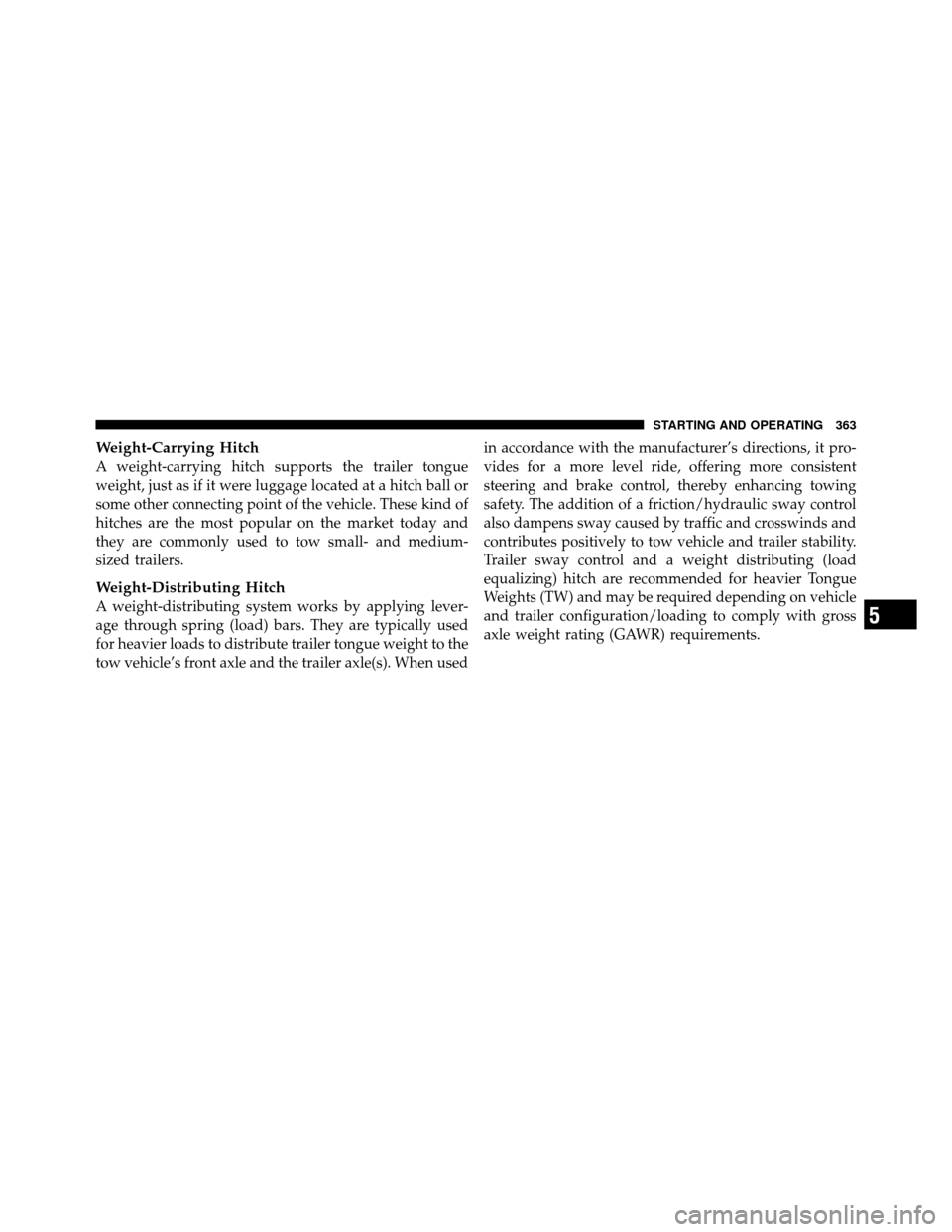
Weight-Carrying Hitch
A weight-carrying hitch supports the trailer tongue
weight, just as if it were luggage located at a hitch ball or
some other connecting point of the vehicle. These kind of
hitches are the most popular on the market today and
they are commonly used to tow small- and medium-
sized trailers.
Weight-Distributing Hitch
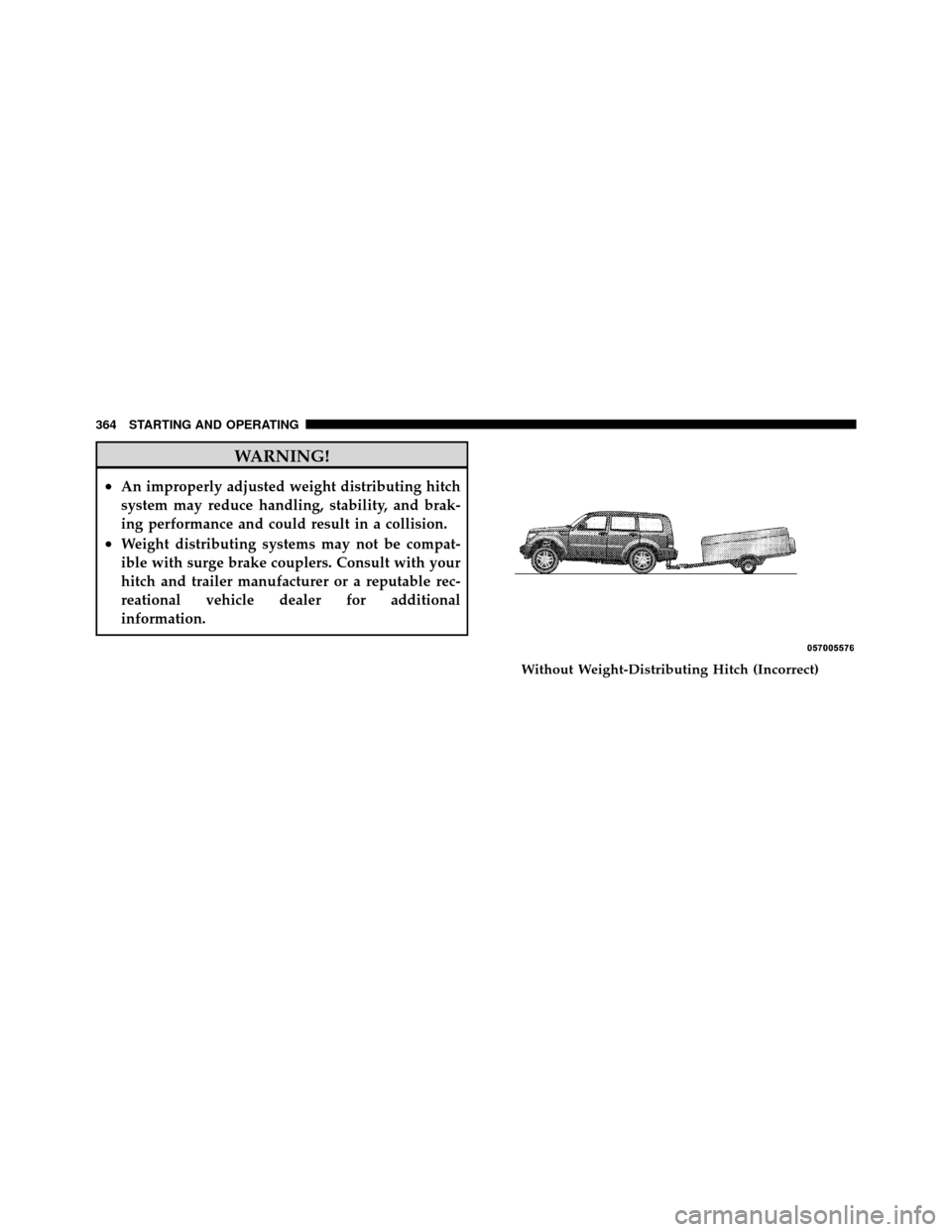
A weight-distributing system works by applying lever-
age through spring (load) bars. They are typically used
for heavier loads to distribute trailer tongue weight to the
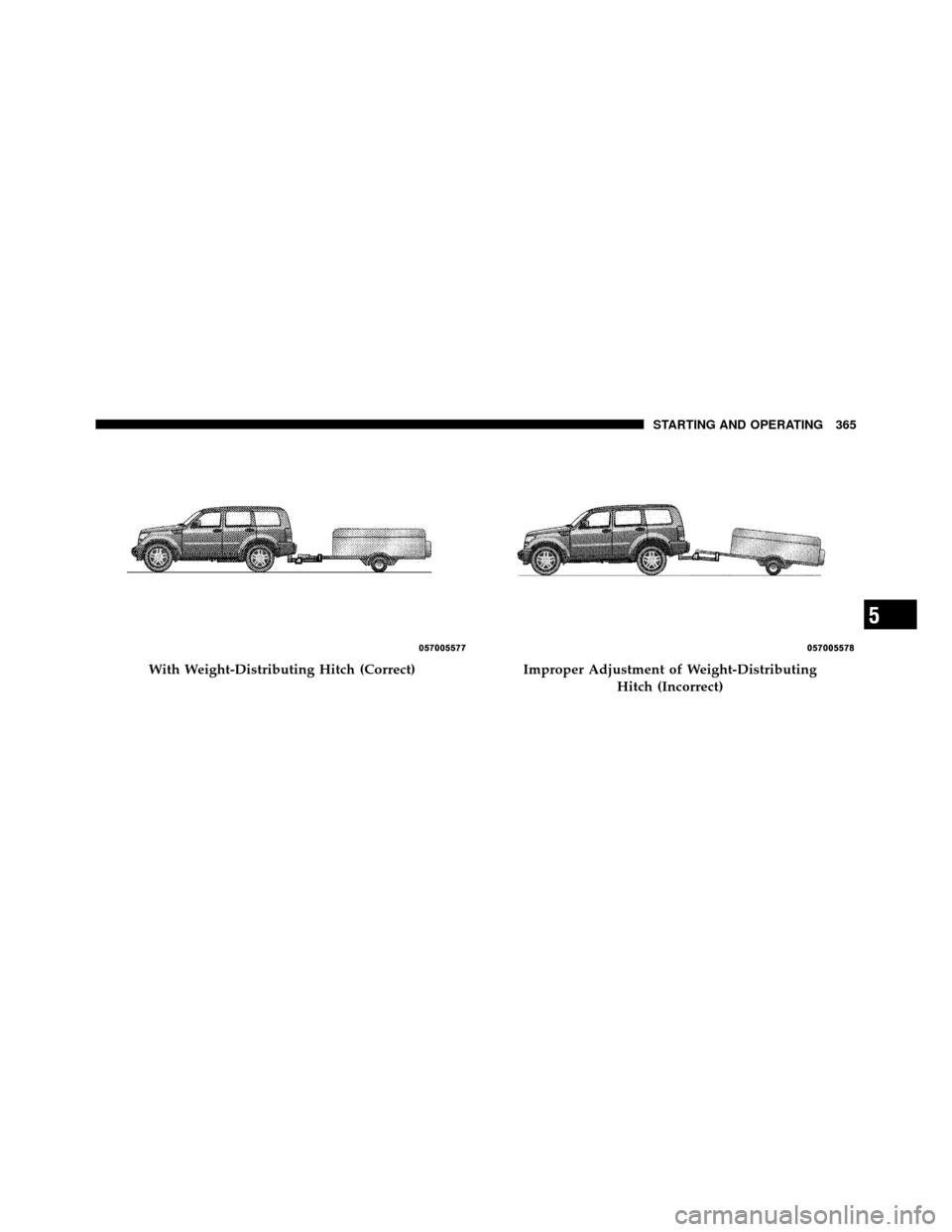
tow vehicle’s front axle and the trailer axle(s). When usedin accordance with the manufacturer’s directions, it pro-
vides for a more level ride, offering more consistent
steering and brake control, thereby enhancing towing
safety. The addition of a friction/hydraulic sway control
also dampens sway caused by traffic and crosswinds and
contributes positively to tow vehicle and trailer stability.
Trailer sway control and a weight distributing (load
equalizing) hitch are recommended for heavier Tongue
Weights (TW) and may be required depending on vehicle
and trailer configuration/loading to comply with gross
axle weight rating (GAWR) requirements.5
STARTING AND OPERATING 363
Page 367 of 497
WARNING!
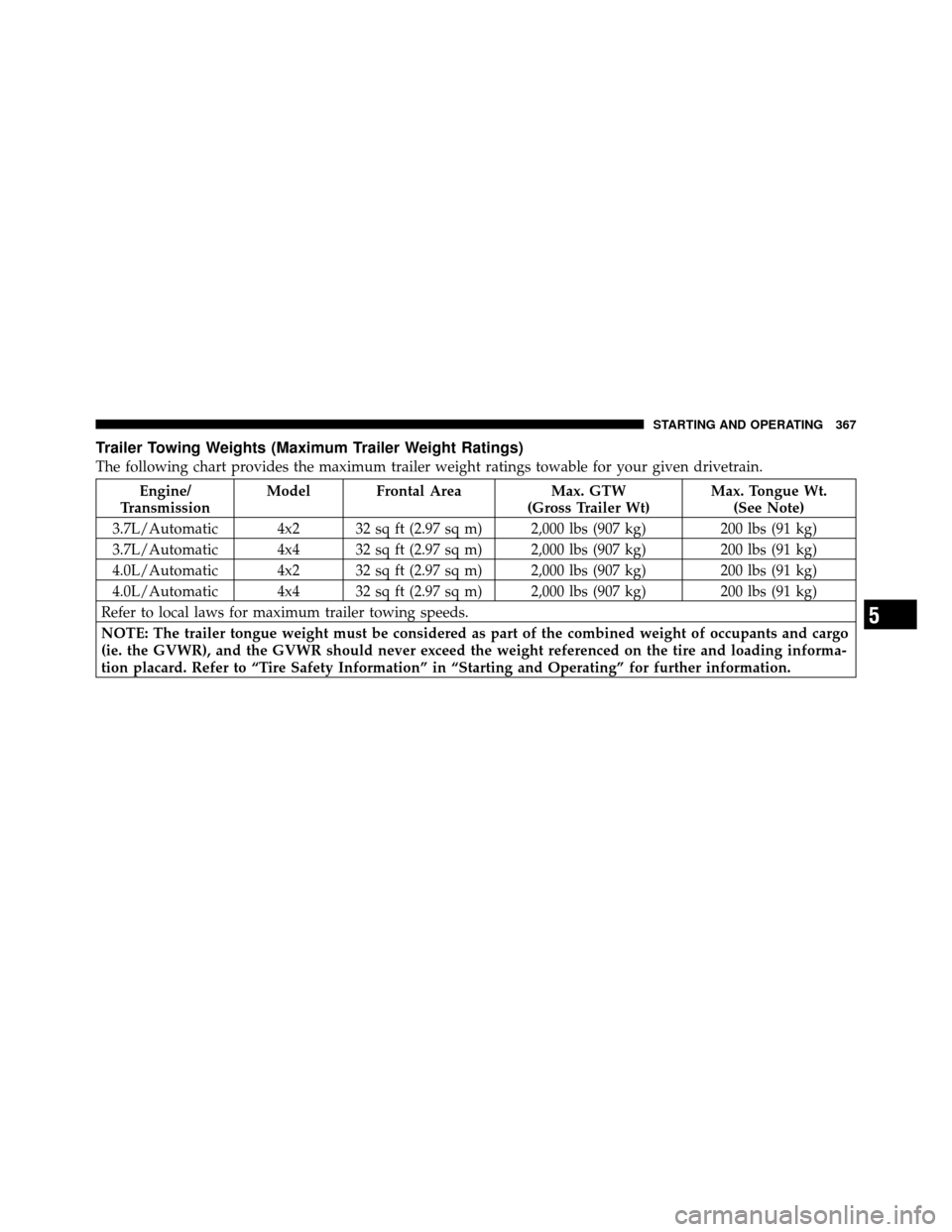
•An improperly adjusted weight distributing hitch
system may reduce handling, stability, and brak-
ing performance and could result in a collision.
•Weight distributing systems may not be compat-
ible with surge brake couplers. Consult with your
hitch and trailer manufacturer or a reputable rec-
reational vehicle dealer for additional
information.
Without Weight-Distributing Hitch (Incorrect)
364 STARTING AND OPERATING
Page 368 of 497
With Weight-Distributing Hitch (Correct)Improper Adjustment of Weight-DistributingHitch (Incorrect)
5
STARTING AND OPERATING 365
Page 369 of 497
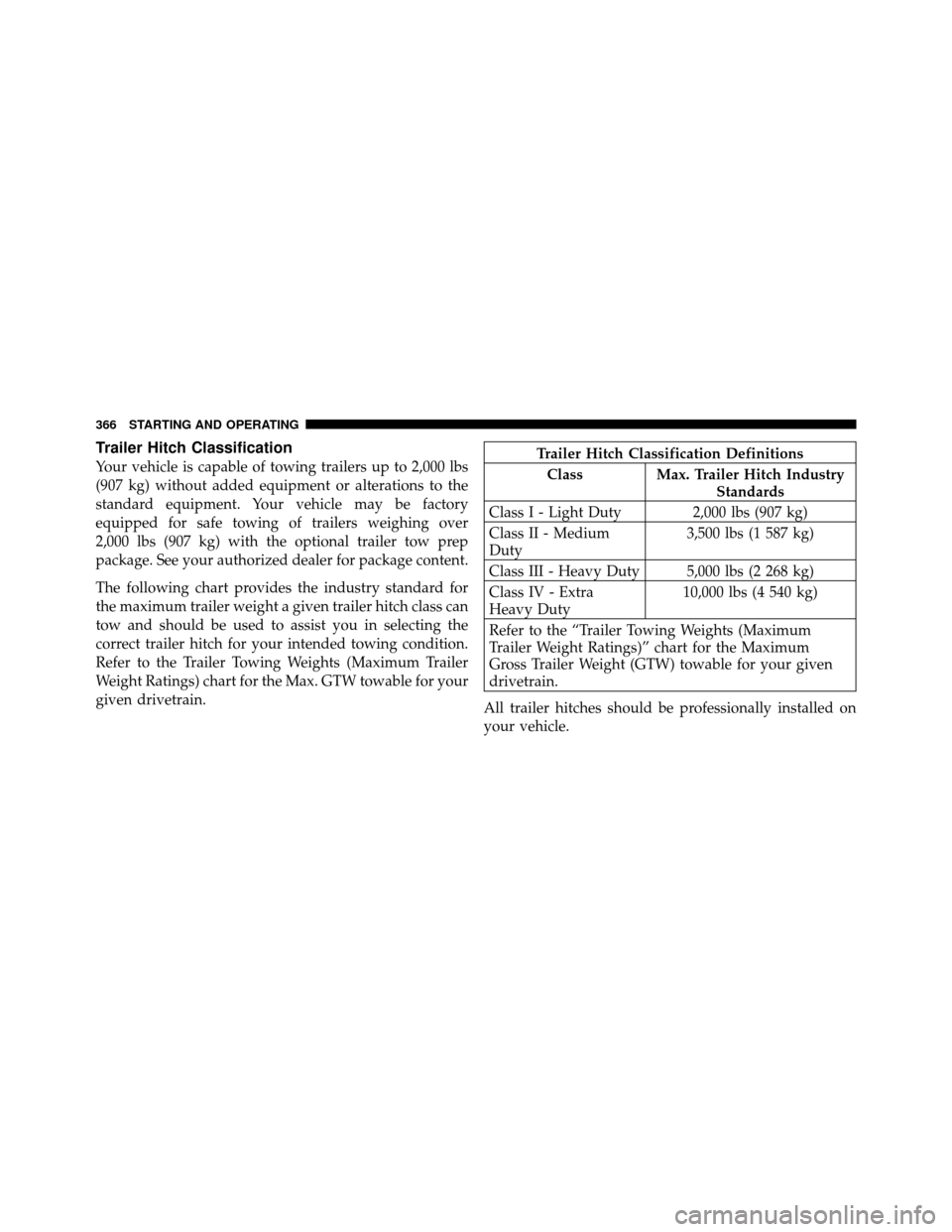
Trailer Hitch Classification
Your vehicle is capable of towing trailers up to 2,000 lbs
(907 kg) without added equipment or alterations to the
standard equipment. Your vehicle may be factory
equipped for safe towing of trailers weighing over
2,000 lbs (907 kg) with the optional trailer tow prep
package. See your authorized dealer for package content.
The following chart provides the industry standard for
the maximum trailer weight a given trailer hitch class can
tow and should be used to assist you in selecting the
correct trailer hitch for your intended towing condition.
Refer to the Trailer Towing Weights (Maximum Trailer
Weight Ratings) chart for the Max. GTW towable for your
given drivetrain.Trailer Hitch Classification DefinitionsClass Max. Trailer Hitch Industry Standards
Class I - Light Duty 2,000 lbs (907 kg)
Class II - Medium
Duty 3,500 lbs (1 587 kg)
Class III - Heavy Duty 5,000 lbs (2 268 kg)
Class IV - Extra
Heavy Duty 10,000 lbs (4 540 kg)
Refer to the “Trailer Towing Weights (Maximum
Trailer Weight Ratings)” chart for the Maximum
Gross Trailer Weight (GTW) towable for your given
drivetrain.
All trailer hitches should be professionally installed on
your vehicle.
366 STARTING AND OPERATING
Page 370 of 497
Trailer Towing Weights (Maximum Trailer Weight Ratings)
The following chart provides the maximum trailer weight ratings towable for your given drivetrain.
Engine/
Transmission Model Frontal Area Max. GTW
(Gross Trailer Wt)Max. Tongue Wt.
(See Note)
3.7L/Automatic 4x2 32 sq ft (2.97 sq m) 2,000 lbs (907 kg) 200 lbs (91 kg)
3.7L/Automatic 4x4 32 sq ft (2.97 sq m) 2,000 lbs (907 kg) 200 lbs (91 kg)
4.0L/Automatic 4x2 32 sq ft (2.97 sq m) 2,000 lbs (907 kg) 200 lbs (91 kg)
4.0L/Automatic 4x4 32 sq ft (2.97 sq m) 2,000 lbs (907 kg) 200 lbs (91 kg)
Refer to local laws for maximum trailer towing speeds.
NOTE: The trailer tongue weight must be considered as part of the combined weight of occupants and cargo
(ie. the GVWR), and the GVWR should never exceed the weight referenced on the tire and loading informa-
tion placard. Refer to “Tire Safety Information” in “Starting and Operating” for further information.
5
STARTING AND OPERATING 367
Page 371 of 497
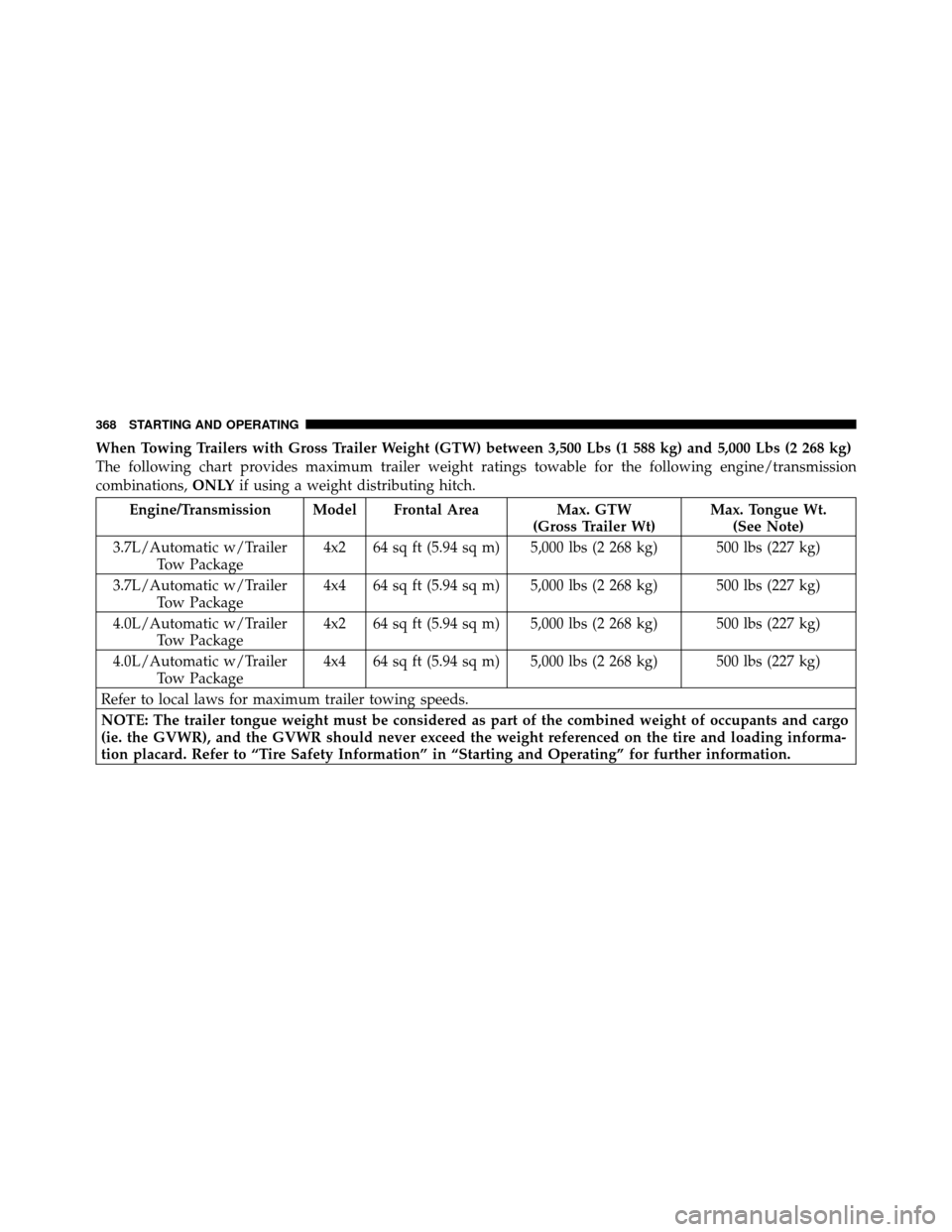
When Towing Trailers with Gross Trailer Weight (GTW) between 3,500 Lbs (1 588 kg) and 5,000 Lbs (2 268 kg)
The following chart provides maximum trailer weight ratings towable for the following engine/transmission
combinations,ONLYif using a weight distributing hitch.
Engine/Transmission Model Frontal Area Max. GTW
(Gross Trailer Wt) Max. Tongue Wt.
(See Note)
3.7L/Automatic w/Trailer Tow Package 4x2 64 sq ft (5.94 sq m) 5,000 lbs (2 268 kg) 500 lbs (227 kg)
3.7L/Automatic w/Trailer Tow Package 4x4 64 sq ft (5.94 sq m) 5,000 lbs (2 268 kg) 500 lbs (227 kg)
4.0L/Automatic w/Trailer Tow Package 4x2 64 sq ft (5.94 sq m) 5,000 lbs (2 268 kg) 500 lbs (227 kg)
4.0L/Automatic w/Trailer Tow Package 4x4 64 sq ft (5.94 sq m) 5,000 lbs (2 268 kg) 500 lbs (227 kg)
Refer to local laws for maximum trailer towing speeds.
NOTE: The trailer tongue weight must be considered as part of the combined weight of occupants and cargo
(ie. the GVWR), and the GVWR should never exceed the weight referenced on the tire and loading informa-
tion placard. Refer to “Tire Safety Information” in “Starting and Operating” for further information.
368 STARTING AND OPERATING
Page 372 of 497
Trailer And Tongue Weight
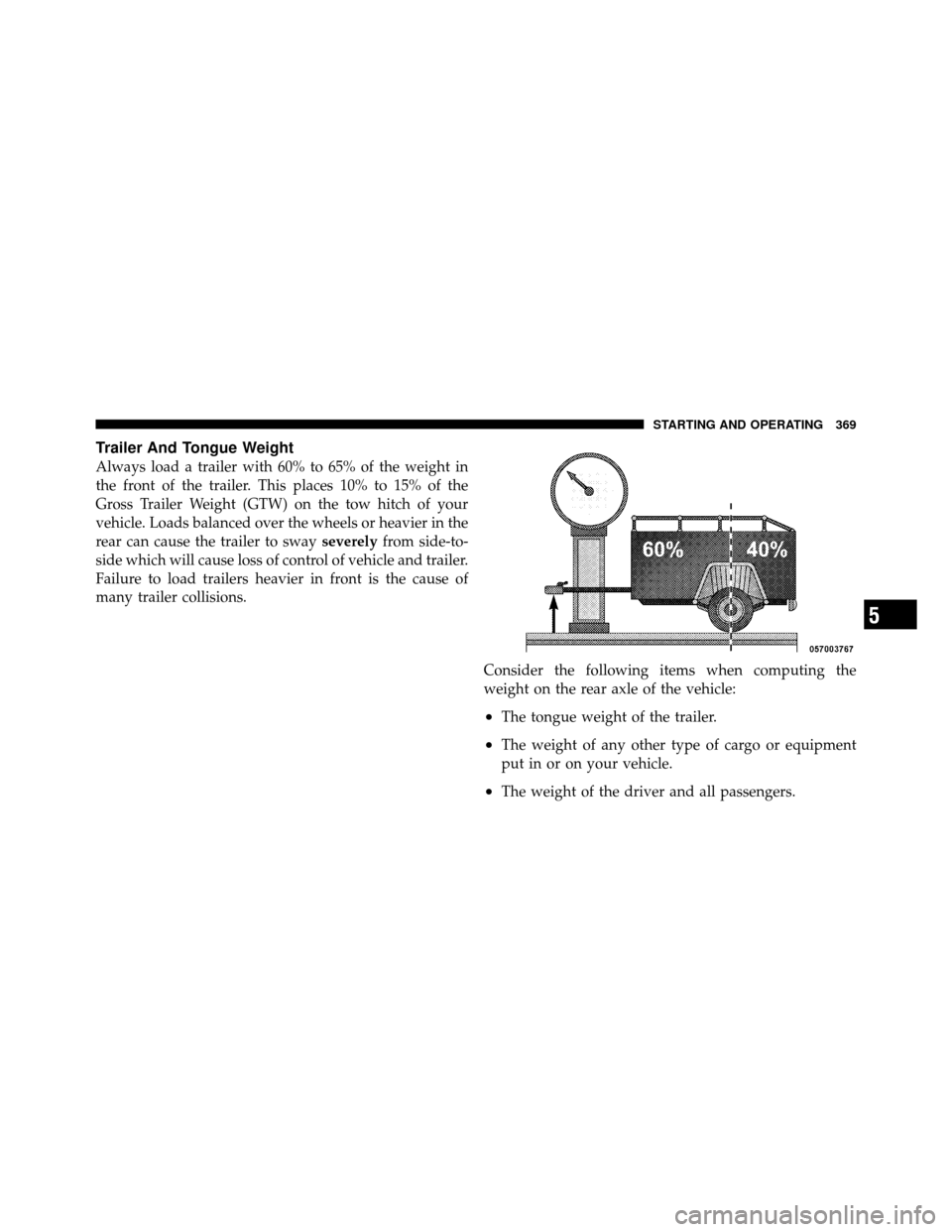
Always load a trailer with 60% to 65% of the weight in
the front of the trailer. This places 10% to 15% of the
Gross Trailer Weight (GTW) on the tow hitch of your
vehicle. Loads balanced over the wheels or heavier in the
rear can cause the trailer to swayseverelyfrom side-to-
side which will cause loss of control of vehicle and trailer.
Failure to load trailers heavier in front is the cause of
many trailer collisions.
Consider the following items when computing the
weight on the rear axle of the vehicle:
•The tongue weight of the trailer.
•The weight of any other type of cargo or equipment
put in or on your vehicle.
•The weight of the driver and all passengers.
5
STARTING AND OPERATING 369
Page 373 of 497
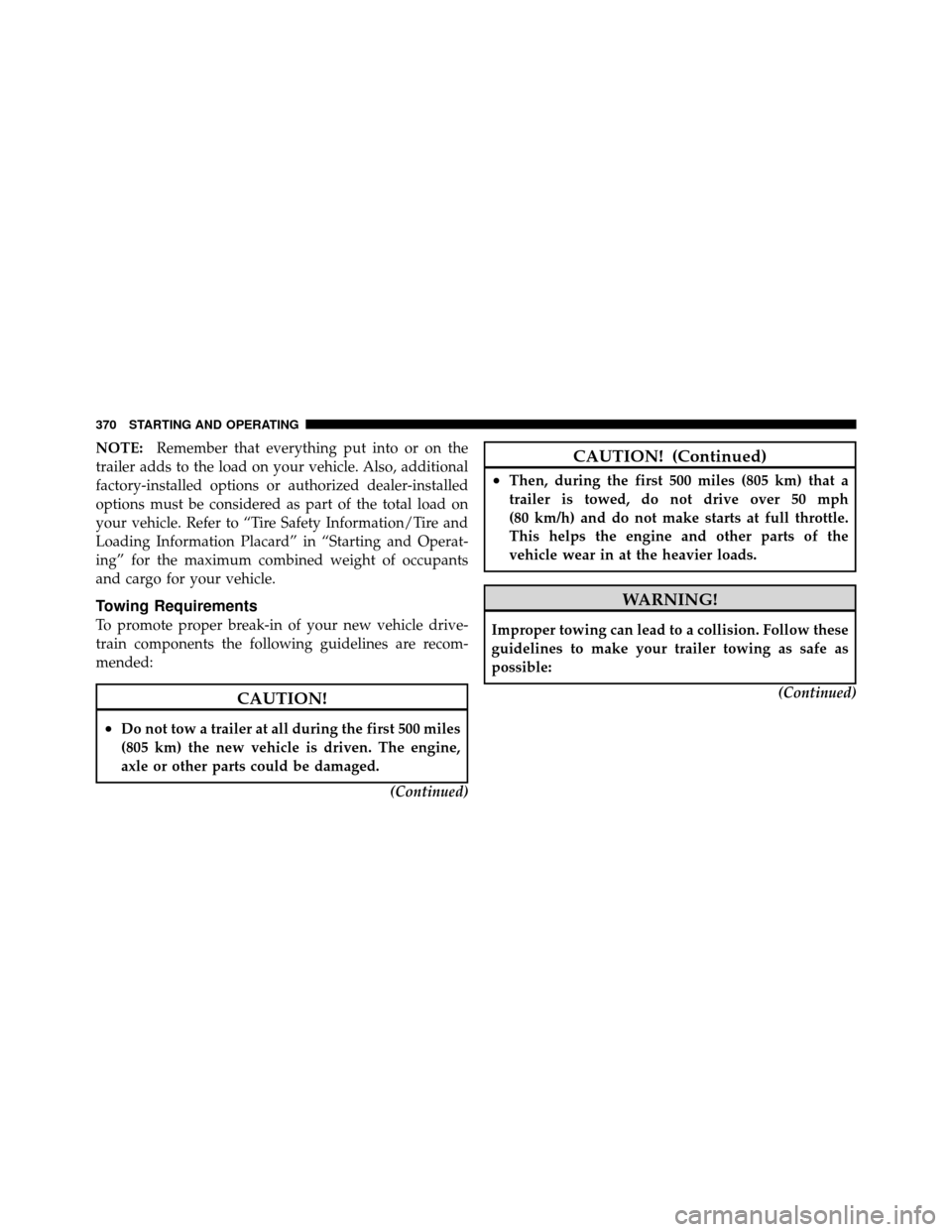
NOTE:Remember that everything put into or on the
trailer adds to the load on your vehicle. Also, additional
factory-installed options or authorized dealer-installed
options must be considered as part of the total load on
your vehicle. Refer to “Tire Safety Information/Tire and
Loading Information Placard” in “Starting and Operat-
ing” for the maximum combined weight of occupants
and cargo for your vehicle.
Towing Requirements
To promote proper break-in of your new vehicle drive-
train components the following guidelines are recom-
mended:
CAUTION!
•Do not tow a trailer at all during the first 500 miles
(805 km) the new vehicle is driven. The engine,
axle or other parts could be damaged.
(Continued)
CAUTION! (Continued)
•Then, during the first 500 miles (805 km) that a
trailer is towed, do not drive over 50 mph
(80 km/h) and do not make starts at full throttle.
This helps the engine and other parts of the
vehicle wear in at the heavier loads.
WARNING!
Improper towing can lead to a collision. Follow these
guidelines to make your trailer towing as safe as
possible: (Continued)
370 STARTING AND OPERATING