Page 370 of 497
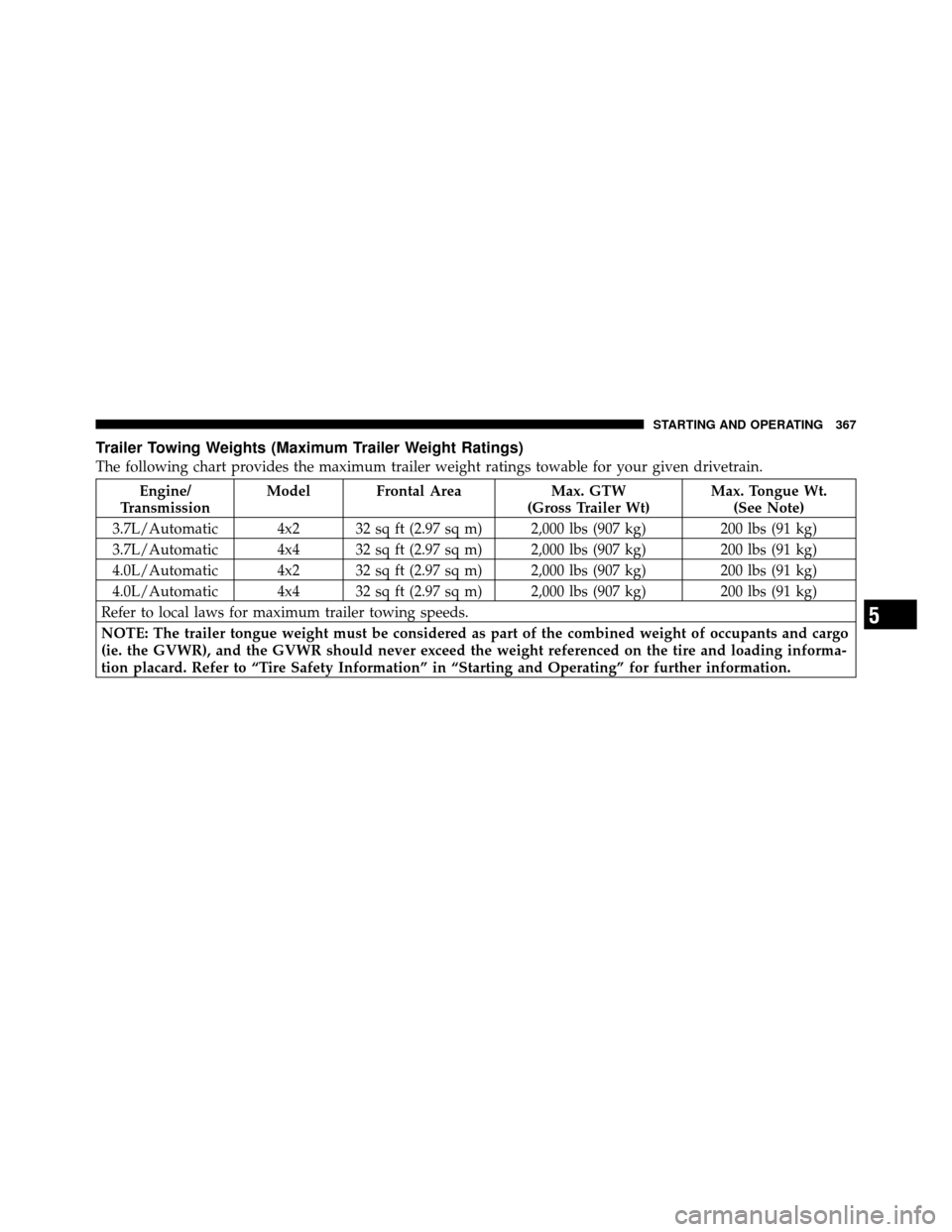
Trailer Towing Weights (Maximum Trailer Weight Ratings)
The following chart provides the maximum trailer weight ratings towable for your given drivetrain.
Engine/
Transmission Model Frontal Area Max. GTW
(Gross Trailer Wt)Max. Tongue Wt.
(See Note)
3.7L/Automatic 4x2 32 sq ft (2.97 sq m) 2,000 lbs (907 kg) 200 lbs (91 kg)
3.7L/Automatic 4x4 32 sq ft (2.97 sq m) 2,000 lbs (907 kg) 200 lbs (91 kg)
4.0L/Automatic 4x2 32 sq ft (2.97 sq m) 2,000 lbs (907 kg) 200 lbs (91 kg)
4.0L/Automatic 4x4 32 sq ft (2.97 sq m) 2,000 lbs (907 kg) 200 lbs (91 kg)
Refer to local laws for maximum trailer towing speeds.
NOTE: The trailer tongue weight must be considered as part of the combined weight of occupants and cargo
(ie. the GVWR), and the GVWR should never exceed the weight referenced on the tire and loading informa-
tion placard. Refer to “Tire Safety Information” in “Starting and Operating” for further information.
5
STARTING AND OPERATING 367
Page 371 of 497
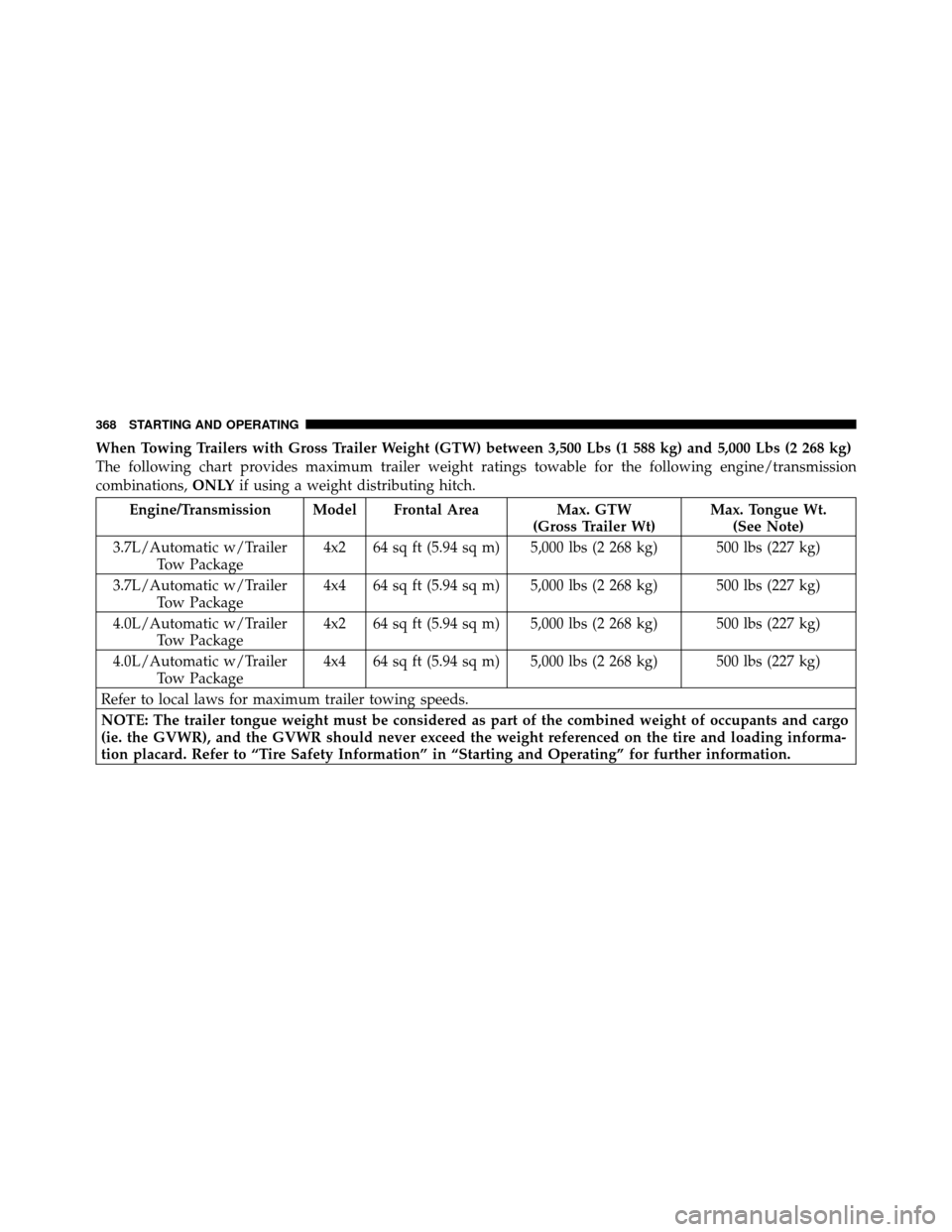
When Towing Trailers with Gross Trailer Weight (GTW) between 3,500 Lbs (1 588 kg) and 5,000 Lbs (2 268 kg)
The following chart provides maximum trailer weight ratings towable for the following engine/transmission
combinations,ONLYif using a weight distributing hitch.
Engine/Transmission Model Frontal Area Max. GTW
(Gross Trailer Wt) Max. Tongue Wt.
(See Note)
3.7L/Automatic w/Trailer Tow Package 4x2 64 sq ft (5.94 sq m) 5,000 lbs (2 268 kg) 500 lbs (227 kg)
3.7L/Automatic w/Trailer Tow Package 4x4 64 sq ft (5.94 sq m) 5,000 lbs (2 268 kg) 500 lbs (227 kg)
4.0L/Automatic w/Trailer Tow Package 4x2 64 sq ft (5.94 sq m) 5,000 lbs (2 268 kg) 500 lbs (227 kg)
4.0L/Automatic w/Trailer Tow Package 4x4 64 sq ft (5.94 sq m) 5,000 lbs (2 268 kg) 500 lbs (227 kg)
Refer to local laws for maximum trailer towing speeds.
NOTE: The trailer tongue weight must be considered as part of the combined weight of occupants and cargo
(ie. the GVWR), and the GVWR should never exceed the weight referenced on the tire and loading informa-
tion placard. Refer to “Tire Safety Information” in “Starting and Operating” for further information.
368 STARTING AND OPERATING
Page 378 of 497

Towing Tips
Before setting out on a trip, practice turning, stopping
and backing up the trailer in an area away from heavy
traffic.
Automatic Transmission
The “D” range can be selected when towing. However, if
frequent shifting occurs while in this range, the “TOW/
HAUL” button (if equipped) or a lower gear range
should be selected.
NOTE:Using the “TOW/HAUL” button (3.7L engine)
or “4” range (4.0L engine) while operating the vehicle
under heavy operating conditions will improve perfor-
mance and extend transmission life by reducing exces-
sive shifting and heat build up. This action will also
provide better engine braking. The automatic transmission fluid and filter should be
changed if you regularly tow a trailer for more than
45 minutes of continuous operation. Refer to “Mainte-
nance Schedule” for the proper maintenance intervals.
TOW/HAUL – If Equipped
To reduce potential for automatic transmission overheat-
ing, press the “TOW/HAUL” button when driving in
hilly areas or shift the transmission to DRIVE position 2
on more severe grades. Refer to “Automatic Transmis-
sion” in “Starting and Operating” for further
information.
5
STARTING AND OPERATING 375
Page 387 of 497
WARNING!
Do not attempt to change a tire on the side of the
vehicle close to moving traffic, pull far enough off
the road to avoid being hit when operating the jack
or changing the wheel.
2. Turn on the Hazard Warning flasher.
3. Set the parking brake.
4. Place the shift lever into PARK.
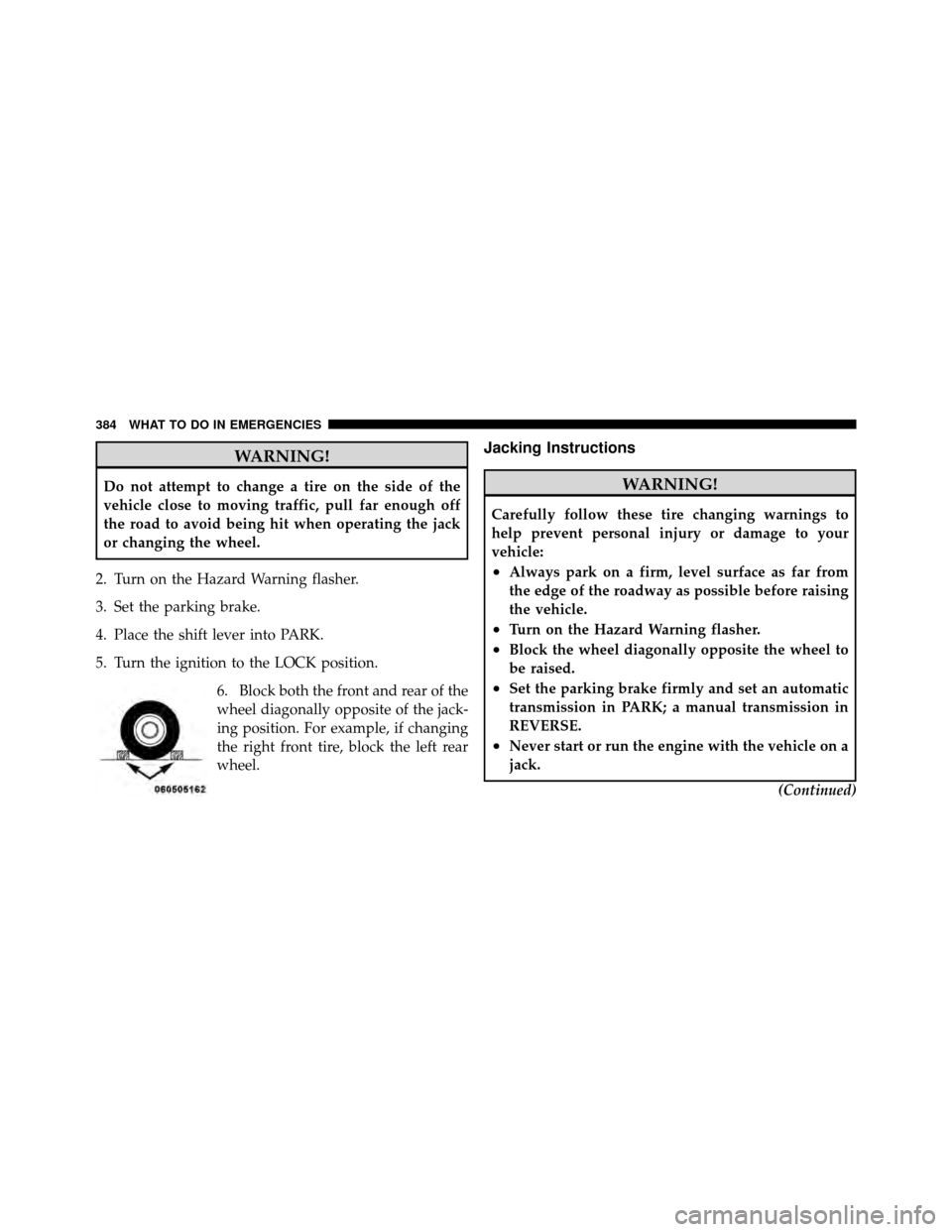
5. Turn the ignition to the LOCK position. 6. Block both the front and rear of the
wheel diagonally opposite of the jack-
ing position. For example, if changing
the right front tire, block the left rear
wheel.
Jacking Instructions
WARNING!
Carefully follow these tire changing warnings to
help prevent personal injury or damage to your
vehicle:
•Always park on a firm, level surface as far from
the edge of the roadway as possible before raising
the vehicle.
•Turn on the Hazard Warning flasher.
•Block the wheel diagonally opposite the wheel to
be raised.
•Set the parking brake firmly and set an automatic
transmission in PARK; a manual transmission in
REVERSE.
•Never start or run the engine with the vehicle on a
jack. (Continued)
384 WHAT TO DO IN EMERGENCIES
Page 392 of 497
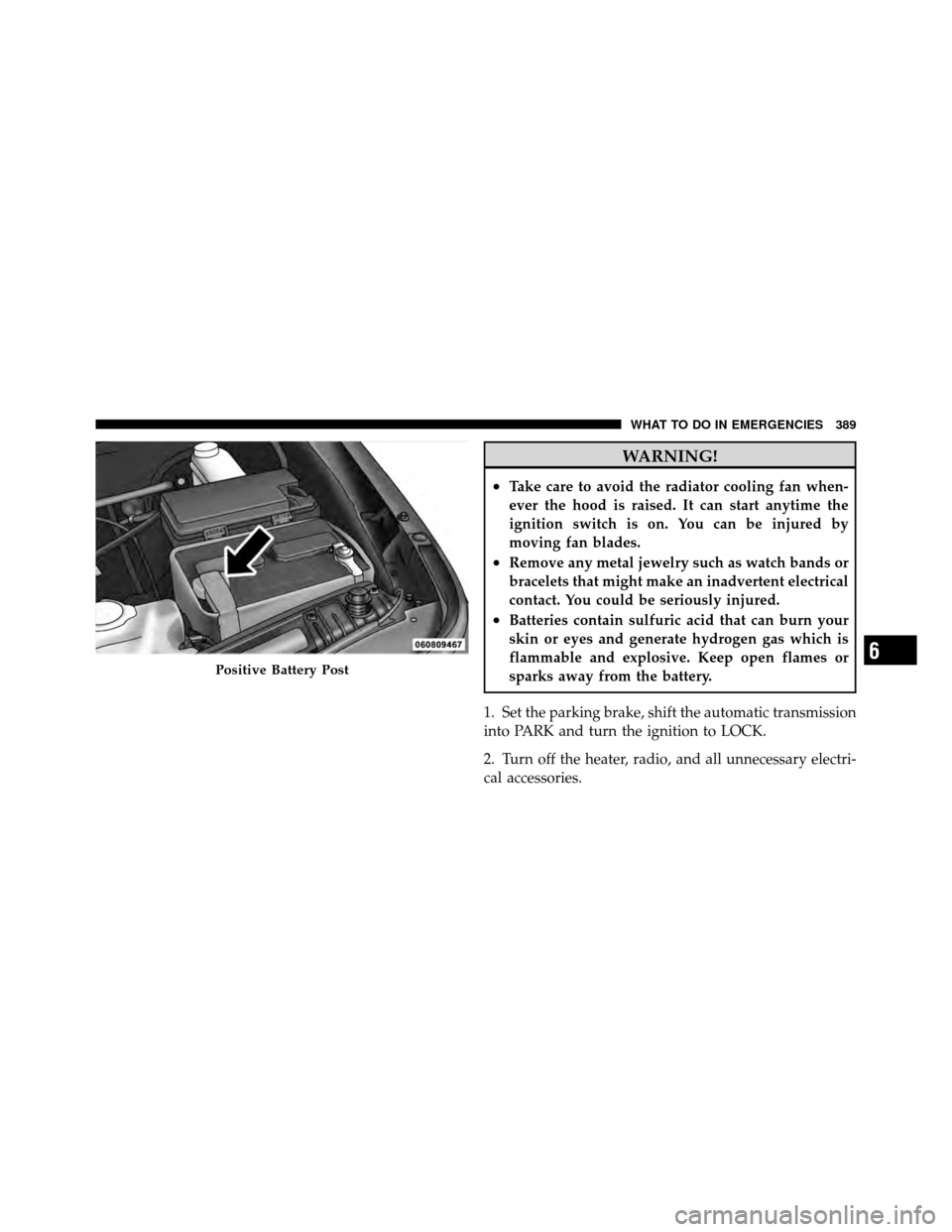
WARNING!
•Take care to avoid the radiator cooling fan when-
ever the hood is raised. It can start anytime the
ignition switch is on. You can be injured by
moving fan blades.
•Remove any metal jewelry such as watch bands or
bracelets that might make an inadvertent electrical
contact. You could be seriously injured.
•Batteries contain sulfuric acid that can burn your
skin or eyes and generate hydrogen gas which is
flammable and explosive. Keep open flames or
sparks away from the battery.
1. Set the parking brake, shift the automatic transmission
into PARK and turn the ignition to LOCK.
2. Turn off the heater, radio, and all unnecessary electri-
cal accessories.
Positive Battery Post6
WHAT TO DO IN EMERGENCIES 389
Page 398 of 497
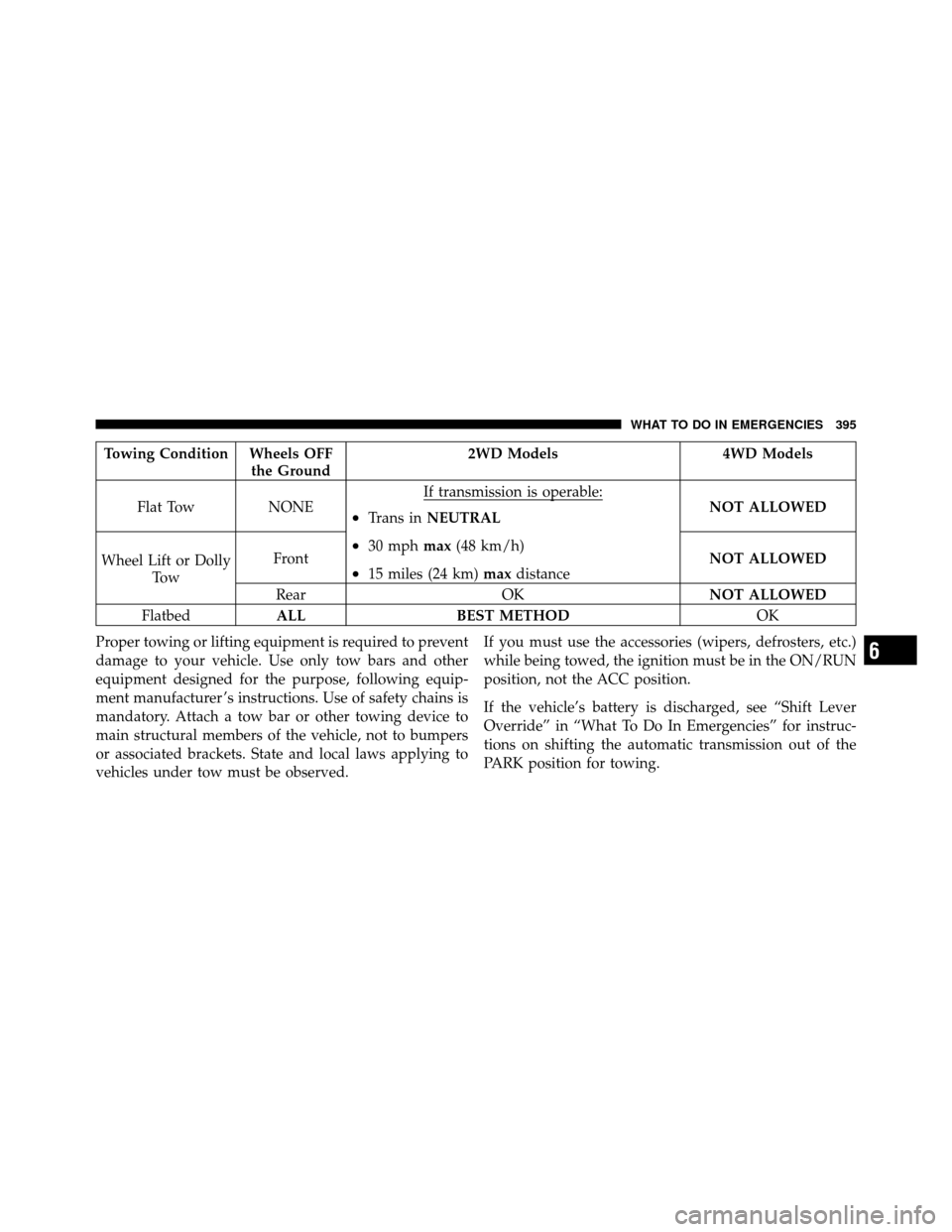
Towing Condition Wheels OFFthe Ground 2WD Models
4WD Models
Flat Tow NONE If transmission is operable:
•Trans in
NEUTRAL
•30 mphmax(48 km/h)
•15 miles (24 km) maxdistance NOT ALLOWED
Wheel Lift or Dolly To w Front
NOT ALLOWED
Rear OKNOT ALLOWED
Flatbed ALL BEST METHOD OK
Proper towing or lifting equipment is required to prevent
damage to your vehicle. Use only tow bars and other
equipment designed for the purpose, following equip-
ment manufacturer ’s instructions. Use of safety chains is
mandatory. Attach a tow bar or other towing device to
main structural members of the vehicle, not to bumpers
or associated brackets. State and local laws applying to
vehicles under tow must be observed. If you must use the accessories (wipers, defrosters, etc.)
while being towed, the ignition must be in the ON/RUN
position, not the ACC position.
If the vehicle’s battery is discharged, see “Shift Lever
Override” in “What To Do In Emergencies” for instruc-
tions on shifting the automatic transmission out of the
PARK position for towing.
6
WHAT TO DO IN EMERGENCIES 395
Page 403 of 497

▫Exhaust System ..................... 415
▫ Cooling System ..................... 417
▫ Brake System ....................... 422
▫ Automatic Transmission ............... 424
▫ Transfer Case ....................... 426
▫ Front/Rear Axle Fluid ................. 427
▫ Appearance Care And Protection From
Corrosion .......................... 427
� Fuses .............................. 432
▫ Totally Integrated Power Module ......... 432
� Replacement Bulbs .................... 438
� Bulb Replacement ..................... 438
▫ Headlamp ......................... 438 ▫
Left Front Turn Signal ................. 439
▫ Right Front Turn Signal ................ 440
▫ Front Side Marker .................... 440
▫ Front Fog Lamp (Front Fascia Mounted) .... 440
▫ Rear Tail, Stop, Turn Signal, And Backup
Lamp ............................. 441
▫ Center High Mounted Stop Lamp
(CHMSL) .......................... 442
� Fluid Capacities ...................... 443
� Fluids, Lubricants And Genuine Parts ....... 444
▫ Engine ............................ 444
▫ Chassis ........................... 445
400 MAINTAINING YOUR VEHICLE
Page 406 of 497

ONBOARD DIAGNOSTIC SYSTEM — OBD II
Your vehicle is equipped with a sophisticated onboard
diagnostic system called OBD II. This system monitors
the performance of the emissions, engine, and automatic
transmission control systems. When these systems are
operating properly, your vehicle will provide excellent
performance and fuel economy, as well as engine emis-
sions well within current government regulations.
If any of these systems require service, the OBD II system
will turn on the “Malfunction Indicator Light” (MIL). It
will also store diagnostic codes and other information to
assist your service technician in making repairs. Al-
though your vehicle will usually be drivable and not
need towing, see your authorized dealer for service as
soon as possible.CAUTION!
•Prolonged driving with the MIL on could cause
further damage to the emission control system. It
could also affect fuel economy and drivability. The
vehicle must be serviced before any emissions
tests can be performed.
•If the MIL is flashing while the engine is running,
severe catalytic converter damage and power loss
will soon occur. Immediate service is required.
Loose Fuel Filler Cap Message
If the vehicle diagnostic system determines that the fuel
filler cap is loose, improperly installed, or damaged, a
“gASCAP” message will display in the odometer or a
“CHECK GASCAP” message will be displayed in the
Electronic Vehicle Information Center (EVIC). Refer to
“Electronic Vehicle Information Center (EVIC)” in “Under-
standing Your Instrument Panel” for further information.
7
MAINTAINING YOUR VEHICLE 403