Page 334 of 452
8. After the NEUTRAL indicator light turns off, release
the NEUTRAL button.
9. After the NEUTRAL button has been released, the
transfer case will shift into the position identified by the
transfer case switch.
10. Start the engine. Shift the transmission into DRIVE to
verify that the transfer case has engaged.
11. Set the parking brake. Shift the transmission into
PARK.
NOTE:
•Steps 1 through 5 are requirements that must be met
prior to pressing the NEUTRAL button, and must
continue to be met until one second elapses and the
shift has been completed. If any of these requirements
(with the exception of 3 - key ON) are not met prior to
pressing the NEUTRAL button or are no longer met
during the one second time, then all of the modeposition indicator lights will flash continuously until
all requirements are met or until the NEUTRAL button
is released.
•The ignition key must be ON for a shift to take place
and for the position indicator lights to be operable. If
the key is not ON, the shift will not take place and no
position indicator lights will be on or flashing.
•A flashing NEUTRAL position indicator light indicates
that shift requirements have not been met.
CAUTION!
•Do not use a bumper mounted clamp-on tow bar
on your vehicle. The bumper face bar will be
damaged.
•Do not disconnect the rear driveshaft because
fluid will leak from the transfer case and damage
internal parts.
332 STARTING AND OPERATING
Page 342 of 452
Preparations
1. Park the vehicle on a firm, level surface. Avoid icy or
slippery areas.
WARNING!
Do not attempt to change a tire on the side of the
vehicle close to moving traffic. Pull far enough off
the road to avoid the danger of being hit when
operating the jack or changing the wheel.
2. Turn on the Hazard Warning flasher.
3. Set the parking brake. 4. Place the shift lever in PARK (automatic transmission).
On 4-Wheel Drive vehicles, shift the transfer case to the
4L position.
5. Turn the ignition OFF.
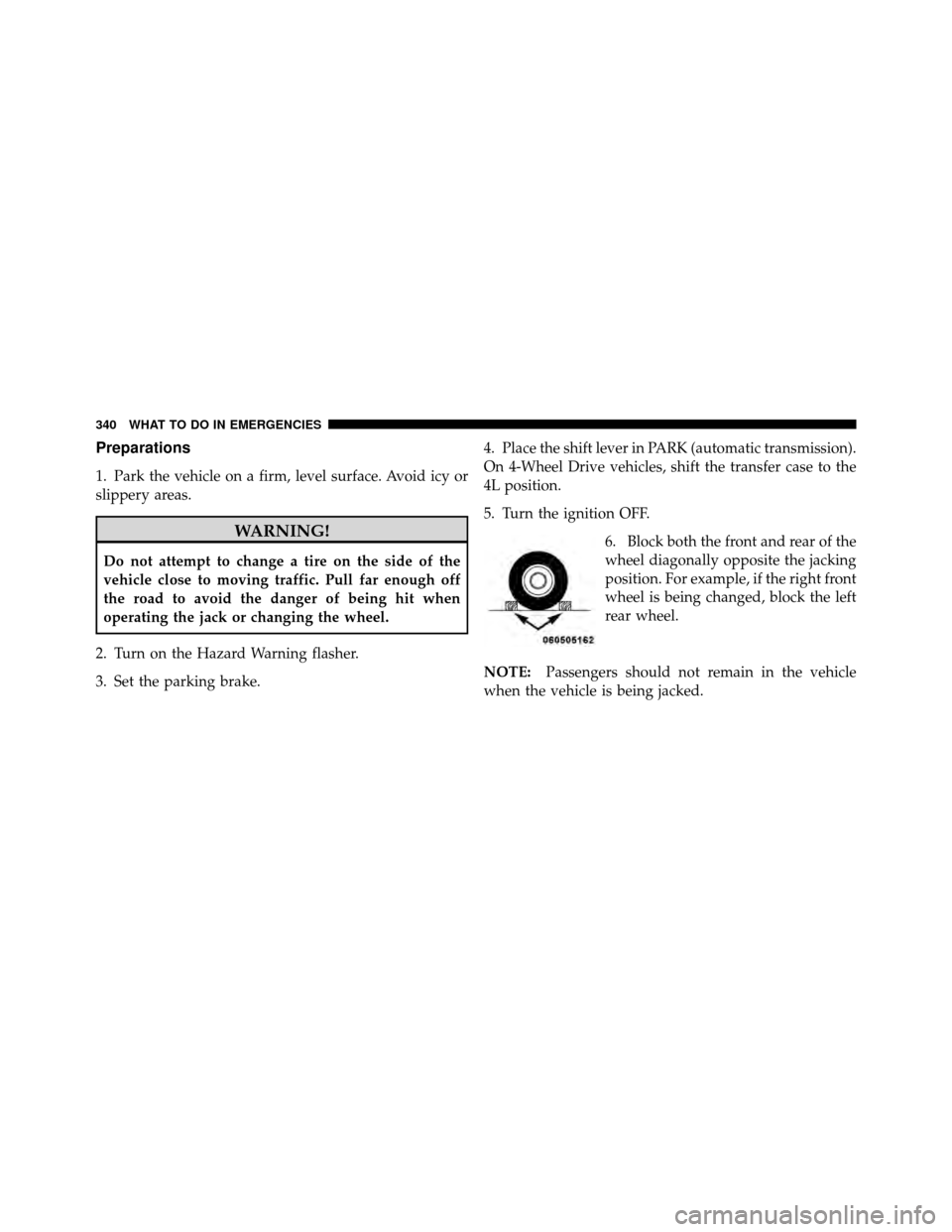
6. Block both the front and rear of the
wheel diagonally opposite the jacking
position. For example, if the right front
wheel is being changed, block the left
rear wheel.
NOTE: Passengers should not remain in the vehicle
when the vehicle is being jacked.
340 WHAT TO DO IN EMERGENCIES
Page 343 of 452
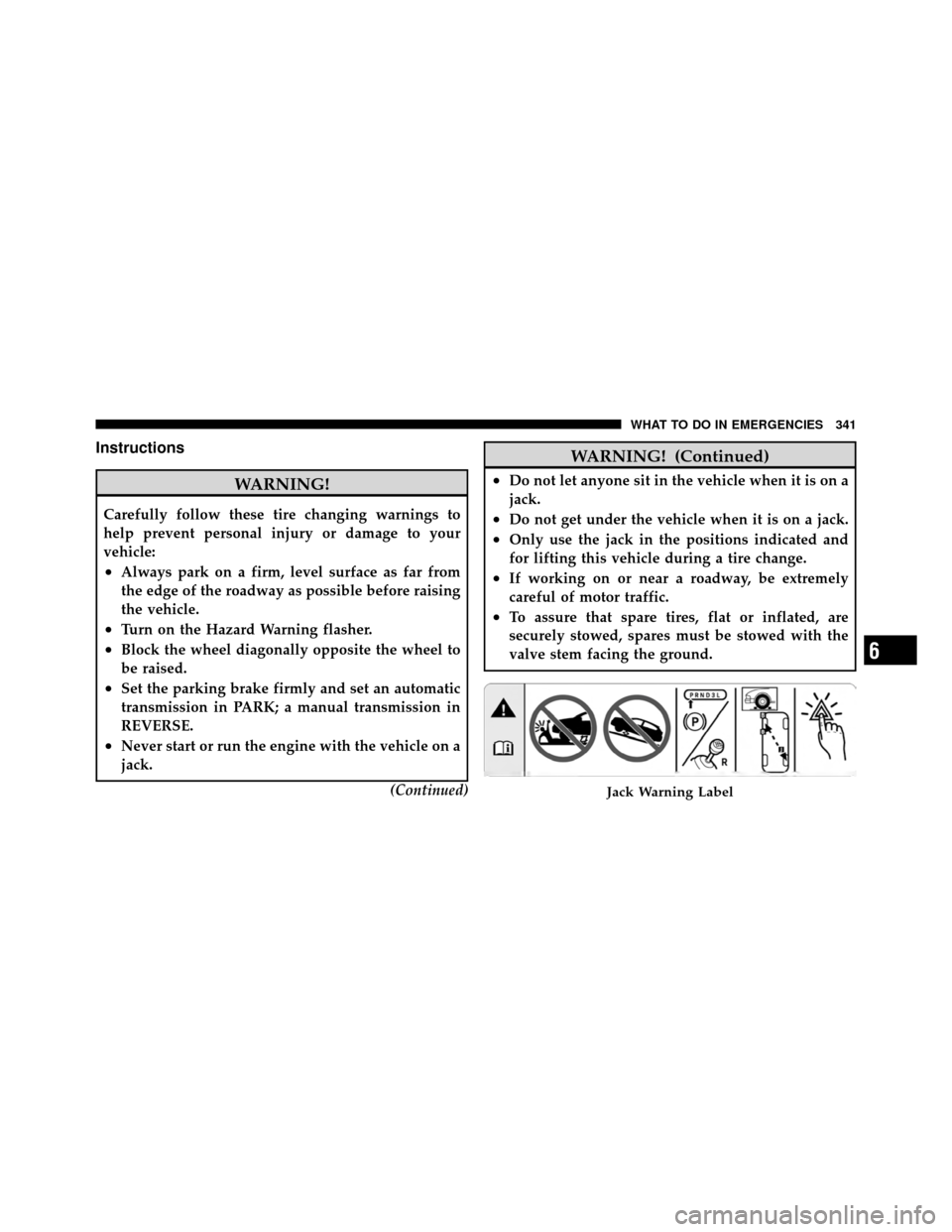
Instructions
WARNING!
Carefully follow these tire changing warnings to
help prevent personal injury or damage to your
vehicle:
•Always park on a firm, level surface as far from
the edge of the roadway as possible before raising
the vehicle.
•Turn on the Hazard Warning flasher.
•Block the wheel diagonally opposite the wheel to
be raised.
•Set the parking brake firmly and set an automatic
transmission in PARK; a manual transmission in
REVERSE.
•Never start or run the engine with the vehicle on a
jack.(Continued)
WARNING! (Continued)
•Do not let anyone sit in the vehicle when it is on a
jack.
•Do not get under the vehicle when it is on a jack.
•Only use the jack in the positions indicated and
for lifting this vehicle during a tire change.
•If working on or near a roadway, be extremely
careful of motor traffic.
•To assure that spare tires, flat or inflated, are
securely stowed, spares must be stowed with the
valve stem facing the ground.
Jack Warning Label
6
WHAT TO DO IN EMERGENCIES 341
Page 347 of 452
WARNING! (Continued)
•Always park on a firm, level surface as far from
the edge of the roadway as possible before raising
the vehicle.
•Block the wheel diagonally opposite the wheel to
be raised.
•Apply the parking brake firmly before jacking.
•Never start the engine with the vehicle on a jack.
•Do not let anyone sit in the vehicle when it is on a
jack.
•Do not get under the vehicle when it is on a jack.
•Only use the jack in the positions indicated.
•If working on or near a roadway, be extremely
careful of motor traffic.
•To assure that spare tires, flat or inflated, are
securely stowed, spares must be stowed with the
valve stem facing the ground.
To Stow The Flat Or Spare
Turn the wheel so that the valve stem is down. Slide the
wheel retainer through the center of the wheel and
position it properly across the wheel opening.
For convenience in checking the spare tire inflation, stow
with the valve stem toward the rear of the vehicle.
Rotate the winch mechanism until the wheel is drawn
into place against the underside of the vehicle. Continue
to rotate until you feel the winch mechanism slip or click
three times. It cannot be overtightened. Push against the
tire several times to be sure it is firmly in place.
NOTE:To Stow the Flat or Spare: Wheel retainer does
not fit through the center of the aluminum wheel. The tire
must be stored in a safe manner in the bed of the truck.
JUMP-STARTING PROCEDURES
If your vehicle has a discharged battery it can be jump-
started using a set of jumper cables and a battery in
6
WHAT TO DO IN EMERGENCIES 345
Page 349 of 452
WARNING!
•Take care to avoid the radiator cooling fan when-
ever the hood is raised. It can start anytime the
ignition switch is on. You can be injured by
moving fan blades.
•Remove any metal jewelry such as watch bands or
bracelets that might make an inadvertent electrical
contact. You could be seriously injured.
•Batteries contain sulfuric acid that can burn your
skin or eyes and generate hydrogen gas which is
flammable and explosive. Keep open flames or
sparks away from the battery.
1. Set the parking brake, shift the automatic transmission
into PARK and turn the ignition to LOCK.
2. Turn off the heater, radio, and all unnecessary electri-
cal accessories. 3. If using another vehicle to jump-start the battery, park
the vehicle within the jumper cables reach, set the
parking brake and make sure the ignition is OFF.
WARNING!
Do not allow vehicles to touch each other as this
could establish a ground connection and personal
injury could result.
Jump-Starting Procedure
WARNING!
Failure to follow this procedure could result in per-
sonal injury or property damage due to battery ex-
plosion.
6
WHAT TO DO IN EMERGENCIES 347
Page 356 of 452
▫Exhaust System ..................... 368
▫ Cooling System ..................... 371
▫ Brake System ....................... 376
▫ Automatic Transmission ............... 378
▫ Transfer Case ....................... 381
▫ Front/Rear Axle Fluid ................. 381
▫ Appearance Care And Protection From
Corrosion .......................... 382
� Fuses .............................. 387
▫ Underhood Fuses (Power Distribution
Center) ........................... 387
� Vehicle Storage ....................... 391
� Replacement Bulbs .................... 392 �
Bulb Replacement ..................... 392
▫ Headlamp (Halogen)/Front Park And Turn
Signal Lamps ....................... 392
▫ Rear Side Marker, Taillamps/Stop Lamps,
And Turn Signal Bulbs ................ 394
▫ Center High-Mounted Stop Lamp And Cargo
Lamp ............................. 397
▫ License Lamps ...................... 399
▫ Fog Lamps ......................... 401
� Fluid Capacities ...................... 401
� Fluids, Lubricants And Genuine Parts ....... 402
▫ Engine ............................ 402
▫ Chassis ........................... 403
354 MAINTAINING YOUR VEHICLE
Page 357 of 452
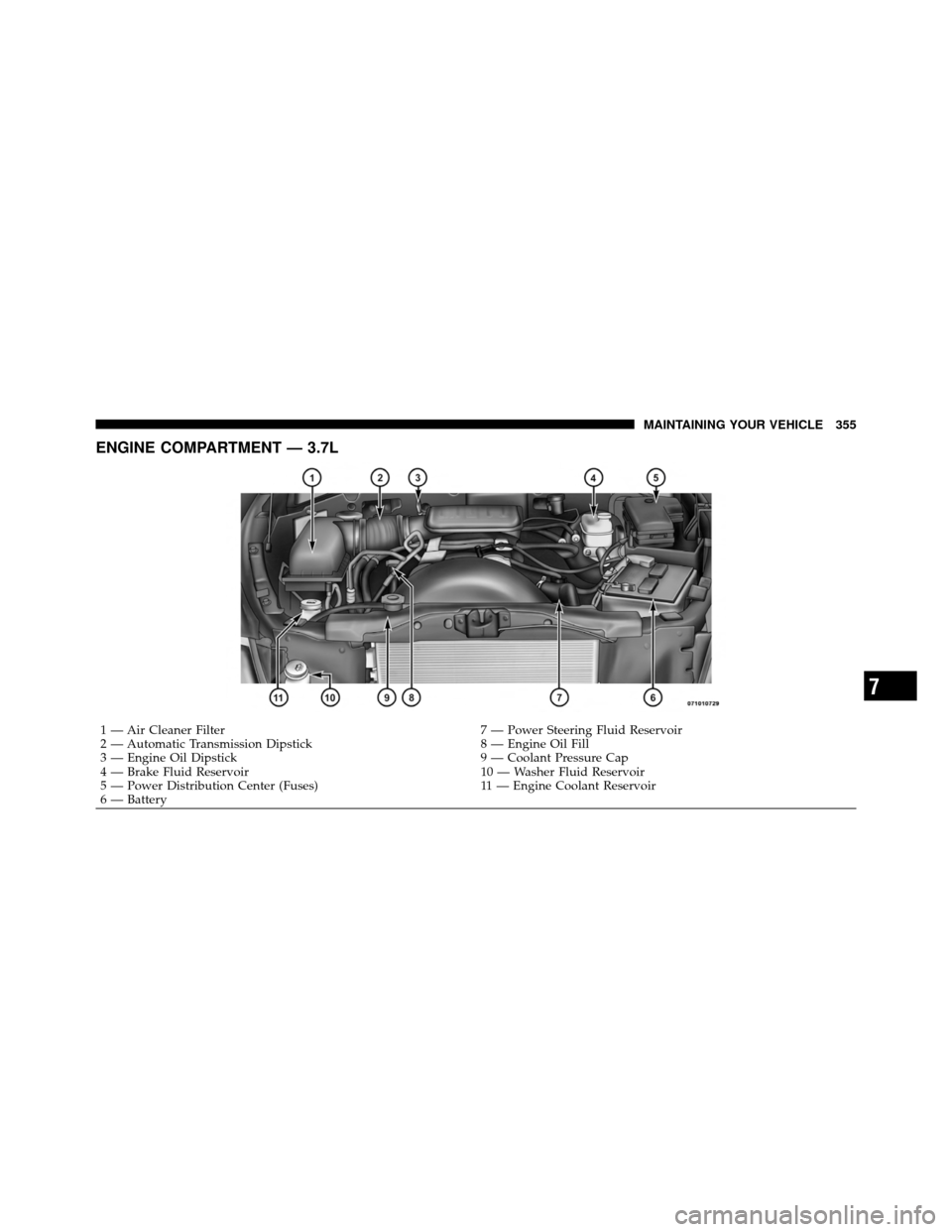
ENGINE COMPARTMENT — 3.7L
1 — Air Cleaner Filter7 — Power Steering Fluid Reservoir
2 — Automatic Transmission Dipstick 8 — Engine Oil Fill
3 — Engine Oil Dipstick 9 — Coolant Pressure Cap
4 — Brake Fluid Reservoir 10 — Washer Fluid Reservoir
5 — Power Distribution Center (Fuses) 11 — Engine Coolant Reservoir
6 — Battery
7
MAINTAINING YOUR VEHICLE 355
Page 358 of 452
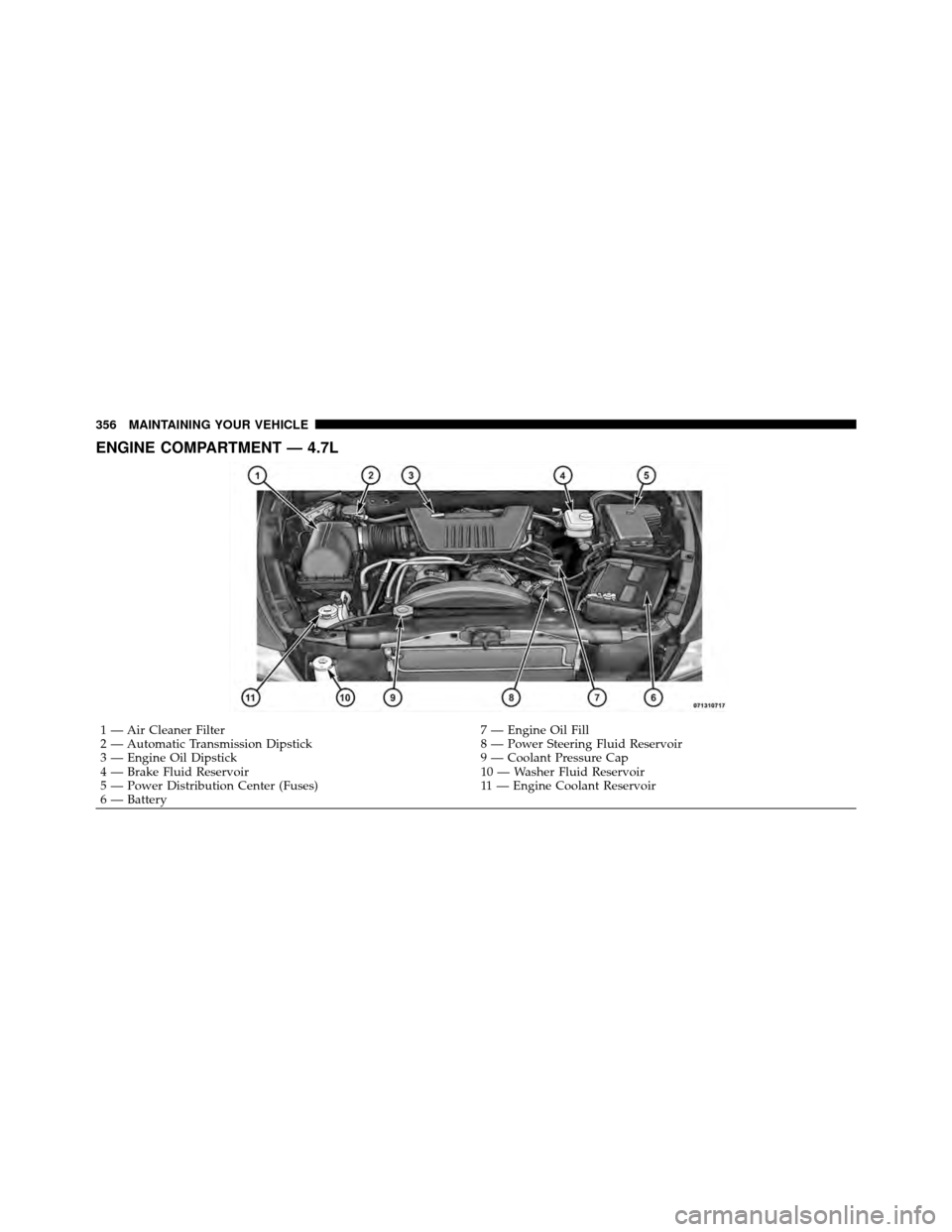
ENGINE COMPARTMENT — 4.7L
1 — Air Cleaner Filter7 — Engine Oil Fill
2 — Automatic Transmission Dipstick 8 — Power Steering Fluid Reservoir
3 — Engine Oil Dipstick 9 — Coolant Pressure Cap
4 — Brake Fluid Reservoir 10 — Washer Fluid Reservoir
5 — Power Distribution Center (Fuses) 11 — Engine Coolant Reservoir
6 — Battery
356 MAINTAINING YOUR VEHICLE