Page 345 of 566
STARTING AND OPERATING
CONTENTS
�Starting Procedures .................... 348
▫ Automatic Transmission ............... 348
▫ Keyless Enter-N-Go ................... 349
▫ Normal Starting ..................... 349
▫ Extreme Cold Weather
(Below –20°F Or �29°C)............... 350
▫ If Engine Fails To Start ................ 351
▫ After Starting ....................... 351
� Engine Block Heater — If Equipped ........ 352�
Automatic Transmission ................. 352
▫ General Information .................. 353
▫ Brake/Transmission Shift Interlock System . . 355
▫ Five-Speed Automatic Transmission ....... 355
▫ Gear Ranges ........................ 356
� AutoStick� .......................... 359
▫ Operation ......................... 359
� All-Wheel Drive (AWD) — If Equipped ...... 360
5
Page 347 of 566
▫Tire Loading And Tire Pressure .......... 384
� Tires — General Information ............. 388
▫ Tire Pressure ....................... 388
▫ Tire Inflation Pressures ................ 389
▫ Tire Pressures For High Speed Operation . . . 391
▫ Radial Ply Tires ..................... 391
▫ Spare Tire Matching Original Equipped Tire
And Wheel – If Equipped .............. 392
▫ Compact Spare Tire – If Equipped ........ 392
▫ Full Size Spare – If Equipped ............ 393
▫ Limited-Use Spare – If Equipped ......... 393
▫ Tire Spinning ....................... 394
▫ Tread Wear Indicators ................. 395 ▫
Life Of Tire ........................ 395
▫ Replacement Tires .................... 396
� Tire Chains .......................... 397
� Snow Tires .......................... 398
� Tire Rotation Recommendations ........... 399
� Tire Pressure Monitor System (TPMS) ....... 400
▫ Base System ........................ 403
▫ Premium System – If Equipped .......... 405
▫ General Information .................. 410
� Fuel Requirements ..................... 410
▫ 3.6L Engine – If Equipped .............. 410
▫ 5.7L Engine – If Equipped .............. 410
▫ Reformulated Gasoline ................ 411
5
STARTING AND OPERATING 345
Page 349 of 566
▫Trailer Hitch Classification .............. 427
▫ Trailer Towing Weights
(Maximum Trailer Weight Ratings) ........ 428
▫ Trailer And Tongue Weight ............. 428
▫ Towing Requirements ................. 429 ▫
Towing Tips ........................ 434
� Recreational Towing
(Behind Motorhome, Etc.) ................ 436
▫ Two-Wheel Drive And All-Wheel Drive .... 436
5
STARTING AND OPERATING 347
Page 358 of 566
Gear Ranges
PARK
This range supplements the parking brake by locking the
transmission. The engine can be started in this range.
Never use PARK while the vehicle is in motion. Apply
the parking brake when leaving the vehicle in this range.
When parking on a flat surface, place the shift lever in the
PARK position first, and then apply the parking brake.
When parking on a hill, it is important to set the parking
brake before placing the shift lever in PARK, otherwise
the load on the transmission locking mechanism may
make it difficult to move the shift lever out of PARK. As
an added precaution, turn the front wheels toward the
curb on a downhill grade and away from the curb on an
uphill grade.
WARNING!
Never use the PARK position as a substitute for the
parking brake. Always apply parking brake fully
when parked to guard against vehicle movement and
possible injury or damage.
The following indicators should be used to ensure that
you have engaged the shift lever in the PARK position:
•When shifting into PARK, move the shift lever all the
way forward and left until it stops and is fully seated.
•Look at the shift indicator display on the instrument
panel to ensure it is in the PARK position.
356 STARTING AND OPERATING
Page 362 of 566
Fully pressing the accelerator pedal while in AutoStick�
mode will downshift the transmission as needed for
maximum acceleration (3.6L Models Only).
The transmission will automatically downshift as the
vehicle slows to a stop (to prevent engine lugging) and
will display the current gear. Tapping the shift lever to
the D+ position (at a stop) will allow starting in second
gear. After a stop, the driver should manually upshift
(D+) the transmission as the vehicle is accelerated.
To disengage AutoStick�mode, hold the shift lever to the
right (D+) for a few seconds. You can shift in or out of the
AutoStick� mode at any time without taking your foot off
the accelerator pedal.WARNING!
Do not downshift for additional engine braking on a
slippery surface. The drive wheels could lose their
grip and the vehicle could skid, causing a collision or
personal injury.
ALL-WHEEL DRIVE (AWD) — IF EQUIPPED
This vehicle is equipped with an active on-demand
All-Wheel Drive (AWD) system which makes available
optimum traction for a wide variety of road surface and
driving conditions. The system minimizes wheel slip by
automatically redirecting torque to the front and rear
wheels as necessary.
To maximize fuel economy, your AWD vehicle automati-
cally defaults to rear-wheel drive (RWD) when road and
environmental conditions are such that wheel slip is
unlikely to occur. When specific road and environmental
conditions require increased levels of road traction, the
360 STARTING AND OPERATING
Page 363 of 566
vehicle automatically shifts into AWD mode. Automatic
AWD operation could be activated by outside tempera-
ture, wheel slip, or other predetermined conditions (there
may be a slight delay for AWD engagement after a wheel
slip condition occurs). AWD can also be manually se-
lected by moving the shift lever into the AutoStick�mode
(+/-) or activating the windshield wipers for an extended
period of time. Drive mode, RWD or AWD, is displayed
momentarily in the Electronic Vehicle Information Center
(EVIC) in the gage area of the vehicle display when the
transmission is first shifted into gear, and if the drive
mode changes during vehicle operation.
NOTE: If the “SERVICE AWD SYSTEM” warning mes-
sage appears after engine start up, or during driving, it
means that the AWD system is not functioning properly
and that service is required. Refer to “Electronic Vehicle
Information Center (EVIC)” in “Understanding Your
Instrument Panel” for further information.CAUTION!
All wheels must have the same size and type tires.
Unequal tire sizes must not be used. Unequal tire
size may cause failure of the front differential and/or
the transfer case.
DRIVING ON SLIPPERY SURFACES
Acceleration
Rapid acceleration on snow covered, wet, or other slip-
pery surfaces may cause the driving wheels to pull
erratically to the right or left. This phenomenon occurs
when there is a difference in the surface traction under
the rear (driving) wheels.5
STARTING AND OPERATING 361
Page 364 of 566
WARNING!
Rapid acceleration on slippery surfaces is dangerous.
Unequal traction can cause sudden pulling of the rear
wheels. You could lose control of the vehicle and
possibly have a collision. Accelerate slowly and
carefully whenever there is likely to be poor traction
(ice, snow, wet mud, loose sand, etc.).
Traction
When driving on wet or slushy roads, it is possible for a
wedge of water to build up between the tire and road
surface. This is known as hydroplaning and may cause
partial or complete loss of vehicle control and stopping
ability. To reduce this possibility, the following precau-
tions should be observed:
1. Slow down during rainstorms or when the roads are
slushy.2. Slow down if the road has standing water or puddles.
3. Replace tires when tread wear indicators first become
visible.
4. Keep tires properly inflated.
5. Maintain sufficient distance between your vehicle and
the vehicle in front of you to avoid a collision in a sudden
stop.DRIVING THROUGH WATER
Driving through water more than a few inches/
centimeters deep will require extra caution to ensure
safety and prevent damage to your vehicle.
362 STARTING AND OPERATING
Page 369 of 566
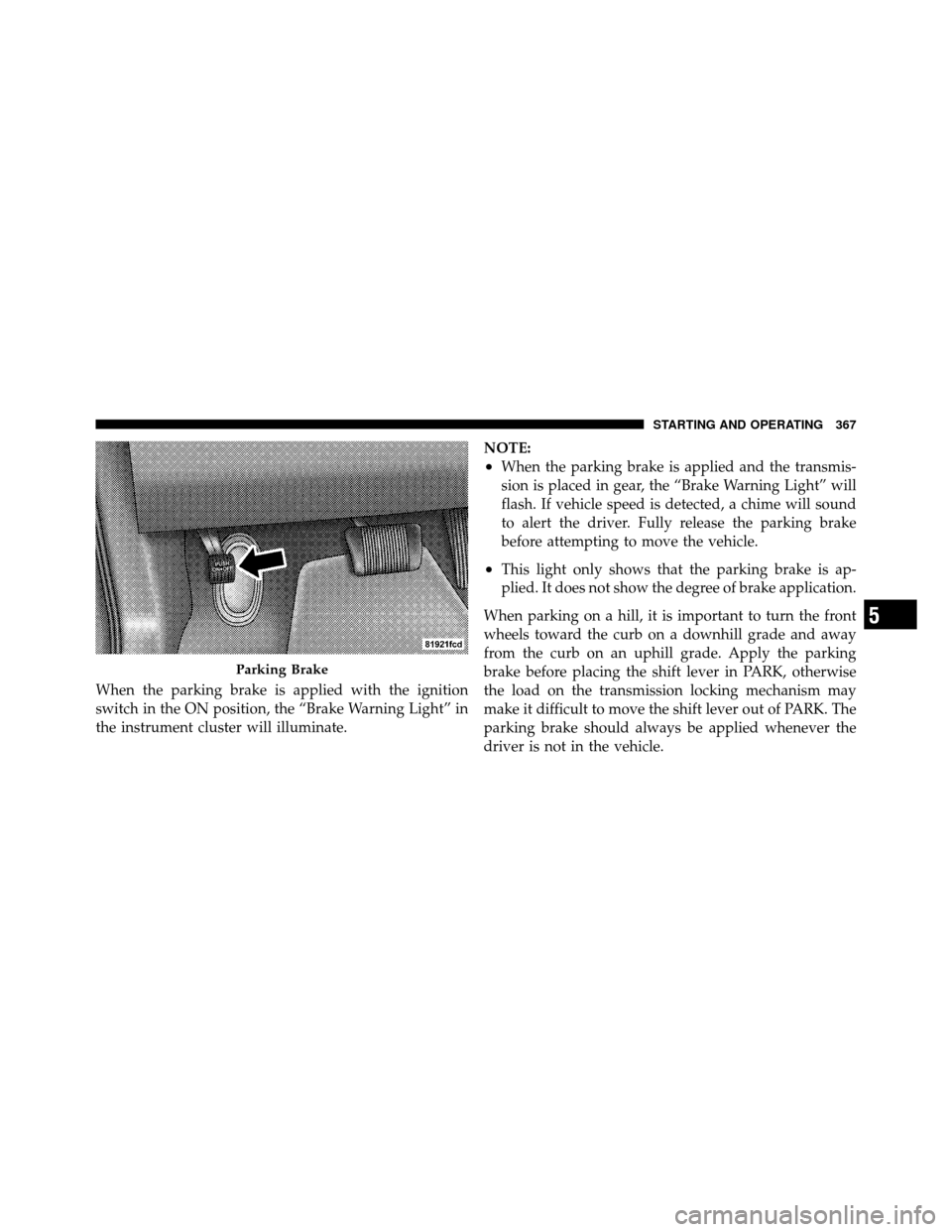
When the parking brake is applied with the ignition
switch in the ON position, the “Brake Warning Light” in
the instrument cluster will illuminate.NOTE:
•When the parking brake is applied and the transmis-
sion is placed in gear, the “Brake Warning Light” will
flash. If vehicle speed is detected, a chime will sound
to alert the driver. Fully release the parking brake
before attempting to move the vehicle.
•This light only shows that the parking brake is ap-
plied. It does not show the degree of brake application.
When parking on a hill, it is important to turn the front
wheels toward the curb on a downhill grade and away
from the curb on an uphill grade. Apply the parking
brake before placing the shift lever in PARK, otherwise
the load on the transmission locking mechanism may
make it difficult to move the shift lever out of PARK. The
parking brake should always be applied whenever the
driver is not in the vehicle.
Parking Brake
5
STARTING AND OPERATING 367