Page 75 of 490

WARNING! (Continued)
•A rearward-facing child restraint should only be
used in a rear seat. A rearward-facing child re-
straint in the front seat may be struck by a deploy-
ing passenger air bag, which may cause severe or
fatal injury to the infant.
Here are some tips on getting the most out of your child
restraint:
•Before buying any restraint system, make sure that it
has a label certifying that it meets all applicable Safety
Standards. Chrysler Group LLC also recommends that
you make sure that you can install the child restraint in
the vehicle where you will use it before you buy it.
•The restraint must be appropriate for your child’s
weight and height. Check the label on the restraint for
weight and height limits.
•Carefully follow the instructions that come with the
restraint. If you install the restraint improperly, it may
not work when you need it.
•Buckle the child into the seat according to the child
restraint manufacturer’s directions.
WARNING!
When your child restraint is not in use, secure it in
the vehicle with the seat belt or remove it from the
vehicle. Do not leave it loose in the vehicle. In a
sudden stop or accident, it could strike the occupants
or seatbacks and cause serious personal injury.
Lower Anchors and Tether for CHildren (LATCH)
Your vehicle’s rear seat is equipped with the child
restraint anchorage system called LATCH. The LATCH
system provides for the installation of the child restraint
without using the vehicle’s seat belts, instead securing
2
THINGS TO KNOW BEFORE STARTING YOUR VEHICLE 73
Page 76 of 490

the child restraint using lower anchorages and upper
tether straps from the child restraint to the vehicle
structure.
LATCH-compatible child restraint systems are now avail-
able. However, because the lower anchorages are to be
introduced over a period of years, child restraint systems
having attachments for those anchorages will continue to
have features for installation using the vehicle’s seat
belts. Child restraints having tether straps and hooks for
connection to the top tether anchorages have been avail-
able for some time. For some older child restraints, many
child restraint manufacturers offer add-on tether strap
kits or retrofit kits. You are urged to take advantage of all
the available attachments provided with your child re-
straint in any vehicle.
All three rear-seating positions have lower anchorages
that are capable of accommodating LATCH-compatible
child seats. You should never install LATCH-compatiblechild seats so that two seats share a common lower
anchorage. If installing child seats in adjacent rear-
seating positions, or if your child restraints are not
LATCH-compatible, install the restraints using the vehi-
cle’s seat belts.
LATCH Anchorages
74 THINGS TO KNOW BEFORE STARTING YOUR VEHICLE
Page 77 of 490
Installing The LATCH-Compatible Child Restraint
System
We urge you to follow the manufacturer’s directions
carefully when installing your child restraint. Not all
child restraint systems will be installed as described here.
Again, carefully follow the installation instructions that
are provided with the child restraint system.The rear seat lower anchorages are round bars
located at the rear of the seat cushion where it
meets the seatback and are just visible when
you lean into the rear seat to install the child
restraint. You will easily feel them if you run your finger
along the intersection of the seatback and seat cushion
surfaces.
In addition, there are tether strap anchorages
behind each rear seating position located in the
panel between the rear seatback and the rear window. These tether strap anchorages are under a
plastic cover with this symbol on it.
Many, but not all, restraint systems will be equipped with
separate straps on each side, with each having a hook or
connector for attachment to the lower anchorage and a
means of adjusting the tension in the strap. Forward-
facing toddler restraints and some rear-facing infant
restraints will also be equipped with a tether strap, a
hook for attachment to the tether strap anchorage and a
means of adjusting the tension of the strap.
You will first loosen the child seat adjusters on the lower
straps and on the tether strap so that you can more easily
attach the hooks or connectors to the vehicle anchorages.
Next, attach the lower hooks or connectors over the top
of the seatcover material. Then, rotate the tether anchor-
age cover directly behind the seat where you are placing
the child restraint and attach the tether strap to the
anchorage, being careful to route the tether strap to
2
THINGS TO KNOW BEFORE STARTING YOUR VEHICLE 75
Page 78 of 490
provide the most direct path between the anchor and the
child restraint. Finally, tighten all three straps as you
push the child restraint rearward and downward into the
seat, removing slack in the straps according to the child
restraint manufacturer’s instructions.
NOTE:
•Ensure that the tether strap does not slip into the
opening between the seatbacks as you remove slack in
the strap.
•When using the LATCH attaching system to install a
child restraint, please ensure that all seat belts not
being used for occupant restraints are stowed and out
of reach of children. It is recommended that before
installing the child restraint, buckle the seat belt so the
seat belt is tucked behind the child restraint and out of
reach. If the buckled seat belt interferes with the childrestraint installation, instead of tucking the seat belt
behind the child restraint, route the seat belt through
the child restraint belt path and then buckle it. This
should stow the seat belt out of the reach of an
inquisitive child. Remind all children in the vehicle
that the seat belts are not toys and should not be
played with, and never leave your child unattended in
the vehicle.
WARNING!
Improper installation of a child restraint to the
LATCH anchorages can lead to failure of an infant or
child restraint. The child could be badly injured or
killed. Follow the manufacturer’s directions exactly
when installing an infant or child restraint.
76 THINGS TO KNOW BEFORE STARTING YOUR VEHICLE
Page 79 of 490
Installing Child Restraints Using The Vehicle Seat
Belt
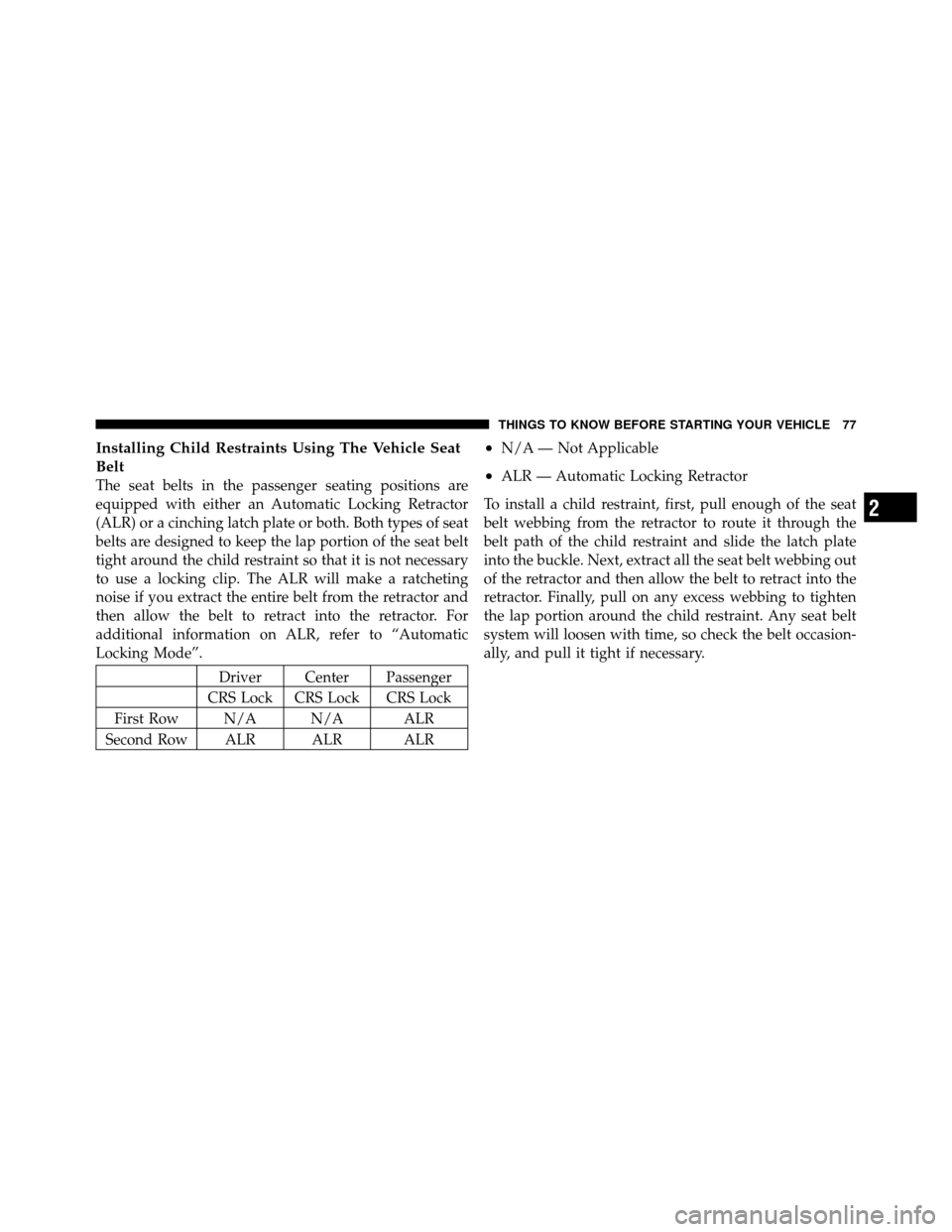
The seat belts in the passenger seating positions are
equipped with either an Automatic Locking Retractor
(ALR) or a cinching latch plate or both. Both types of seat
belts are designed to keep the lap portion of the seat belt
tight around the child restraint so that it is not necessary
to use a locking clip. The ALR will make a ratcheting
noise if you extract the entire belt from the retractor and
then allow the belt to retract into the retractor. For
additional information on ALR, refer to “Automatic
Locking Mode”.
Driver Center Passenger
CRS Lock CRS Lock CRS Lock
First Row N/A N/A ALR
Second Row ALR ALR ALR
•N/A — Not Applicable
•ALR — Automatic Locking Retractor
To install a child restraint, first, pull enough of the seat
belt webbing from the retractor to route it through the
belt path of the child restraint and slide the latch plate
into the buckle. Next, extract all the seat belt webbing out
of the retractor and then allow the belt to retract into the
retractor. Finally, pull on any excess webbing to tighten
the lap portion around the child restraint. Any seat belt
system will loosen with time, so check the belt occasion-
ally, and pull it tight if necessary.
2
THINGS TO KNOW BEFORE STARTING YOUR VEHICLE 77
Page 80 of 490
To attach a child restraint tether strap:
1. Rotate the cover over the anchor directly behind the
seat where you are placing the child restraint.2. Route the tether strap to provide the most direct path
for the strap between the anchor and the child seat.
3. Attach the tether strap hook (A) of the child restraint to
the anchor (B) and remove slack in the tether strap
according to the child restraint manufacturer’s instruc-
tions.
NOTE:
Ensure that the tether strap does not slip into the
opening between the seatbacks as you remove slack in
the strap.
WARNING!
An incorrectly anchored tether strap could lead to
increased head motion and possible injury to the
child. Use only the anchor positions directly behind
the child seat to secure a child restraint top tether
strap.
Tether Strap Mounting
1 — Cover A — Tether Strap Hook
3 — Attaching Strap B — Tether Anchor
78 THINGS TO KNOW BEFORE STARTING YOUR VEHICLE
Page 139 of 490
When the seatback is folded to the upright position, make
sure it is latched by strongly pulling on the top of the
seatback above the seat strap.
WARNING!
•Be certain that the seatback is securely locked into
position. If the seatback is not securely locked into
position, the seat will not provide the proper
stability for child seats and/or passengers. An
improperly latched seat could cause serious injury.
•The cargo area in the rear of the vehicle (with the
rear seatbacks in the locked-up or folded down
position) should not be used as a play area by
children when the vehicle is in motion. They could
be seriously injured in a collision. Children
should be seated and using the proper restraint
system.
Folded Rear Seat
3
UNDERSTANDING THE FEATURES OF YOUR VEHICLE 137
Page 470 of 490

Brightness, Interior Lights.................. 145
Bulb Replacement ..................... 426,427
Bulbs, Light .......................... 84,426
Calibration, Compass ..................... 197
Capacities, Fluid ........................ 433
Caps, Filler Fuel .............................. 330
Oil (Engine) ........................ 392
Radiator (Coolant Pressure) ............. 405
Car Washes ............................ 413
Carbon Monoxide Warning ...............80,325
Cargo (Vehicle Loading) ................... 332
Cellular Phone ........................ 94,238
Center High Mounted Stop Light ............ 431
Certification Label ....................... 332
Chains, Tire ............................ 309
Changing A Flat Tire ..................... 360
Chart, Tire Sizing ........................ 292 Check Engine Light
(Malfunction Indicator Light)
............... 387
Checking Your Vehicle For Safety ............. 80
Checks, Safety ........................... 80
Child Restraint .................. 70,71,72,75,77
Child Restraint Tether Anchors .............73,75
Clean Air Gasoline ....................... 322
Cleaning Wheels ............................ 415
Windshield Wiper Blades ............... 398
Clock ............................. 205,214
Cold Weather Operation ................... 257
Compact Disc (CD) Maintenance ............. 237
Compact Spare Tire ...................... 304
Compass .............................. 197
Compass Calibration ..................... 197
Compass Variance ....................... 198
Computer, Trip/Travel .................... 193
468 INDEX