Page 75 of 490

WARNING! (Continued)
•A rearward-facing child restraint should only be
used in a rear seat. A rearward-facing child re-
straint in the front seat may be struck by a deploy-
ing passenger air bag, which may cause severe or
fatal injury to the infant.
Here are some tips on getting the most out of your child
restraint:
•Before buying any restraint system, make sure that it
has a label certifying that it meets all applicable Safety
Standards. Chrysler Group LLC also recommends that
you make sure that you can install the child restraint in
the vehicle where you will use it before you buy it.
•The restraint must be appropriate for your child’s
weight and height. Check the label on the restraint for
weight and height limits.
•Carefully follow the instructions that come with the
restraint. If you install the restraint improperly, it may
not work when you need it.
•Buckle the child into the seat according to the child
restraint manufacturer’s directions.
WARNING!
When your child restraint is not in use, secure it in
the vehicle with the seat belt or remove it from the
vehicle. Do not leave it loose in the vehicle. In a
sudden stop or accident, it could strike the occupants
or seatbacks and cause serious personal injury.
Lower Anchors and Tether for CHildren (LATCH)
Your vehicle’s rear seat is equipped with the child
restraint anchorage system called LATCH. The LATCH
system provides for the installation of the child restraint
without using the vehicle’s seat belts, instead securing
2
THINGS TO KNOW BEFORE STARTING YOUR VEHICLE 73
Page 131 of 490
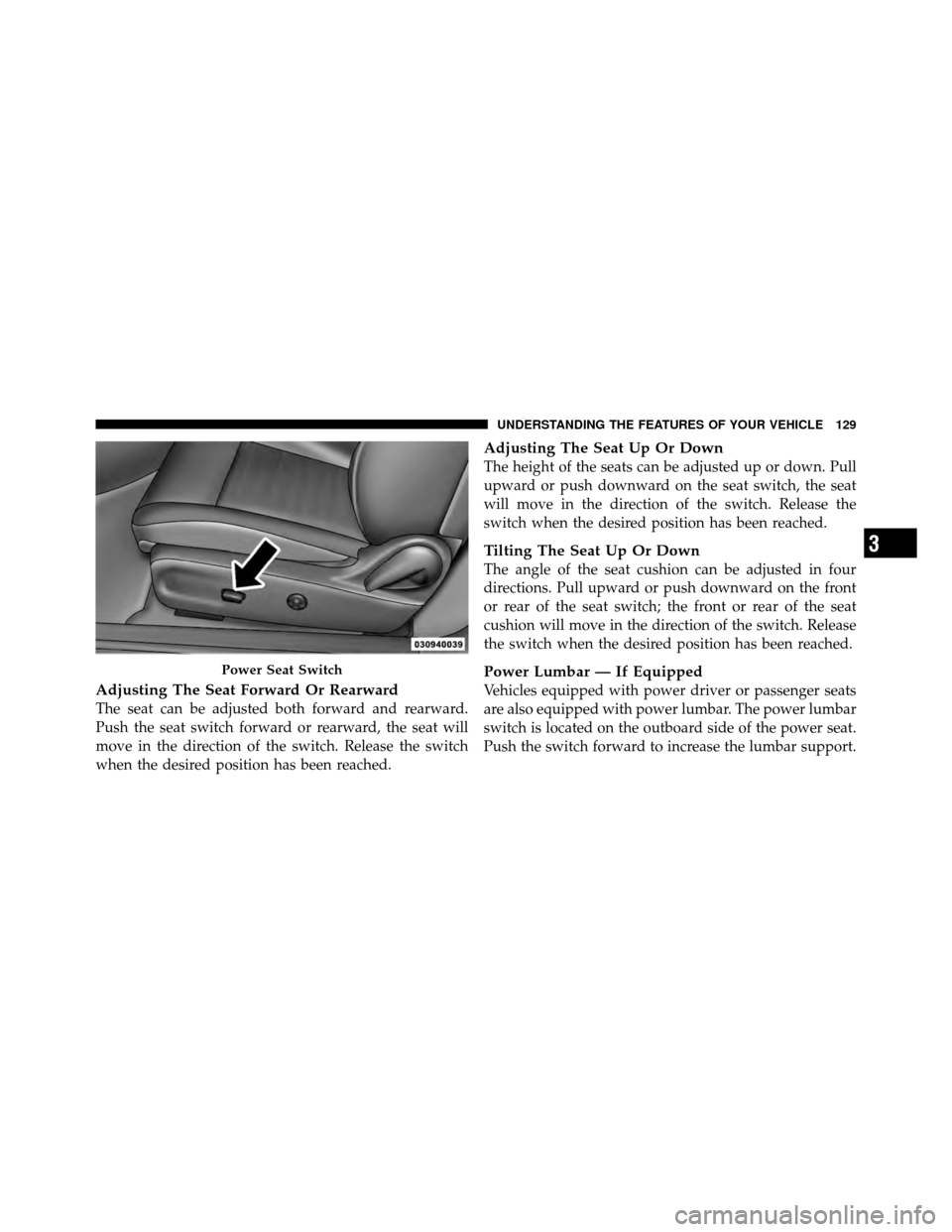
Adjusting The Seat Forward Or Rearward
The seat can be adjusted both forward and rearward.
Push the seat switch forward or rearward, the seat will
move in the direction of the switch. Release the switch
when the desired position has been reached.
Adjusting The Seat Up Or Down
The height of the seats can be adjusted up or down. Pull
upward or push downward on the seat switch, the seat
will move in the direction of the switch. Release the
switch when the desired position has been reached.
Tilting The Seat Up Or Down
The angle of the seat cushion can be adjusted in four
directions. Pull upward or push downward on the front
or rear of the seat switch; the front or rear of the seat
cushion will move in the direction of the switch. Release
the switch when the desired position has been reached.
Power Lumbar — If Equipped
Vehicles equipped with power driver or passenger seats
are also equipped with power lumbar. The power lumbar
switch is located on the outboard side of the power seat.
Push the switch forward to increase the lumbar support.
Power Seat Switch
3
UNDERSTANDING THE FEATURES OF YOUR VEHICLE 129
Page 294 of 490
Tire Sizing Chart
TIRE SIZING TERMS
Size Designation:
P= Passenger Car tire size based on U.S. design standards
�....blank....� = Passenger Car tire based on European design standards
LT = Light Truck tire based on U.S. design standards
T = Temporary spare tire
31 = Overall diameter in inches (in)
215 = Section width in millimeters (mm)
65 = Aspect ratio in percent (%)
— Ratio of section height to section width of tire
10.5 = Section width in inches (in)
R = Construction code
—�R� means radial construction
—�D� means diagonal or bias construction
15 = Rim diameter in inches (in)
292 STARTING AND OPERATING
Page 338 of 490

Tongue Weight (TW)
The TW is the downward force exerted on the hitch ball
by the trailer. In most cases, it should not be less than 10%
or more than 15% of the trailer load. You must consider
this as part of the load on your vehicle.
Frontal Area
The frontal area is the maximum height multiplied by the
maximum width of the front of a trailer.
Trailer Sway Control
The trailer sway control is a telescoping link that can be
installed between the hitch receiver and the trailer tongue
that typically provides adjustable friction associated with
the telescoping motion to dampen any unwanted trailer
swaying motions while traveling.
Weight-Carrying Hitch
A weight-carrying hitch supports the trailer tongue
weight, just as if it were luggage located at a hitch ball or
some other connecting point of the vehicle. These kindsof hitches are the most popular on the market today and
they are commonly used to tow small- and medium-
sized trailers.
Weight-Distributing Hitch
A weight-distributing system works by applying lever-
age through spring (load) bars. They are typically used
for heavier loads to distribute trailer tongue weight to the
tow vehicle’s front axle and the trailer axle(s). When used
in accordance with the manufacturer’s directions, it pro-
vides for a more level ride, offering more consistent
steering and brake control thereby enhancing towing
safety. The addition of a friction / hydraulic sway control
also dampens sway caused by traffic and crosswinds and
contributes positively to tow vehicle and trailer stability.
Trailer sway control and a weight distributing (load
equalizing) hitch are recommended for heavier Tongue
Weights (TW) and may be required depending on vehicle
and trailer configuration / loading to comply with Gross
Axle Weight Rating (GAWR) requirements.
336 STARTING AND OPERATING
Page 483 of 490

Seat Belts.......................... 42,45,81
And Pregnant Women .................. 55
Child Restraint ................. 70,71,72,77
Extender ........................... 55
Front Seat ......................... 45,46
Inspection .......................... 81
Operating Instructions .................. 46
Pretensioners ........................ 53
Rear Seat ........................... 45
Reminder .......................... 180
Untwisting Procedure .................. 50
Seats ................................. 128
Adjustment ......................... 128
Head Restraints ...................... 133
Heated ............................ 131
Height Adjustment ................... 128
Power ............................ 128
Rear Folding ........................ 136
Seatback Release ..................... 136 Tilting
............................ 128
Security Alarm (Theft Alarm) ................ 18
Selection of Coolant (Antifreeze) ..........403,434
Selection of Oil ......................... 391
Sentry Key (Immobilizer) ................... 16
Sentry Key Programming ................... 17
Sentry Key Replacement ................... 17
Service Assistance ....................... 457
Service Contract ......................... 459
Service Engine Soon Light
(Malfunction Indicator) .................... 187
Service Manuals ........................ 461
Setting the Clock ..................... 205,214
Settings, Personal ........................ 199
Shift Indicator Light ...................... 263
Shift Lever Override ...................... 375
Shifting ............................... 264
Automatic Transmission .............264,268
Shoulder Belts ........................... 45
10
INDEX 481
