Page 439 of 562
WHAT TO DO IN EMERGENCIES
CONTENTS
�Hazard Warning Flashers ................ 438
� If Your Engine Overheats ................ 438
� Jacking And Tire Changing ............... 439
▫ Jack Location ....................... 440
▫ Spare Tire Removal ................... 441
▫ To Access Spare Tire Winch Drive Nut ..... 441
▫ Spare Tire Tools ..................... 444
▫ Spare Tire Removal Instructions .......... 445
▫ Preparations For Jacking ............... 447
▫ Jacking Instructions ................... 448 ▫
Wheel Nuts ........................ 453
▫ Securing The Spare Tire ................ 454
� Jump-Starting Procedure ................ 456
▫ Preparations For Jump-Start ............. 457
▫ Jump-Starting Procedure ............... 458
� Freeing A Stuck Vehicle ................. 460
� Shift Lever Override ................... 461
� Towing A Disabled Vehicle ............... 462
▫ Without The Ignition Key .............. 464
6
ProCarManuals.com
Page 451 of 562
WARNING! (Continued)
•If working on or near a roadway, be extremely
careful of motor traffic.
•To assure that spare tires, flat or inflated, are
securely stowed, spares must be stowed with the
valve stem facing the ground.
CAUTION!
Do not attempt to raise the vehicle by jacking on
locations other than those indicated in the Jacking
Instructions for this vehicle.
NOTE: Refer to the “Compact Spare Tire” section of
“Tires – General Information” for information about the
spare tire, its use, and operation.
1. Loosen (but do not remove) the wheel lug nuts by
turning them to the left one turn while the wheel is still
on the ground.
Jack Warning Label
6
WHAT TO DO IN EMERGENCIES 449
ProCarManuals.com
Page 453 of 562
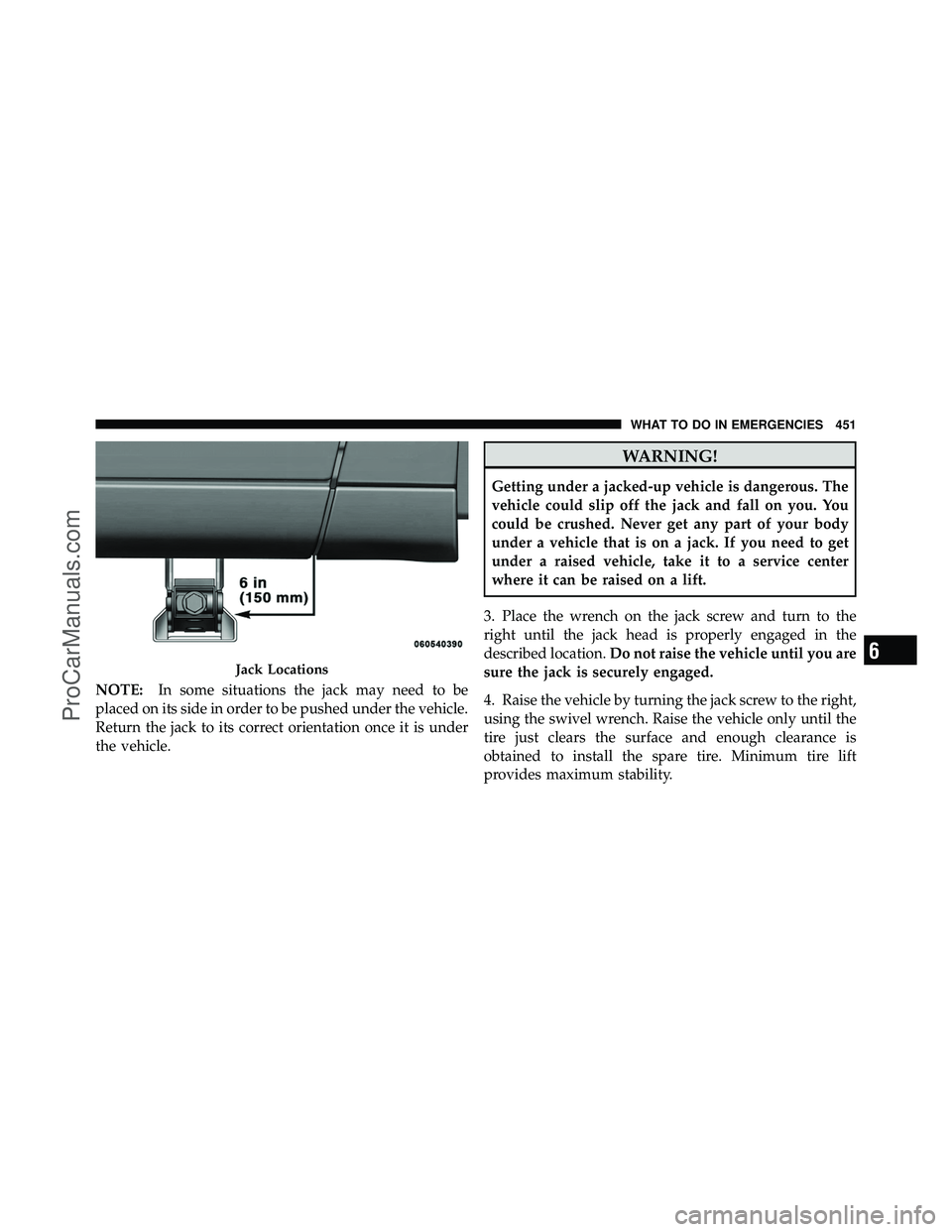
NOTE:In some situations the jack may need to be
placed on its side in order to be pushed under the vehicle.
Return the jack to its correct orientation once it is under
the vehicle.
WARNING!
Getting under a jacked-up vehicle is dangerous. The
vehicle could slip off the jack and fall on you. You
could be crushed. Never get any part of your body
under a vehicle that is on a jack. If you need to get
under a raised vehicle, take it to a service center
where it can be raised on a lift.
3. Place the wrench on the jack screw and turn to the
right until the jack head is properly engaged in the
described location. Do not raise the vehicle until you are
sure the jack is securely engaged.
4. Raise the vehicle by turning the jack screw to the right,
using the swivel wrench. Raise the vehicle only until the
tire just clears the surface and enough clearance is
obtained to install the spare tire. Minimum tire lift
provides maximum stability.
Jack Locations6
WHAT TO DO IN EMERGENCIES 451
ProCarManuals.com
Page 456 of 562
Securing The Spare Tire
1. Assemble the winch handle extensions to form a
T-handle and fit the winch T-handle over the drive nut.
Rotate the nut to the left until the winch mechanism stops
turning freely. This will allow enough slack in the cable to
allow you to pull the wheel spacer out from under the
vehicle.
WARNING!
A loose compact spare tire/cover assembly, thrown
forward in a collision or hard stop could endanger
the occupants of the vehicle. Always stow the com-
pact spare tire with the cover assembly in the place
provided.
CAUTION!
The winch mechanism is designed for use with the
winch T-handle only. Use of an air wrench or other
power tools is not recommended and can damage the
winch.
2. Assemble the winch handle extensions to form the
spare tire hook, and pull the wheel spacer from under the
vehicle.
3. Turn the compact spare tire so that the valve stem is
down, and place the tire into the spare tire/cover assem-
bly. Slide the wheel spacer through the center of the
wheel and spare tire/cover assembly, so that the two
retainer tabs snap out and engage the spare tire cover on
the opposite side.
454 WHAT TO DO IN EMERGENCIES
ProCarManuals.com
Page 465 of 562
Proper towing or lifting equipment is required to prevent
damage to your vehicle. Use only tow bars and other
equipment designed for the purpose, following equip-
ment manufacturer ’s instructions. Use of safety chains is
mandatory. Attach a tow bar or other towing device to
main structural members of the vehicle, not to bumpers
or associated brackets. State and local laws applying to
vehicles under tow must be observed.
If you must use the accessories (wipers, defrosters, etc.)
while being towed, the ignition must be in the ON/RUN
position, not the ACC position.
CAUTION!
•Do not use sling type equipment when towing.
Damage to the fascia will occur.(Continued)
CAUTION! (Continued)
•When securing the vehicle to a flatbed truck, do
not attach to front or rear suspension components.
Damage to your vehicle may result from improper
towing.
•Do not push or tow this vehicle with another
vehicle as damage to the bumper fascia and trans-
mission may result.
•If the vehicle being towed requires steering, the
ignition switch must be in the ON position, not
the LOCK or ACC positions.
The manufacturer recommends towing your vehicle with
all four wheels OFF the ground using a flatbed. If flatbed
equipment is not available, and the transmission is
operable, the vehicle may be flat towed (with all four
wheels on the ground) under the following conditions:
•The shift lever must be in NEUTRAL.
6
WHAT TO DO IN EMERGENCIES 463
ProCarManuals.com
Page 483 of 562
WARNING!
Do not remove the A/C air filter while the blower is
operating or personal injury may result.
The A/C air filter is located in the fresh air inlet behind
the glove box. Perform the following procedure to re-
place the filter:
1. Open the glove compartment and remove all contents.
2. Push in on the sides of the glove compartment and
lower the door.
3. Pivot the glove compartment downward.
4. Disengage the two retaining tabs that secure the filter
cover to the HVAC housing, and remove the cover. 5. Remove the A/C air filter by pulling it straight out of
the housing.
6. Install the A/C air filter with the arrow on the filter
pointing toward the floor. When installing the filter
cover, make sure the retaining tabs fully engage the
cover.
A/C Air Filter Replacement
7
MAINTAINING YOUR VEHICLE 481
ProCarManuals.com
Page 493 of 562
WARNING!
•Use only manufacturer’s recommended brake
fluid. Refer to “Fluids, Lubricants, and Genuine
Parts” in “Maintaining Your Vehicle” for further
information. Using the wrong type of brake fluid
can severely damage your brake system and/or
impair its performance. The proper type of brake
fluid for your vehicle is also identified on the
original factory installed hydraulic master cylin-
der reservoir.(Continued)
WARNING! (Continued)
•To avoid contamination from foreign matter or
moisture, use only new brake fluid or fluid that
has been in a tightly closed container. Keep the
master cylinder reservoir cap secured at all times.
Brake fluid in a open container absorbs moisture
from the air resulting in a lower boiling point.
This may cause it to boil unexpectedly during hard
or prolonged braking, resulting in sudden brake
failure. This could result in a collision.
•Overfilling the brake fluid reservoir can result in
spilling brake fluid on hot engine parts, causing
the brake fluid to catch fire. Brake fluid can also
damage painted and vinyl surfaces, care should be
taken to avoid its contact with these surfaces.(Continued)
7
MAINTAINING YOUR VEHICLE 491
ProCarManuals.com
Page 512 of 562
NOTE:
•If a screwdriver is used, make sure a soft material is
placed between the vehicle body and tool so not to
scratch the paint.
•The PRY location is best closest to the studs while
dislodging them separately.
3. Twist the socket and remove from the lamp assembly.
4. Pull the bulb to remove it from the socket.
5. Replace the bulb, reinstall the socket, and reattach the
lamp assembly.
Center High-Mounted Stop Lamp (CHMSL)
The CHMSL uses LED lamps that are not serviceable
separately. The CHMSL must be replaced as an assembly.
See your authorized dealer.
License Lamp
The license plate lamp is located under the tailgate light
bar and above the license plate.
1. Using a small screwdriver, press inward the locking
tab on the outboard side of the lamp assembly and pull
down on the lamp assembly for removal.
2. Twist and remove the socket from the lamp assembly
and pull the bulb out to remove.
3. Push the bulb into the socket, twist the socket into the
lamp assembly and reinstall the lamp assembly into place
ensuring the locking tab is secure.
510 MAINTAINING YOUR VEHICLE
ProCarManuals.com