Page 97 of 562
WARNING!
An incorrectly anchored tether strap could lead to
increased head motion and possible injury to the
child. Use only the anchor positions directly behind
the child seat to secure a child restraint top tether
strap.
Installing The Child Restraint Using The Vehicle
Seat Belts
The seat belts in the passenger seating positions are
equipped with an Automatic Locking Retractor to secure
a Child Restraint System (CRS). These types of seat belts
are designed to keep the lap portion of the seat belt tight
around the child restraint so that it is not necessary to use
a locking clip. The ALR will make a ratcheting noise if
you extract the entire belt from the retractor and then
allow the belt to retract into the retractor. For additional
information on ALR, refer to “Automatic Locking Mode”
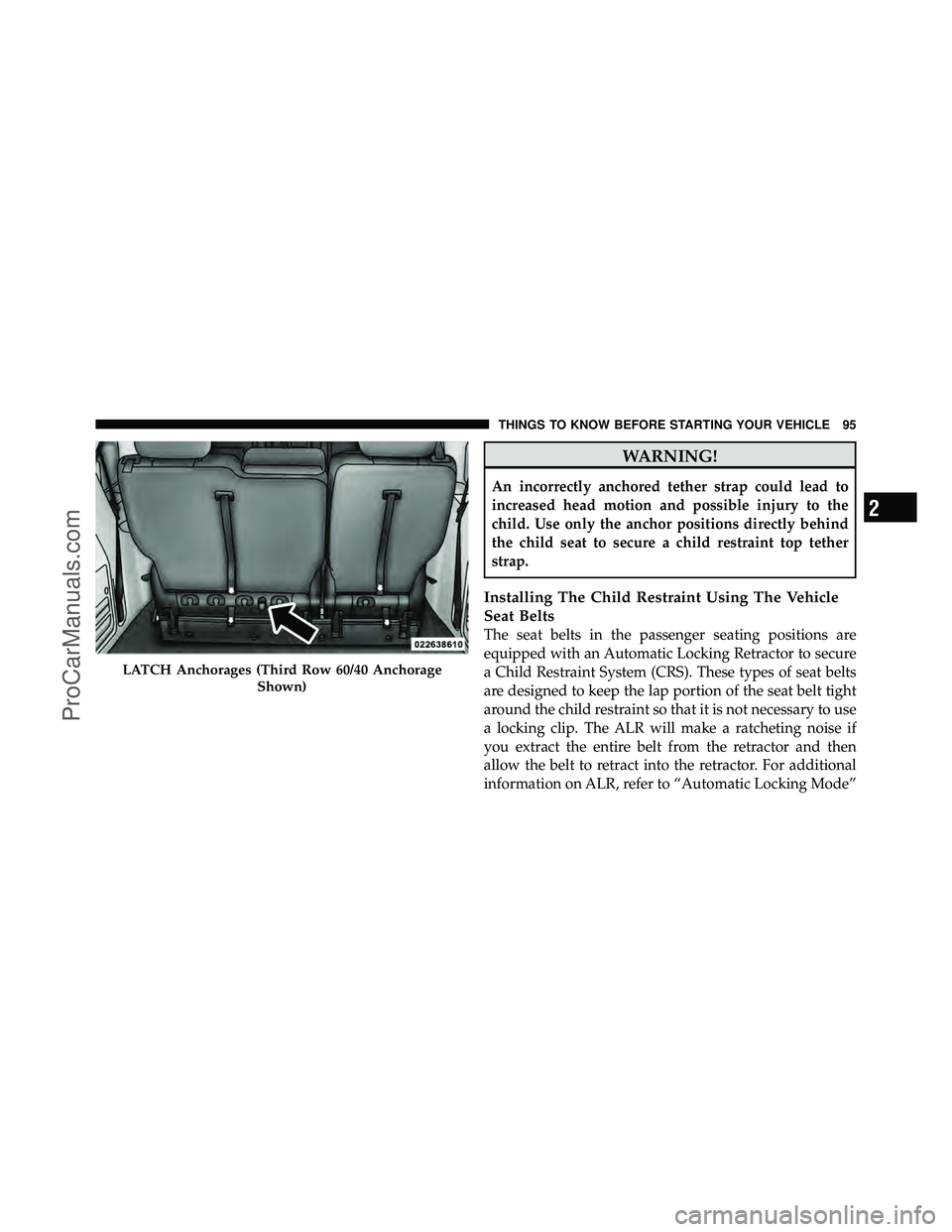
LATCH Anchorages (Third Row 60/40 AnchorageShown)
2
THINGS TO KNOW BEFORE STARTING YOUR VEHICLE 95
ProCarManuals.com
Page 99 of 562
Transporting Pets
Air Bags deploying in the front seat could harm your pet.
An unrestrained pet could be thrown about and possibly
injured, or injure a passenger during panic braking or in
an accident.
Pets should be restrained in the rear seat in pet harnesses
or pet carriers that are secured by seat belts.
REAR SEAT DELETE FEATURE (COMMERCIAL
VEHICLES ONLY) — IF EQUIPPED
Commercial cargo vehicles are not designed for use as a
family vehicle and are not intended for carrying children
in the front passenger seat. However, if you must carry a
child in a vehicle without a rear seat, the passenger seat
should be moved to the full rearward position and the
child must be in a proper restraint system based on its
age, size and weight.
WARNING!
NEVER carry a child in a rear facing infant carrier in
a vehicle without rear seats. In an accident, serious
injury or death may occur from the deploying pas-
senger airbag.
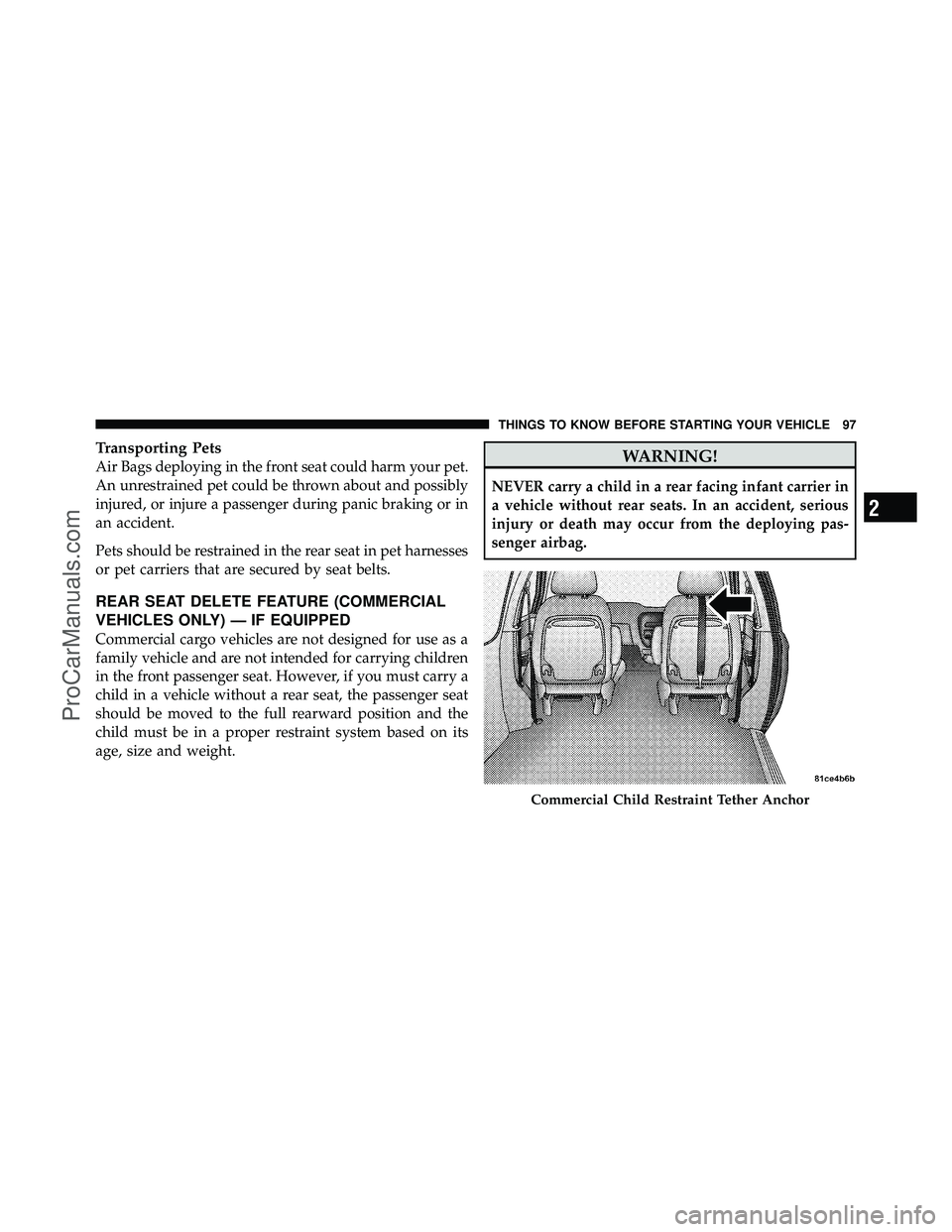
Commercial Child Restraint Tether Anchor
2
THINGS TO KNOW BEFORE STARTING YOUR VEHICLE 97
ProCarManuals.com
Page 100 of 562
This vehicle is equipped with a child restraint tether
anchor located on the lower rear of the front passenger
seat.Use this tether anchor to secure only forward-
facing child restraints equipped with an upper tether
strap.
WARNING!
Rearward-facing infant restraints must never be se-
cured in the passenger seat of a vehicle with a
passenger airbag. In an accident, a passenger airbag
may deploy causing severe injury or death to infants
riding in rearward-facing infant restraints.
Restraining Infants and Small Children with Seat
Delete Feature (Commercial Vehicles Only)
There are different sizes and types of restraints for
children from newborn size to the child almost large
enough for an adult safety belt. Use the restraint that is
correct for your child:
•The rearward-facing infant carrier is for babies weigh-
ing up to about 20 lbs (9 kg), and less than one year
old. THIS TYPE OF SEAT CANNOT BE USED IN A
VEHICLE EQUIPPED WITH THE REAR SEAT DE-
LETE FEATURE (Commercial Vehicles Only).
•The forward-facing child seat is for children from
about 20 to 40 lbs (9 to 18 kg), and more than one year
old.
•A convertible child seat, one that is designed to be
used for children who are too heavy for a rearward-
facing infant seat, may be used IN THE FORWARD
FACING POSITION ONLY, IT MUST NEVER BE
INSTALLED FACING TO THE REAR IN A VEHICLE
EQUIPPED WITH THE REAR SEAT DELETE FEA-
TURE (Commercial Vehicles Only). When a convert-
ible seat is properly installed facing forward, the
vehicle seat should be adjusted to the rear most
position.
98 THINGS TO KNOW BEFORE STARTING YOUR VEHICLE
ProCarManuals.com
Page 101 of 562
•Children more than 40 lbs (18 kg) should be secured in
the passenger seat in a child restraint or belt-
positioning booster seat with the seat adjusted to the
rear most position. Older children who do not use
child restraints or belt-positioning booster seats
should ride properly buckled in the passenger seat
with the seat adjusted to the rearmost position. Never
allow children to slide the shoulder belt behind them
or under their arm.
Tether Installation for Commercial Vehicles with
Rear Seat Delete
To secure the child restraint upper tether strap to the
vehicle, follow the instructions shown:
1. Locate the child restraint tether anchor on the lower
rear of the front passenger seat.
2. Follow the child restraint manufacturer’s directions
for proper use of connecting the child restraint to the
extended tether strap.3. Route the tether strap under the head rest.
NOTE:
Ensure that the child restraint tether strap is
centered between the headrest supports underneath the
head rest.
4. Using the hook attached to the child restraint tether
strap, attach the child restraint tether strap to the metal
anchor on the lower rear of the front passenger seat.
5. Following the child seat manufacturer’s instructions,
tighten the child restraint tether strap.
6. Inspect the tether anchor strap for nicks, abrasions,
discoloration, and loose threads. If these, or any other
condition that might affect the performance of the strap is
observed, DO NOT USE. Contact your authorized deal-
ership for a replacement part.
2
THINGS TO KNOW BEFORE STARTING YOUR VEHICLE 99
ProCarManuals.com
Page 105 of 562
authorized dealer. If the light stays on, flickers, or comes
on while driving, have the system checked by an autho-
rized dealer.
Defroster
Check operation by selecting the defrost mode and place
the blower control on high speed. You should be able to
feel the air directed against the windshield. See your
authorized dealer for service if your defroster is
inoperable.
Floor Mat Safety Information
Always use floor mats designed to fit the footwell of your
vehicle. Use only floor mats that leave the pedal area
unobstructed and that are firmly secured so that they
cannot slip out of position and interfere with the pedals
or impair safe operation of your vehicle in other ways.
WARNING!
Pedals that cannot move freely can cause loss of
vehicle control and increase the risk of serious per-
sonal injury.
•Always make sure that floor mats are properly
attached to the floor mat fasteners.
•Never place or install floor mats or other floor
coverings in the vehicle that cannot be properly
secured to prevent them from moving and inter-
fering with the pedals or the ability to control the
vehicle.
•Never put floor mats or other floor coverings on
top of already installed floor mats. Additional
floor mats and other coverings will reduce the size
of the pedal area and interfere with the pedals.(Continued)
2
THINGS TO KNOW BEFORE STARTING YOUR VEHICLE 103
ProCarManuals.com
Page 106 of 562
WARNING! (Continued)
•Check mounting of mats on a regular basis. Al-
ways properly reinstall and secure floor mats that
have been removed for cleaning.
•Always make sure that objects cannot fall into the
driver footwell while the vehicle is moving. Ob-
jects can become trapped under the brake pedal
and accelerator pedal causing a loss of vehicle
control.
•If required, mounting posts must be properly
installed, if not equipped from the factory.
Failure to properly follow floor mat installation or
mounting can cause interference with the brake
pedal and accelerator pedal operation causing loss
of control of the vehicle.
Periodic Safety Checks You Should Make Outside
The Vehicle
Tires
Examine tires for excessive tread wear and uneven wear
patterns. Check for stones, nails, glass, or other objects
lodged in the tread or sidewall. Inspect the tread for cuts
and cracks. Inspect sidewalls for cuts, cracks and bulges.
Check the wheel nuts for tightness. Check the tires
(including spare) for proper cold inflation pressure.
Lights
Have someone observe the operation of exterior lights
while you work the controls. Check turn signal and high
beam indicator lights on the instrument panel.
Door Latches
Check for positive closing, latching, and locking.
104 THINGS TO KNOW BEFORE STARTING YOUR VEHICLE
ProCarManuals.com
Page 113 of 562

▫Reprogramming A Single HomeLink�
Button ............................ 202
▫ Security ........................... 202
▫ Troubleshooting Tips .................. 203
▫ General Information .................. 203
� Power Sunroof — If Equipped ............ 204
▫ Opening Sunroof — Express ............ 205
▫ Opening The Sunroof — Manual Mode ..... 205
▫ Closing Sunroof — Express ............. 205
▫ Closing Sunroof — Manual Mode ........ 205
▫ Pinch Protect Feature ................. 205
▫ Pinch Protect Override ................ 206
▫ Venting Sunroof — Express ............. 206▫
Sunshade Operation .................. 206
▫ Wind Buffeting ...................... 206
▫ Sunroof Maintenance ................. 206
▫ Ignition Off Operation ................. 207
▫ Sunroof Fully Closed .................. 207
� Electrical Power Outlets — If Equipped ...... 207
� Power Inverter — If Equipped ............ 212
� Cupholders .......................... 213
▫ Instrument Panel Cupholders ............ 214
▫ Super Console — If Equipped ........... 214
▫ Premium Console Cupholders —
If Equipped ........................ 215
▫ Interior Bottle Holders ................ 216
3
UNDERSTANDING THE FEATURES OF YOUR VEHICLE 111
ProCarManuals.com
Page 152 of 562
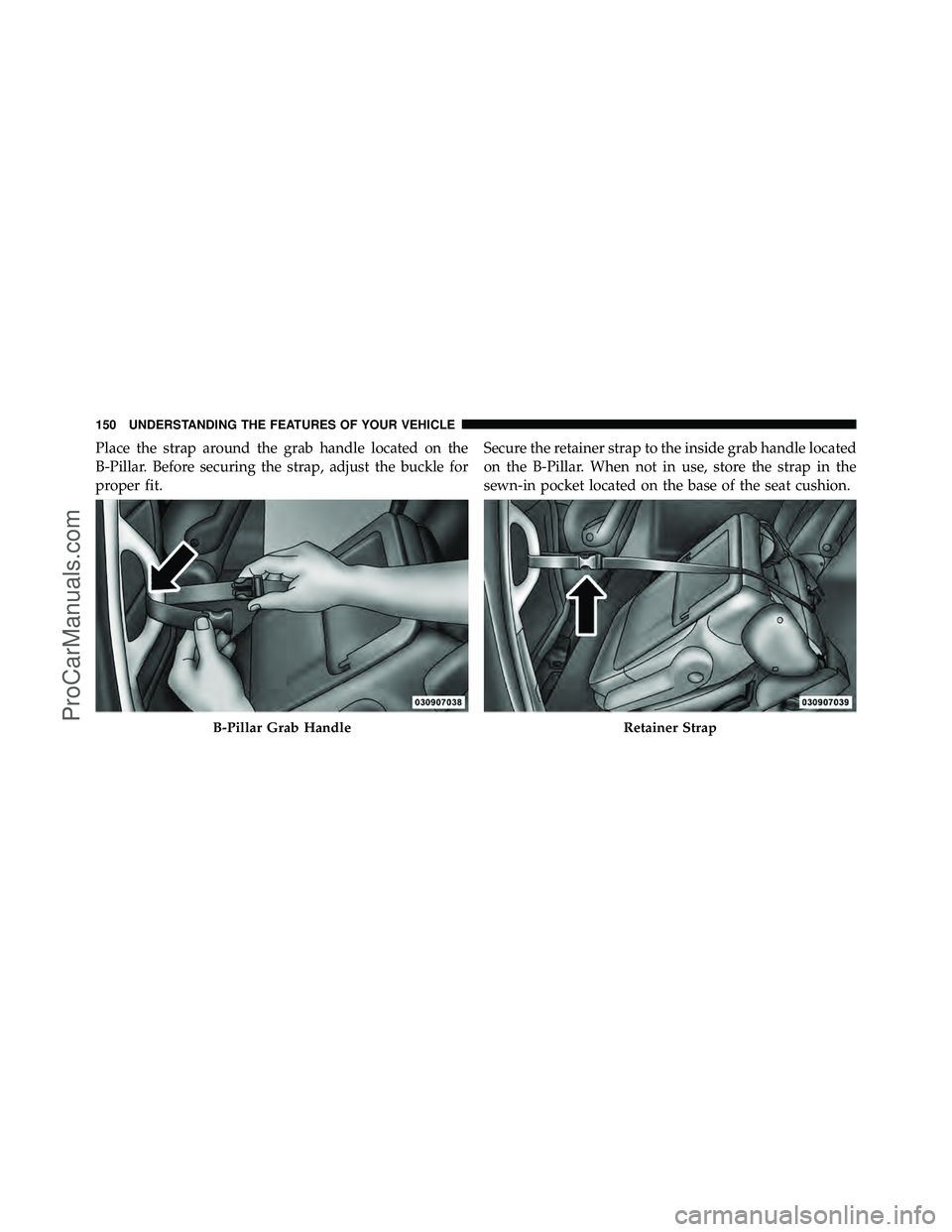
Place the strap around the grab handle located on the
B-Pillar. Before securing the strap, adjust the buckle for
proper fit.Secure the retainer strap to the inside grab handle located
on the B-Pillar. When not in use, store the strap in the
sewn-in pocket located on the base of the seat cushion.
B-Pillar Grab HandleRetainer Strap
150 UNDERSTANDING THE FEATURES OF YOUR VEHICLE
ProCarManuals.com