Page 53 of 494
anytime a child safety seat is installed in a seating
position that has a belt with this feature. Children
12 years old and under should always be properly
restrained in the rear seat.
How To Engage The Automatic Locking Mode
1. Buckle the combination lap and shoulder belt.
2. Grasp the shoulder portion and pull downward until
the entire belt is extracted.
3. Allow the belt to retract. As the belt retracts, you will
hear a clicking sound. This indicates the safety belt is
now in the Automatic Locking Mode.
How To Disengage The Automatic Locking Mode
Unbuckle the combination lap/shoulder belt and allow it
to retract completely to disengage the Automatic Locking
Mode and activate the vehicle sensitive (emergency)
locking mode.
WARNING!
•The belt and retractor assembly must be replaced
if the seat belt assembly Automatic Locking Re-
tractor (ALR) feature or any other seat belt func-
tion is not working properly when checked ac-
cording to the procedures in the Service Manual.
•Failure to replace the belt and retractor assembly
could increase the risk of injury in collisions.
Energy Management Feature
This vehicle has a safety belt system with an Energy
Management feature in the front seating positions to help
further reduce the risk of injury in the event of a head-on
accident. This safety belt system has a retractor assembly
that is designed to release webbing in a controlled
manner. This feature is designed to help reduce the belt
force acting on the occupant’s chest.
2
THINGS TO KNOW BEFORE STARTING YOUR VEHICLE 51
Page 56 of 494
CAUTION!
All occupants, including the driver, should not oper-
ate a vehicle or sit in a vehicle’s seat until the head
restraints are placed in their proper positions in order
to minimize the risk of neck injury in the event of an
accident.
NOTE: For more information on properly adjusting and
positioning the head restraint, refer to “Adjusting Active
Head Restraints” in “Understanding The Features Of
Your Vehicle”.
Resetting Active Head Restraints (AHR)
If the Active Head Restraints are triggered in an accident,
you must reset the head restraint on the driver ’s and
front passenger seat. You can recognize when the Active
Head Restraint has been triggered by the fact that they
have moved forward (as shown in step three of the
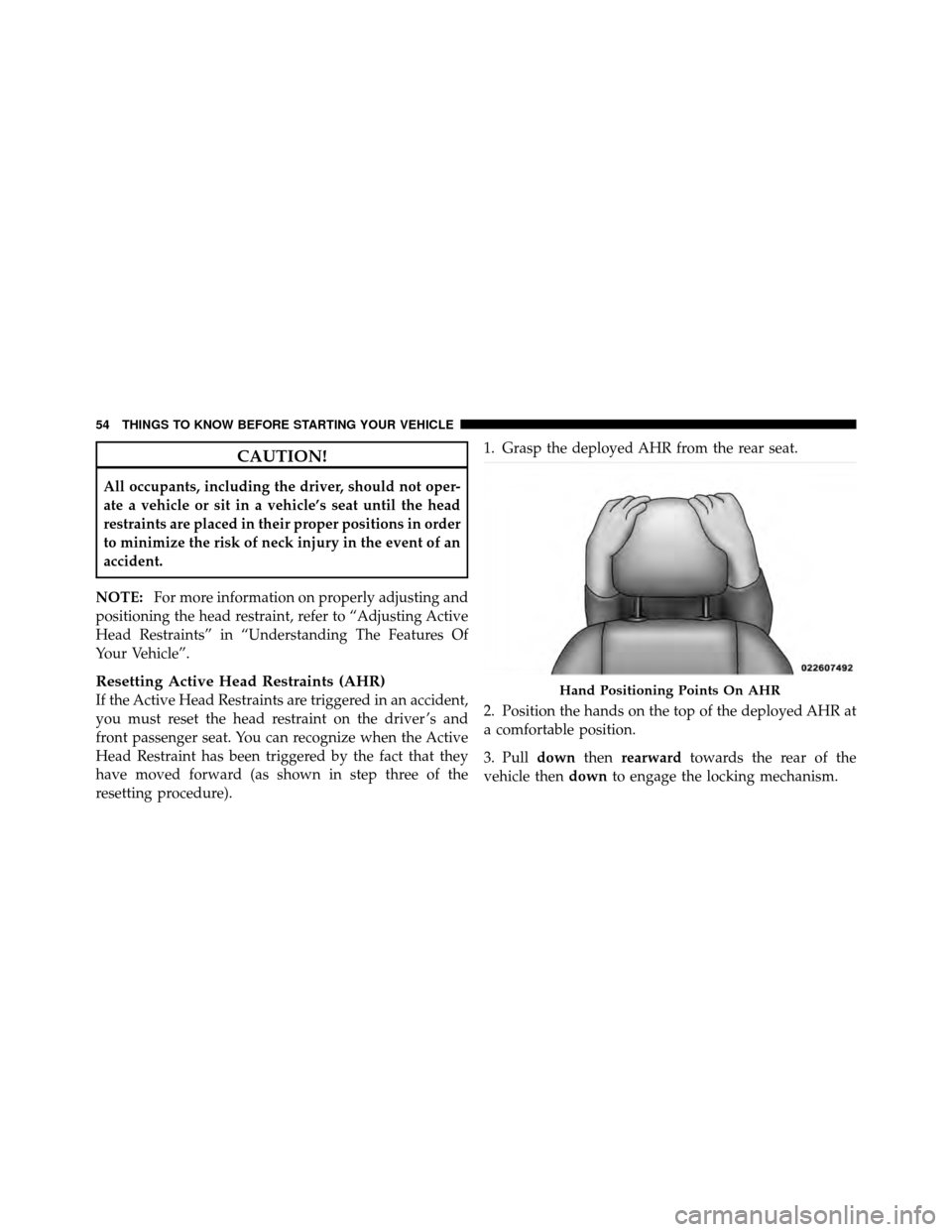
resetting procedure). 1. Grasp the deployed AHR from the rear seat.
2. Position the hands on the top of the deployed AHR at
a comfortable position.
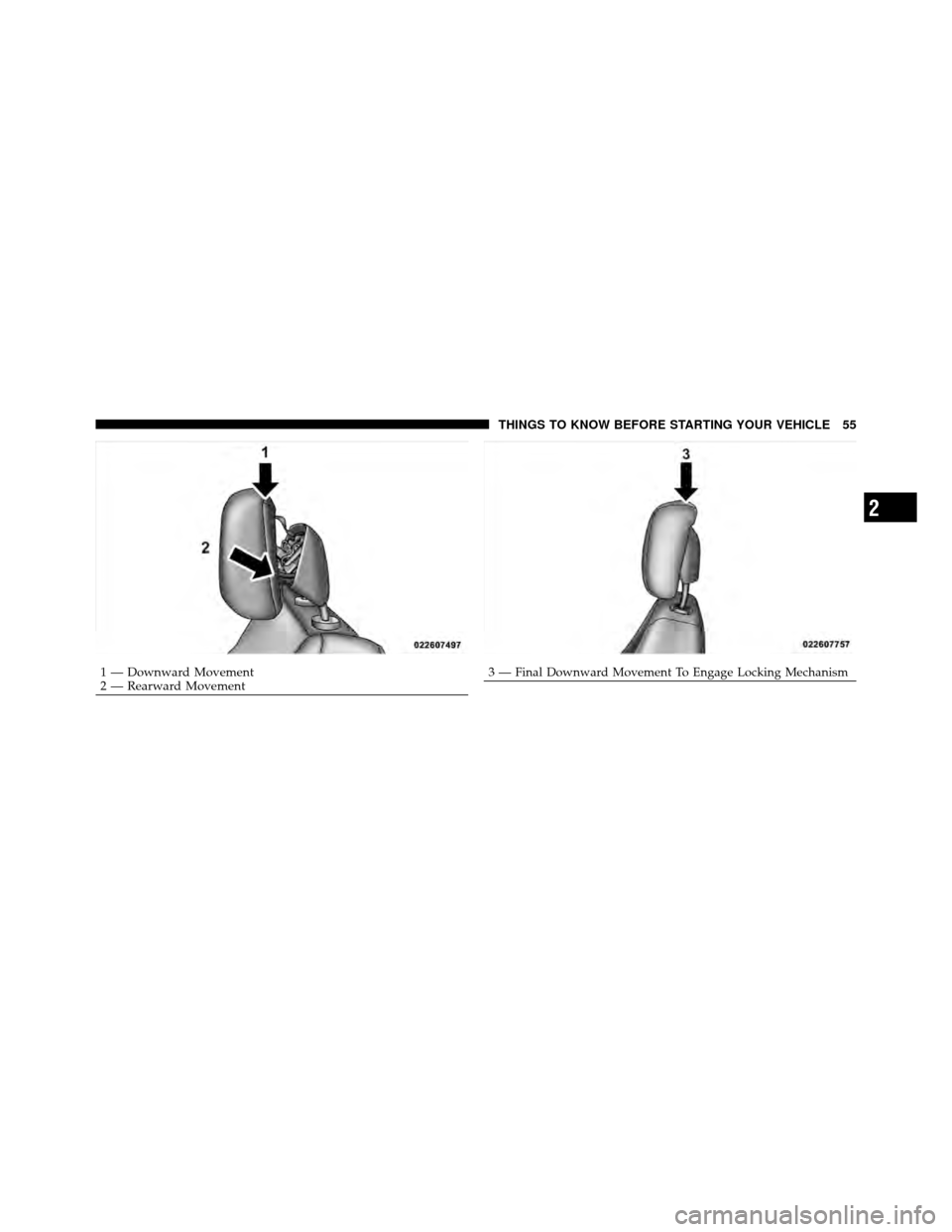
3. Pull
downthenrearward towards the rear of the
vehicle then downto engage the locking mechanism.Hand Positioning Points On AHR
54 THINGS TO KNOW BEFORE STARTING YOUR VEHICLE
Page 57 of 494
1 — Downward Movement
2 — Rearward Movement3—Final Downward Movement To Engage Locking Mechanism
2
THINGS TO KNOW BEFORE STARTING YOUR VEHICLE 55
Page 58 of 494
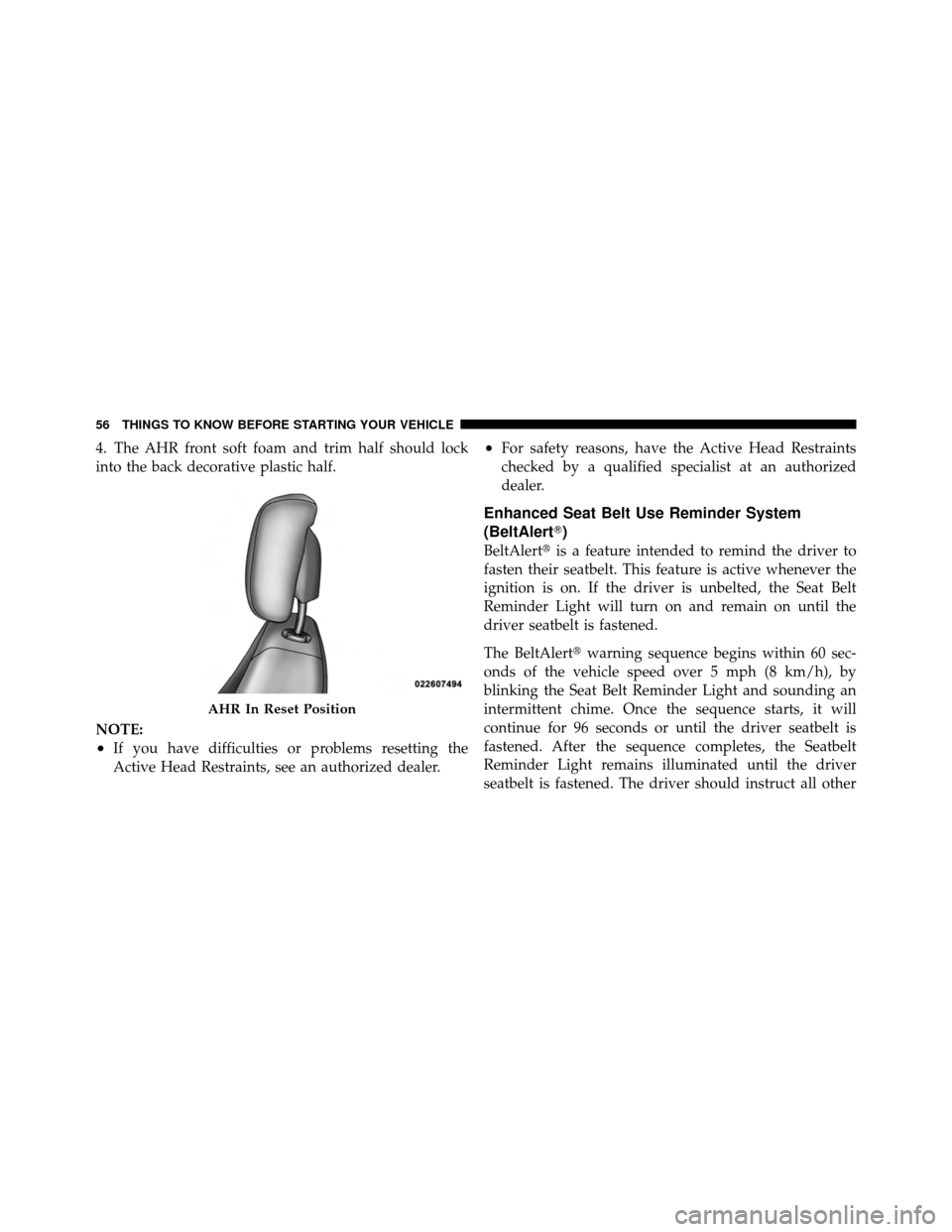
4. The AHR front soft foam and trim half should lock
into the back decorative plastic half.
NOTE:
•If you have difficulties or problems resetting the
Active Head Restraints, see an authorized dealer.
•For safety reasons, have the Active Head Restraints
checked by a qualified specialist at an authorized
dealer.
Enhanced Seat Belt Use Reminder System
(BeltAlert�)
BeltAlert�is a feature intended to remind the driver to
fasten their seatbelt. This feature is active whenever the
ignition is on. If the driver is unbelted, the Seat Belt
Reminder Light will turn on and remain on until the
driver seatbelt is fastened.
The BeltAlert� warning sequence begins within 60 sec-
onds of the vehicle speed over 5 mph (8 km/h), by
blinking the Seat Belt Reminder Light and sounding an
intermittent chime. Once the sequence starts, it will
continue for 96 seconds or until the driver seatbelt is
fastened. After the sequence completes, the Seatbelt
Reminder Light remains illuminated until the driver
seatbelt is fastened. The driver should instruct all other
AHR In Reset Position
56 THINGS TO KNOW BEFORE STARTING YOUR VEHICLE
Page 65 of 494
NOTE:
•Air Bag covers may not be obvious in the interior trim,
but they will open during air bag deployment.
•Being too close to the SAB and SABIC air bags during
deployment could cause you to be severely injured or
killed.The system includes side impact sensors that are cali-
brated to deploy the side air bags during impacts that
require air bag occupant protection.
WARNING!
•If your vehicle is equipped with left and right
Supplemental Side Air Bag Inflatable Curtain
(SABIC), do not stack luggage or other cargo up
high enough to block the location of the SABIC.
The area where the SABIC is located should re-
main free from any obstructions.
•Do not use accessory seat covers or place objects
between you and the side air bags; the perfor-
mance could be adversely affected and/or objects
could be pushed into you, causing serious injury.
(Continued)Side Air Bag Inflatable Curtains (SABIC) Location
2
THINGS TO KNOW BEFORE STARTING YOUR VEHICLE 63
Page 70 of 494

A quantity of non-toxic gas is generated to inflate the side
curtain air bag. The inflating side curtain air bag pushes
the outside edge of the headliner out of the way and
covers the window. The air bag inflates in about 30
milliseconds (about one-quarter of the time that it takes
to blink your eyes) with enough force to injure you if you
are not belted and seated properly, or if items are
positioned in the area where the side curtain air bag
inflates. This especially applies to children. The side
curtain air bag is only about 3-1/2 in (9 cm) thick when
it is inflated.
Because air bag sensors estimate deceleration over time,
vehicle speed and damage are not good indicators of
whether or not an air bag should have deployed.
Front And Side Impact Sensors
In front and side impacts, impact sensors can aid the
ORC in determining appropriate response to impact
events.
Enhanced Accident Response System
In the event of an impact causing air bag deployment, if
the communication network remains intact, and the
power remains intact, depending on the nature of the
event the ORC will determine whether to have the
Enhanced Accident Response System perform the follow-
ing functions:
•Cut off fuel to the engine.
•Flash hazard lights as long as the battery has power or
until the ignition key is turned off.
•Turn on the interior lights, which remain on as long as
the battery has power or until the ignition key is
removed.
•Unlock the doors automatically.
If A Deployment Occurs
The Advanced Front Air Bags are designed to deflate
immediately after deployment.
68 THINGS TO KNOW BEFORE STARTING YOUR VEHICLE
Page 73 of 494
Air Bag Warning Light
You will want to have the air bags ready to
inflate for your protection in a collision. The
Air Bag Warning Light monitors the internal
circuits and interconnecting wiring associated
with air bag system electrical components. While the air
bag system is designed to be maintenance free. If any of
the following occurs, have an authorized dealer service
the air bag system immediately.
•The Air Bag Warning Light does not come on during
the four to eight seconds when the ignition switch is
first turned to the ON/RUN position.
•The Air Bag Warning Light remains on after the four to
eight-second interval.
•The Air Bag Warning Light comes on intermittently or
remains on while driving. NOTE:
If the speedometer, tachometer, or any engine
related gauges are not working, the Occupant Restraint
Controller (ORC) may also be disabled. The air bags may
not be ready to inflate for your protection. Promptly
check the fuse block for blown fuses. Refer to the label
located on the inside of the fuse block cover for the
proper air bag fuses. See your authorized dealer if the
fuse is good.
Event Data Recorder (EDR)
This vehicle is equipped with an event data recorder
(EDR). The main purpose of an EDR is to record, in
certain crash or near crash-like situations, such as an air
bag deployment or hitting a road obstacle, data that will
assist in understanding how a vehicle’s systems per-
formed. The EDR is designed to record data related to
vehicle dynamics and safety systems for a short period of
time, typically 30 seconds or less. The EDR in this vehicle
is designed to record such data as:
•How various systems in your vehicle were operating;
2
THINGS TO KNOW BEFORE STARTING YOUR VEHICLE 71
Page 77 of 494
WARNING! (Continued)
•A rearward-facing child restraint should only be
used in a rear seat. A rearward-facing child re-
straint in the front seat may be struck by a deploy-
ing passenger air bag which may cause severe or
fatal injury to the infant.
Here are some tips on getting the most out of your
child restraints:
•
Children who are large enough to wear the shoulder
belt comfortably, and whose legs are long enough to
bend over the front of the seat when their back is
against the seatback, should use the lap/shoulder belt
in a rear seat.
•Before buying any restraint system, make sure that it
has a label certifying that it meets all applicable Safety
Standards. Chrysler Group LLC also recommends thatyou make sure that you can install the child restraint in
the vehicle where you will use it, before you buy it.
•The restraint must be appropriate for your child’s
weight and height. Check the label on the restraint for
weight and height limits.
•Carefully follow the instructions that come with the
restraint. If you install the restraint improperly, it may
not work when you need it.
•All passenger seating positions contain automatic
locking retractors. However, any seat belt system will
loosen with time, so check the belt occasionally and
pull it tight if necessary.
•In the rear seat, you may have trouble tightening the
lap/shoulder belt on the child restraint because the
buckle or latch plate is too close to the belt path
opening on the restraint. Disconnect the latch plate
from the buckle and twist the short buckle end of the
2
THINGS TO KNOW BEFORE STARTING YOUR VEHICLE 75