Page 131 of 324
129Child safety
Child seat in the front
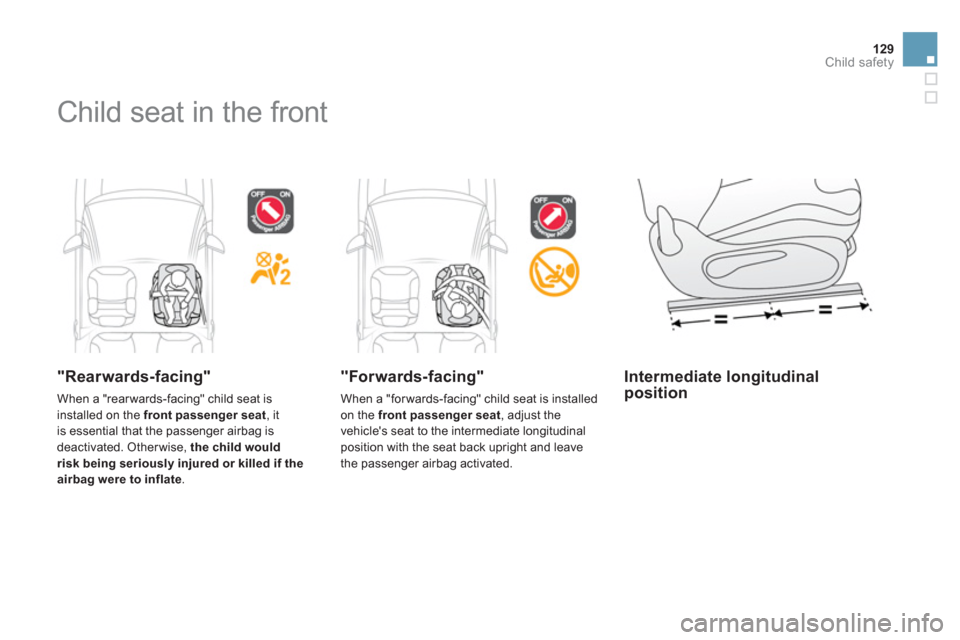
"Rearwards-facing"
When a "rear wards-facing" child seat is
installed on the front passenger seat
, it
is essential that the passenger airbag is
deactivated. Otherwise, the child would
risk being seriously injured or killed if the
airbag were to inflate
.
"Forwards-facing"
When a "for wards-facing" child seat is installed
on the front passenger seat
, adjust the
vehicle's seat to the intermediate longitudinal
position with the seat back upright and leave
the passenger airbag activated.
Intermediate longitudinal
position
Page 132 of 324
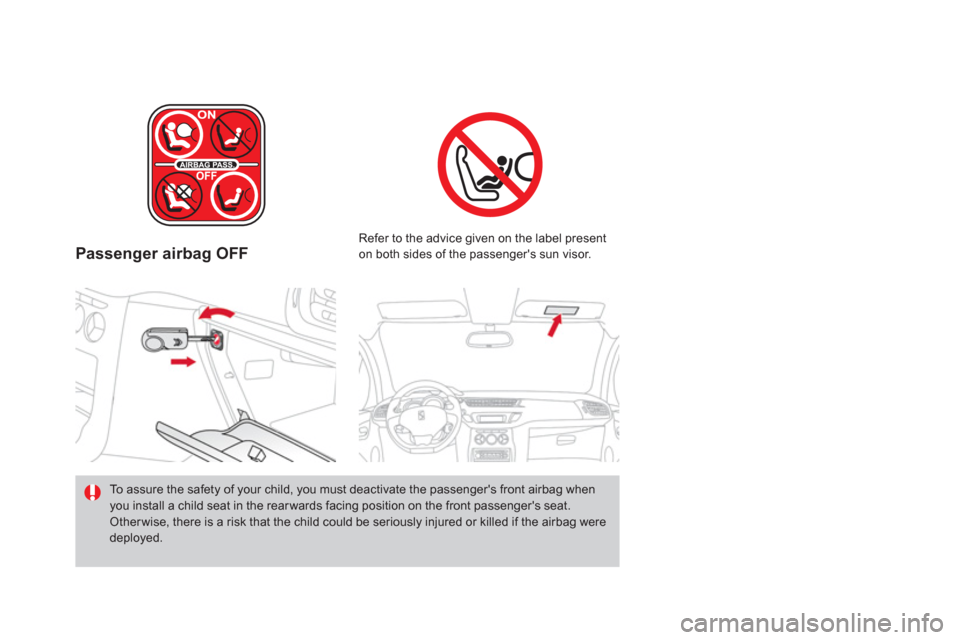
Passenger airbag OFF
Refer to the advice given on the label present
on both sides of the passenger's sun visor.
To assure the safety of your child, you must deactivate the passenger's front airbag when
you install a child seat in the rear wards facing position on the front passenger's seat.
Other wise, there is a risk that the child could be seriously injured or killed if the airbag were
deployed.
Page 135 of 324

133Child safety
Advice on child seats
The incorrect installation of a child seat in a
vehicle compromises the child's protection
in the event of an accident.
Remember to fasten the seat belts or the
child seat harness keeping the slack
in
relation to the child's body to a minimum
,
even for shor t journeys.
To install a child seat using the vehicle's
seat belt, ensure that the belt is well
tightened on the child seat and that it holds
the child seat firmly against the vehicle's
seat.
For optimum installation of the "for ward
facing" child seat, ensure that the back of
the child seat is in contact with the back
of the vehicle's seat and that the head
restraint does not cause any discomfor t.
If the head restraint has to be removed,
ensure that it is stored or attached securely
to prevent it from being thrown around the
vehicle in the event of sharp braking. Children under the age of 10 must not travel
in the "for ward facing" position on the front
passenger seat, unless the rear seats are
already occupied by other children, cannot
be used or are absent.
Deactivate the passenger airbag * when a
"rear facing" child seat is installed on the
front seat.
Other wise, the child would risk being
seriously injured or killed if the airbag were
to inflate.
Installing a booster seat
The chest par t of the seat belt must be
positioned on the child's shoulder without
touching the neck.
Ensure that the lap part of the seat belt
passes correctly over the child's thighs.
CITROËN recommends the use of a
booster seat which has a back, fitted with a
seat belt guide at shoulder level.
* According to country. As a safety precaution, do not leave:
- one or more children alone and
unsuper vised in a vehicle,
- a child or an animal in a vehicle which
is exposed to the sun, with the windows
closed,
- the keys within reach of children inside
the vehicle.
To protect young children from the rays of
the sun, fit side blinds on the rear windows.
Page 140 of 324
008
Safety
This section describes the operation of the direction indicators, hazard
warning lamps and the horn to warn other road users, the emergency
or assistance call in the event of an accident or breakdown, the various
braking and trajectory control systems for maintaining control of your
vehicle, the seat belts and airbags to reduce the risk of injury in the event
of a collision.
Page 146 of 324
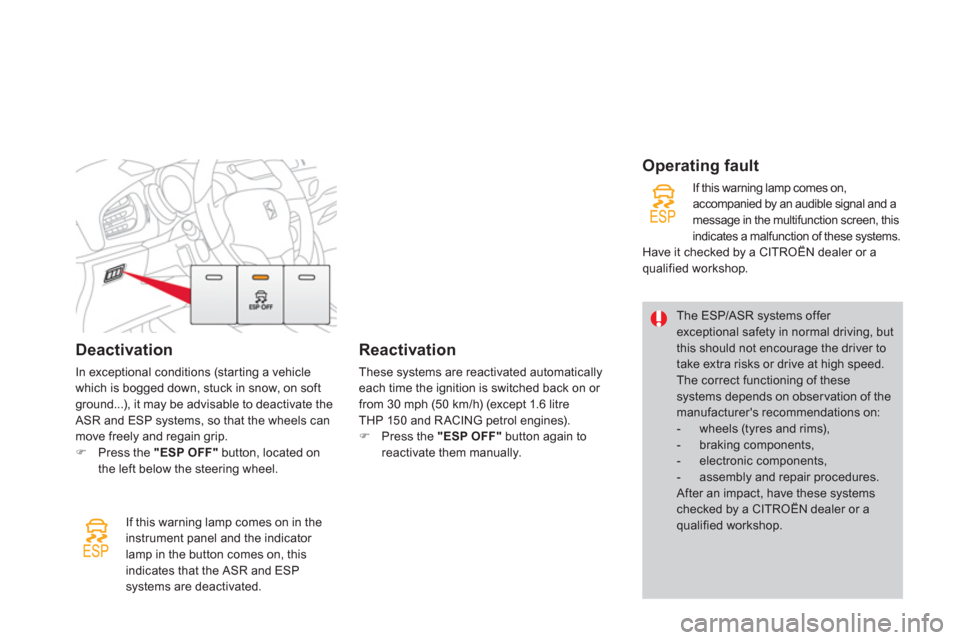
Deactivation
In exceptional conditions (starting a vehicle
which is bogged down, stuck in snow, on soft
ground...), it may be advisable to deactivate the
ASR and ESP systems, so that the wheels can
move freely and regain grip.
)
Press the "ESP OFF"
button, located on
the left below the steering wheel.
If this warning lamp comes on in the
instrument panel and the indicator
lamp in the button comes on, this
indicates that the ASR and ESP
systems are deactivated.
Reactivation
These systems are reactivated automatically
each time the ignition is switched back on or
from 30 mph (50 km/h) (except 1.6 litre
THP 150 and R ACING petrol engines).
)
Press the "ESP OFF"
button again to
reactivate them manually.
Operating fault
The ESP/ASR systems offer
exceptional safety in normal driving, but
this should not encourage the driver to
take extra risks or drive at high speed.
The correct functioning of these
systems depends on obser vation of the
manufacturer's recommendations on:
- wheels (tyres and rims),
- braking components,
- electronic components,
- assembly and repair procedures.
After an impact, have these systems
checked by a CITROËN dealer or a
qualified workshop.
If this warning lamp comes on,
accompanied by an audible signal and a
message in the multifunction screen, this
indicates a malfunction of these systems.
Have it checked by a CITROËN dealer or a
qualified workshop.
Page 149 of 324

147Safety
The driver must ensure that passengers use
the seat belts correctly and that they are all
restrained securely before setting off.
Wherever you are seated in the vehicle,
always fasten your seat belt, even for short
journeys.
Do not interchange the seat belt buckles as
they will not fulfil their role fully.
The seat belts are fitted with an iner tia reel
permitting automatic adjustment of the length
of the strap to your size. The seat belt is
stowed automatically when not in use.
Before and after use, ensure that the seat
belt is reeled in correctly.
The lower part of the strap must be
positioned as low as possible on the pelvis.
The upper par t must be positioned in the
hollow of the shoulder.
The iner tia reels are fitted with an automatic
locking device which comes into operation in
the event of a collision, emergency braking
or if the vehicle rolls over. You can release
the device by pulling firmly on the strap and
releasing it so that it reels in slightly. In order to be effective, a seat belt must:
- be tightened as close to the body as
possible,
- be pulled in front of you with a smooth
movement, checking that it does not
twist,
- be used to restrain only one person,
- not bear any trace of cuts or fraying,
- not be conver ted or modified to avoid
affecting its per formance.
In accordance with current safety regulations,
for all repairs on your vehicle, go to a
qualified workshop with the skills and
equipment needed, which a CITROËN dealer
is able to provide.
Have your seat belts checked regularly by
a CITROËN dealer or a qualified workshop,
par ticularly if the straps show signs of
damage.
Clean the seat belt straps with soapy water or
a textile cleaning product, sold by CITROËN
dealers.
After folding or moving a seat or rear bench
seat, ensure that the seat belt is positioned
and reeled in correctly.
Recommendations for children
Use a suitable child seat if the passenger is
less than 12 years old or shor ter than one
and a half metres.
Never use the same seat belt to secure
more than one person.
Never allow a child to travel on your lap.
In the event of an impact
Depending on the nature and seriousness
of the impact
, the pretensioning device may
be deployed before and independently of the
airbags. Deployment of the pretensioners is
accompanied by a slight discharge of
harmless smoke and a noise, due to the
activation of the pyrotechnic car tridge
incorporated in the system.
In all cases, the airbag warning lamp
comes on.
Following an impact, have the seat belts
system checked, and if necessary replaced,
by a CITROËN dealer or a qualified
workshop.
Page 150 of 324
Airbags
System designed to maximise the safety of the
occupants (with the exception of the rear centre
passenger) in the event of violent collisions.
It supplements the action of the force-limiting
seat belts (with the exception of the rear centre
passenger).
If a collision occurs, the electronic detectors
record and analyse the front and side impacts
sustained in the impact detection zones:
- in the case of a serious impact, the airbags
are deployed instantly and protect the
occupants of the vehicle (with the exception
of the rear centre passenger); immediately
after the impact, the airbags deflate rapidly
so that they do not hinder visibility or the
exit of the occupants,
- in the case of a minor or rear impact or in
cer tain roll-over conditions, the airbags
will not be deployed; the seat belt alone is
sufficient to provide optimum protection in
these situations.
The airbags do not operate when the
ignition is switched off.
This equipment will only deploy once.
If a second impact occurs (during the
same or a subsequent accident), the
airbag will not be deployed again.
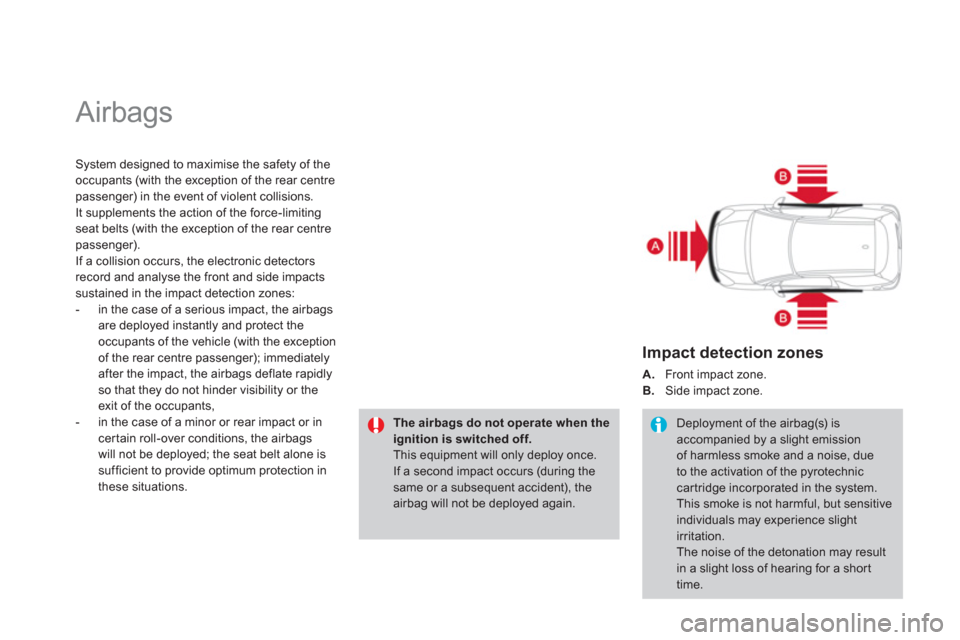
Impact detection zones
A.
Front impact zone.
B.
Side impact zone.
Deployment of the airbag(s) is
accompanied by a slight emission
of harmless smoke and a noise, due
to the activation of the pyrotechnic
car tridge incorporated in the system.
This smoke is not harmful, but sensitive
individuals may experience slight
irritation.
The noise of the detonation may result
in a slight loss of hearing for a short
time.
Page 151 of 324
149Safety
Front airbags
System which protects the driver and front
passenger in the event of a serious front impact
in order to limit the risk of injury to the head and
chest.
The driver's airbag is fitted in the centre of the
steering wheel; the front passenger's airbag is
fitted in the dashboard above the glove box.
Deployment
The airbags are deployed simultaneously,
unless the passenger's front airbag is
deactivated, in the event of a serious front
impact applied to all or par t of the front impact
zone A
, in the longitudinal centreline of the
vehicle on a horizontal plane and directed from
the front to the rear of the vehicle.
The front airbag inflates between the head-
thorax of the front occupant of the vehicle
and the dashboard to cushion their for ward
movement.