Page 16 of 573
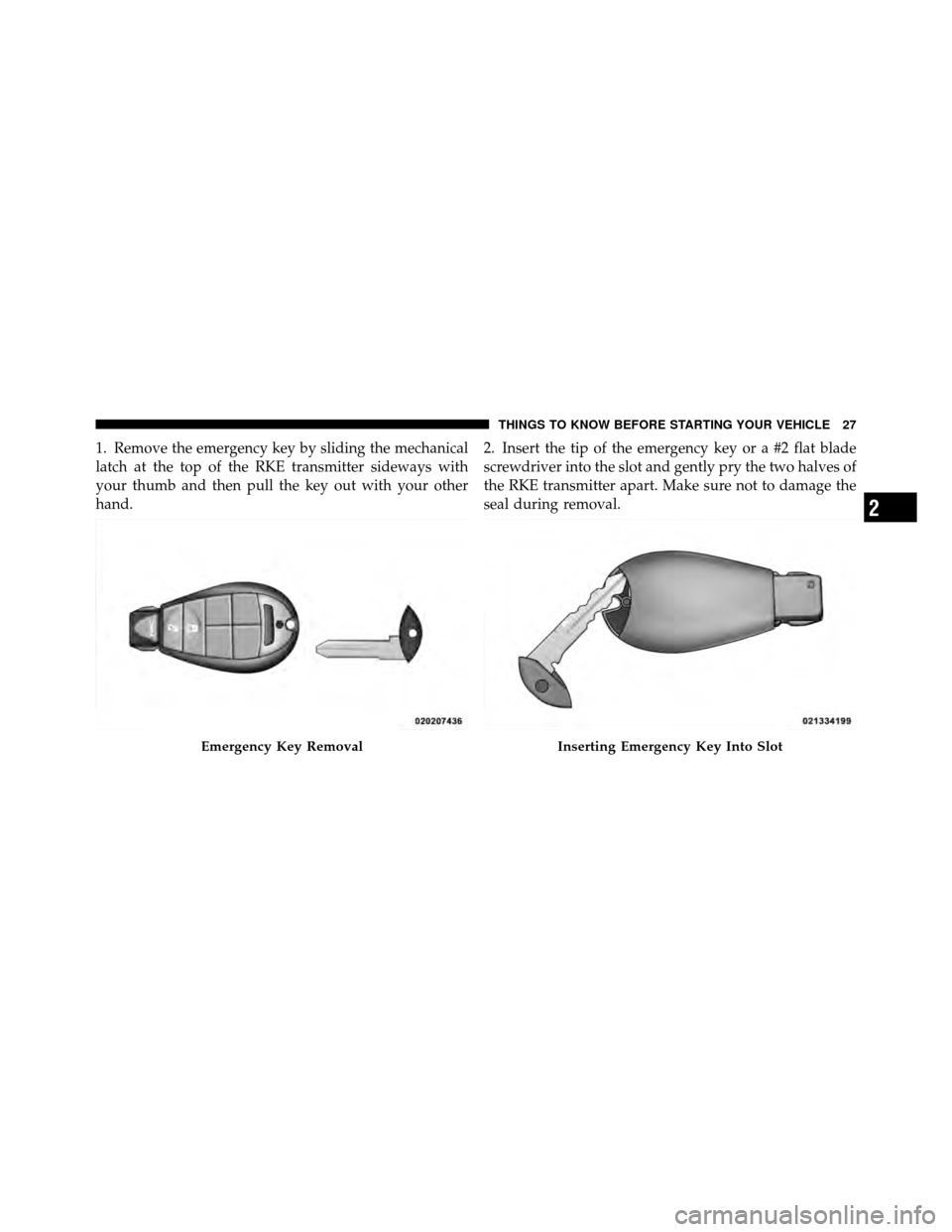
Key Fob
The Key Fob operates the ignition switch. Insert the
square end of the key fob into the ignition switch located
on the instrument panel and rotate to the desired posi-
tion. It also contains the Remote Keyless Entry (RKE)
transmitter and an emergency key, which stores in the
rear of the Key Fob.
The emergency key allows for entry into the vehicle
should the battery in the vehicle or the RKE transmitter
go dead. The emergency key is also for locking the lower
glove compartment. You can keep the emergency key
with you when valet parking.
To remove the emergency key, slide the mechanical latch
at the top of the Key Fob sideways with your thumb and
then pull the key out with your other hand.NOTE:
You can insert the double-sided emergency key
into the lock cylinder with either side up.
Removing Key Fob From Ignition
Place the shift lever in PARK. Turn the Key Fob to the
OFF position and then remove the Key Fob.
Emergency Key Removal
2
THINGS TO KNOW BEFORE STARTING YOUR VEHICLE 13
Page 30 of 573
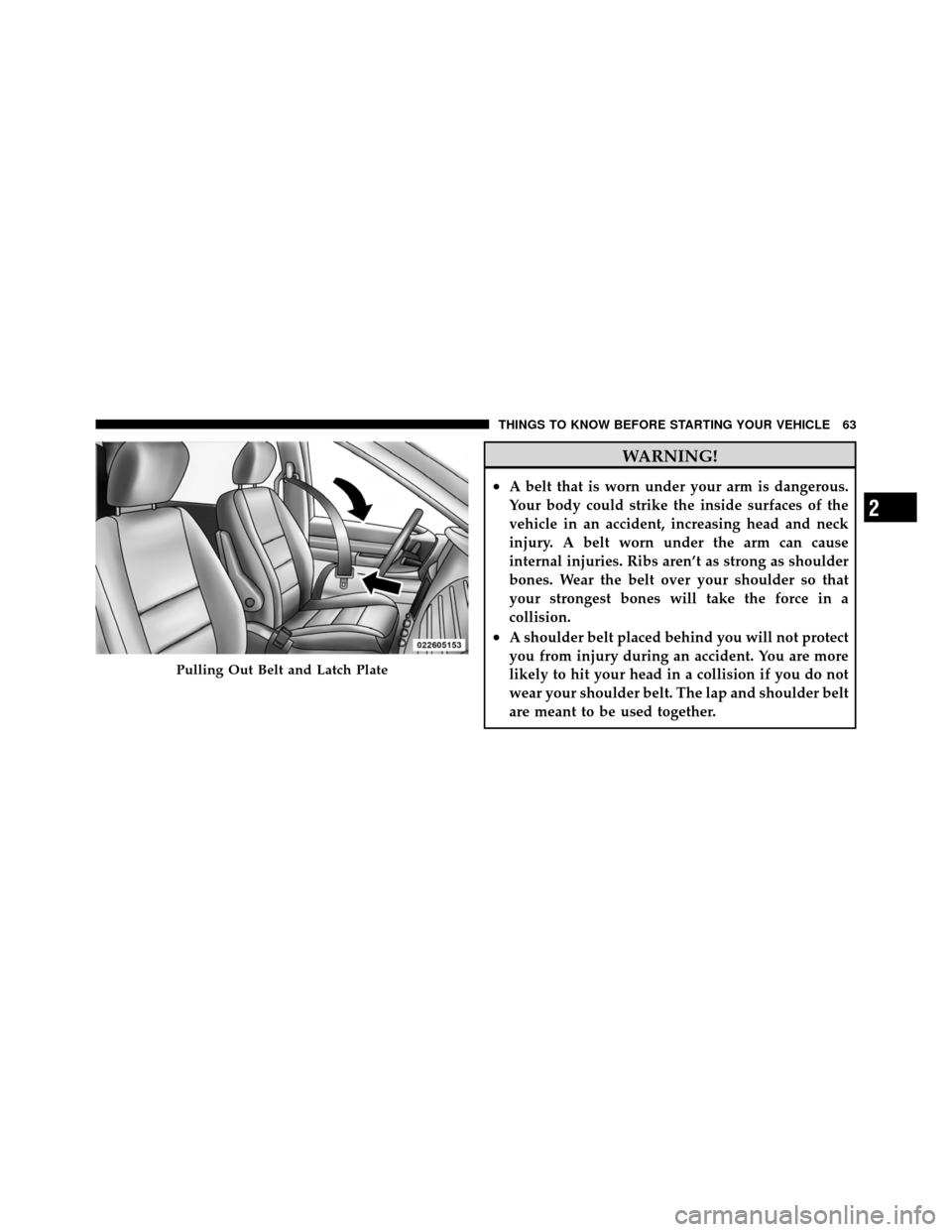
1. Remove the emergency key by sliding the mechanical
latch at the top of the RKE transmitter sideways with
your thumb and then pull the key out with your other
hand.2. Insert the tip of the emergency key or a #2 flat blade
screwdriver into the slot and gently pry the two halves of
the RKE transmitter apart. Make sure not to damage the
seal during removal.
Emergency Key RemovalInserting Emergency Key Into Slot
2
THINGS TO KNOW BEFORE STARTING YOUR VEHICLE 27
Page 49 of 573
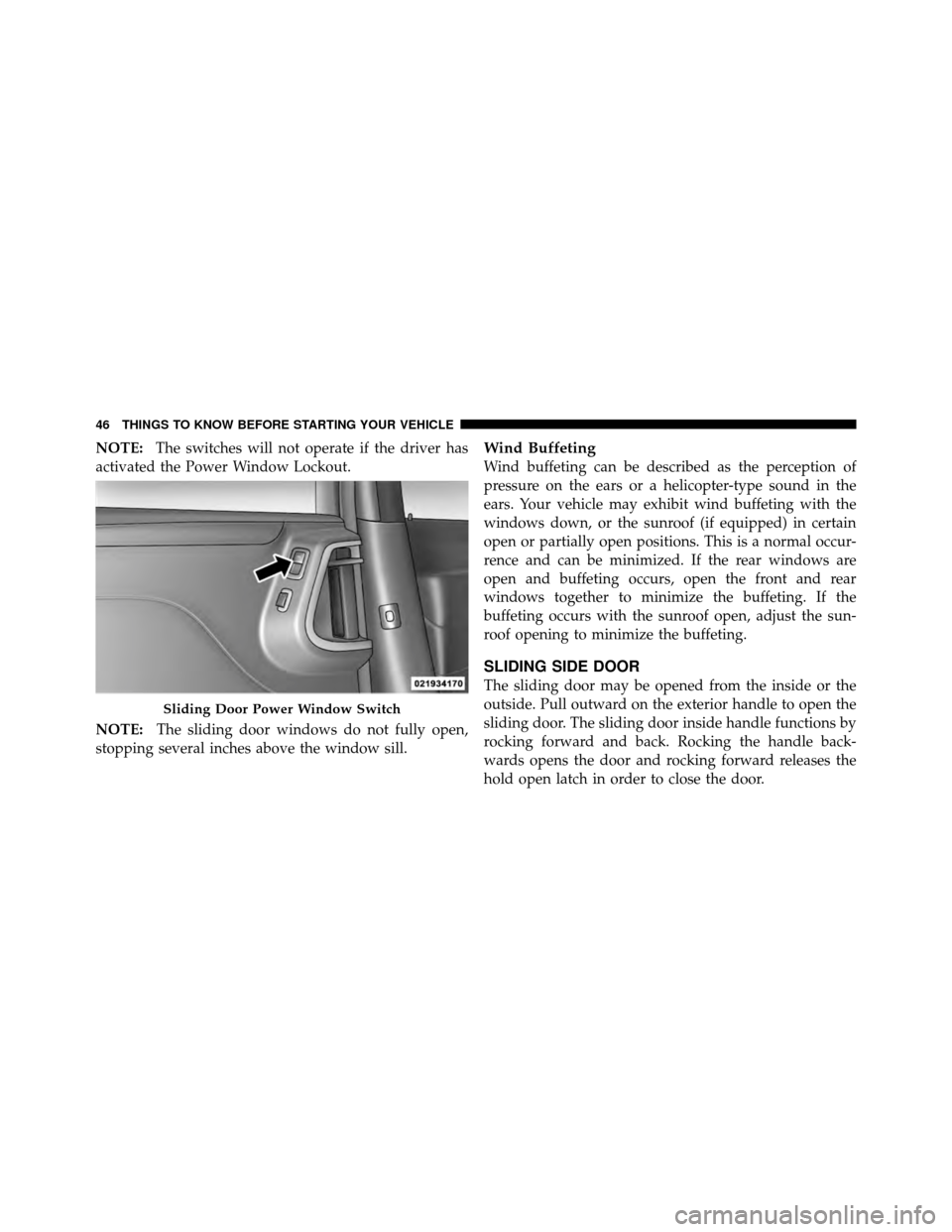
NOTE:The switches will not operate if the driver has
activated the Power Window Lockout.
NOTE: The sliding door windows do not fully open,
stopping several inches above the window sill.Wind Buffeting
Wind buffeting can be described as the perception of
pressure on the ears or a helicopter-type sound in the
ears. Your vehicle may exhibit wind buffeting with the
windows down, or the sunroof (if equipped) in certain
open or partially open positions. This is a normal occur-
rence and can be minimized. If the rear windows are
open and buffeting occurs, open the front and rear
windows together to minimize the buffeting. If the
buffeting occurs with the sunroof open, adjust the sun-
roof opening to minimize the buffeting.
SLIDING SIDE DOOR
The sliding door may be opened from the inside or the
outside. Pull outward on the exterior handle to open the
sliding door. The sliding door inside handle functions by
rocking forward and back. Rocking the handle back-
wards opens the door and rocking forward releases the
hold open latch in order to close the door.
Sliding Door Power Window Switch
46 THINGS TO KNOW BEFORE STARTING YOUR VEHICLE
Page 50 of 573
To keep your door operating properly, observe the fol-
lowing guidelines:
•Always open the door smoothly.
•Avoid high impacts against the door stop when open-
ing the door. This is very important when your vehicle
is parked on an incline as the door will slide faster in
the downhill direction.
•There is a hold-open latch that is activated when the
sliding door is fully opened. This latch will keep your
sliding door open on any incline. To close the sliding
door after the hold-open latch is activated, you must
rock the inside handle forward or pull outward on the
exterior handle.
Always make sure that the sliding door is fully latched
anytime the vehicle is in motion. NOTE:
The left side sliding door cannot be opened
while the fuel door is open. This feature operates only
when the sliding door is fully closed prior to opening the
fuel door.
Power Sliding Side Door — If Equipped
The power sliding door may be opened or
closed manually or by using the buttons on the
RKE transmitter, overhead console switch, or
rear door switch. Pulling the inside or outside
power sliding door handle will also power open or close
the power sliding door.
NOTE: Pulling the outside power sliding door handle a
second time while the sliding door is power opening or
power closing will allow the sliding door to be opened or
closed manually.
2
THINGS TO KNOW BEFORE STARTING YOUR VEHICLE 47
Page 59 of 573

WARNING!
During power operation, personal injury or cargo
damage may occur. Ensure the liftgate travel path is
clear. Make sure the liftgate is closed and latched
before driving away.
NOTE:
•If anything obstructs the power liftgate while it is
closing or opening, the liftgate will automatically
reverse to the closed or open position, provided it
meets sufficient resistance.
•There are also pinch sensors attached to the side of the
liftgate opening. Light pressure anywhere along these
strips will cause the liftgate to return to the open
position.
•The power liftgate must be in the full open or close
positions for any of the buttons to operate. If the
liftgate is not in the full open or close positions, it must
be opened or closed manually.
•If the liftgate release button is activated while the
power liftgate is closing, the liftgate will reverse to the
full open position.
•The power liftgate buttons will not operate if the shift
lever is in gear or the vehicle speed is above 0 mph
(0 km/h).
•The power liftgate will not operate in temperatures
below �12°F (�24°C) or temperatures above 143°F
(62°C). Be sure to remove any buildup of snow or ice
from the liftgate before pressing any of the power
liftgate buttons.
56 THINGS TO KNOW BEFORE STARTING YOUR VEHICLE
Page 61 of 573
•An energy-absorbing steering column and steering
wheel
•Knee bolsters/blockers for front seat occupants
•Front seat belts incorporate pretensioners that may
enhance occupant protection by managing occupant
energy during an impact event
•All seat belt systems (except the driver ’s and third row
center) include Automatic Locking Retractors (ALRs),
which lock the seat belt webbing into position by
extending the belt all the way out and then adjusting
the belt to the desired length to restrain a child seat or
secure a large item in a seat
Please pay close attention to the information in this
section. It tells you how to use your restraint system
properly, to keep you and your passengers as safe as
possible. If you will be carrying children too small for adult-sized
seat belts, the seat belts or the Lower Anchors and Tether
for CHildren (LATCH) feature also can be used to hold
infant and child restraint systems. For more information
on LATCH, refer to Lower Anchors and Tether for
CHildren (LATCH).
NOTE:
The Advanced Front Air Bags have a multistage
inflator design. This allows the air bag to have different
rates of inflation based on the severity and type of
collision.
Here are some simple steps you can take to minimize the
risk of harm from a deploying air bag:
1. Children 12 years old and under should always ride
buckled up in a rear seat.
58 THINGS TO KNOW BEFORE STARTING YOUR VEHICLE
Page 65 of 573

WARNING! (Continued)
•Wearing a seat belt incorrectly is dangerous. Seat
belts are designed to go around the large bones of
your body. These are the strongest parts of your
body and can take the forces of an accident the
best.
•Wearing your belt in the wrong place could make
your injuries in an accident much worse. You
might suffer internal injuries, or you could even
slide out of part of the belt. Follow these instruc-
tions to wear your seat belt safely and to keep your
passengers safe, too.
•Two people should never be belted into a single
seat belt. People belted together can crash into one
another in an accident, hurting one another badly.
Never use a lap/shoulder belt or lap belt for more
than one person, no matter what their size.
Lap/Shoulder Belt Operating Instructions
1. Enter the vehicle and close the door. Sit back and
adjust the seat.
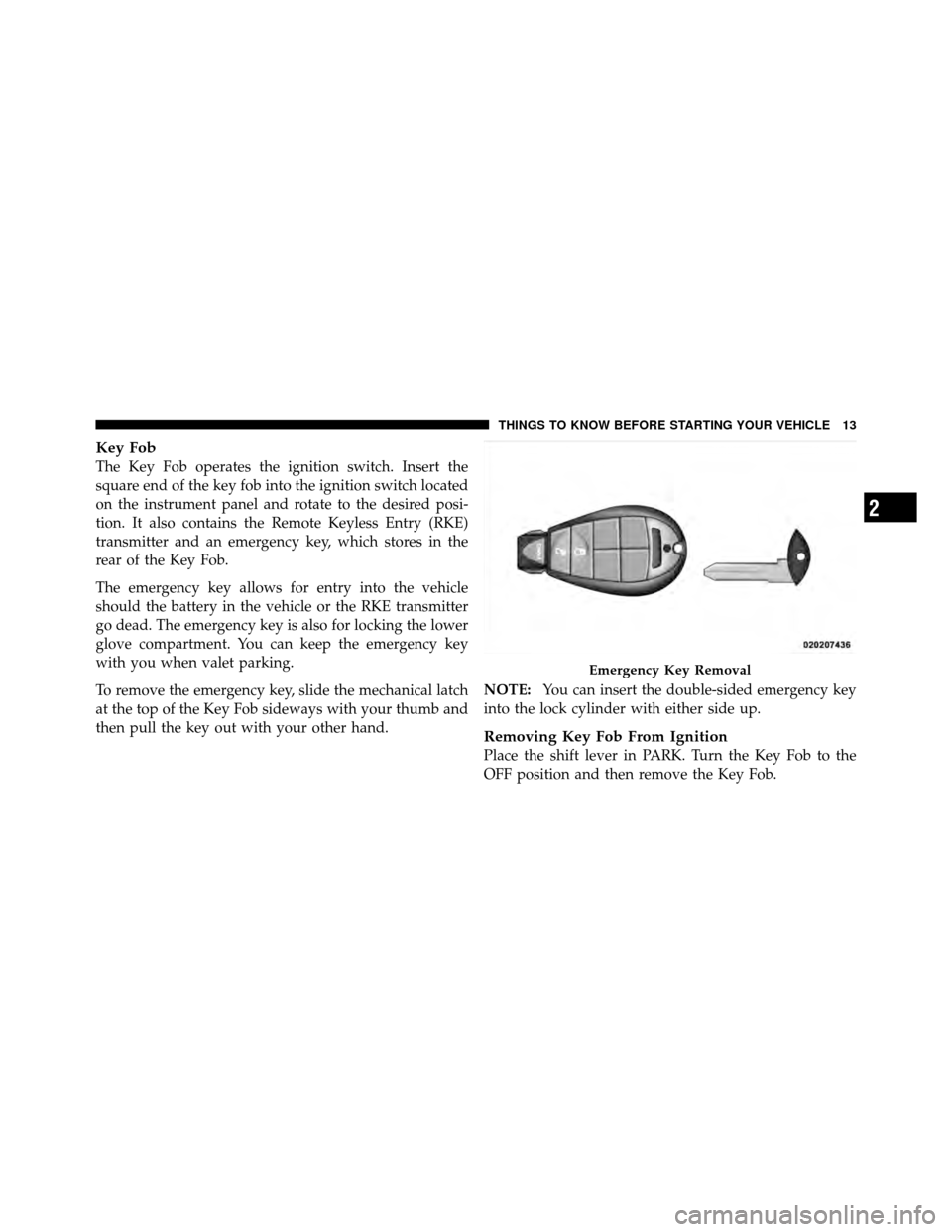
2. The seat belt latch plate is near the seatback of the
front seats and next to your arm in the rear seats. Grasp
the latch plate and pull out the belt. Slide the latch plate
up the webbing as far as necessary to allow the belt to go
around your lap.
62 THINGS TO KNOW BEFORE STARTING YOUR VEHICLE
Page 66 of 573
WARNING!
•A belt that is worn under your arm is dangerous.
Your body could strike the inside surfaces of the
vehicle in an accident, increasing head and neck
injury. A belt worn under the arm can cause
internal injuries. Ribs aren’t as strong as shoulder
bones. Wear the belt over your shoulder so that
your strongest bones will take the force in a
collision.
•A shoulder belt placed behind you will not protect
you from injury during an accident. You are more
likely to hit your head in a collision if you do not
wear your shoulder belt. The lap and shoulder belt
are meant to be used together.
Pulling Out Belt and Latch Plate
2
THINGS TO KNOW BEFORE STARTING YOUR VEHICLE 63