Page 34 of 505
Automatic Door Locks — If Equipped
When enabled, the door locks will lock automatically
when the vehicle’s speed exceeds 15 mph (24 km/h). The
Automatic Door Locks feature can be enabled or disabled
by your authorized dealer. See your authorized dealer for
programming.
Auto Unlock On Exit
The doors will unlock automatically on vehicles with
power door locks if:
1. The Automatic Unlock Doors On Exit feature is en-
abled.
2. The transaxle was in gear and the vehicle speed
returned to 0 mph (0 km/h).
3. The transaxle is in NEUTRAL or PARK.
4. The driver door is opened.
5. The doors were not previously unlocked.6. The vehicle speed is 0 mph (0 km/h).
Auto Unlock Door On Exit Programming
The Automatic Unlock Doors On Exit feature can be
enabled or disabled as follows:
•For vehicles equipped with the Electronic Vehicle
Information Center (EVIC), refer to “Electronic Vehicle
Information Center (EVIC)/Personal Settings
(Customer-Programmable Features)” in “Understand-
ing Your Instrument Panel” for further information.
•For vehicles not equipped with the EVIC, perform the
following procedure:
1. Close all doors and place the key in the ignition.
2. Cycle the ignition switch between LOCK and ON/
RUN and then back to LOCK four times ending up in the
LOCK position.
32 THINGS TO KNOW BEFORE STARTING YOUR VEHICLE
Page 38 of 505
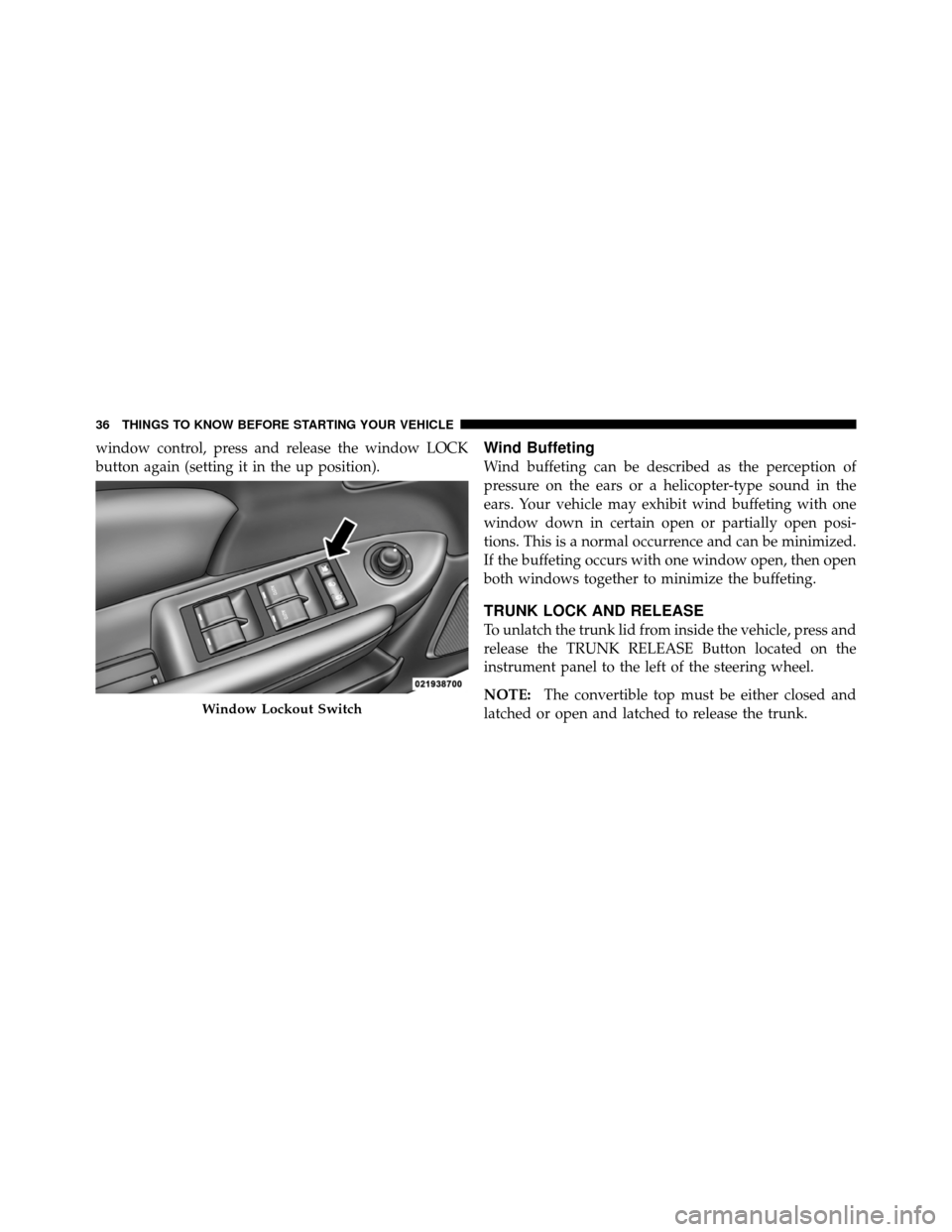
window control, press and release the window LOCK
button again (setting it in the up position).Wind Buffeting
Wind buffeting can be described as the perception of
pressure on the ears or a helicopter-type sound in the
ears. Your vehicle may exhibit wind buffeting with one
window down in certain open or partially open posi-
tions. This is a normal occurrence and can be minimized.
If the buffeting occurs with one window open, then open
both windows together to minimize the buffeting.
TRUNK LOCK AND RELEASE
To unlatch the trunk lid from inside the vehicle, press and
release the TRUNK RELEASE Button located on the
instrument panel to the left of the steering wheel.
NOTE:The convertible top must be either closed and
latched or open and latched to release the trunk.
Window Lockout Switch
36 THINGS TO KNOW BEFORE STARTING YOUR VEHICLE
Page 43 of 505
4.Do not lean against the door or window. If your
vehicle has side air bags, and deployment occurs, the
side air bags will inflate forcefully into the space
between you and the door.
5. If the air bag system in this vehicle needs to be
modified to accommodate a disabled person, contact
the Customer Center. Phone numbers are provided
under �If You Need Assistance�.
WARNING!
•Relying on the air bags alone could lead to more
severe injuries in a collision. The air bags work
with your seat belt to restrain you properly. In
some collisions, the air bags won’t deploy at all.
Always wear your seat belts even though you have
air bags.
(Continued)
WARNING! (Continued)
•Being too close to the steering wheel or instrument
panel during Advanced Front Air Bag deployment
could cause serious injury, including death. Air
Bags need room to inflate. Sit back, comfortably
extending your arms to reach the steering wheel or
instrument panel.
•Seat-Mounted Side Air Bags (SAB) need room to
inflate. Do not lean against the door or window.
Sit upright in the center of the seat.
•In an accident, you and your passengers can suffer
much greater injuries if you are not properly
buckled up. You can strike the interior of your
vehicle or other passengers, or you can be thrown
out of the vehicle. Always be sure you and others
in your vehicle are buckled up properly.
2
THINGS TO KNOW BEFORE STARTING YOUR VEHICLE 41
Page 58 of 505
WARNING!
Using a seat belt extender when not needed can
increase the risk of injury in an accident. Only use
when the lap belt is not long enough when it is worn
low and snug, and in the recommended seating
positions. Remove and store the extender when not
needed.
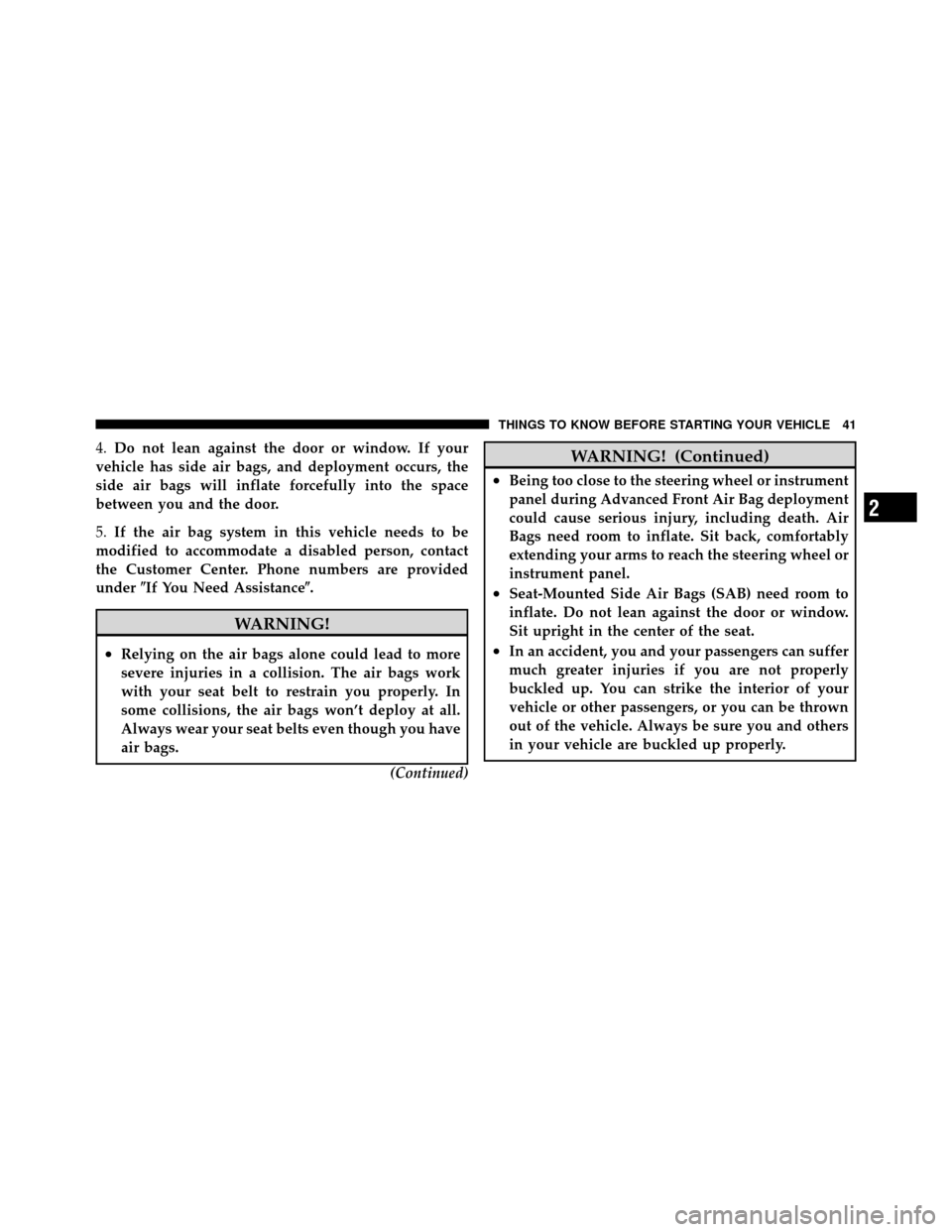
Supplemental Restraint System (SRS) — Air Bags
This vehicle has Advanced Front Air Bags for both the
driver and front passenger as a supplement to the seat
belt restraint systems. The driver’s Advanced Front Air
Bag is mounted in the center of the steering wheel. The
passenger’s Advanced Front Air Bag is mounted in the
instrument panel, above the glove compartment. The
words SRS AIRBAG are embossed on the air bag covers.NOTE:
These air bags are certified to the new Federal
regulations for Advanced Air Bags.
Advanced Front Air Bag And Knee Bolster Locations
1 — Driver And Passenger Advanced Front Air Bags
2 — Knee Bolster
56 THINGS TO KNOW BEFORE STARTING YOUR VEHICLE
Page 59 of 505

The Advanced Front Air Bags have a multistage inflator
design. This allows the air bag to have different rates of
inflation that are based on the severity and type of
collision.
This vehicle may be equipped with driver and/or front
passenger seat track position sensors that may adjust the
inflation rate of the Advanced Front Air Bags based upon
seat position.
This vehicle may be equipped with a driver and/or front
passenger seat belt buckle switch that detects whether
the driver or front passenger seat belt is fastened. The
seat belt buckle switch may adjust the inflation rate of the
Advanced Front Air Bags.
This vehicle is equipped with Supplemental Seat-
Mounted Side Air Bags (SAB) to provide enhanced
protection for an occupant during a side impact. The
SABs are located in the outboard side of the front seats.NOTE:
•Air Bag covers may not be obvious in the interior trim,
but they will open during air bag deployment.
•After any accident, the vehicle should be taken to an
authorized dealer immediately.
Air Bag System Components
Your vehicle may be equipped with the following air bag
system components:
•Occupant Restraint Controller (ORC)
•Air Bag Warning Light
•Steering Wheel and Column
•Instrument Panel
•Knee Impact Bolster
•Driver Advanced Front Air Bag
•Passenger Advanced Front Air Bag
2
THINGS TO KNOW BEFORE STARTING YOUR VEHICLE 57
Page 60 of 505

•Supplemental Seat-Mounted Side Air Bags (SAB)
•Front and Side Impact Sensors
•Front Seat Belt Pretensioners, Seat Belt Buckle Switch,
and Seat Track Position Sensors
•Supplemental Active Head Restraint for Driver and
Front Passenger
Advanced Front Air Bag Features
The Advanced Front Air Bag system has multistage
driver and front passenger air bags. This system provides
output appropriate to the severity and type of collision as
determined by the Occupant Restraint Controller (ORC),
which may receive information from the front impact
sensors.
The first stage inflator is triggered immediately during an
impact that requires air bag deployment. This low output
is used in less severe collisions. A higher energy output is
used for more severe collisions.
WARNING!
•No objects should be placed over or near the air
bag on the instrument panel, because any such
objects could cause harm if the vehicle is in a
collision severe enough to cause the air bag to
inflate.
•Do not put anything on or around the air bag
covers or attempt to open them manually. You may
damage the air bags and you could be injured
because the air bags may no longer be functional.
The protective covers for the air bag cushions are
designed to open only when the air bags are
inflating.
•Do not drill, cut or tamper with the knee bolster in
any way.
•Do not mount any accessories to the knee bolster
such as alarm lights, stereos, citizen band radios,
etc.
58 THINGS TO KNOW BEFORE STARTING YOUR VEHICLE
Page 63 of 505

Because air bag sensors measure vehicle deceleration
over time, vehicle speed and damage by themselves are
not good indicators of whether or not an air bag should
have deployed.
Seat belts are necessary for your protection in all acci-
dents, and also are needed to help keep you in position,
away from an inflating air bag.
The ORC monitors the readiness of the electronic parts of
the air bag system whenever the ignition switch is in the
START or ON/RUN position. If the key is in the OFF
position, in the ACC position, or not in the ignition, the
air bag system is not on and the air bags will not inflate.
The ORC contains a backup power supply system that
may deploy the air bags even if the battery loses power or
it becomes disconnected prior to deployment.Also, the ORC turns on the Air Bag Warning
Light in the instrument panel for approxi-
mately four to eight seconds for a self-check
when the ignition is first turned on. After the
self-check, the Air Bag Warning Light will turn off. If the
ORC detects a malfunction in any part of the system, it
turns on the Air Bag Warning Light, either momentarily
or continuously. A single chime will sound if the light
comes on again after initial startup.
It also includes diagnostics that will illuminate the instru-
ment cluster Air Bag Warning Light if a malfunction is
noted that could affect the air bag system. The diagnos-
tics also record the nature of the malfunction.
2
THINGS TO KNOW BEFORE STARTING YOUR VEHICLE 61
Page 64 of 505
WARNING!
Ignoring the Air Bag Warning Light in your instru-
ment panel could mean you won’t have the air bags
to protect you in a collision. If the light does not come
on as a bulb check when the ignition is first turned
on, stays on after you start the vehicle, or if it comes
on as you drive, have an authorized dealer service the
air bag system immediately.
Driver And Passenger Advanced Front Air Bag
Inflator Units
The Driver and Passenger Advanced Front Air Bag
Inflator Units are located in the center of the steering
wheel and on the right side of the instrument panel.
When the ORC detects a collision requiring the Ad-
vanced Front Air Bags, it signals the inflator units. A large
quantity of non-toxic gas is generated to inflate the
Advanced Front Air Bags. Different air bag inflation ratesare possible, based on the collision type and severity. The
steering wheel hub trim cover and the upper right side of
the instrument panel separate and fold out of the way as
the air bags inflate to their full size. The air bags fully
inflate in about 50 to 70 milliseconds. This is about half of
the time it takes to blink your eyes. The air bags then
quickly deflate while helping to restrain the driver and
front passenger.
The Advanced Front Air Bag gas is vented through the
vent holes in the sides of the air bag. In this way, the air
bags do not interfere with your control of the vehicle.Supplemental Seat-Mounted Side Air Bag (SAB)
Inflator Units
The Supplemental Seat-Mounted Side Air Bags (SAB) are
designed to activate only in certain side collisions.
The ORC determines if a side collision requires the side
air bags to inflate, based on the severity and type of
collision.
62 THINGS TO KNOW BEFORE STARTING YOUR VEHICLE