2011 CHEVROLET VOLT warning
[x] Cancel search: warningPage 436 of 516
Black plate (70,1)Chevrolet Volt Owner Manual - 2011
10-70 Vehicle Care
But if there ever is a blowout, here
are a few tips about what to expect
and what to do:
If a front tire fails, the flat tire will
create a drag that pulls the vehicle
toward that side. Take your foot
off the accelerator pedal and grip
the steering wheel firmly. Steer to
maintain lane position, and then
gently brake to a stop, well off
the road, if possible.
A rear blowout, particularly on a
curve, acts much like a skid and
may require the same correction
as used in a skid. Stop pressing
the accelerator pedal and steer to
straighten the vehicle. It may be
very bumpy and noisy. Gently
brake to a stop, well off the road,
if possible.{WARNING
Driving on a flat tire will cause
permanent damage to the tire.
Re-inflating a tire after it has
been driven on while severely
underinflated or flat may cause
a blowout and a serious crash.
Never attempt to re-inflate a tire
that has been driven on while
severely underinflated or flat.
Have your dealer or an authorized
tire service center repair or
replace the flat tire as soon
as possible.
If a tire goes flat, avoid further tire
and wheel damage by driving slowly
to a level place and stopping, well
off the road, if possible.
1. Turn on the hazard warning flashers. See Hazard Warning
Flashers on page 6‑4.
2. Set the parking brake firmly. 3. Put the shift lever in P (Park).
See Shifting Into Park on
page 9‑22.
4. Turn off the engine.
5. Inspect the flat tire.
If the tire has been separated from
the wheel, has damaged sidewalls,
or has a puncture larger than
6 mm (¼ in), the tire is too severely
damaged for the tire sealant and
compressor kit to be effective.
See Roadside Assistance Program
on page 13‑6.
If the tire has a puncture less
than 6 mm (¼ in) in the tread area
of the tire, see Tire Sealant and
Compressor Kit on page 10‑71.
Page 437 of 516

Black plate (71,1)Chevrolet Volt Owner Manual - 2011
Vehicle Care 10-71
Tire Sealant and
Compressor Kit
{WARNING
Running the engine in Extended
Range Mode in an enclosed
area with poor ventilation is
dangerous. Engine exhaust may
enter the vehicle. Engine exhaust
contains Carbon Monoxide (CO)
which cannot be seen or smelled.
It can cause unconsciousness
and even death. Never run the
engine in Extended Range Mode
in an enclosed area that has no
fresh air ventilation. For more
information, seeEngine Exhaust
on page 9‑30.
{WARNING
Overinflating a tire could cause
the tire to rupture and you or
others could be injured. Be sure
to read and follow the tire
sealant and compressor kit
instructions and inflate the tire
to its recommended pressure.
Do not exceed the recommended
pressure.
{WARNING
Storing the tire sealant
and compressor kit or other
equipment in the passenger
compartment of the vehicle could
cause injury. In a sudden stop or
collision, loose equipment could
strike someone. Store the tire
sealant and compressor kit in
its original location. If this vehicle has a tire sealant and
compressor kit, there may not be a
spare tire, tire changing equipment,
and on some vehicles there may not
be a place to store a tire.
The tire sealant and compressor
can be used to temporarily seal
punctures up to 6 mm (¼ in) in the
tread area of the tire. It can also be
used to inflate an underinflated tire.
If the tire has been separated from
the wheel, has damaged sidewalls,
or has a large puncture, the tire is
too severely damaged for the tire
sealant and compressor kit to be
effective. See
Roadside Assistance
Program on page 13‑6.
Read and follow all of the tire
sealant and compressor kit
instructions.
Page 439 of 516

Black plate (73,1)Chevrolet Volt Owner Manual - 2011
Vehicle Care 10-73
When using the tire sealant
and compressor kit during cold
temperatures, warm the kit in a
heated environment for five minutes.
This will help to inflate the tire
faster.
If a tire goes flat, avoid further tire
and wheel damage by driving slowly
to a level place. Turn on the hazard
warning flashers. SeeHazard
Warning Flashers on page 6‑4.
See If a Tire Goes Flat on
page 10‑69 for other important
safety warnings. Do not remove any objects that
have penetrated the tire.
1. Remove the tire sealant and
compressor kit from its storage
location. See Storing the Tire
Sealant and Compressor Kit on
page 10‑78.
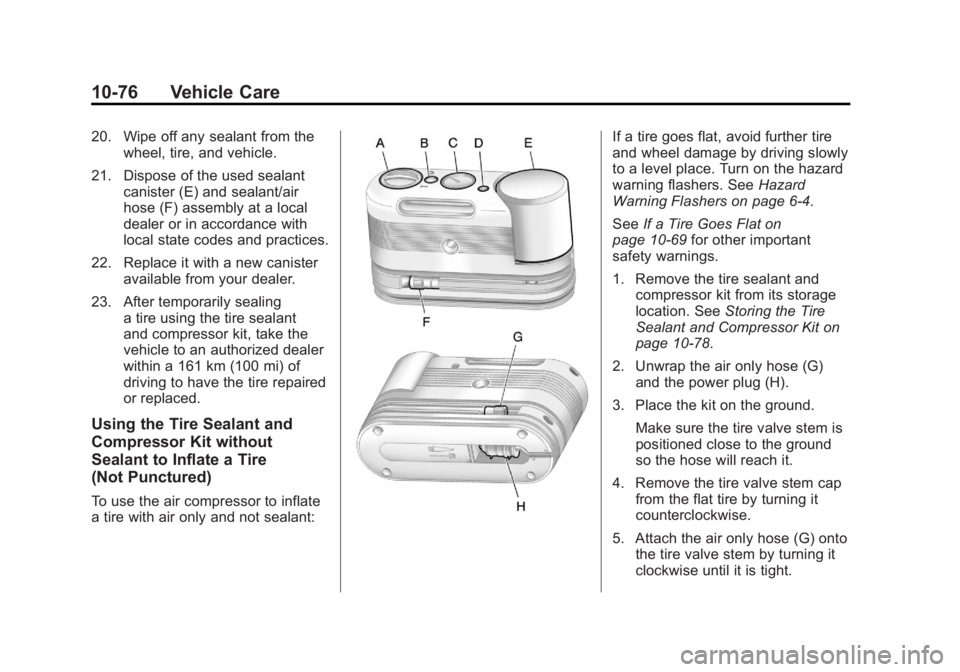
2. Unwrap the sealant/air hose (F) and the power plug (H).
3. Place the kit on the ground. Make sure the tire valve stem is
positioned close to the ground
so the hose will reach it.
4. Remove the valve stem cap from the flat tire by turning it
counterclockwise.
5. Attach the sealant/air hose (F) onto the tire valve stem. Turn it
clockwise until it is tight.
Page 442 of 516
Black plate (76,1)Chevrolet Volt Owner Manual - 2011
10-76 Vehicle Care
20. Wipe off any sealant from thewheel, tire, and vehicle.
21. Dispose of the used sealant canister (E) and sealant/air
hose (F) assembly at a local
dealer or in accordance with
local state codes and practices.
22. Replace it with a new canister available from your dealer.
23. After temporarily sealing a tire using the tire sealant
and compressor kit, take the
vehicle to an authorized dealer
within a 161 km (100 mi) of
driving to have the tire repaired
or replaced.
Using the Tire Sealant and
Compressor Kit without
Sealant to Inflate a Tire
(Not Punctured)
To use the air compressor to inflate
a tire with air only and not sealant:
If a tire goes flat, avoid further tire
and wheel damage by driving slowly
to a level place. Turn on the hazard
warning flashers. See Hazard
Warning Flashers on page 6‑4.
See If a Tire Goes Flat on
page 10‑69 for other important
safety warnings.
1. Remove the tire sealant and compressor kit from its storage
location. See Storing the Tire
Sealant and Compressor Kit on
page 10‑78.
2. Unwrap the air only hose (G) and the power plug (H).
3. Place the kit on the ground. Make sure the tire valve stem is
positioned close to the ground
so the hose will reach it.
4. Remove the tire valve stem cap from the flat tire by turning it
counterclockwise.
5. Attach the air only hose (G) onto the tire valve stem by turning it
clockwise until it is tight.
Page 445 of 516

Black plate (79,1)Chevrolet Volt Owner Manual - 2011
Vehicle Care 10-79
Jump Starting
Jump starting is connecting jumper
cables between the two vehicles to
enable vehicle starting. If the Volt
or another vehicle has a run‐down
12‐volt battery, it can be jump
started using good condition
jumper cables. There are different
procedures depending on if the Volt
has a run‐down battery or another
vehicle has a run‐down battery.
Read the appropriate procedures
that follow.
{WARNING
The high voltage battery
cannot be jump started either
with another vehicle or battery
charger. Personal injury, death,
or damage to the vehicle could
result.
{WARNING
Batteries are dangerous and can
cause injury. Batteries contain
acid and can explode or ignite.
They contain electricity that can
burn. Follow the exact steps
provided or injuries could occur.
Using an open flame near a
battery can cause battery gas
to explode; you or others could
be hurt. Battery acid can cause
blindness.
Be sure the battery in the other
vehicle has enough water.
Add water if the level is low.
A low water level could cause
explosive gas to be present.
Battery fluid contains acid that
can burn. If battery fluid gets in
eyes or on skin; flush with water
and get medical help immediately.
{WARNING
Electric fans can start up
even when the engine is not
running and can cause injury.
Keep hands, clothing, and tools
away from any underhood
electric fans.
Notice: Ignoring these steps
could result in costly damage
to the vehicle that would not be
covered by the warranty.
Trying to start the vehicle by
pushing or pulling it will not
work, and it could damage the
vehicle.
Page 461 of 516

Black plate (95,1)Chevrolet Volt Owner Manual - 2011
Vehicle Care 10-95
Do not use silicone or wax-based
products, or those containing
organic solvents to clean the
interior because they can alter
the appearance by increasing the
gloss in a non-uniform manner.
Instrument Panel, Vinyl, and
Other Plastic Surfaces
To remove dust, a soft cloth
dampened with water can be
used. If a more thorough cleaning
is necessary, a clean soft cloth
dampened with a mild soap solution
can be used to gently remove
dust and dirt. Never use spot lifters
or removers on plastic surfaces.
Many commercial cleaners and
coatings that are sold to preserve
and protect soft plastic surfaces
may permanently change the
appearance and feel of the interior
and are not recommended. Do not
use silicone or wax-based products,
or those containing organic solventsto clean the interior because
they can alter the appearance
by increasing the gloss in a
non-uniform manner.
Some commercial products may
increase gloss on the instrument
panel. The increase in gloss may
cause annoying reflections in the
windshield and even make it difficult
to see through the windshield under
certain conditions.
Notice:
Air fresheners contain
solvents that may cause damage
to plastics and painted surfaces.
Follow the manufacturer ’s
instructions when using air
fresheners in the vehicle. If air
freshener comes in contact with
paint or a plastic surface, blot
immediately with a soft cloth.
Damage caused by using air
fresheners would not be covered
by the vehicle warranty.
Care of Safety Belts
Keep belts clean and dry.
{WARNING
Do not bleach or dye safety belts.
It may severely weaken them.
In a crash, they might not be able
to provide adequate protection.
Clean safety belts only with mild
soap and lukewarm water.
Page 462 of 516

Black plate (96,1)Chevrolet Volt Owner Manual - 2011
10-96 Vehicle Care
Floor Mats
{WARNING
If a floor mat is the wrong size or
is not properly installed, it can
interfere with the accelerator
pedal and/or brake pedal.
Interference with the pedals can
cause unintended acceleration
and/or increased stopping
distance which can cause a crash
and injury. Make sure the floor
mat does not interfere with the
accelerator or brake pedal.Use the following guidelines for
proper floor mat usage:
.The original equipment floor
mats were designed for your
vehicle. If the floor mats need
replacing, it is recommended
that GM certified floor mats be
purchased. Non-GM floor mats
may not fit properly and may
interfere with the accelerator or
brake pedal. Always check that
the floor mats do not interfere
with the pedals.
.Use the floor mat with the
correct side up. Do not turn
it over.
.Do not place anything on top of
the driver side floor mat.
.Use only a single floor mat on
the driver side.
.Do not place one floor mat on
top of another.
Removing and Replacing the
Floor Mats
Pull up on the rear of the floor mat
to unlock each retainer and remove.
Reinstall by lining up the floor mat
retainer openings over the carpet
retainers and snap into position.
Make sure the floor mat is properly
secured in place.
Verify the floor mat does not
interfere with the accelerator
or the brake pedal.
Page 464 of 516

Black plate (2,1)Chevrolet Volt Owner Manual - 2011
11-2 Service and Maintenance
{WARNING
Performing maintenance work can
be dangerous. Some jobs can
cause serious injury. Perform
maintenance work only if you
have the required know-how and
the proper tools and equipment.
If in doubt, see your dealer to
have a qualified technician do
the work. SeeDoing Your Own
Service Work on page 10‑8.
At your dealer, you can be
certain that you will receive the
highest level of service available.
Your dealer has specially trained
service technicians, uses genuine
replacement parts, as well as,
up‐to‐date tools and equipment
to ensure fast and accurate
diagnostics. The proper replacement parts,
fluids, and lubricants to use are
listed in
Recommended Fluids
and Lubricants on page 11‑6 and
Maintenance Replacement Parts on
page 11‑7. We recommend the use
of genuine parts from your dealer.
Rotation of New Tires
To maintain ride, handling, and
performance of the vehicle, it is
important that the first rotation
service for new tires be performed.
Tires should be rotated every
12 000 km/7,500 mi. See Tire
Rotation on page 10‑61.
Scheduled
Maintenance
Required Services
Every Month
.Engine oil level check.
See Engine Oil on page 10‑12.
.Engine, power electronics,
and high voltage battery
pack coolant level checks.
SeeCooling System (Engine) on
page 10‑18 orCooling System
(High Voltage Battery) on
page 10‑19 orCooling System
(Power Electronics and Charger
Modules) on page 10‑20 for
more information.
.Fluids visual leak check. A leak
in any system must be repaired
and the fluid level checked.