2011 CHEVROLET SUBURBAN Tire
[x] Cancel search: TirePage 351 of 542
Black plate (63,1)Chevrolet Tahoe/Suburban Owner Manual - 2011
Driving and Operating 9-63
Side Blind Zone
Alert (SBZA)
The vehicle may have a Side Blind
Zone Alert (SBZA) system. Read
this entire section before using the
system.
{WARNING
SBZA is only a lane changing aid
and does not replace driver
vision. SBZA does not detect:
.Vehicles outside the side
blind zones which may be
rapidly approaching.
.Pedestrians, bicyclists,
or animals.(Continued)
WARNING (Continued)
Failure to use proper care when
changing lanes may result in
damage to the vehicle, injury,
or death. Always check the
outside and rearview mirrors,
glance over your shoulder, and
use the turn signal before
changing lanes.
When the system detects a vehicle
in the side blind zone, amber SBZA
displays light up in the side mirrors.
This indicates that it may be unsafe
to change lanes. Before making a
lane change, always check the
SBZA display, check the outside
and rearview mirrors, look over your
shoulder for vehicles and hazards,
and use the turn signal.
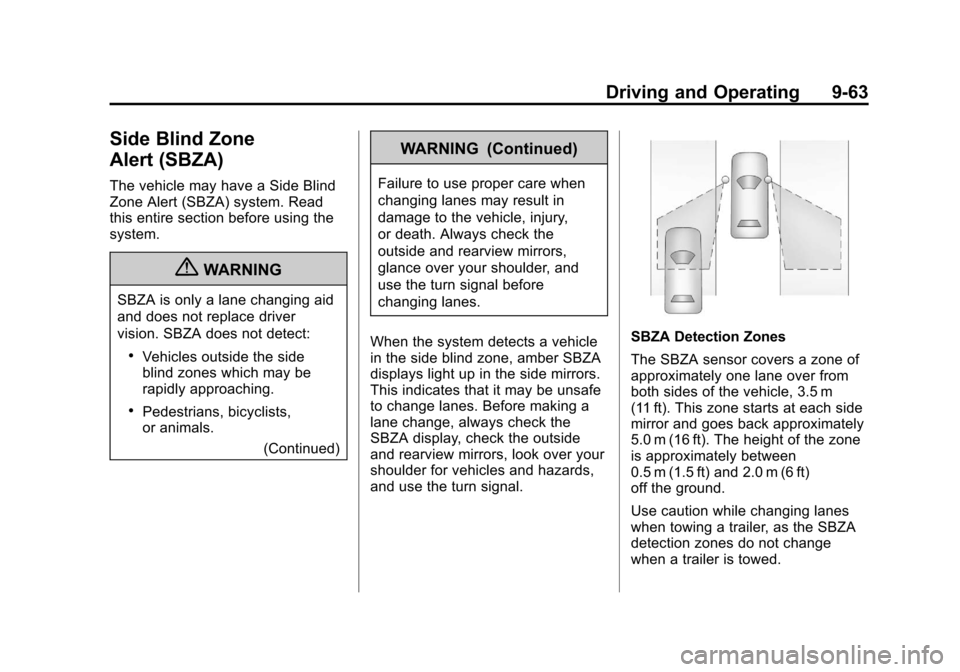
SBZA Detection Zones
The SBZA sensor covers a zone of
approximately one lane over from
both sides of the vehicle, 3.5 m
(11 ft). This zone starts at each side
mirror and goes back approximately
5.0 m (16 ft). The height of the zone
is approximately between
0.5 m (1.5 ft) and 2.0 m (6 ft)
off the ground.
Use caution while changing lanes
when towing a trailer, as the SBZA
detection zones do not change
when a trailer is towed.
Page 354 of 542

Black plate (66,1)Chevrolet Tahoe/Suburban Owner Manual - 2011
9-66 Driving and Operating
Rear Vision
Camera (RVC)
This vehicle may have a Rear
Vision Camera system. Read this
entire section before using it.
{WARNING
The Rear Vision Camera (RVC)
system does not replace driver
vision. RVC does not:
.Detect objects that are
outside the camera's field of
view, below the bumper,
or underneath the vehicle.
.Detect children, pedestrians,
bicyclists, or pets.
Do not back the vehicle by only
looking at the RVC screen, or use
the screen during longer, higher
speed backing maneuvers or
where there could be cross-traffic. (Continued)
WARNING (Continued)
Your judged distances using the
screen will differ from actual
distances.
If you do not use proper care
before backing up, you could hit a
vehicle, child, pedestrian,
bicyclist, or pet, resulting in
vehicle damage, injury, or death.
Even though the vehicle has the
RVC system, always check
carefully before backing up by
checking behind and around the
vehicle.
Vehicles Without Navigation
System
The rear vision camera system is
designed to help the driver when
backing up by displaying a view of
the area behind the vehicle. When
the key is in the ON/RUN position
and the driver shifts the vehicle into
R (Reverse), the video image
automatically appears on the inside
rear view mirror. Once the driver
shifts out of R (Reverse), the video
image automatically disappears
from the inside rear view mirror.
Turning the Rear Vision Camera
System Off or On
To turn off the rear vision camera
system, press and hold
z, located
on the inside rearview mirror, until
the left indicator light turns off. The
rear camera vision display is now
disabled.
Page 367 of 542
Black plate (79,1)Chevrolet Tahoe/Suburban Owner Manual - 2011
Driving and Operating 9-79
Important considerations that have
to do with weight:
.The weight of the trailer
.The weight of the trailer tongue
.The weight on the vehicle's tires
.And the weight of the trailering
combination
Driving with a Trailer
{WARNING
When towing a trailer, exhaust
gases may collect at the rear of
the vehicle and enter if the
liftgate, trunk/hatch, or rear-most
window is open.
Engine exhaust contains Carbon
Monoxide (CO) which cannot be
seen or smelled. It can cause
unconsciousness and even death.(Continued)
WARNING (Continued)
To maximize safety when towing
a trailer:
.Have the exhaust system
inspected for leaks and make
necessary repairs before
starting a trip.
.Never drive with the liftgate,
trunk/hatch, or rear-most
window open.
.Fully open the air outlets on
or under the instrument
panel.
.Adjust the Climate Control
system to a setting that
brings in only outside air and
set the fan speed to the
highest setting. See Climate
Control System in the Index.
For more information about
Carbon Monoxide, see Engine
Exhaust on page 9‑37. Towing a trailer requires a certain
amount of experience. The
combination you are driving is
longer and not as responsive as the
vehicle itself. Get acquainted with
the handling and braking of the rig
before setting out for the open road.
Before starting, check all trailer hitch
parts and attachments, safety
chains, electrical connectors, lamps,
tires and mirrors. If the trailer has
electric brakes, start the
combination moving and then apply
the trailer brake controller by hand
to be sure the brakes work.
During the trip, check occasionally
to be sure that the load is secure
and the lamps and any trailer
brakes still work.
Page 374 of 542
Black plate (86,1)Chevrolet Tahoe/Suburban Owner Manual - 2011
9-86 Driving and Operating
reduce the trailer weight the vehicle
can tow. SeeVehicle Load Limits on
page 9‑23 for more information
about the vehicle's maximum load
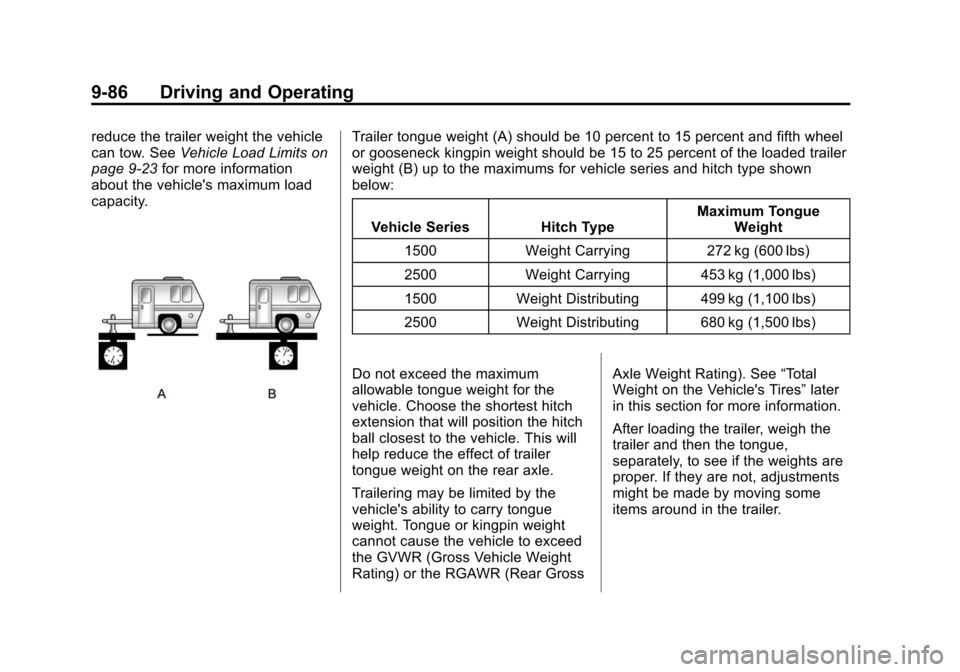
capacity.Trailer tongue weight (A) should be 10 percent to 15 percent and fifth wheel
or gooseneck kingpin weight should be 15 to 25 percent of the loaded trailer
weight (B) up to the maximums for vehicle series and hitch type shown
below:
Vehicle Series Hitch Type Maximum Tongue
Weight
1500 Weight Carrying 272 kg (600 lbs)
2500 Weight Carrying 453 kg (1,000 lbs)
1500 Weight Distributing 499 kg (1,100 lbs)
2500 Weight Distributing 680 kg (1,500 lbs)
Do not exceed the maximum
allowable tongue weight for the
vehicle. Choose the shortest hitch
extension that will position the hitch
ball closest to the vehicle. This will
help reduce the effect of trailer
tongue weight on the rear axle.
Trailering may be limited by the
vehicle's ability to carry tongue
weight. Tongue or kingpin weight
cannot cause the vehicle to exceed
the GVWR (Gross Vehicle Weight
Rating) or the RGAWR (Rear Gross Axle Weight Rating). See
“Total
Weight on the Vehicle's Tires” later
in this section for more information.
After loading the trailer, weigh the
trailer and then the tongue,
separately, to see if the weights are
proper. If they are not, adjustments
might be made by moving some
items around in the trailer.
Page 375 of 542
Black plate (87,1)Chevrolet Tahoe/Suburban Owner Manual - 2011
Driving and Operating 9-87
Total Weight on the Vehicle's
Tires
Be sure the vehicle's tires are
inflated to the inflation pressures
found on the Certification label on
the drivers door or seeVehicle Load
Limits on page 9‑23 for more
information. Make sure not to
exceed the GVWR limit for the
vehicle, or the RGAWR, with the tow
vehicle and trailer fully loaded for
the trip including the weight of the
trailer tongue. If using a weight
distributing hitch, make sure not to
exceed the RGAWR before applying
the weight distribution spring bars.
Weight of the Trailering
Combination
It is important that the combination
of the tow vehicle and trailer
does not exceed any of its weight
ratings —GCWR, GVWR, RGAWR,
Trailer Weight Rating or Tongue
Weight. The only way to be sure it is
not exceeding any of these ratings
is to weigh the tow vehicle and
trailer combination, fully loaded for
the trip, getting individual weights
for each of these items.
Towing Equipment
Hitches
The correct hitch equipment helps
maintain combination control. Most
small-to-medium trailers can be
towed with a weight carrying hitch
which simply features a coupler
latched to the hitch ball. Larger
trailers may require a weight distributing hitch that uses spring
bars to distribute the trailer tongue
weight among the two vehicle and
trailer axles. See
“Weight of the
Trailer Tongue” inTrailer Towing on
page 9‑82 for rating limits with
various hitch types.
If a step-bumper hitch will be used,
the bumper could be damaged in
sharp turns. Make sure there
is ample room when turning to avoid
contact between the trailer and the
bumper.
Consider using sway controls with
any trailer. Ask a trailering
professional about sway controls or
refer to the trailer manufacturer's
recommendations and instructions.
Page 383 of 542

Black plate (95,1)Chevrolet Tahoe/Suburban Owner Manual - 2011
Driving and Operating 9-95
Use the following procedure to
correctly adjust Trailer Gain for each
towing condition:
1. Make sure the trailer brakes arein proper working condition.
2. Connect a properly loaded trailer to the vehicle and make all
necessary mechanical and
electrical connections. See
Vehicle Load Limits on
page 9‑23 for more information.
3. After the electrical connection is made to a trailer equipped with
electric brakes:
.A TRAILER CONNECTED
message will be briefly
displayed on the DIC
display.
.The Trailer Brake Display
Page will appear on the
DIC showing TRAILER
GAIN and TRAILER
OUTPUT.
.In the Trailer Output display
on the DIC, “- - - - - -“will
disappear if there is no
error present. Connecting a
trailer without electric
brakes will not clear the six
dashed lines.
4. Adjust the Trailer Gain by using the gain adjustment (+ / -)
buttons on the Trailer Brake
Control Panel.
5. Drive the vehicle with the trailer attached on a level road surface
representative of the towing
condition and free of traffic at
about 32 to 40 km/h (20 to
25 mph) and fully apply the
Manual Trailer Brake Apply
lever.
Adjusting trailer gain at speeds
lower than 32 to 40 km/h (20 to
25 mph) may result in an
incorrect gain setting. 6. Adjust the Trailer Gain to just
below the point of trailer wheel
lock-up, indicated by trailer
wheel squeal or tire smoke when
a trailer wheel locks.
Trailer wheel lock-up may not
occur if towing a heavily loaded
trailer. In this case, adjust the
Trailer Gain to the highest
allowable setting for the towing
condition.
7. Re-adjust Trailer Gain any time vehicle loading, trailer loading or
road surface conditions change
or if trailer wheel lock-up is
noticed at any time while towing
Page 387 of 542
Black plate (99,1)Chevrolet Tahoe/Suburban Owner Manual - 2011
Driving and Operating 9-99
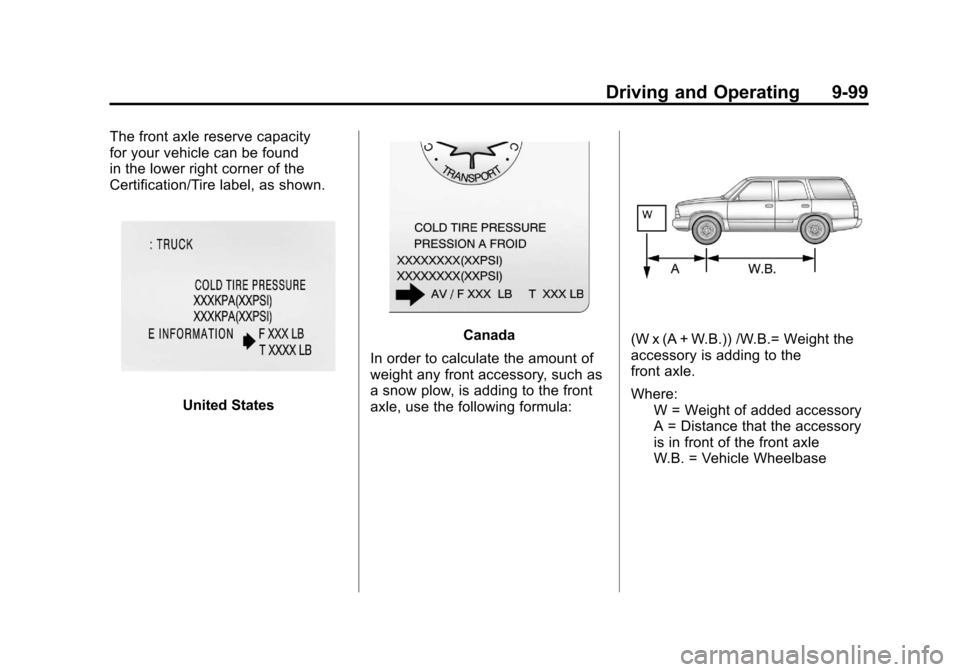
The front axle reserve capacity
for your vehicle can be found
in the lower right corner of the
Certification/Tire label, as shown.
United States
Canada
In order to calculate the amount of
weight any front accessory, such as
a snow plow, is adding to the front
axle, use the following formula:(W x (A + W.B.)) /W.B.= Weight the
accessory is adding to the
front axle.
Where: W = Weight of added accessory
A = Distance that the accessory
is in front of the front axle
W.B. = Vehicle Wheelbase
Page 389 of 542
Black plate (101,1)Chevrolet Tahoe/Suburban Owner Manual - 2011
Driving and Operating 9-101
Total vehicle reserve capacity is the
difference between your GVWR and
the weight of your vehicle with full
fuel and passengers. It is the
amount of weight you can add to
your vehicle before reaching your
GVWR. Keep in mind that reserve
capacity numbers are intended as a
guide when selecting the amount of
equipment or cargo your vehicle can
carry. If you are unsure of your
vehicle's front, rear, or total weight,
go to a weigh station and weigh
your vehicle. Your dealer can also
help you with this.
The total vehicle reserve capacity
for your vehicle can be found
in the lower right corner of the
Certification/Tire label as shown
previously.
See your dealer for additional
advice and information about using
a snow plow on your vehicle. Also,
seeVehicle Load Limits on
page 9‑23.Emergency Roof Lamp
Provisions
Vehicles with the RPO VYU snow
plow prep package also have an
emergency roof lamp provision
package, RPO TRW. Wiring for the
emergency roof lamp is provided
above the overhead console. See
Auxiliary Roof-Mounted Lamp on
page 6‑6 for switch location.