Black plate (57,1)Chevrolet Tahoe/Suburban Owner Manual - 2011
Vehicle Care 10-57
Vehicle Placard:A label
permanently attached to a
vehicle showing the vehicle's
capacity weight and the original
equipment tire size and
recommended inflation pressure.
See “Tire and Loading
Information Label” underVehicle
Load Limits on page 9‑23.
Tire Pressure
If the vehicle is a hybrid, see the
hybrid supplement for more
information.
Tires need the correct amount of
air pressure to operate
effectively. Notice:
Do not let anyone tell
you that under‐inflation or
over‐inflation is all right. It is
not. If your tires do not have
enough air (under‐inflation),
you can get the following:
.Tire overloading and
over-heating which could
lead to a blowout.
.Premature or
irregular wear.
.Poor handling.
.Reduced fuel economy.
If your tires have too much air
(over‐inflation), you can get
the following:
.Unusual wear.
.Poor handling.
.Rough ride.
.Needless damage from
road hazards. A vehicle specific Tire and
Loading Information label is
attached to your vehicle. This
label shows your vehicle's
original equipment tires and the
correct inflation pressures for
your tires when they are cold.
The recommended cold tire
inflation pressure, shown on the
label, is the minimum amount of
air pressure needed to support
your vehicle's maximum load
carrying capacity.
For additional information
regarding how much weight your
vehicle can carry, and an
example of the Tire and Loading
Information label, see
Vehicle
Load Limits on page 9‑23. How
you load your vehicle affects
vehicle handling and ride
comfort. Never load your vehicle
with more weight than it was
designed to carry.
Black plate (65,1)Chevrolet Tahoe/Suburban Owner Manual - 2011
Vehicle Care 10-65
When It Is Time for New
Tires
Various factors, such as
maintenance, temperatures, driving
speeds, vehicle loading, and road
conditions influence when you need
new tires.
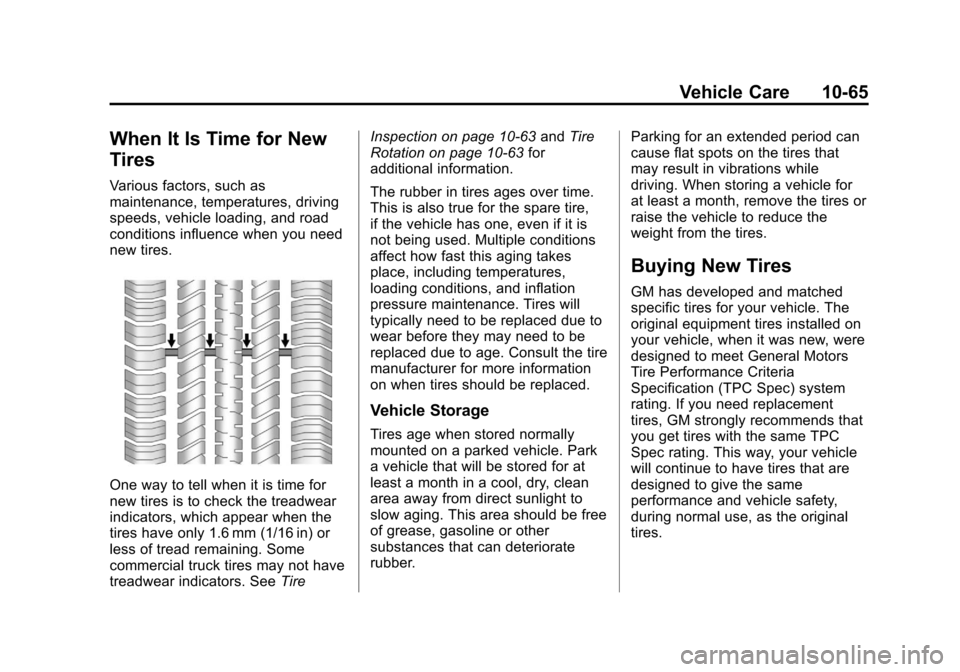
One way to tell when it is time for
new tires is to check the treadwear
indicators, which appear when the
tires have only 1.6 mm (1/16 in) or
less of tread remaining. Some
commercial truck tires may not have
treadwear indicators. SeeTireInspection on page 10‑63
andTire
Rotation on page 10‑63 for
additional information.
The rubber in tires ages over time.
This is also true for the spare tire,
if the vehicle has one, even if it is
not being used. Multiple conditions
affect how fast this aging takes
place, including temperatures,
loading conditions, and inflation
pressure maintenance. Tires will
typically need to be replaced due to
wear before they may need to be
replaced due to age. Consult the tire
manufacturer for more information
on when tires should be replaced.
Vehicle Storage
Tires age when stored normally
mounted on a parked vehicle. Park
a vehicle that will be stored for at
least a month in a cool, dry, clean
area away from direct sunlight to
slow aging. This area should be free
of grease, gasoline or other
substances that can deteriorate
rubber. Parking for an extended period can
cause flat spots on the tires that
may result in vibrations while
driving. When storing a vehicle for
at least a month, remove the tires or
raise the vehicle to reduce the
weight from the tires.
Buying New Tires
GM has developed and matched
specific tires for your vehicle. The
original equipment tires installed on
your vehicle, when it was new, were
designed to meet General Motors
Tire Performance Criteria
Specification (TPC Spec) system
rating. If you need replacement
tires, GM strongly recommends that
you get tires with the same TPC
Spec rating. This way, your vehicle
will continue to have tires that are
designed to give the same
performance and vehicle safety,
during normal use, as the original
tires.