2011 CHEVROLET MALIBU tire size
[x] Cancel search: tire sizePage 26 of 382
Black plate (20,1)Chevrolet Malibu Owner Manual - 2011
1-20 In Brief
Fuel E85 (85% Ethanol)
Vehicles that have a FlexFuel badge
and a yellow fuel cap can use either
unleaded gasoline or ethanol fuel
containing up to 85% ethanol (E85).
SeeFuel E85 (85% Ethanol)
on
page 9‑40. For all other vehicles,
use only the unleaded gasoline
described under Recommended
Fuel on page 9‑38.
Driving for Better Fuel
Economy
Driving habits can affect fuel
mileage. Here are some driving tips
to get the best fuel economy
possible.
.Avoid fast starts and accelerate
smoothly.
.Brake gradually and avoid
abrupt stops.
.Avoid idling the engine for long
periods of time.
.When road and weather
conditions are appropriate, use
cruise control.
.Always follow posted speed
limits or drive more slowly when
conditions require.
.Keep vehicle tires properly
inflated.
.Combine several trips into a
single trip.
.Replace the vehicle's tires with
the same TPC Spec number
molded into the tire's sidewall
near the size.
.Follow recommended scheduled
maintenance.
Roadside Assistance
Program
U.S.: 1-800-243-8872
TTY Users: 1-888-889-2438
Canada: 1-800-268-6800
As the owner of a new Chevrolet,
you are automatically enrolled in the
Roadside Assistance program. This
program provides technically trained
advisors who are available 24 hours
a day, 365 days a year, to give
minor repair information or make
towing arrangements.
For more information see Roadside
Assistance Program (United States
and Canada)
on page 13‑7or
Roadside Assistance Program
(Mexico) on page 13‑9.
Page 207 of 382
Black plate (13,1)Chevrolet Malibu Owner Manual - 2011
Driving and Operating 9-13
positions (A), and the maximum
vehicle capacity weight (B) in
kilograms and pounds.
The Tire and Loading
Information label also shows
the tire size of the original
equipment tires (C) and the
recommended cold tire inflation
pressures (D). For more
information on tires and inflation
seeTires
on page 10‑38and Tire
Pressure
on page 10‑45.
There is also important loading
information on the Certification
label. It tells you the Gross
Vehicle Weight Rating (GVWR)
and the Gross Axle Weight
Rating (GAWR) for the front and
rear axle. See “Certification
Label” later in this section. Steps for Determining Correct
Load Limit
1.Locate the statement
“The combined weight of
occupants and cargo should
never exceed XXX kg or
XXX lbs”
on your vehicle's
placard.
2.Determine the combined
weight of the driver and
passengers that will be
riding in your vehicle.
3.Subtract the combined
weight of the driver and
passengers from XXX kg or
XXX lbs.
4.The resulting figure equals
the available amount of cargo
and luggage load capacity.
For example, if the “XXX”
amount equals 1400 lbs and
there will be five 150 lb
passengers in your vehicle
, the amount of available
cargo and luggage load
capacity is 650 lbs
(1400 −750
(5 x 150) = 650 lbs).
5.Determine the combined
weight of luggage and cargo
being loaded on the vehicle.
That weight may not safely
exceed the available cargo
and luggage load capacity
calculated in Step 4.
Page 244 of 382
Black plate (2,1)Chevrolet Malibu Owner Manual - 2011
10-2 Vehicle Care
When It Is Time for NewTires . . . . . . . . . . . . . . . . . . . . . . 10-53
Buying New Tires . . . . . . . . . . . 10-54
Different Size Tires and Wheels . . . . . . . . . . . . . . . . . . . 10-56
Uniform Tire Quality Grading . . . . . . . . . . . . . . . . . . . 10-56
Wheel Alignment and Tire Balance . . . . . . . . . . . . . . . . . . . 10-58
Wheel Replacement . . . . . . . . 10-58
Tire Chains . . . . . . . . . . . . . . . . . 10-59
If a Tire Goes Flat . . . . . . . . . . 10-59
Tire Sealant and Compressor Kit . . . . . . . . . . . 10-61
Storing the Tire Sealant and Compressor Kit . . . . . . . . . . . 10-68
Tire Changing . . . . . . . . . . . . . . 10-68
Compact Spare Tire . . . . . . . . 10-77Jump Starting
Jump Starting . . . . . . . . . . . . . . 10-78
Towing
Towing the Vehicle . . . . . . . . . 10-83
Recreational Vehicle Towing . . . . . . . . . . . . . . . . . . . . 10-83
Appearance Care
Exterior Care . . . . . . . . . . . . . . . 10-85
Interior Care . . . . . . . . . . . . . . . . 10-89
Floor Mats . . . . . . . . . . . . . . . . . . 10-92
General Information
For service and parts needs, visit
your dealer. You will receive
genuine GM parts and GM-trained
and supported service people.
Genuine GM parts have one of
these marks:
Page 281 of 382
Black plate (39,1)Chevrolet Malibu Owner Manual - 2011
Vehicle Care 10-39
Winter Tires
If you expect to drive on snow or ice
covered roads often, you may want
to get winter tires for your vehicle.
All season tires provide good overall
performance on most surfaces but
they may not offer the traction you
would like or the same level of
performance as winter tires on snow
or ice covered roads.
Winter tires, in general, are
designed for increased traction on
snow and ice covered roads. With
winter tires, there may be decreased
dry road traction, increased road
noise, and shorter tread life. After
switching to winter tires, be alert for
changes in vehicle handling and
braking.
See your dealer for details
regarding winter tire availability and
proper tire selection. Also, see
Buying New Tires on page 10‑54.If you choose to use winter tires:.Use tires of the same brand and
tread type on all four wheel
positions.
.Use only radial ply tires of the
same size, load range, and
speed rating as the original
equipment tires.
Winter tires with the same speed
rating as your original equipment
tires may not be available for H, V,
W, Y, and ZR speed rated tires.
If you choose winter tires with a
lower speed rating, never exceed
the tire's maximum speed capability.
Low-Profile Tires
If your vehicle has P225/50R18
or P225/50R17 size tires, they
are classified as low‐profile
performance tires. These tires
are designed for very responsive
driving on wet or dry pavement. You may also notice more
road noise with low‐profile
performance tires and that they
tend to wear faster.
Notice:
If the vehicle has
low‐profile tires, they are more
susceptible to damage from
road hazards or curb impact
than standard profile tires.
Tire and/or wheel assembly
damage can occur when
coming into contact with road
hazards like, potholes,
or sharp edged objects,
or when sliding into a curb.
The vehicle warranty does not
cover this type of damage.
Keep tires set to the correct
inflation pressure and, when
possible avoid contact with
curbs, potholes, and other
road hazards.
Page 282 of 382
Black plate (40,1)Chevrolet Malibu Owner Manual - 2011
10-40 Vehicle Care
Tire Sidewall Labeling
Useful information about a tire is
molded into its sidewall. The
examples below show a typical
passenger vehicle tire and a
compact spare tire sidewall.
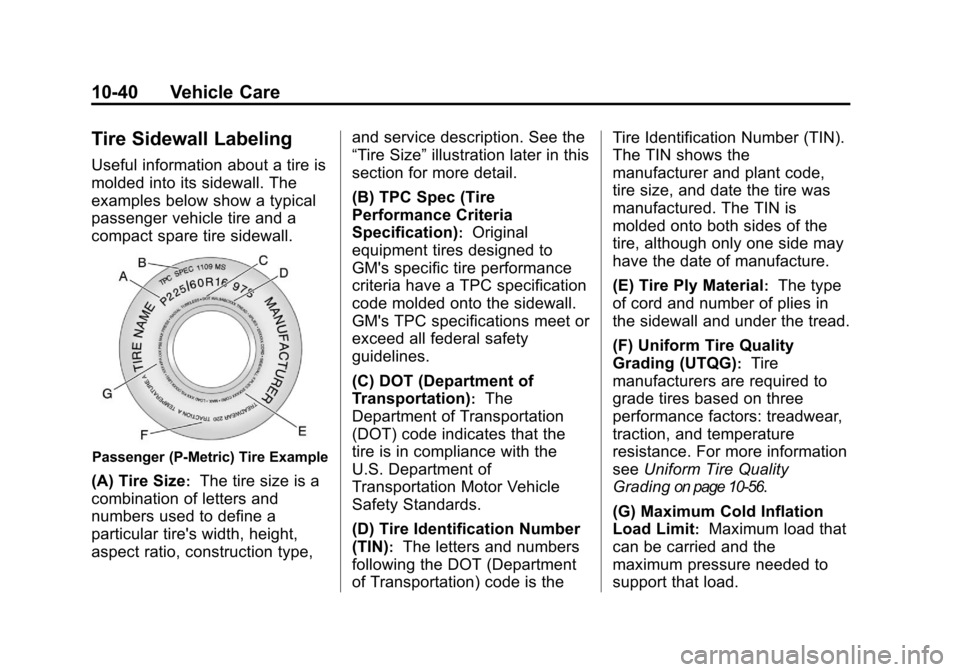
Passenger (P‐Metric) Tire Example
(A) Tire Size:The tire size is a
combination of letters and
numbers used to define a
particular tire's width, height,
aspect ratio, construction type, and service description. See the
“Tire Size”
illustration later in this
section for more detail.
(B) TPC Spec (Tire
Performance Criteria
Specification)
:Original
equipment tires designed to
GM's specific tire performance
criteria have a TPC specification
code molded onto the sidewall.
GM's TPC specifications meet or
exceed all federal safety
guidelines.
(C) DOT (Department of
Transportation)
:The
Department of Transportation
(DOT) code indicates that the
tire is in compliance with the
U.S. Department of
Transportation Motor Vehicle
Safety Standards.
(D) Tire Identification Number
(TIN)
:The letters and numbers
following the DOT (Department
of Transportation) code is the Tire Identification Number (TIN).
The TIN shows the
manufacturer and plant code,
tire size, and date the tire was
manufactured. The TIN is
molded onto both sides of the
tire, although only one side may
have the date of manufacture.
(E) Tire Ply Material
:The type
of cord and number of plies in
the sidewall and under the tread.
(F) Uniform Tire Quality
Grading (UTQG)
:Tire
manufacturers are required to
grade tires based on three
performance factors: treadwear,
traction, and temperature
resistance. For more information
see Uniform Tire Quality
Grading
on page 10‑56.
(G) Maximum Cold Inflation
Load Limit
:Maximum load that
can be carried and the
maximum pressure needed to
support that load.
Page 283 of 382
Black plate (41,1)Chevrolet Malibu Owner Manual - 2011
Vehicle Care 10-41
Compact Spare Tire Example
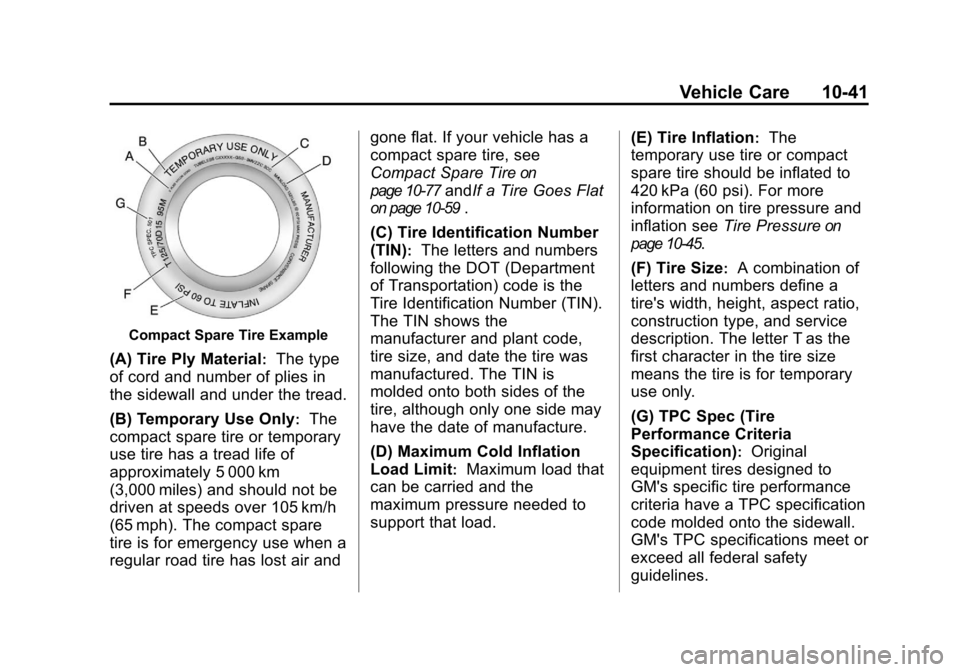
(A) Tire Ply Material:The type
of cord and number of plies in
the sidewall and under the tread.
(B) Temporary Use Only
:The
compact spare tire or temporary
use tire has a tread life of
approximately 5 000 km
(3,000 miles) and should not be
driven at speeds over 105 km/h
(65 mph). The compact spare
tire is for emergency use when a
regular road tire has lost air and gone flat. If your vehicle has a
compact spare tire, see
Compact Spare Tire
on
page 10‑77
andIf a Tire Goes Flat
on page 10‑59.
(C) Tire Identification Number
(TIN)
:The letters and numbers
following the DOT (Department
of Transportation) code is the
Tire Identification Number (TIN).
The TIN shows the
manufacturer and plant code,
tire size, and date the tire was
manufactured. The TIN is
molded onto both sides of the
tire, although only one side may
have the date of manufacture.
(D) Maximum Cold Inflation
Load Limit
:Maximum load that
can be carried and the
maximum pressure needed to
support that load. (E) Tire Inflation
:The
temporary use tire or compact
spare tire should be inflated to
420 kPa (60 psi). For more
information on tire pressure and
inflation see Tire Pressure
on
page 10‑45
.
(F) Tire Size
:A combination of
letters and numbers define a
tire's width, height, aspect ratio,
construction type, and service
description. The letter T as the
first character in the tire size
means the tire is for temporary
use only.
(G) TPC Spec (Tire
Performance Criteria
Specification)
:Original
equipment tires designed to
GM's specific tire performance
criteria have a TPC specification
code molded onto the sidewall.
GM's TPC specifications meet or
exceed all federal safety
guidelines.
Page 284 of 382
Black plate (42,1)Chevrolet Malibu Owner Manual - 2011
10-42 Vehicle Care
Tire Designations
Tire Size
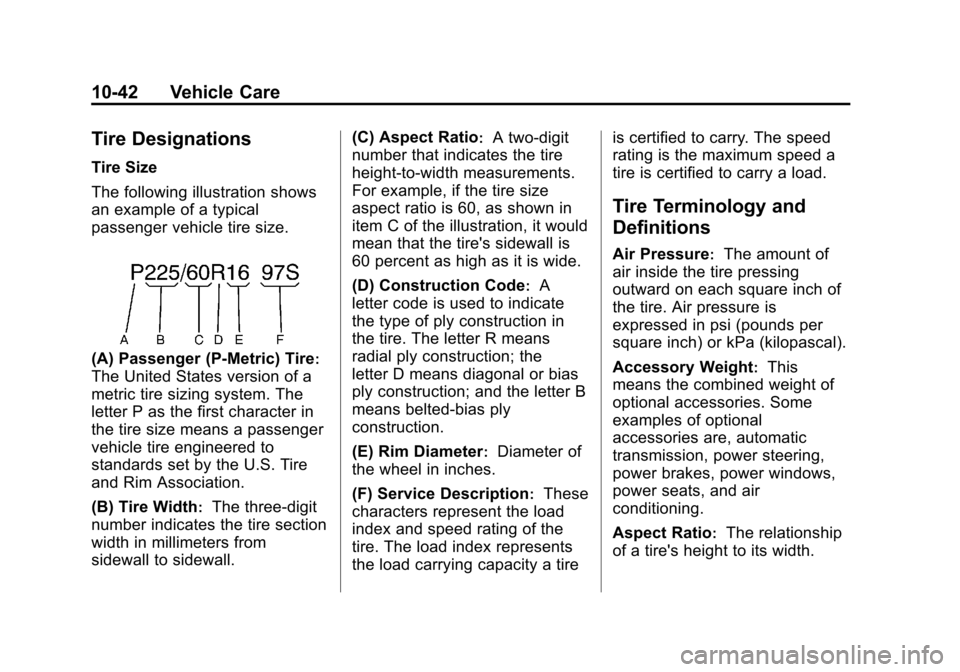
The following illustration shows
an example of a typical
passenger vehicle tire size.
(A) Passenger (P‐Metric) Tire:
The United States version of a
metric tire sizing system. The
letter P as the first character in
the tire size means a passenger
vehicle tire engineered to
standards set by the U.S. Tire
and Rim Association.
(B) Tire Width
:The three‐digit
number indicates the tire section
width in millimeters from
sidewall to sidewall. (C) Aspect Ratio
:A two‐digit
number that indicates the tire
height‐to‐width measurements.
For example, if the tire size
aspect ratio is 60, as shown in
item C of the illustration, it would
mean that the tire's sidewall is
60 percent as high as it is wide.
(D) Construction Code
:A
letter code is used to indicate
the type of ply construction in
the tire. The letter R means
radial ply construction; the
letter D means diagonal or bias
ply construction; and the letter B
means belted‐bias ply
construction.
(E) Rim Diameter
:Diameter of
the wheel in inches.
(F) Service Description
:These
characters represent the load
index and speed rating of the
tire. The load index represents
the load carrying capacity a tire is certified to carry. The speed
rating is the maximum speed a
tire is certified to carry a load.
Tire Terminology and
Definitions
Air Pressure:The amount of
air inside the tire pressing
outward on each square inch of
the tire. Air pressure is
expressed in psi (pounds per
square inch) or kPa (kilopascal).
Accessory Weight
:This
means the combined weight of
optional accessories. Some
examples of optional
accessories are, automatic
transmission, power steering,
power brakes, power windows,
power seats, and air
conditioning.
Aspect Ratio
:The relationship
of a tire's height to its width.
Page 287 of 382
Black plate (45,1)Chevrolet Malibu Owner Manual - 2011
Vehicle Care 10-45
tire's traction, temperature,
and treadwear. Ratings are
determined by tire
manufacturers using
government testing procedures.
The ratings are molded into the
sidewall of the tire. SeeUniform
Tire Quality Grading
on
page 10‑56
.
Vehicle Capacity Weight
:The
number of designated seating
positions multiplied by
68 kg (150 lbs) plus the rated
cargo load. See Vehicle Load
Limits
on page 9‑12.
Vehicle Maximum Load on the
Tire
:Load on an individual tire
due to curb weight, accessory
weight, occupant weight, and
cargo weight.
Vehicle Placard
:A label
permanently attached to a
vehicle showing the vehicle's
capacity weight and the original equipment tire size and
recommended inflation pressure.
See
“Tire and Loading
Information Label” underVehicle
Load Limits
on page 9‑12.
Tire Pressure
Tires need the correct amount of
air pressure to operate
effectively.
Notice: Do not let anyone tell
you that under‐inflation or
over‐inflation is all right. It is
not. If your tires do not have
enough air (under‐inflation),
you can get the following:
.Tire overloading and
over-heating which could
lead to a blowout.
.Premature or
irregular wear.
.Poor handling.
.Reduced fuel economy. If your tires have too much air
(over‐inflation), you can get
the following:
.Unusual wear.
.Poor handling.
.Rough ride.
.Needless damage from
road hazards.
A vehicle-specific Tire and
Loading Information label is
attached to your vehicle. This
label shows your vehicle's
original equipment tires and the
correct inflation pressures for
your tires when they are cold.
The recommended cold tire
inflation pressure, shown on the
label, is the minimum amount of
air pressure needed to support
your vehicle's maximum load
carrying capacity.