2011 CHEVROLET MALIBU ignition
[x] Cancel search: ignitionPage 275 of 382
Black plate (33,1)Chevrolet Malibu Owner Manual - 2011
Vehicle Care 10-33
FusesUsage
54 Regulated Voltage
Control
55 DC/AC Inverter
56 Antilock Brake
System BATT
Relays Usage
28 Cooling Fan 1
29 Cooling Fan
Series/Parallel
30 Cooling Fan 2
31 Starter
32 Run/Crank,
Ignition
33 Powertrain
34 Air Conditioning
Clutch
35 High Beam Relays
Usage
36 Front Fog Lamps
37 Horn
38 Low-Beam
Headlamp
39 Windshield
Wiper 1
40 Windshield
Wiper 2
48 Daytime Running
Lamps
49 Stoplamps
53 AIR Solenoid
Diodes Usage
27 WiperInstrument Panel Fuse
Block
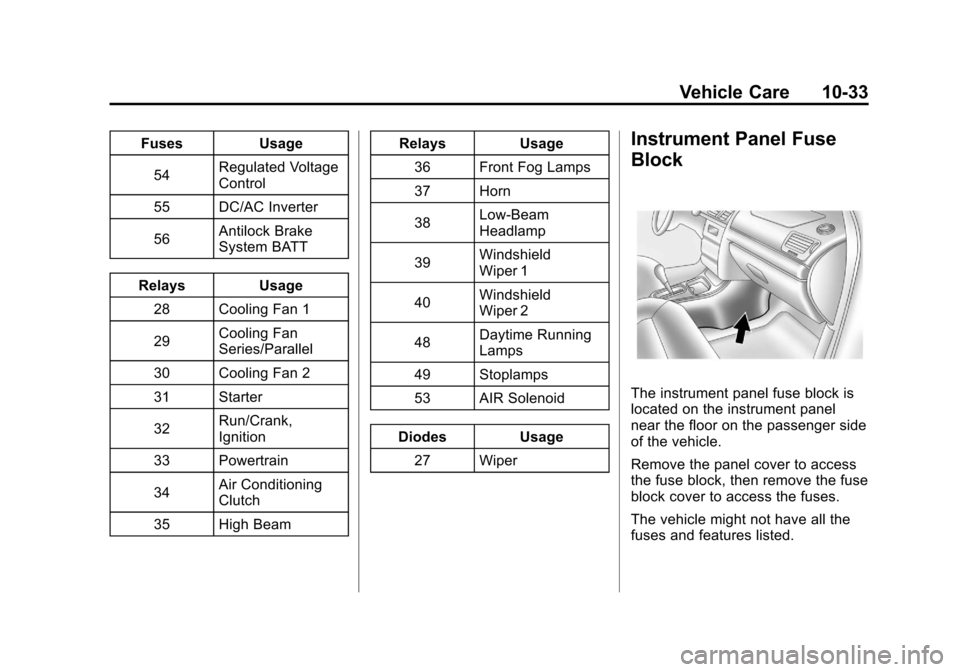
The instrument panel fuse block is
located on the instrument panel
near the floor on the passenger side
of the vehicle.
Remove the panel cover to access
the fuse block, then remove the fuse
block cover to access the fuses.
The vehicle might not have all the
fuses and features listed.
Page 276 of 382
Black plate (34,1)Chevrolet Malibu Owner Manual - 2011
10-34 Vehicle Care
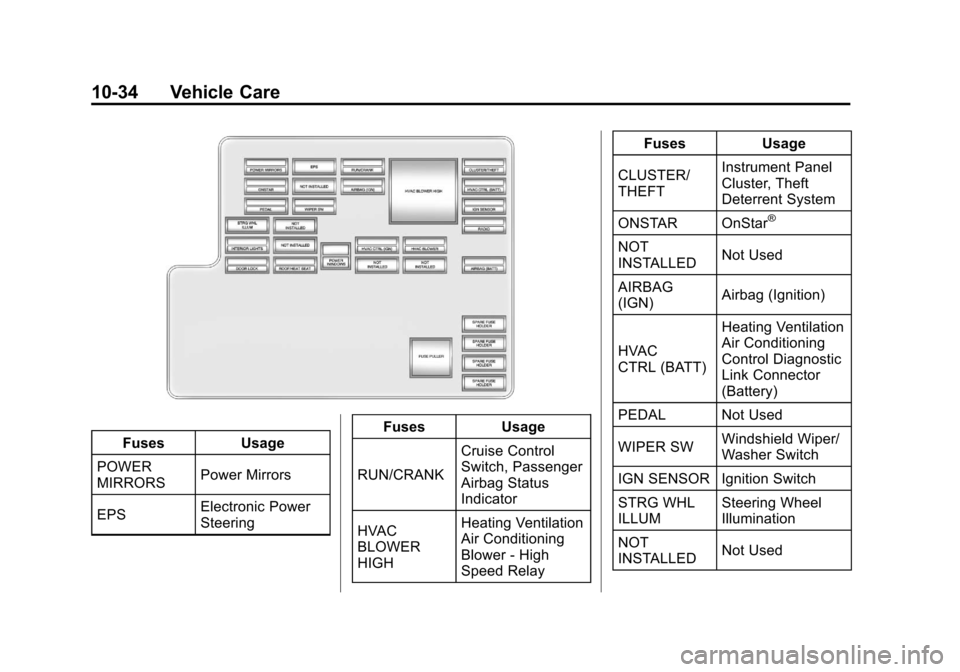
FusesUsage
POWER
MIRRORS Power Mirrors
EPS Electronic Power
Steering Fuses
Usage
RUN/CRANK Cruise Control
Switch, Passenger
Airbag Status
Indicator
HVAC
BLOWER
HIGH Heating Ventilation
Air Conditioning
Blower - High
Speed Relay Fuses
Usage
CLUSTER/
THEFT Instrument Panel
Cluster, Theft
Deterrent System
ONSTAR OnStar
®
NOT
INSTALLED Not Used
AIRBAG
(IGN) Airbag (Ignition)
HVAC
CTRL (BATT) Heating Ventilation
Air Conditioning
Control Diagnostic
Link Connector
(Battery)
PEDAL Not Used
WIPER SW Windshield Wiper/
Washer Switch
IGN SENSOR Ignition Switch
STRG WHL
ILLUM Steering Wheel
Illumination
NOT
INSTALLED Not Used
Page 277 of 382
Black plate (35,1)Chevrolet Malibu Owner Manual - 2011
Vehicle Care 10-35
FusesUsage
RADIO Audio System
INTERIOR
LIGHTS Interior Lamps
NOT
INSTALLED Not Used
POWER
WINDOWS Power Windows
HVAC
CTRL (IGN) Heating Ventilation
Air Conditioning
Control (Ignition)
HVAC
BLOWER Heating Ventilation
Air Conditioning
Blower Switch
DOOR LOCK Door Locks
ROOF/
HEAT SEAT Sunroof,
Heated Seat
NOT
INSTALLED Not Used Fuses
Usage
NOT
INSTALLED Not Used
AIRBAG
(BATT) Airbag (Battery)
SPARE FUSE
HOLDER Spare Fuse Holder
SPARE FUSE
HOLDER Spare Fuse Holder
SPARE FUSE
HOLDER Spare Fuse Holder
SPARE FUSE
HOLDER Spare Fuse Holder
FUSE
PULLER Fuse PullerRear Compartment Fuse
Block
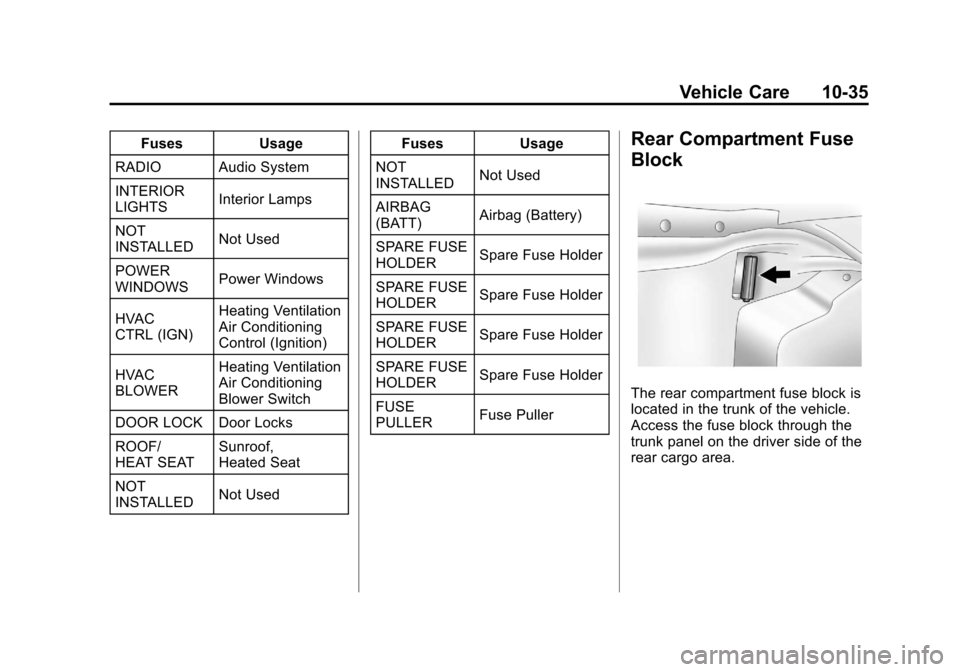
The rear compartment fuse block is
located in the trunk of the vehicle.
Access the fuse block through the
trunk panel on the driver side of the
rear cargo area.
Page 290 of 382
Black plate (48,1)Chevrolet Malibu Owner Manual - 2011
10-48 Vehicle Care
The TPMS malfunction indicator is
combined with the low tire pressure
telltale. When the system detects a
malfunction, the telltale will flash for
approximately one minute and then
remain continuously illuminated.
This sequence will continue upon
subsequent vehicle start‐ups as
long as the malfunction exists.
When the malfunction indicator is
illuminated, the system may not be
able to detect or signal low tire
pressure as intended. TPMS
malfunctions may occur for a variety
of reasons, including the installation
of replacement or alternate tires or
wheels on the vehicle that prevent
the TPMS from functioning properly.
Always check the TPMS malfunction
telltale after replacing one or more
tires or wheels on your vehicle to
ensure that the replacement or
alternate tires and wheels allow the
TPMS to continue to function
properly.
SeeTire Pressure Monitor
Operation
on page 10‑48for
additional information.
Federal Communications
Commission (FCC) and
Industry Canada
See Radio Frequency Statementon
page 13‑17for information regarding
Part 15 of the Federal
Communications Commission (FCC)
rules and Industry Canada
Standards RSS-210/220/310.
Tire Pressure Monitor
Operation
This vehicle may have a Tire
Pressure Monitor System (TPMS).
The TPMS is designed to warn the
driver when a low tire pressure
condition exists. TPMS sensors are
mounted onto each tire and wheel
assembly, excluding the spare tire
and wheel assembly. The TPMS
sensors monitor the air pressure in
the vehicle's tires and transmits the
tire pressure readings to a receiver
located in the vehicle.
When a low tire pressure condition
is detected, the TPMS turns on the
low tire pressure warning light
located on the instrument panel
cluster. If the warning light comes
on, stop as soon as possible and
inflate the tires to the recommended
pressure shown on the tire loading
information label. See Vehicle Load
Limits on page 9‑12.
At the same time a message to
check the pressure in a specific tire
appears on the Driver Information
Center (DIC) display. The low tire
pressure warning light and the DIC
warning message come on at each
ignition cycle until the tires are
inflated to the correct inflation
pressure. Using the DIC, tire
pressure levels can be viewed by
the driver. For additional information
Page 291 of 382
Black plate (49,1)Chevrolet Malibu Owner Manual - 2011
Vehicle Care 10-49
and details about the DIC operation
and displays seeTire Messageson
page 5‑30.
The low tire pressure warning light
may come on in cool weather when
the vehicle is first started, and then
turn off as you start to drive. This
could be an early indicator that the
air pressure in the tire(s) are getting
low and need to be inflated to the
proper pressure.
A Tire and Loading Information label
shows the size of your vehicle's
original equipment tires and the
correct inflation pressure for your
vehicle's tires when they are cold.
See Vehicle Load Limits
on
page 9‑12, for an example of the
Tire and Loading Information label
and its location on your vehicle.
Also see Tire Pressure
on
page 10‑45. Your vehicle's TPMS system can
warn you about a low tire pressure
condition but it does not replace
normal tire maintenance. See
Tire
Inspection
on page 10‑51, Tire
Rotationon page 10‑52and Tireson
page 10‑38.
Notice: Tire sealant materials are
not all the same. A non-approved
tire sealant could damage the Tire
Pressure Monitor System (TPMS)
sensors. TPMS sensor damage
caused by using an incorrect tire
sealant is not covered by the
vehicle warranty. Always use only
the GM approved tire sealant
available through your dealer or
included in the vehicle.
Factory-installed Tire Inflator Kits
use a GM approved liquid tire
sealant. Using non-approved tire
sealants could damage the TPMS
sensors. See Tire Sealant and
Compressor Kit
on page 10‑61for
information regarding the inflator kit
materials and instructions.
TPMS Malfunction Light and
Message
The TPMS will not function properly
if one or more of the TPMS sensors
are missing or inoperable. When the
system detects a malfunction, the
low tire warning light flashes for
about one minute and then stays on
for the remainder of the ignition
cycle. A DIC warning message is
also displayed. The low tire warning
light and DIC warning message
come on at each ignition cycle until
the problem is corrected. Some of
the conditions that can cause the
malfunction light and DIC message
to come on are:
.One of the road tires has been
replaced with the spare tire. The
spare tire does not have a
TPMS sensor. The TPMS
malfunction light and DIC
message should go off once you
re‐install the road tire containing
the TPMS sensor.
Page 292 of 382
Black plate (50,1)Chevrolet Malibu Owner Manual - 2011
10-50 Vehicle Care
.The TPMS sensor matching
process was started but not
completed or not completed
successfully after rotating the
vehicle's tires. The DIC message
and TPMS malfunction light
should go off once the TPMS
sensor matching process is
performed successfully. See
“TPMS Sensor Matching
Process”later in this section.
.One or more TPMS sensors are
missing or damaged. The DIC
message and the TPMS
malfunction light should go off
when the TPMS sensors are
installed and the sensor
matching process is performed
successfully. See your dealer for
service.
.Replacement tires or wheels do
not match your vehicle's original
equipment tires or wheels. Tires
and wheels other than those
recommended for your vehicle
could prevent the TPMS from
functioning properly. See Buying
New Tires on page 10‑54.
.Operating electronic devices or
being near facilities using radio
wave frequencies similar to the
TPMS could cause the TPMS
sensors to malfunction.
If the TPMS is not functioning it
cannot detect or signal a low tire
condition. See your dealer for
service if the TPMS malfunction
light and DIC message comes on
and stays on.
TPMS Sensor Matching
Process
Each TPMS sensor has a unique
identification code. Any time you
replace one or more of the TPMS
sensors or rotate the vehicle's tires,
the identification codes need to be
matched to the new tire/wheel
location. The sensors are matched,
to the tire/wheel locations, in the
following order: driver side front tire,
passenger side front tire, passenger
side rear tire, and driver side rear
tire using a TPMS diagnostic tool.
See your dealer for service. The TPMS sensors can also be
matched to each tire/wheel position
by increasing or decreasing the
tire's air pressure. When increasing
the tire's pressure, do not exceed
the maximum inflation pressure
indicated on the tire's sidewall. To
decrease the tire's air-pressure use
the pointed end of the valve cap, a
pencil-style air pressure gage,
or a key.
You have two minutes to match
each tire and wheel position. If it
takes longer than two minutes to
match any tire and wheel position,
the matching process stops and you
need to start over.
The TPMS matching process is
outlined below:
1. Set the parking brake.
2. Turn the ignition switch to
ON/RUN with the engine off.
3. Press and hold the Remote Keyless Entry (RKE)
transmitter's LOCK and
UNLOCK buttons, at the same
Page 293 of 382
Black plate (51,1)Chevrolet Malibu Owner Manual - 2011
Vehicle Care 10-51
time, for about five seconds to
start the TPMS learn mode. The
horn sounds twice indicating the
TPMS receiver is ready and in
learn mode.
4. Start with the driver side front tire. The driver side front turn
signal also comes on to indicate
that corner's sensor is ready to
be learned.
5. Remove the valve cap from the tire's valve stem. Activate the
TPMS sensor by increasing or
decreasing the tire's air pressure
for about eight seconds. The
horn chirp, can take up to
30 seconds to sound. It chirps
one time and then all the turn
signals flash one time to confirm
the sensor identification code
has been matched to the tire/
wheel position. 6. The passenger side front turn
signal comes on to indicate that
corner sensor is ready to be
learned. Proceed to the
passenger side front tire and
repeat the procedure in Step 5.
7. The passenger side rear turn signal comes on to indicate that
corner sensor is ready to be
learned. Proceed to the
passenger side rear tire and
repeat the procedure in Step 5.
8. The driver side rear turn signal comes on to indicate that corner
sensor is ready to be learned.
Proceed to the driver side rear
tire, and repeat the procedure in
Step 5.
9. After hearing the single horn chirp for the driver side rear tire,
two additional horn chirps sound
to indicate the tire learning
process is done. Turn the
ignition switch to LOCK/OFF. If no tires are learned after
entering the TPMS learn mode,
or if communication with the
receiver stops, or if the time limit
has expired, turn the ignition
switch to LOCK/OFF and start
over beginning with Step 2.
10. Set all four tires to the recommended air pressure
level as indicated on the Tire
and Loading Information label.
11. Put the valve caps back on the valve stems.
Tire Inspection
We recommend that you
regularly inspect your vehicle's
tires, including the spare tire,
if the vehicle has one, for signs
of wear or damage at least once
a month.
Page 321 of 382
Black plate (79,1)Chevrolet Malibu Owner Manual - 2011
Vehicle Care 10-79
Notice:Ignoring these steps
could result in costly damage to
the vehicle that would not be
covered by the warranty.
Trying to start the vehicle by
pushing or pulling it will not
work, and it could damage the
vehicle.
1. Check the other vehicle. It must
have a 12-volt battery with a
negative ground system.
Notice: If the other vehicle's
system is not a 12-volt system
with a negative ground, both
vehicles can be damaged. Only
use vehicles with 12-volt systems
with negative grounds to jump
start your vehicle. 2. Get the vehicles close enough
so the jumper cables can reach,
but be sure the vehicles are not
touching each other. If they are,
it could cause a ground
connection you do not want. You
would not be able to start your
vehicle, and the bad grounding
could damage the electrical
systems.
To avoid the possibility of the
vehicles rolling, set the parking
brake firmly on both vehicles
involved in the jump start
procedure. Put an automatic
transmission in P (Park) or a
manual transmission in
N (Neutral) before setting the
parking brake. Notice:
If you leave the radio or
other accessories on during the
jump starting procedure, they
could be damaged. The repairs
would not be covered by the
warranty. Always turn off the
radio and other accessories when
jump starting the vehicle.
3. Turn off the ignition on both
vehicles. Unplug unnecessary
accessories plugged into the
cigarette lighter or the accessory
power outlet. Turn off the radio
and all lamps that are not
needed. This will avoid sparks
and help save both batteries.
And it could save the radio!