2011 CHEVROLET MALIBU check engine
[x] Cancel search: check enginePage 260 of 382
Black plate (18,1)Chevrolet Malibu Owner Manual - 2011
10-18 Vehicle Care
How to Add Coolant to the
Radiator
{WARNING
An electric engine cooling fan
under the hood can start up even
when the engine is not running
and can cause injury. Keep
hands, clothing, and tools away
from any underhood electric fan.
{WARNING
Steam and scalding liquids from a
hot cooling system can blow out
and burn you badly. They are
under pressure, and if you turn
the surge tank pressure
cap—even a little —they can
come out at high speed. Never
turn the cap when the cooling
system, including the surge tank
(Continued)
WARNING (Continued)
pressure cap, is hot. Wait for the
cooling system and surge tank
pressure cap to cool if you ever
have to turn the pressure cap.
If coolant is needed, add the proper
mixture directly to the radiator, but
be sure the cooling system is cool
before this is done.
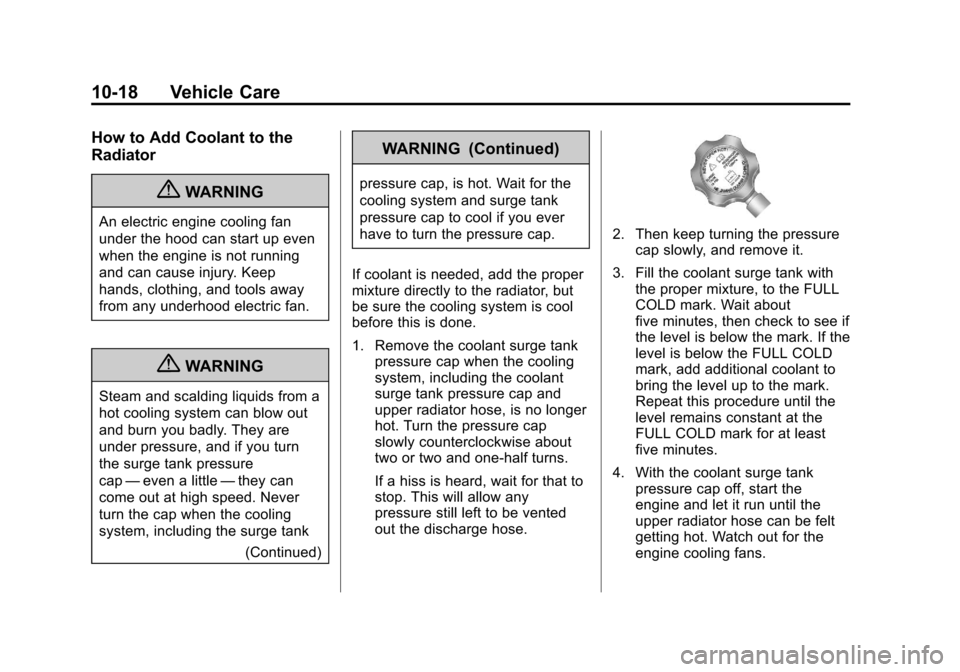
1. Remove the coolant surge tank pressure cap when the cooling
system, including the coolant
surge tank pressure cap and
upper radiator hose, is no longer
hot. Turn the pressure cap
slowly counterclockwise about
two or two and one-half turns.
If a hiss is heard, wait for that to
stop. This will allow any
pressure still left to be vented
out the discharge hose.
2. Then keep turning the pressurecap slowly, and remove it.
3. Fill the coolant surge tank with the proper mixture, to the FULL
COLD mark. Wait about
five minutes, then check to see if
the level is below the mark. If the
level is below the FULL COLD
mark, add additional coolant to
bring the level up to the mark.
Repeat this procedure until the
level remains constant at the
FULL COLD mark for at least
five minutes.
4. With the coolant surge tank pressure cap off, start the
engine and let it run until the
upper radiator hose can be felt
getting hot. Watch out for the
engine cooling fans.
Page 261 of 382
Black plate (19,1)Chevrolet Malibu Owner Manual - 2011
Vehicle Care 10-19
By this time, the coolant level
inside the coolant surge tank
might be lower. If the level is
lower than the FULL COLD
mark, add more of the proper
mixture to the coolant surge tank
until the level reaches the FULL
COLD mark.
5. Then replace the pressure cap. Be sure the pressure cap is
hand-tight and fully seated.
Notice: If the pressure cap is not
tightly installed, coolant loss and
possible engine damage may
occur. Be sure the cap is properly
and tightly secured.
Engine Overheating
The vehicle has several indicators
to warn of engine overheating.
There is an engine coolant
temperature gauge as well as an
engine coolant temperature warning
light on the vehicle's instrument
panel cluster. See Engine Coolant Temperature Gauge on page 5‑20
and
Engine Coolant Temperature
Warning Light on page 5‑20.
If it is decided not to lift the hood
when this warning appears, but
instead get service help right away.
See Roadside Assistance Program
(United States and Canada)
on
page 13‑7or Roadside Assistance
Program (Mexico) on page 13‑9.
If it is decided to lift the hood, make
sure the vehicle is parked on a level
surface.
Then check to see if the engine
cooling fans are running. If the
engine is overheating, both fans
should be running. If they are not,
do not continue to run the engine
and have the vehicle serviced.
Notice: Engine damage from
running the engine without
coolant is not covered by the
warranty.
If Steam is Coming from the
Engine Compartment
{WARNING
Steam from an overheated engine
can burn you badly, even if you
just open the hood. Stay away
from the engine if you see or hear
steam coming from it. Just turn it
off and get everyone away from
the vehicle until it cools down.
Wait until there is no sign of
steam or coolant before you open
the hood.
If you keep driving when your
engine is overheated, the liquids
in it can catch fire. You or others
could be badly burned. Stop your
engine if it overheats, and get out
of the vehicle until the engine
is cool.
Page 263 of 382
Black plate (21,1)Chevrolet Malibu Owner Manual - 2011
Vehicle Care 10-21
Notice:After driving in the
overheated engine protection
operating mode, to avoid engine
damage, allow the engine to cool
before attempting any repair. The
engine oil will be severely
degraded. Repair the cause of
coolant loss, change the oil and
reset the oil life system. See
Engine Oil on page 10‑9.
Power Steering Fluid
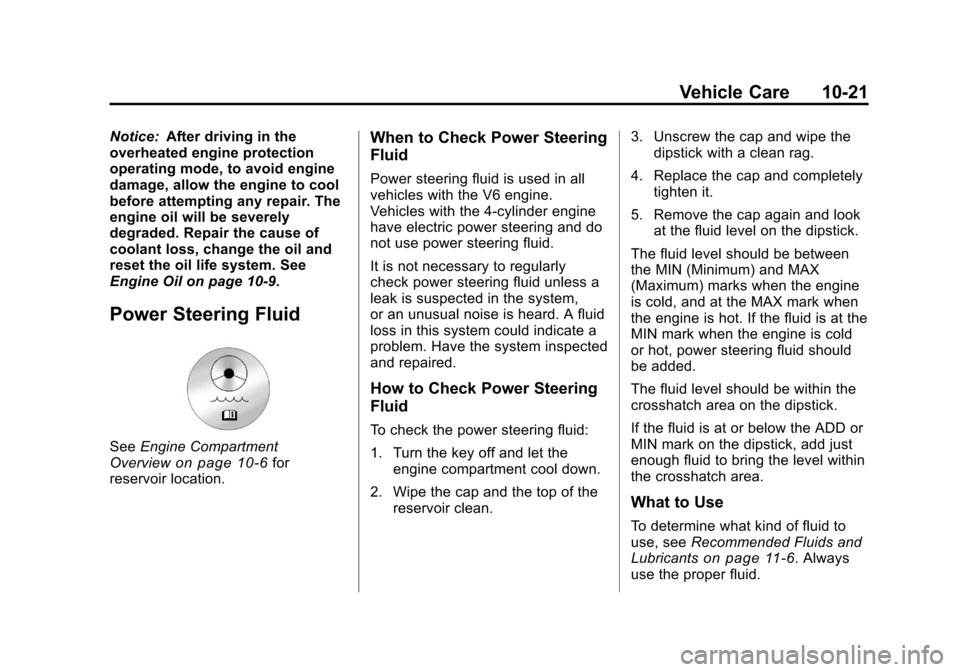
See Engine Compartment
Overviewon page 10‑6for
reservoir location.
When to Check Power Steering
Fluid
Power steering fluid is used in all
vehicles with the V6 engine.
Vehicles with the 4-cylinder engine
have electric power steering and do
not use power steering fluid.
It is not necessary to regularly
check power steering fluid unless a
leak is suspected in the system,
or an unusual noise is heard. A fluid
loss in this system could indicate a
problem. Have the system inspected
and repaired.
How to Check Power Steering
Fluid
To check the power steering fluid:
1. Turn the key off and let the
engine compartment cool down.
2. Wipe the cap and the top of the reservoir clean. 3. Unscrew the cap and wipe the
dipstick with a clean rag.
4. Replace the cap and completely tighten it.
5. Remove the cap again and look at the fluid level on the dipstick.
The fluid level should be between
the MIN (Minimum) and MAX
(Maximum) marks when the engine
is cold, and at the MAX mark when
the engine is hot. If the fluid is at the
MIN mark when the engine is cold
or hot, power steering fluid should
be added.
The fluid level should be within the
crosshatch area on the dipstick.
If the fluid is at or below the ADD or
MIN mark on the dipstick, add just
enough fluid to bring the level within
the crosshatch area.
What to Use
To determine what kind of fluid to
use, see Recommended Fluids and
Lubricants
on page 11‑6. Always
use the proper fluid.
Page 267 of 382
Black plate (25,1)Chevrolet Malibu Owner Manual - 2011
Vehicle Care 10-25
.If brake fluid is spilled on the
vehicle's painted surfaces,
the paint finish can be
damaged. Be careful not to
spill brake fluid on the
vehicle. If you do, wash it off
immediately.
Battery
Refer to the replacement number
shown on the original battery label
when a new battery is needed. See
Engine Compartment Overview
on
page 10‑6for battery location.
{DANGER
Battery posts, terminals, and
related accessories contain lead
and lead compounds, chemicals
known to the State of California to
cause cancer and reproductive
harm. Wash hands after handling.
Vehicle Storage
{WARNING
Batteries have acid that can burn
you and gas that can explode.
You can be badly hurt if you are
not careful. See Jump Starting
on
page 10‑78
for tips on working
around a battery without
getting hurt.
Infrequent Usage: Remove the
black, negative (−) cable from the
battery to keep the battery from
running down.
Extended Storage: Remove the
black, negative (−) cable from the
battery or use a battery trickle
charger.
Starter Switch Check
{WARNING
When you are doing this
inspection, the vehicle could
move suddenly. If the vehicle
moves, you or others could be
injured.
1. Before starting this check, be sure there is enough room
around the vehicle.
2. Firmly apply both the parking brake and the regular brake.
See Parking Brake
on
page 9‑29.
Do not use the accelerator
pedal, and be ready to turn off
the engine immediately if it
starts.
Page 268 of 382
Black plate (26,1)Chevrolet Malibu Owner Manual - 2011
10-26 Vehicle Care
3. Try to start the engine in eachgear. The vehicle should start
only in P (Park) or N (Neutral).
If the vehicle starts in any other
position, contact your dealer for
service.
Automatic Transmission
Shift Lock Control
Function Check
{WARNING
When you are doing this
inspection, the vehicle could
move suddenly. If the vehicle
moves, you or others could be
injured.
1. Before starting this check, be sure there is enough room
around the vehicle. It should be
parked on a level surface.
2. Firmly apply the parking brake. See Parking Brake
on
page 9‑29. Be ready to apply the regular
brake immediately if the vehicle
begins to move.
3. With the engine off, turn the ignition to ON/RUN, but do not
start the engine. Without
applying the regular brake, try to
move the shift lever out of
P (Park) with normal effort. If the
shift lever moves out of P (Park),
contact your dealer for service.
Ignition Transmission
Lock Check
While parked, and with the parking
brake set, try to turn the ignition to
LOCK/OFF in each shift lever
position.
.The ignition should turn to
LOCK/OFF only when the shift
lever is in P (Park).
.The ignition key should come
out only in LOCK/OFF.
Contact your dealer if service is
required.
Park Brake and P (Park)
Mechanism Check
{WARNING
When you are doing this check,
the vehicle could begin to move.
You or others could be injured
and property could be damaged.
Make sure there is room in front
of the vehicle in case it begins to
roll. Be ready to apply the regular
brake at once should the vehicle
begin to move.
Park on a fairly steep hill, with the
vehicle facing downhill. Keeping
your foot on the regular brake, set
the parking brake.
.To check the parking brake's
holding ability: With the engine
running and the transmission in
N (Neutral), slowly remove foot
pressure from the regular brake
pedal. Do this until the vehicle is
held by the parking brake only.
Page 269 of 382
Black plate (27,1)Chevrolet Malibu Owner Manual - 2011
Vehicle Care 10-27
.To check the P (Park)
mechanism's holding ability:
With the engine running, shift to
P (Park). Then release the
parking brake followed by the
regular brake.
Contact your dealer if service is
required.
Wiper Blade Replacement
Windshield wiper blades should be
inspected for wear or cracking. See
Scheduled Maintenance
on
page 11‑2for more information.
It is a good idea to clean or replace
the wiper blade assembly on a
regular basis or when worn. For
proper windshield wiper blade
length and type, see Maintenance
Replacement Parts on page 11‑7.
Notice: Allowing the wiper blade
arm to touch the windshield when
no wiper blade is installed could
damage the windshield. Any
damage that occurs would not be covered by your warranty. Do not
allow the wiper blade arm to
touch the windshield.
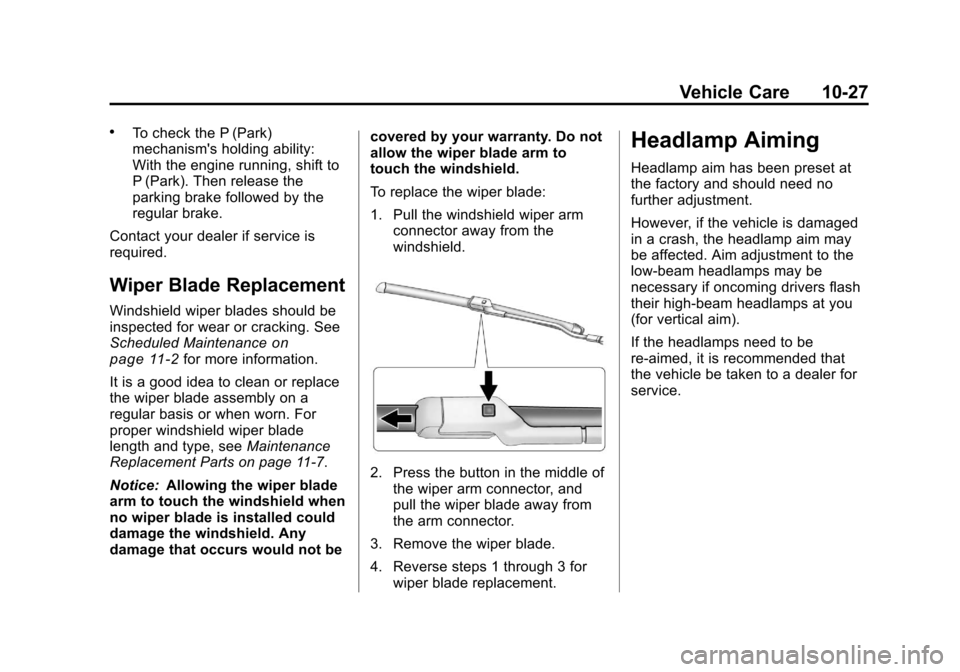
To replace the wiper blade:
1. Pull the windshield wiper arm
connector away from the
windshield.
2. Press the button in the middle of
the wiper arm connector, and
pull the wiper blade away from
the arm connector.
3. Remove the wiper blade.
4. Reverse steps 1 through 3 for wiper blade replacement.
Headlamp Aiming
Headlamp aim has been preset at
the factory and should need no
further adjustment.
However, if the vehicle is damaged
in a crash, the headlamp aim may
be affected. Aim adjustment to the
low-beam headlamps may be
necessary if oncoming drivers flash
their high-beam headlamps at you
(for vertical aim).
If the headlamps need to be
re-aimed, it is recommended that
the vehicle be taken to a dealer for
service.
Page 273 of 382
Black plate (31,1)Chevrolet Malibu Owner Manual - 2011
Vehicle Care 10-31
To identify and check fuses, circuit
breakers, and relays, seeEngine
Compartment Fuse Block
on
page 10‑31, Instrument Panel Fuse
Blockon page 10‑33, and Rear
Compartment Fuse Blockon
page 10‑35.
Engine Compartment
Fuse Block
The engine compartment fuse block
is located on the driver side of the
engine compartment, near the
battery.
Notice: Spilling liquid on any
electrical component on the
vehicle may damage it. Always
keep the covers on any electrical
component.
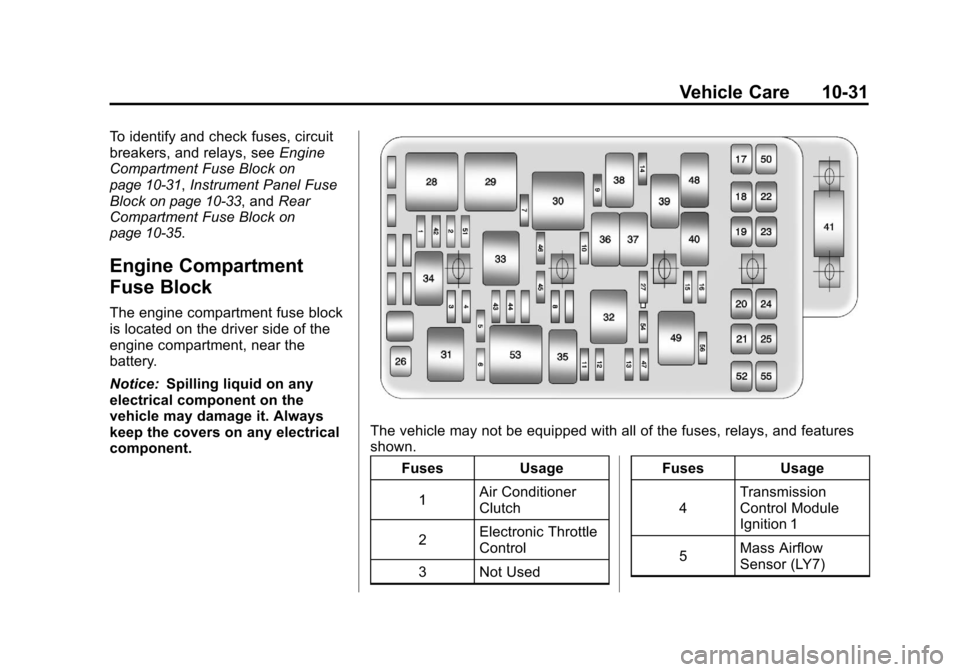
The vehicle may not be equipped with all of the fuses, relays, and features
shown.
Fuses Usage
1 Air Conditioner
Clutch
2 Electronic Throttle
Control
3 Not Used Fuses Usage
4 Transmission
Control Module
Ignition 1
5 Mass Airflow
Sensor (LY7)
Page 322 of 382
Black plate (80,1)Chevrolet Malibu Owner Manual - 2011
10-80 Vehicle Care
4. Open the hoods and locate thebatteries. Find the positive (+)
and negative (−) terminal
locations on each vehicle. Your
vehicle's positive (+) terminal is
located under a red tethered cap
on the battery. The negative (–)
terminal is located under a black
tethered cap on the battery. See
Engine Compartment Overview
on page 10‑6for more
information on location. Flip the
caps up to access the
positive (+) and negative (–)
terminals.
{WARNING
An electric fan can start up even
when the engine is not running
and can injure you. Keep hands,
clothing and tools away from any
underhood electric fan.
{WARNING
Using a match near a battery can
cause battery gas to explode.
People have been hurt doing this,
and some have been blinded.
Use a flashlight if you need more
light.
Be sure the battery has enough
water. You do not need to add
water to the battery installed in
your new vehicle. But if a battery
has filler caps, be sure the right
amount of fluid is there. If it is low,
add water to take care of that
first. If you don't, explosive gas
could be present.
(Continued)
WARNING (Continued)
Battery fluid contains acid that
can burn you. Do not get it on
you. If you accidentally get it in
your eyes or on your skin, flush
the place with water and get
medical help immediately.
{WARNING
Fans or other moving engine
parts can injure you badly. Keep
your hands away from moving
parts once the engine is running.
5. Check that the jumper cables do not have loose or missing
insulation. If they do, you could
get a shock. The vehicles could
be damaged too.