2011 CHEVROLET EQUINOX check engine
[x] Cancel search: check enginePage 327 of 446
Black plate (21,1)Chevrolet Equinox Owner Manual - 2011
Vehicle Care 10-21
Notice:In cold weather, water
can freeze and crack the engine,
radiator, heater core and other
parts. Use the recommended
coolant and the proper coolant
mixture.
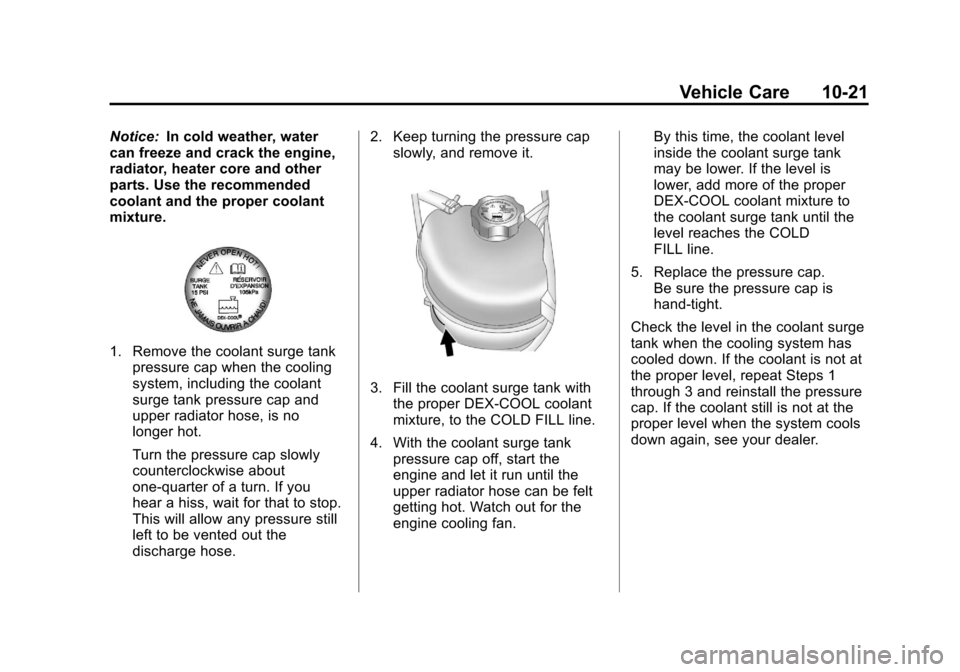
1. Remove the coolant surge tank pressure cap when the cooling
system, including the coolant
surge tank pressure cap and
upper radiator hose, is no
longer hot.
Turn the pressure cap slowly
counterclockwise about
one-quarter of a turn. If you
hear a hiss, wait for that to stop.
This will allow any pressure still
left to be vented out the
discharge hose. 2. Keep turning the pressure cap
slowly, and remove it.
3. Fill the coolant surge tank withthe proper DEX-COOL coolant
mixture, to the COLD FILL line.
4. With the coolant surge tank pressure cap off, start the
engine and let it run until the
upper radiator hose can be felt
getting hot. Watch out for the
engine cooling fan. By this time, the coolant level
inside the coolant surge tank
may be lower. If the level is
lower, add more of the proper
DEX-COOL coolant mixture to
the coolant surge tank until the
level reaches the COLD
FILL line.
5. Replace the pressure cap. Be sure the pressure cap is
hand-tight.
Check the level in the coolant surge
tank when the cooling system has
cooled down. If the coolant is not at
the proper level, repeat Steps 1
through 3 and reinstall the pressure
cap. If the coolant still is not at the
proper level when the system cools
down again, see your dealer.
Page 328 of 446
Black plate (22,1)Chevrolet Equinox Owner Manual - 2011
10-22 Vehicle Care
Engine Overheating
The vehicle has an indicator to warn
of engine overheating. There is an
engine coolant temperature warning
light on the vehicle's instrument
panel. SeeEngine Coolant
Temperature Gauge on page 5‑11.
The decision may be made not to lift
the hood when this warning
appears, but instead get service
help right away. See Roadside
Assistance Program on page 13‑6.
If the decision to lift the hood is
made, make sure the vehicle is
parked on a level surface. Then check to see if the engine
cooling fan(s) are running. If the
engine is overheating, the fan(s)
should be running. If they are not,
do not continue to run the engine
and have the vehicle serviced.
Notice:
Engine damage from
running the engine without
coolant is not covered by the
warranty.
If Steam is Coming from the
Engine Compartment
{WARNING
Steam from an overheated engine
can burn you badly, even if you
just open the hood. Stay away
from the engine if you see or hear
steam coming from it. Just turn it
off and get everyone away from
the vehicle until it cools down.
Wait until there is no sign of
steam or coolant before you
open the hood.
(Continued)
WARNING (Continued)
If you keep driving when your
engine is overheated, the liquids
in it can catch fire. You or others
could be badly burned. Stop your
engine if it overheats, and get out
of the vehicle until the engine
is cool.
If No Steam is Coming from
the Engine Compartment
If an engine overheat warning is
displayed but no steam can be seen
or heard, the problem may not be
too serious. Sometimes the engine
can get a little too hot when the
vehicle:
.Climbs a long hill on a hot day
.Stops after high-speed driving
.Idles for long periods in traffic
.Tows a trailer
Page 330 of 446
Black plate (24,1)Chevrolet Equinox Owner Manual - 2011
10-24 Vehicle Care
When to Check Power Steering
Fluid
The power steering fluid does not
need to be checked unless there is
a leak in the system or you hear an
unusual noise. Have the system
inspected and repaired if there is a
fluid loss.
How to Check Power Steering
Fluid
To check the power steering fluid:
1. Turn the engine off and let itcool down.
2. Remove the engine cover. Refer toEngine Cover on page 10‑10.
3. Wipe the cap and the top of the reservoir clean.
4. Unscrew the cap and wipe the dipstick with a clean rag. 5. Replace the cap and completely
tighten it.
6. Remove the cap again and look at the fluid level on the dipstick.
The fluid level should be between
MAX and MIN line at room
temperature. If the fluid is on or
below MIN line, add fluid.
What to Use
To determine what kind of fluid to
use, refer to Recommended Fluids
and Lubricants on page 11‑6.
Always use the proper fluid.
Notice: Use of the incorrect fluid
may damage the vehicle and the
damages may not be covered by
the vehicle's warranty. Always
use the correct fluid listed in
Recommended Fluids and
Lubricants on page 11‑6.
Washer Fluid
What to Use
Read the manufacturer's
instructions before refilling the
windshield washer fluid. If operating
the vehicle in an area where the
temperature may fall below freezing,
use a fluid that has sufficient
protection against freezing.
Adding Washer Fluid
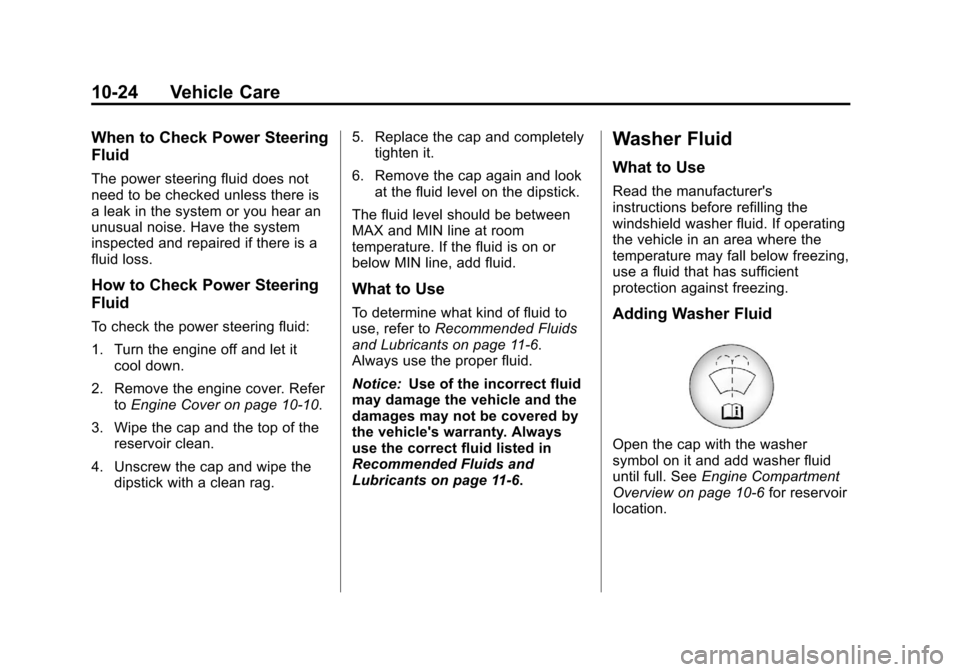
Open the cap with the washer
symbol on it and add washer fluid
until full. See Engine Compartment
Overview on page 10‑6 for reservoir
location.
Page 335 of 446
Black plate (29,1)Chevrolet Equinox Owner Manual - 2011
Vehicle Care 10-29
Starter Switch Check
{WARNING
When you are doing this
inspection, the vehicle could
move suddenly. If the vehicle
moves, you or others could
be injured.
1. Before starting this check, be sure there is enough room
around the vehicle.
2. Firmly apply both the parking brake and the regular brake.
See Parking Brake on
page 9‑40.
Do not use the accelerator
pedal, and be ready to turn off
the engine immediately if it
starts. 3. Try to start the engine in each
gear. The vehicle should start
only in P (Park) or N (Neutral).
If the vehicle starts in any other
position, contact your dealer for
service.
Automatic Transmission
Shift Lock Control
Function Check
{WARNING
When you are doing this
inspection, the vehicle could
move suddenly. If the vehicle
moves, you or others could
be injured.
1. Before starting this check, be sure there is enough room
around the vehicle. It should be
parked on a level surface. 2. Firmly apply the parking brake.
See Parking Brake on
page 9‑40.
Be ready to apply the regular
brake immediately if the vehicle
begins to move.
3. With the engine off, turn the ignition on, but do not start the
engine. Without applying the
regular brake, try to move the
shift lever out of P (Park) with
normal effort. If the shift lever
moves out of P (Park), contact
your dealer for service.
Page 336 of 446
Black plate (30,1)Chevrolet Equinox Owner Manual - 2011
10-30 Vehicle Care
Ignition Transmission
Lock Check
While parked, and with the parking
brake set, try to turn the ignition to
LOCK/OFF in each shift lever
position.
.The ignition should turn to
LOCK/OFF only when the shift
lever is in P (Park).
.The ignition key should come
out only in LOCK/OFF.
Contact your dealer if service is
required.
Park Brake and P (Park)
Mechanism Check
{WARNING
When you are doing this check,
the vehicle could begin to move.
You or others could be injured
and property could be damaged.
Make sure there is room in front
of the vehicle in case it begins to
roll. Be ready to apply the regular
brake at once should the vehicle
begin to move. Park on a fairly steep hill, with the
vehicle facing downhill. Keeping
your foot on the regular brake, set
the parking brake.
.To check the parking brake's
holding ability: With the engine
running and the transmission in
N (Neutral), slowly remove foot
pressure from the regular brake
pedal. Do this until the vehicle is
held by the parking brake only.
.To check the P (Park)
mechanism's holding ability:
With the engine running, shift to
P (Park). Then release the
parking brake followed by the
regular brake.
Contact your dealer if service is
required.
Page 403 of 446
Black plate (3,1)Chevrolet Equinox Owner Manual - 2011
Service and Maintenance 11-3
system whenever the oil is changed.
SeeEngine Oil Life System on
page 10‑14.
Every Engine Oil Change
.Change engine oil and filter.
Reset oil life system. See
Engine Oil on page 10‑10 and
Engine Oil Life System on
page 10‑14. An Emission
Control Service.
.Engine coolant level check. See
Engine Coolant on page 10‑18.
.Engine cooling system
inspection. Visual inspection of
hoses, pipes, fittings, and
clamps and replacement,
if needed.
.Windshield washer fluid level
check. See Washer Fluid on
page 10‑24.
.Windshield wiper blade
inspection for wear, cracking,
or contamination and windshield
and wiper blade cleaning, if contaminated. See
Exterior
Care on page 10‑86. Worn or
damaged wiper blade
replacement. See Wiper Blade
Replacement on page 10‑31.
.Tire inflation pressures check.
See Tire Pressure on
page 10‑53.
.Tire wear inspection. See Tire
Inspection on page 10‑59.
.Rotate tires if necessary. See
Tire Rotation on page 10‑60.
.Fluids visual leak check
(or every 12 months, whichever
occurs first). A leak in any
system must be repaired and the
fluid level checked.
.Engine air cleaner filter
inspection. See Engine Air
Cleaner/Filter on page 10‑15.
.Brake system inspection
(or every 12 months, whichever
occurs first).
.Steering and suspension
inspection. Visual inspection for
damaged, loose, or missing
parts or signs of wear.
.Body hinges and latches,
key lock cylinders, folding
seat hardware, and sunroof
(if equipped) lubrication. See
Recommended Fluids and
Lubricants on page 11‑6. More
frequent lubrication may be
required when the vehicle is
exposed to a corrosive
environment. Applying silicone
grease on weatherstrips with a
clean cloth makes them last
longer, seal better, and not stick
or squeak.
.Restraint system component
check. See Safety System
Check on page 3‑25.
.Fuel system inspection for
damage or leaks.
.Exhaust system and nearby heat
shields inspection for loose or
damaged components.
Page 404 of 446
Black plate (4,1)Chevrolet Equinox Owner Manual - 2011
11-4 Service and Maintenance
Additional Required Services
Every 12 000 km/7,500 Miles
.Rotate tires. Tires should be
rotated every 12 000 km/
7,500 miles. SeeTire Rotation
on page 10‑60.
At Each Fuel Stop
.Engine oil level check. See
Engine Oil on page 10‑10.
.Engine coolant level check. See
Engine Coolant on page 10‑18.
.Windshield washer fluid level
check. See Washer Fluid on
page 10‑24.
Once a Month
.Tire inflation check. See Tire
Pressure on page 10‑53.
.Tire wear inspection. See Tire
Inspection on page 10‑59.
.Sunroof track and seal
inspection, if equipped.
See Sunroof on page 2‑19. Once a Year
.See
Starter Switch Check on
page 10‑29.
.See Automatic Transmission
Shift Lock Control Function
Check on page 10‑29.
.See Ignition Transmission Lock
Check on page 10‑30.
.See Park Brake and P (Park)
Mechanism Check on
page 10‑30.
.Accelerator pedal check for
damage, high effort, or binding.
Replace if needed.
.Underbody flushing service.
.Hood/Decklid/Liftgate/Liftglass
Support Gas Strut Service:
Visually inspect gas strut,
if equipped, for signs of wear,
cracks, or other damage. Check
the hold open ability of the gas
strut. Contact your dealer if
service is required. First Engine Oil Change After
Every 40 000 km/25,000 Miles
.Passenger compartment air filter
replacement (or every
24 months, whichever occurs
first). More frequent replacement
may be needed if you drive in
areas with heavy traffic, areas
with poor air quality, or areas
with high dust levels.
Replacement may also be
needed if you notice reduced air
flow, windows fogging up,
or odors. Your dealer can help
you determine when it is the
right time to replace the filter.
Page 405 of 446
Black plate (5,1)Chevrolet Equinox Owner Manual - 2011
Service and Maintenance 11-5
First Engine Oil Change After
Every 80 000 km/50,000 Miles
.Engine air cleaner filter
replacement. SeeEngine Air
Cleaner/Filter on page 10‑15.
.Automatic transmission fluid
change (severe service) for
vehicles mainly driven in heavy
city traffic in hot weather, in hilly
or mountainous terrain, when
frequently towing a trailer,
or used for taxi, police,
or delivery service. See
Automatic Transmission Fluid on
page 10‑15.
.Transfer case fluid change
(severe service) for vehicles
mainly driven in hilly or
mountainous terrain, when
frequently towing a trailer,
or used for taxi, police,
or delivery service.
.Evaporative control system
inspection. Check all fuel and
vapor lines and hoses for proper
hook‐up, routing, and condition.
Check that the purge valve,
if the vehicle has one, works
properly. Replace as needed.
An Emission Control Service.
The U.S. Environmental
Protection Agency or the
California Air Resources Board
has determined that the failure
to perform this maintenance item
will not nullify the emission
warranty or limit recall liability
prior to the completion of
the vehicle's useful life.
We, however, urge that all
recommended maintenance
services be performed at the
indicated intervals and the
maintenance be recorded. First Engine Oil Change After
Every 160 000 km/100,000 Miles
.Automatic transmission fluid
change (normal service). See
Automatic Transmission Fluid on
page 10‑15.
.Transfer case fluid change
(normal service).
.Spark plug replacement and
spark plug wires inspection.
An Emission Control Service.
First Engine Oil Change After
Every 240 000 km/150,000 Miles
.Engine cooling system drain,
flush, and refill (or every five
years, whichever occurs first).
See Cooling System on
page 10‑17. An Emission
Control Service.
.Engine drive belts inspection for
fraying, excessive cracks,
or obvious damage (or every
10 years, whichever occurs
first). Replace, if needed.