2011 CHEVROLET CORVETTE oil
[x] Cancel search: oilPage 304 of 428
Black plate (20,1)Chevrolet Corvette Owner Manual - 2011
10-20 Vehicle Care
8. Start the engine and let it runat idle for at least 15 seconds.
This will circulate the fresh
engine oil through the lubrication
system.
9. Shut off the engine and check the oil level as described under
“Checking Engine Oil (ZO6,
ZR1, and Grand Sport).”
Selecting the Right Engine Oil
Selecting the right engine oil
depends on both the proper oil
specification and viscosity grade:
Specification
Use and ask for engine oils with
the dexos™ certification mark.
Oils meeting the requirements
of your vehicle should have the
dexos™ certification mark on the
container. This certification mark
indicates that the oil has been
approved to the dexos™
specification.
Your vehicle was filled at the factory
with dexos™ approved engine oil.
Notice: Use only engine oil
that is approved to the dexos™
specification or an equivalent
engine oil of the appropriate
viscosity grade. Engine oils
approved to the dexos™
specification will show the
dexos™ symbol on the container.
Failure to use the recommended
engine oil or equivalent can result
in engine damage not covered
by the vehicle warranty. If you
are unsure whether your oil
is approved to the dexos™
specification, ask your service
provider. It is recommended to use
Mobil 1
®engine oils that meet
the requirements of the dexos™
specification.
Use of Substitute Engine Oils if
dexos™ is unavailable: In the
event that dexos™ approved engine
oil is not available at an oil change
or for maintaining proper oil level,
you may use substitute engine oil
displaying the API Starburst symbol
and of SAE 5W-30 viscosity grade.
Use of oils that do not meet the
dexos™ specification, however,
may result in reduced performance
under certain circumstances.
Viscosity Grade
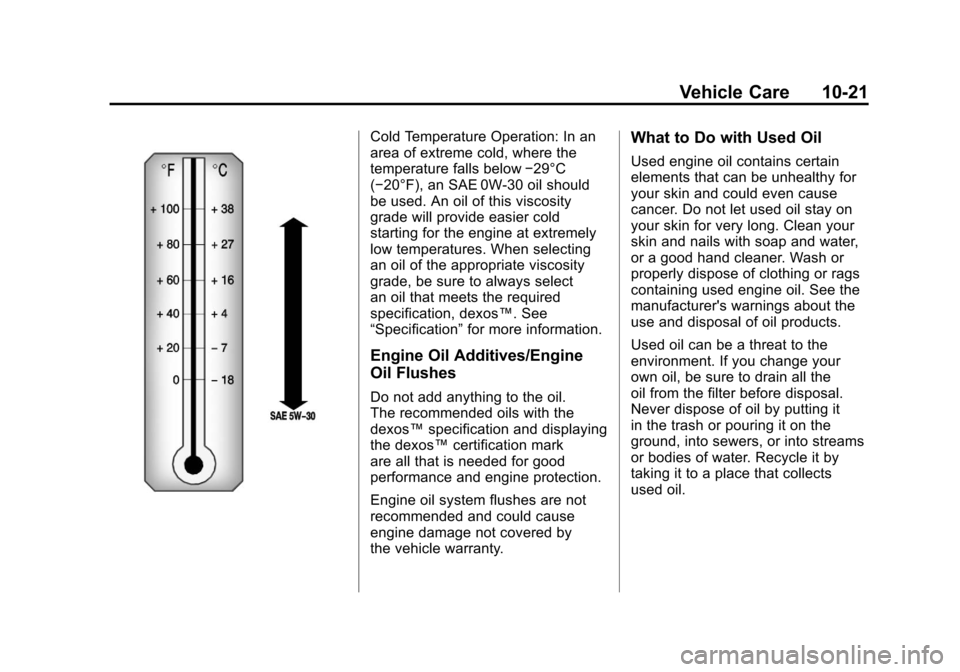
SAE 5W-30 is the best viscosity
grade for the vehicle. Do not
use other viscosity oils such as
SAE 10W‐30, 10W‐40, or 20W-50.
Page 305 of 428
Black plate (21,1)Chevrolet Corvette Owner Manual - 2011
Vehicle Care 10-21
Cold Temperature Operation: In an
area of extreme cold, where the
temperature falls below−29°C
(−20°F), an SAE 0W-30 oil should
be used. An oil of this viscosity
grade will provide easier cold
starting for the engine at extremely
low temperatures. When selecting
an oil of the appropriate viscosity
grade, be sure to always select
an oil that meets the required
specification, dexos™. See
“Specification” for more information.
Engine Oil Additives/Engine
Oil Flushes
Do not add anything to the oil.
The recommended oils with the
dexos™specification and displaying
the dexos™ certification mark
are all that is needed for good
performance and engine protection.
Engine oil system flushes are not
recommended and could cause
engine damage not covered by
the vehicle warranty.
What to Do with Used Oil
Used engine oil contains certain
elements that can be unhealthy for
your skin and could even cause
cancer. Do not let used oil stay on
your skin for very long. Clean your
skin and nails with soap and water,
or a good hand cleaner. Wash or
properly dispose of clothing or rags
containing used engine oil. See the
manufacturer's warnings about the
use and disposal of oil products.
Used oil can be a threat to the
environment. If you change your
own oil, be sure to drain all the
oil from the filter before disposal.
Never dispose of oil by putting it
in the trash or pouring it on the
ground, into sewers, or into streams
or bodies of water. Recycle it by
taking it to a place that collects
used oil.
Page 306 of 428
Black plate (22,1)Chevrolet Corvette Owner Manual - 2011
10-22 Vehicle Care
Engine Oil Life System
When to Change Engine Oil
This vehicle has a computer that
indicates when to change the
engine oil and filter. This is based
on engine revolutions and engine
temperature, and not on mileage.
Based on driving conditions, the
mileage at which an oil change is
indicated can vary considerably.
For the oil life system to work
properly, the system must be reset
every time the oil is changed.
Z06, ZR1, and Grand Sport models
have a racetrack‐ready dry sump
engine lubrication system. This
high‐performance system operates
differently than a standard engine
lubrication system and requires a
special procedure when changing
the engine oil and filter. SeeEngine
Oil on page 10‑15. When the system has calculated
that oil life has been diminished,
it indicates that an oil change is
necessary. A CHANGE ENGINE
OIL message comes on. Change
the oil as soon as possible within
the next 1 000 km (600 miles). It is
possible that, if driving under the
best conditions, the oil life system
might indicate that an oil change
is not necessary for up to a year.
The engine oil and filter must be
changed at least once a year and,
at this time, the system must be
reset. Your dealer has trained
service people who will perform this
work and reset the system. It is also
important to check the oil regularly
over the course of an oil drain
interval and keep it at the proper
level.
If the system is ever reset
accidentally, the oil must be
changed at 5 000 km (3,000 miles)
since the last oil change.
Remember to reset the oil life
system whenever the oil is changed.
How to Reset the Engine Oil
Life System
Reset the system whenever the
engine oil is changed so that the
system can calculate the next
engine oil change. To reset the
system:
1. Press the TRIP button so
the OIL LIFE percentage is
displayed.
2. Press RESET and hold for two seconds. OIL LIFE
REMAINING 100% will appear.
If the CHANGE ENGINE OIL
message comes back on when the
vehicle is started, the engine oil life
system has not reset. Repeat the
procedure.
Page 309 of 428
Black plate (25,1)Chevrolet Corvette Owner Manual - 2011
Vehicle Care 10-25
When to Inspect the Engine Air
Cleaner/Filter
Inspect the air cleaner/filter
at the scheduled maintenance
intervals and replace them at
the first oil change after each
80 000 km (50,000 mile) interval.
SeeScheduled Maintenance on
page 11‑2 for more information.
If driving in dusty/dirty conditions,
inspect the filter at each engine oil
change. How to Inspect the Engine Air
Cleaner/Filter
To inspect the air cleaner/filter,
remove the filter from the vehicle
and lightly shake the filter to release
loose dust and dirt. If the filter
remains caked with dirt, a new filter
is required.
To inspect or replace the engine air
cleaner/filter:
1. Open the hood. See
Hood on
page 10‑9.
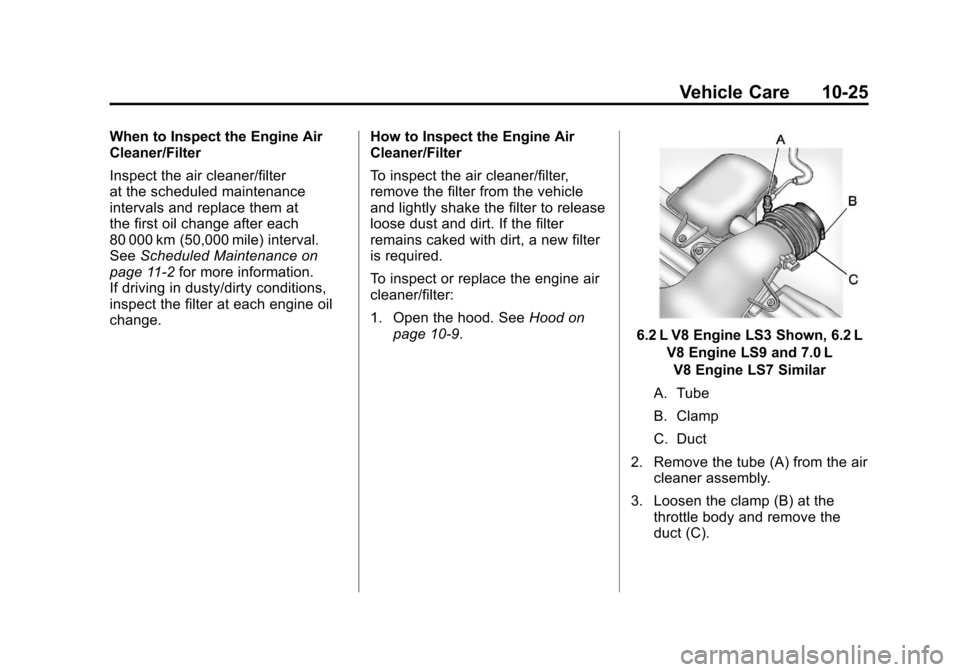
6.2 L V8 Engine LS3 Shown, 6.2 L
V8 Engine LS9 and 7.0 LV8 Engine LS7 Similar
A. Tube
B. Clamp
C. Duct
2. Remove the tube (A) from the air cleaner assembly.
3. Loosen the clamp (B) at the throttle body and remove the
duct (C).
Page 314 of 428
Black plate (30,1)Chevrolet Corvette Owner Manual - 2011
10-30 Vehicle Care
What to Use
{WARNING
Adding only plain water or some
other liquid to the cooling system
can be dangerous. Plain water
and other liquids, can boil before
the proper coolant mixture will.
The vehicle's coolant warning
system is set for the proper
coolant mixture. With plain water
or the wrong mixture, the engine
could get too hot but you would
not get the overheat warning.
The engine could catch fire and
you or others could be burned.
Use a 50/50 mixture of clean,
drinkable water and DEX-COOL
coolant.Use a 50/50 mixture of clean,
drinkable water and DEX-COOL
coolant. If using this mixture,
nothing else needs to be added.
This mixture:.Gives freezing protection down
to
−37°C (−34°F), outside
temperature.
.Gives boiling protection up
to 129°C (265°F), engine
temperature.
.Protects against rust and
corrosion.
.Will not damage aluminum parts.
.Helps keep the proper engine
temperature. Notice:
If an improper coolant
mixture is used, the engine could
overheat and be badly damaged.
The repair cost would not be
covered by the vehicle warranty.
Too much water in the mixture
can freeze and crack the engine,
radiator, heater core, and other
parts.
Notice: If extra inhibitors
and/or additives are used in
the vehicle's cooling system,
the vehicle could be damaged.
Use only the proper mixture of
the engine coolant listed in this
manual for the cooling system.
See Recommended Fluids and
Lubricants on page 11‑6 for more
information.
Page 315 of 428
Black plate (31,1)Chevrolet Corvette Owner Manual - 2011
Vehicle Care 10-31
Checking Coolant
The vehicle must be on a level
surface when checking the coolant
level.
Check to see if coolant is visible in
the coolant surge tank. If the coolant
inside the coolant surge tank is
boiling, do not do anything else until
it cools down. If coolant is visible
but the coolant level is not at or
above the FULL COLD mark, add
a 50/50 mixture of clean, drinkable
water and DEX-COOL coolant at the
coolant recovery tank, but be sure
the cooling system is cool before
this is done. SeeEngine Coolant on
page 10‑29 for more information.
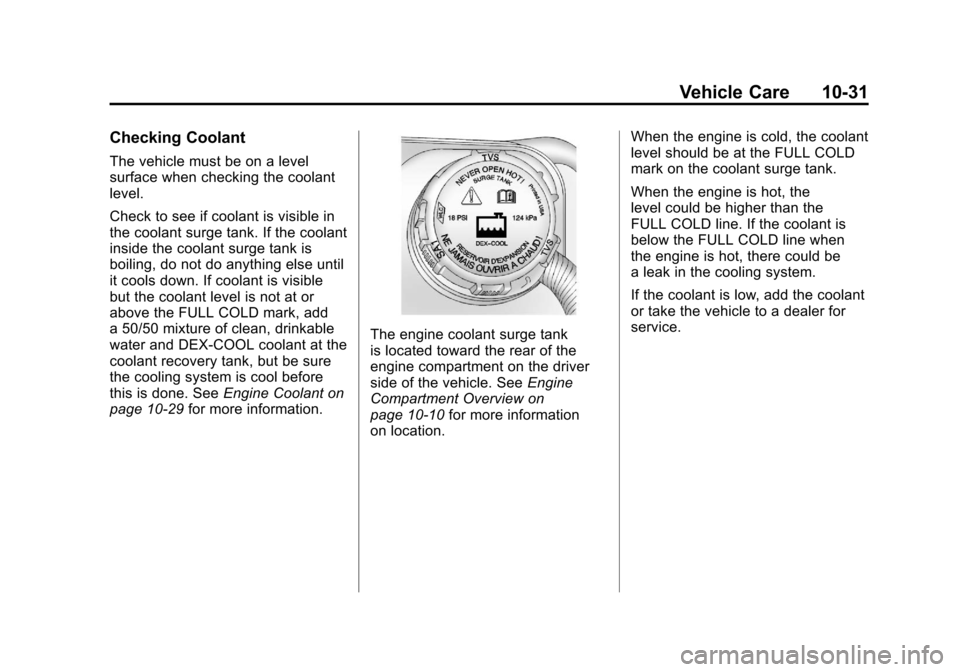
The engine coolant surge tank
is located toward the rear of the
engine compartment on the driver
side of the vehicle. See Engine
Compartment Overview on
page 10‑10 for more information
on location. When the engine is cold, the coolant
level should be at the FULL COLD
mark on the coolant surge tank.
When the engine is hot, the
level could be higher than the
FULL COLD line. If the coolant is
below the FULL COLD line when
the engine is hot, there could be
a leak in the cooling system.
If the coolant is low, add the coolant
or take the vehicle to a dealer for
service.
Page 320 of 428
Black plate (36,1)Chevrolet Corvette Owner Manual - 2011
10-36 Vehicle Care
Driving extended distances in the
overheat protection mode should be
avoided.
Notice:After driving in the
overheated engine protection
operating mode, to avoid engine
damage, allow the engine to cool
before attempting any repair.
The engine oil will be severely
degraded. Repair the cause of
coolant loss, change the oil and
reset the oil life system. See
Engine Oil on page 10‑15.
Power Steering Fluid
See Engine Compartment Overview
on page 10‑10 for reservoir location.
When to Check Power Steering
Fluid
It is not necessary to regularly
check power steering fluid unless
there is a leak suspected in the
system or an unusual noise is
heard. A fluid loss in this system
could indicate a problem. Have the
system inspected and repaired.
How to Check Power Steering
Fluid
To check the power steering fluid:
1. Turn the ignition off and let the
engine compartment cool down.
2. Wipe the cap and the top of the reservoir clean.
3. Unscrew the cap and wipe the dipstick with a clean rag.
4. Replace the cap and completely tighten it.
5. Remove the cap again and look at the fluid level on the dipstick.
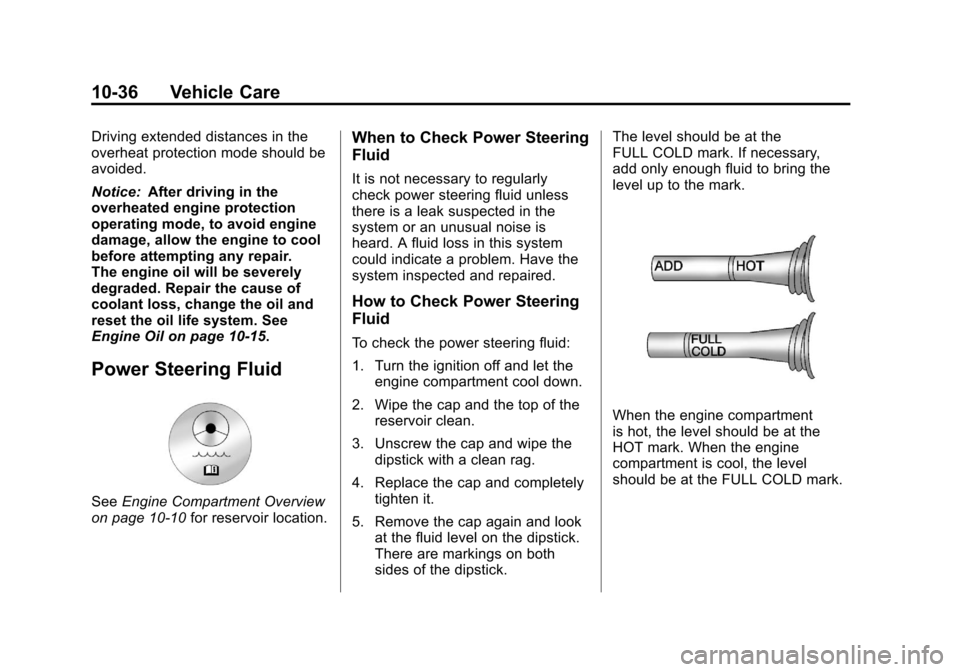
There are markings on both
sides of the dipstick. The level should be at the
FULL COLD mark. If necessary,
add only enough fluid to bring the
level up to the mark.
When the engine compartment
is hot, the level should be at the
HOT mark. When the engine
compartment is cool, the level
should be at the FULL COLD mark.
Page 327 of 428
Black plate (43,1)Chevrolet Corvette Owner Manual - 2011
Vehicle Care 10-43
Notice:
.Using the wrong fluid
can badly damage brake
hydraulic system parts.
For example, just a few
drops of mineral-based oil,
such as engine oil, in the
brake hydraulic system can
damage brake hydraulic
system parts so badly that
they will have to be replaced.
Do not let someone put in
the wrong kind of fluid.
.If brake fluid is spilled on the
vehicle's painted surfaces,
the paint finish can be
damaged. Be careful not
to spill brake fluid on the
vehicle. If you do, wash it
off immediately.
Battery
Refer to the replacement number
on the original battery label when a
new battery is needed.For battery replacement, see
your dealer or the service manual.
To purchase a service manual, see
Service Publications Ordering
Information on page 13‑15.
{DANGER
Battery posts, terminals, and
related accessories contain lead
and lead compounds, chemicals
known to the State of California to
cause cancer and reproductive
harm. Wash hands after handling.
Vehicle Storage
{WARNING
Batteries have acid that can burn
you and gas that can explode.
You can be badly hurt if you are
not careful. See
Jump Starting on
page 10‑82 for tips on working
around a battery without
getting hurt. Some vehicles have a built-in
battery charger that can be
plugged in to keep the battery
charged when the vehicle is not
in use. For vehicles without a
battery charger, see the following
information.
Infrequent Usage: Remove the
black, negative (−) cable from the
battery to keep the battery from
running down.
See
“Power Window Initialization” in
Power Windows on page 2‑17.
Extended Storage: Remove the
black, negative (−) cable from the
battery or use a battery trickle
charger.