2011 CHEVROLET CORVETTE engine oil
[x] Cancel search: engine oilPage 249 of 428
Black plate (19,1)Chevrolet Corvette Owner Manual - 2011
Driving and Operating 9-19
For the first 80 km (500 miles):
.Avoid full throttle starts and
abrupt stops.
.Do not exceed 4,000 rpm.
.Avoid driving at any one
constant speed, fast or slow,
including the use of cruise
control.
.Avoid downshifting to brake
or slow the vehicle when the
engine speed will exceed
4000 rpm.
.Do not let the engine labor.
Never lug the engine in high
gear at low speeds. With a
manual transmission, shift to
the next lower gear. This rule
applies at all times, not just
during the break-in period.For the first 2 414 km (1,500 miles):
.Do not participate in track
events, sport driving schools,
or similar activities during the
first 2 414 km (1,500 miles).
.Check engine oil with every
refueling and add if necessary.
Oil and fuel consumption may be
higher than normal during the
first 2 414 km (1,500 miles).
Front Air Dam
The vehicle is equipped with a front
air dam which has minimal ground
clearance.
Vehicles with the ZR-1 package,
or Z‐06 vehicles with RPO ULZ,
also come with a splitter made from
carbon fiber.
{WARNING
ZR‐1s, and Z‐06s with RPO ULZ,
contain parts made from carbon
fiber.
(Continued)
WARNING (Continued)
When damaged, the exposed
edges can be very sharp.
A person could be injured
by these sharp edges. Use
caution when washing the
vehicle, coming in contact with,
or removing damaged carbon
fiber parts. See your dealer for
replacement.
Under normal operation, these
components will occasionally
contact some road surfaces
(speed bumps, driveway
ramps, etc.). This can be heard
inside the vehicle as a scraping
noise. This is normal and does
not indicate a problem.
Use care when approaching bumps
or objects on road surfaces and
avoid them when possible.
Page 252 of 428
Black plate (22,1)Chevrolet Corvette Owner Manual - 2011
9-22 Driving and Operating
Cell phone chargers can interfere
with the operation of the Keyless
Access System. Battery chargers
should not be plugged in when
starting or turning off the engine.
To start the vehicle, do the following:
1. For vehicles with an automatictransmission, with your foot
on the brake pedal, press the
START button located on the
instrument panel. For vehicles
with a manual transmission, you
must also press in the clutch
pedal while pressing the START
button.
If there is not a keyless access
transmitter in the vehicle or if
there is something causing
interference with it, the DIC will
display NO FOBS DETECTED.
See Key and Lock Messages on
page 5‑42 for more information. 2. When the engine begins
cranking, let go of the button and
the engine cranks automatically
until it starts. If the battery in the
keyless access transmitter is
weak, the DIC displays FOB
BATTERY LOW. You can still
drive the vehicle.
See “Battery Replacement”
under Remote Keyless Entry
(RKE) System Operation on
page 2‑3 for more information.
If the fob battery is dead, you
need to insert the fob into
the fob slot to enable engine
starting. See “NO FOBS
DETECTED” underKey and
Lock Messages on page 5‑42.
3. Do not race the engine immediately after starting it.
Operate the engine and
transmission gently until the
oil warms up and lubricates
all moving parts. 4. If the engine does not start and
no DIC message is displayed,
wait 15 seconds before trying
again to let the cranking motor
cool down.
If the engine does not start after
5-10 seconds, especially in very
cold weather (below −18°C
or 0°F), it could be flooded with
too much gasoline. Try pushing
the accelerator pedal all the way
to the floor while cranking for up
to 15 seconds maximum. Wait at
least 15 seconds between each
try, to allow the cranking motor
to cool down. When the engine
starts, let go of the accelerator.
If the vehicle starts briefly but
then stops again, repeat these
steps. This clears the extra
gasoline from the engine.
Page 279 of 428
Black plate (49,1)Chevrolet Corvette Owner Manual - 2011
Driving and Operating 9-49
If the vehicle has the 6.2L V8 engine
(VIN Code T) or the 7.0L V8 engine
(VIN Code E), use premium
unleaded gasoline with a posted
octane rating of 91 or higher.
For best performance, use premium
unleaded gasoline with a posted
octane rating of 93. In an
emergency, you can use regular
unleaded gasoline with an octane
rating of 87 or higher. If 87 octane
fuel is used, do not perform any
aggressive driving maneuvers such
as wide open throttle applications.
You might also hear audible spark
knock during acceleration. Refill the
tank with premium fuel as soon as
possible to avoid damaging the
engine. If heavy knocking is heard
when using gasoline rated at
91 octane or higher, the engine
needs service.Gasoline Specifications
At a minimum, gasoline
should meet ASTM specification
D 4814 in the United States or
CAN/CGSB‐3.5 or 3.511 in Canada.
Some gasolines contain an
octane-enhancing additive called
methylcyclopentadienyl manganese
tricarbonyl (MMT). We recommend
against the use of gasolines
containing MMT. SeeFuel Additives
on page 9‑50 for additional
information.
California Fuel
Requirements
If the vehicle is certified to meet
California Emissions Standards,
it is designed to operate on fuels
that meet California specifications.
See the underhood emission control
label. If this fuel is not available in
states adopting California emissions
standards, the vehicle will operate
satisfactorily on fuels meeting
federal specifications, but emission
control system performance might be affected. The malfunction
indicator lamp could turn on and the
vehicle might fail a smog‐check test.
See
Malfunction Indicator Lamp on
page 5‑18. If this occurs, return to
your authorized dealer for diagnosis.
If it is determined that the condition
is caused by the type of fuel used,
repairs might not be covered by the
vehicle warranty.
Fuels in Foreign
Countries
If you plan on driving in another
country outside the United States or
Canada, the proper fuel might be
hard to find. Never use leaded
gasoline or any other fuel not
recommended in the previous text
on fuel. Costly repairs caused by
use of improper fuel would not be
covered by the vehicle warranty.
To check the fuel availability, ask
an auto club, or contact a major oil
company that does business in the
country where you will be driving.
Page 280 of 428
Black plate (50,1)Chevrolet Corvette Owner Manual - 2011
9-50 Driving and Operating
Fuel Additives
To provide cleaner air, all gasolines
in the United States are now
required to contain additives
that help prevent engine and fuel
system deposits from forming,
allowing the emission control
system to work properly. In most
cases, nothing should have to be
added to the fuel. However, some
gasolines contain only the minimum
amount of additive required to meet
U.S. Environmental Protection
Agency regulations. To help keep
fuel injectors and intake valves
clean, or if the vehicle experiences
problems due to dirty injectors or
valves, look for gasoline that is
advertised as TOP TIER Detergent
Gasoline. Look for the TOP TIER
label on the fuel pump to ensure
gasoline meets enhanced
detergency standards developed
by the auto companies. A list of
marketers providing TOP TIER
Detergent Gasoline can be found
at www.toptiergas.com.For customers who do not use
TOP TIER Detergent Gasoline
regularly, one bottle of GM Fuel
System Treatment PLUS, added
to the fuel tank at every engine oil
change, can help clean deposits
from fuel injectors and intake
valves. GM Fuel System Treatment
PLUS is the only gasoline additive
recommended by General Motors.
It is available at your dealer.
Gasolines containing oxygenates,
such as ethers and ethanol, and
reformulated gasolines might
be available in your area. We
recommend that you use these
gasolines, if they comply with the
specifications described earlier.
However, E85 (85% ethanol) and
other fuels containing more than
10% ethanol must not be used in
vehicles that were not designed for
those fuels.
Notice:
This vehicle was not
designed for fuel that contains
methanol. Do not use fuel
containing methanol. It can
corrode metal parts in the fuel
system and also damage plastic
and rubber parts. That damage
would not be covered under the
vehicle warranty.
Some gasolines that are
not reformulated for low
emissions can contain an
octane-enhancing additive called
methylcyclopentadienyl manganese
tricarbonyl (MMT); ask the attendant
where you buy gasoline whether the
fuel contains MMT. We recommend
against the use of such gasolines.
Fuels containing MMT can reduce
the life of spark plugs and the
performance of the emission
control system could be affected.
The malfunction indicator lamp
might turn on. If this occurs, return
to your dealer for service.
Page 285 of 428

Black plate (1,1)Chevrolet Corvette Owner Manual - 2011
Vehicle Care 10-1
Vehicle Care
General Information
General Information . . . . . . . . . . 10-3
California Proposition65 Warning . . . . . . . . . . . . . . . . . 10-3
California Perchlorate Materials Requirements . . . . 10-3
Accessories and Modifications . . . . . . . . . . . . . . . 10-4
Lifting the Vehicle . . . . . . . . . . . . 10-5
Vehicle Checks
Doing Your Own Service Work . . . . . . . . . . . . . . . 10-8
Hood . . . . . . . . . . . . . . . . . . . . . . . . 10-9
Engine Compartment Overview . . . . . . . . . . . . . . . . . . 10-10
Engine Oil . . . . . . . . . . . . . . . . . . 10-15
Engine Oil Life System . . . . . 10-22
Automatic Transmission Fluid . . . . . . . . . . . . . . . . . . . . . . 10-23 Manual Transmission
Fluid . . . . . . . . . . . . . . . . . . . . . . 10-23
Hydraulic Clutch . . . . . . . . . . . . 10-24
Engine Air Cleaner/Filter . . . . 10-24
Cooling System (Engine) . . . 10-28
Cooling System (Intercooler) . . . . . . . . . . . . . . . 10-29
Engine Coolant . . . . . . . . . . . . . 10-29
Engine Overheating . . . . . . . . 10-34
Overheated Engine Protection
Operating Mode . . . . . . . . . . . 10-35
Power Steering Fluid . . . . . . . 10-36
Washer Fluid . . . . . . . . . . . . . . . 10-37
Brakes . . . . . . . . . . . . . . . . . . . . . 10-38
Brake Fluid . . . . . . . . . . . . . . . . . 10-41
Battery . . . . . . . . . . . . . . . . . . . . . 10-43
Rear Axle . . . . . . . . . . . . . . . . . . 10-44
Starter Switch Check . . . . . . . 10-44
Automatic Transmission Shift Lock Control Function
Check . . . . . . . . . . . . . . . . . . . . . 10-45 Park Brake and P (Park)
Mechanism Check . . . . . . . . 10-45
Wiper Blade Replacement . . . . . . . . . . . . . . 10-46
Windshield Replacement . . . 10-47
Headlamp Aiming
Headlamp Aiming . . . . . . . . . . 10-48
Bulb Replacement
Bulb Replacement . . . . . . . . . . 10-48
Halogen Bulbs . . . . . . . . . . . . . . 10-48
High Intensity Discharge
(HID) Lighting . . . . . . . . . . . . . 10-48
Headlamps, Front Turn Signal and Parking
Lamps . . . . . . . . . . . . . . . . . . . . 10-49
Taillamps, Turn Signal, and Stoplamps . . . . . . . . . . . . . . . . 10-50
Replacement Bulbs . . . . . . . . . 10-50
Page 294 of 428
Black plate (10,1)Chevrolet Corvette Owner Manual - 2011
10-10 Vehicle Care
Engine Compartment Overview
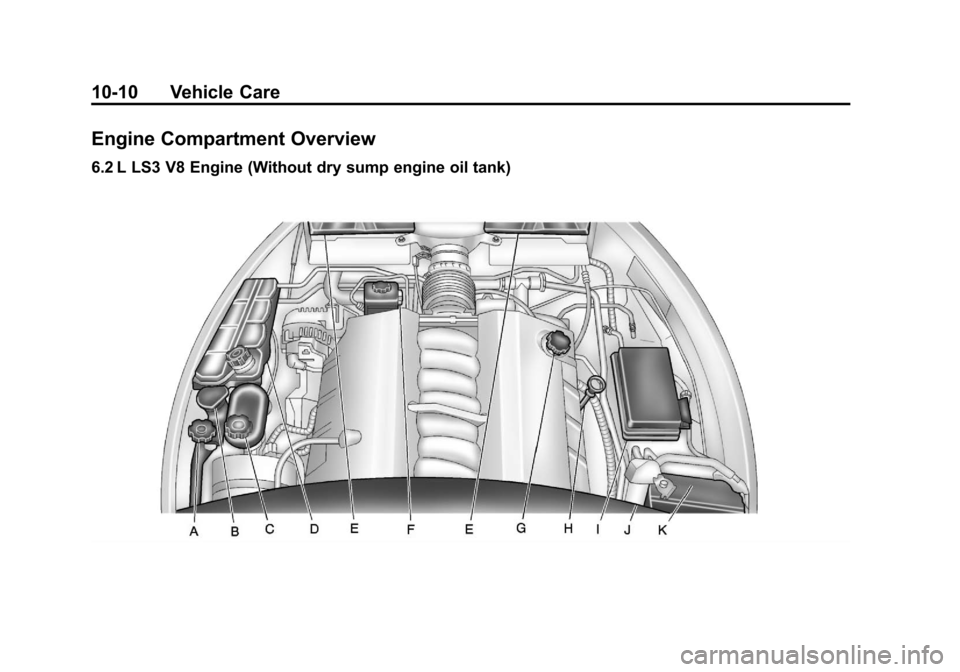
6.2 L LS3 V8 Engine (Without dry sump engine oil tank)
Page 295 of 428
Black plate (11,1)Chevrolet Corvette Owner Manual - 2011
Vehicle Care 10-11
A. Clutch Master CylinderReservoir (If Equipped).
See Hydraulic Clutch on
page 10‑24.
B. Windshield Washer Fluid Reservoir. See “Adding Washer
Fluid” under Washer Fluid on
page 10‑37.
C. Brake Fluid Reservoir. See “Brake Fluid” under
Brakes on page 10‑38.
D. Coolant Surge Tank and Pressure Cap. See Engine
Coolant on page 10‑29.
E. Engine Air Cleaner/Filter on
page 10‑24.
F. Power Steering Fluid Reservoir. See Power Steering Fluid on
page 10‑36. G. Engine Oil Fill Cap. See
“When
to Add Engine Oil” underBrake
Fluid on page 10‑41.
H. Engine Oil Dipstick. See “Checking Engine Oil” under
Engine Oil on page 10‑15.
I. Engine Compartment Fuse
Block on page 10‑52.
J. Passenger Compartment Air Filter (Out of View). See
Passenger Compartment Air
Filter on page 8‑7.
K. Battery on page 10‑43.
If the vehicle has the 6.2 L LS3
V8 engine (without the dry sump
engine oil tank) and you are facing
the front of the vehicle.
Page 297 of 428
Black plate (13,1)Chevrolet Corvette Owner Manual - 2011
Vehicle Care 10-13
A. Intercooler. SeeCooling System
(Engine) on page 10‑28 or
Cooling System (Intercooler) on
page 10‑29.
B. Engine Air Cleaner/Filter on
page 10‑24.
C. Power Steering Fluid Reservoir and Cap. See Power Steering
Fluid on page 10‑36.
D. Coolant Surge Tank and Pressure Cap. See Engine
Coolant on page 10‑29.
E. Windshield Washer Fluid Reservoir. See “Adding Washer
Fluid” under Washer Fluid on
page 10‑37.
F. Clutch Master Cylinder Reservoir (If Equipped).
See Hydraulic Clutch on
page 10‑24.
G. Brake Fluid Reservoir. See “Brake Fluid” under
Brakes on page 10‑38. H. Passenger Compartment
Air Filter (Out of View).
See Passenger Compartment
Air Filter on page 8‑7.
I. Engine Oil Fill Cap. See “When
to Add Engine Oil” under
Engine Oil on page 10‑15.
J. Dry Sump Engine Oil Tank. See “Changing Engine Oil
and Filter” Brake Fluid on
page 10‑41.
K. Engine Oil Dipstick. See “Checking Engine Oil” under
Engine Oil on page 10‑15.
L. Remote Positive (+) Terminal (Out of View). See Jump
Starting on page 10‑82.
M. Engine Compartment Fuse
Block on page 10‑52.
If the vehicle has the 6.2 L LS9
Supercharged V8 engine and you
are facing the front of the vehicle.