2011 CHEVROLET CORVETTE change wheel
[x] Cancel search: change wheelPage 274 of 428

Black plate (44,1)Chevrolet Corvette Owner Manual - 2011
9-44 Driving and Operating
SPORT:Use where road conditions
or personal preference demand
more control. This setting provides
more “feel”, or response to the road
conditions.
The setting can be changed
at any time. Based on road
conditions, steering wheel angle
and the vehicle speed, the system
automatically adjusts to provide
the best handling while providing a
smooth ride. The Tour and Sport
modes will feel similar on a smooth
road. Select a new setting whenever
driving conditions change.
The Selective Ride knob will not
display the Tour or Sport setting
when the Performance Traction
Management mode is selected. When this mode is selected,
turning the Selective Ride knob
will change the Performance
Traction Management mode
and the suspension setting
will be determined automatically.
See
Competitive Driving Mode on
page 9‑38 for more information.
Three Driver Information Center
(DIC) messages (SERVICE
RIDE CONTROL, SHOCKS
INOPERATIVE and MAXIMUM
SPEED 80 MPH (129 KM/H) display
when a malfunction occurs with
the Selective Ride Control system.
Refer to Ride Control System
Messages on page 5‑44 for more
information.Cruise Control
With cruise control, a speed of
about 40 km/h (25 mph) or more can
be maintained without keeping your
foot on the accelerator. Cruise
control does not work at speeds
below about 40 km/h (25 mph).
Cruise control will not work if the
parking brake is set, or if the master
cylinder brake fluid level is low.
{WARNING
Cruise control can be dangerous
where you cannot drive safely at
a steady speed. So, do not use
the cruise control on winding
roads or in heavy traffic.
Cruise control can be dangerous
on slippery roads. On such roads,
fast changes in tire traction can
cause excessive wheel slip, and
you could lose control. Do not use
cruise control on slippery roads.
Page 323 of 428

Black plate (39,1)Chevrolet Corvette Owner Manual - 2011
Vehicle Care 10-39
Front
.Brake pads can be visually
inspected through the wheel by
inspecting the outer brake pads
at each wheel.
.Brake pads should be replaced
when worn to two mm of pad
thickness. New pads are 10 mm
thick.
.In addition, brake pad inspection
is required any time the tires are
removed.
The ZR1 also has an electronic
brake pad wear sensor system.
When pads are worn, the CHANGE
BRAKE PADS message displays
in the Driver Information Center.
SeeBrake System Messages on
page 5‑36.
Some driving conditions or climates
can cause a brake squeal when the
brakes are first applied or lightly
applied. This does not mean
something is wrong with the brakes.
Brake linings should always be
replaced as complete axle sets. Brake Rotor Wear
ZR1 models have ceramic brake
rotors. Rotors should be visually
inspected whenever the brake pads
are replaced. Rotors also need to
be weighed before brake pads are
replaced to confirm that the rotor
mass is greater than the wear‐out
mass printed on the rotor. The rotor
can be reused if the weight of the
rotor is above the mass limit. Rotor
inspection and weighing methods
can be found in the service manual.
See
Service Publications Ordering
Information on page 13‑15.
Page 343 of 428
Black plate (59,1)Chevrolet Corvette Owner Manual - 2011
Vehicle Care 10-59
Winter Tires
If you expect to drive on snow or ice
covered roads often, you may want
to get winter tires for your vehicle.
All season tires provide good overall
performance on most surfaces but
they may not offer the traction you
would like or the same level of
performance as winter tires on
snow or ice covered roads.
Winter tires, in general, are
designed for increased traction
on snow and ice covered roads.
With winter tires, there may be
decreased dry road traction,
increased road noise, and shorter
tread life. After switching to winter
tires, be alert for changes in
vehicle handling and braking.
See your dealer for details
regarding winter tire availability
and proper tire selection. Also, see
Buying New Tires on page 10‑73.If you choose to use winter tires:.Use tires of the same brand and
tread type on all four wheel
positions.
.Use only radial ply tires of the
same size, load range, and
speed rating as the original
equipment tires.
Winter tires with the same speed
rating as your original equipment
tires may not be available for H, V,
W, Y, and ZR speed rated tires.
If you choose winter tires with a
lower speed rating, never exceed
the tire's maximum speed capability.
Run-Flat Tires
This vehicle, when new, had run-flat
tires. There is no spare tire, no tire
changing equipment, and no place
to store a tire in the vehicle. Run-flat
tires perform so well without any air
that a Tire Pressure Monitor System
(TPMS) is used to alert you if a tire
has lost pressure.
{WARNING
When the low tire warning light is
displayed on the instrument panel
cluster, your vehicle's handling
capabilities will be reduced during
severe maneuvers. If you drive
too fast, you could lose control
of your vehicle. You or others
could be injured. Do not drive
over 55 mph (90 km/h) when the
low tire warning light is displayed.
Drive cautiously and check your
tire pressures as soon as
you can.
If a tire goes flat, you will not
need to stop on the side of the
road to change the tire. You can
keep driving, however, if driven
too far or too fast, the tire may
be permanently damaged and
you might not be able to continue
driving on the tire. The tire can
be driven with no air pressure for
up to 105 km (65 miles) at speeds
slower than 90 km/h (55 mph).
Page 363 of 428
Black plate (79,1)Chevrolet Corvette Owner Manual - 2011
Vehicle Care 10-79
{WARNING
Rust or dirt on a wheel, or on the parts to which it is
fastened, can make wheel
nuts become loose after a
time. The wheel could come
off and cause a crash. When
you change a wheel, remove
any rust or dirt from places
where the wheel attaches to
the vehicle. In an emergency,
you can use a cloth or a paper
towel to do this; but be sure to
use a scraper or wire brush
later, if you need to, to get all
the rust or dirt off.Tightening Wheel Lug Nuts
{WARNING
Never use oil or grease on studs
or the threads of the wheel nuts.
If you do, the wheel nuts might
come loose and the wheel could
fall off, causing a crash.
{WARNING
Incorrect wheel nuts or improperly
tightened wheel nuts can cause
the wheel to become loose and
even come off. This could lead
to a crash. Be sure to use the
correct wheel nuts. If you have
to replace them, be sure to get
new GM original equipment
wheel nuts. Notice:
Improperly tightened
wheel nuts can lead to brake
pulsation and rotor damage.
To avoid expensive brake repairs,
evenly tighten the wheel nuts in
the proper sequence and to the
proper torque specification.
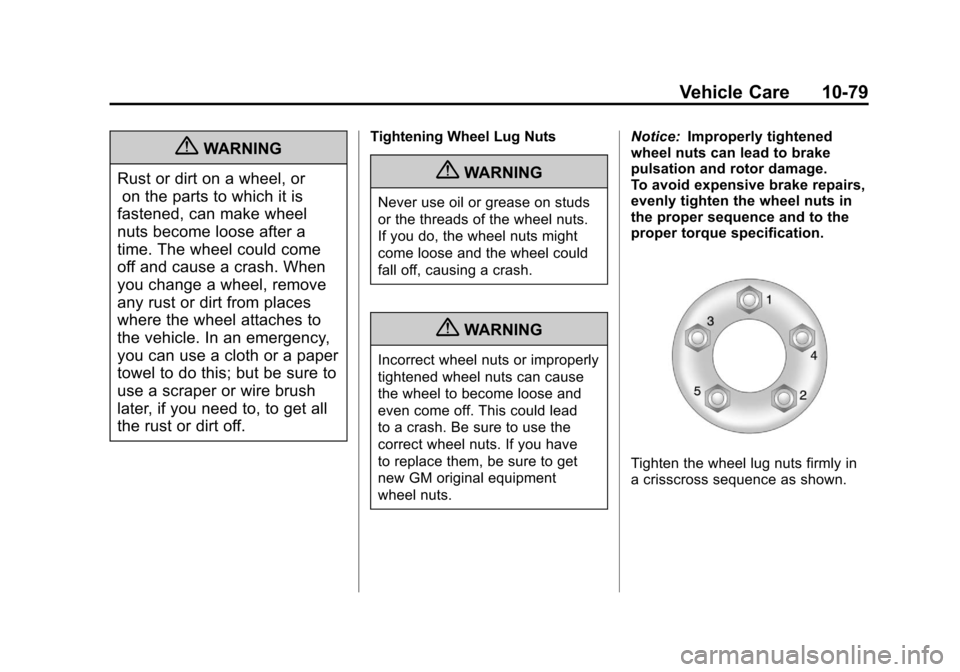
Tighten the wheel lug nuts firmly in
a crisscross sequence as shown.
Page 426 of 428

Black plate (10,1)Chevrolet Corvette Owner Manual - 2011
i-10 INDEX
S
Safety Belts . . . . . . . . . . . . . . . . . . . . 3-9Care . . . . . . . . . . . . . . . . . . . . . . . . . . 3-21
Extender . . . . . . . . . . . . . . . . . . . . . . 3-21
How to Wear Safety BeltsProperly . . . . . . . . . . . . . . . . . . . . . 3-13
Lap-Shoulder Belt . . . . . . . . . . . . 3-18
Messages . . . . . . . . . . . . . . . . . . . . 5-49
Reminders . . . . . . . . . . . . . . . . . . . . 5-16
Replacing After a Crash . . . . . . 3-22
Use During Pregnancy . . . . . . . . 3-20
Safety Defects Reporting Canadian Government . . . . . . 13-16
General Motors . . . . . . . . . . . . . 13-17
U.S. Government . . . . . . . . . . . 13-16
Safety System Check . . . . . . . . . . 3-21
Satellite Radio . . . . . . . . . . . . . . . . . . 7-8
Scheduled Maintenance . . . . . . . 11-2
Scheduling Appointments . . . . . 13-10
Seatback Latches . . . . . . . . . . . . . . 3-8
Seats
Adjustment, Front . . . . . . . . . . . . . . 3-2
Head Restraints . . . . . . . . . . . . . . . 3-2
Heated Front . . . . . . . . . . . . . . . . . . 3-8 Seats (cont.)
Lumbar Adjustment, Front . . . . . 3-6
Power Adjustment, Front . . . . . . 3-3
Reclining Seatbacks . . . . . . . . . . . 3-6
Securing Child Restraints . . . . . . 3-48
Security Light . . . . . . . . . . . . . . . . . . . . . . . . . . 5-24
Vehicle . . . . . . . . . . . . . . . . . . . . . . . 2-12
Selective Ride Control . . . . . . . . . 9-42
Service
Accessories andModifications . . . . . . . . . . . . . . . . 10-4
Doing Your Own Work . . . . . . . . 10-8
Engine Soon Light . . . . . . . . . . . . 5-18
Maintenance Records . . . . . . . . 11-9
Maintenance, General Information . . . . . . . . . . . . . . . . . . 11-1
Parts Identification Label . . . . . 12-1
Publications Ordering
Information . . . . . . . . . . . . . . . . 13-15
Scheduling Appointments . . . 13-10
Vehicle Messages . . . . . . . . . . . . 5-50
Servicing the
Airbag-Equipped Vehicle . . . . . 3-34
Shift Lock Control Function Check, Automatic
Transmission . . . . . . . . . . . . . . . . 10-45 Shifting
Into Park . . . . . . . . . . . . . . . . . . . . . . 9-24
Out of Park . . . . . . . . . . . . . . . . . . . 9-25
Signals, Turn and Lane-Change . . . . . . . . . . . . . . . . . 6-4
Specifications and Capacities . . . . . . . . . . . . . . . . . . . . 12-2
Speedometer . . . . . . . . . . . . . . . . . . 5-11
Starter Switch Check . . . . . . . . . 10-44
Starting the Engine . . . . . . . . . . . . 9-21
Starting the Vehicle Messsages . . . . . . . . . . . . . . . . . . . 5-50
Steering . . . . . . . . . . . . . . . . . . . . . . . . 9-4 Fluid, Power . . . . . . . . . . . . . . . . 10-36
Wheel Adjustment . . . . . . . . . . . . . 5-2
Wheel Controls . . . . . . . . . . . . . . . . 5-3
Storage Rear . . . . . . . . . . . . . . . . . . . . . . . . . . . 4-1
Storage Areas Cargo Cover . . . . . . . . . . . . . . . . . . . 4-2
Center Console . . . . . . . . . . . . . . . . 4-2
Convenience Net . . . . . . . . . . . . . . 4-3
Glove Box . . . . . . . . . . . . . . . . . . . . . 4-1
Stuck Vehicle . . . . . . . . . . . . . . . . . . 9-13
Sun Visors . . . . . . . . . . . . . . . . . . . . . 2-18
Symbols . . . . . . . . . . . . . . . . . . . . . . . . . . iv
Page 427 of 428

Black plate (11,1)Chevrolet Corvette Owner Manual - 2011
INDEX i-11
T
Tachometer . . . . . . . . . . . . . . . . . . . . 5-11
TaillampsTurn Signal, andStoplamps . . . . . . . . . . . . . . . . 10-50
Text Telephone (TTY) Users . . . 13-6
Theft-Deterrent Systems . . . . . . . 2-14 Immobilizer . . . . . . . . . . . . . . . . . . . 2-14
Time . . . . . . . . . . . . . . . . . . . . . . . . . . . . 5-6
Tires Buying New Tires . . . . . . . . . . . 10-73
Chains . . . . . . . . . . . . . . . . . . . . . . 10-80
Designations . . . . . . . . . . . . . . . 10-62
Different Size . . . . . . . . . . . . . . . 10-75
If a Tire Goes Flat . . . . . . . . . . 10-80
Inflation Monitor System . . . . 10-69
Inspection . . . . . . . . . . . . . . . . . . 10-72
Lifting the Vehicle . . . . . . . . . . . . . 10-5
Low Profile . . . . . . . . . . . . . . . . . 10-60
Messages . . . . . . . . . . . . . . . . . . . . 5-51
Pressure . . . . . . . . . . . . . . . . . . . . 10-67
Pressure Light . . . . . . . . . . . . . . . . 5-24
Pressure Monitor System . . . 10-68 Tires (cont.)
Rotation . . . . . . . . . . . . . . . . . . . . 10-72
Run-Flat . . . . . . . . . . . . . . . . . . . . 10-59
Sidewall Labeling . . . . . . . . . . . 10-61
Terminology and
Definitions . . . . . . . . . . . . . . . . . 10-63
Uniform Tire Quality Grading . . . . . . . . . . . . . . . . . . . 10-76
Wheel Alignment and Tire
Balance . . . . . . . . . . . . . . . . . . . 10-77
Wheel Replacement . . . . . . . . 10-78
When It Is Time for New Tires . . . . . . . . . . . . . . . . . . . . . . 10-72
Winter . . . . . . . . . . . . . . . . . . . . . . 10-59
Towing General Information . . . . . . . . . . 9-54
Recreational Vehicle . . . . . . . . 10-86
Vehicle . . . . . . . . . . . . . . . . . . . . . 10-86
Traction Active Handling System . . . . . . 9-37
Control System (TCS) . . . . . . . . 9-36
Control System WarningLight . . . . . . . . . . . . . . . . . . . . . . . . 5-23
Limited-Slip Rear Axle . . . . . . . . 9-42
Selective Ride Control . . . . . . . . 9-42 Transmission
Automatic . . . . . . . . . . . . . . . . . . . . . 9-28
Fluid, Automatic . . . . . . . . . . . . 10-23
Fluid, Manual . . . . . . . . . . . . . . . 10-23
Messages . . . . . . . . . . . . . . . . . . . . 5-53
One-to-Four Shift Light . . . . . . . 5-22
Transportation Program,
Courtesy . . . . . . . . . . . . . . . . . . . . 13-10
Turn and Lane-Change Signals . . . . . . . . . . . . . . . . . . . . . . . . 6-4
Twilight Sentinel . . . . . . . . . . . . . . . . 6-3
U
Uniform Tire Quality
Grading . . . . . . . . . . . . . . . . . . . . . 10-76
Universal Remote System . . . . . 5-64 Operation . . . . . . . . . . . . . . . . . . . . . 5-69
Programming . . . . . . . . . . . . . . . . . 5-64
Using this Manual . . . . . . . . . . . . . . . . iv