2011 CHEVROLET COLORADO ECU
[x] Cancel search: ECUPage 37 of 392

Black plate (11,1)Chevrolet Colorado Owner Manual - 2011
Keys, Doors and Windows 2-11
be a problem with the theft-deterrent
system. Turn the ignition off and try
again.
If the engine still does not start, and
the key appears to be undamaged,
try another ignition key. Check the
fuse. SeeFuses and Circuit
Breakers on page 10‑40. If the
engine still does not start with the
other key, the vehicle needs service.
If the vehicle does start, the first key
may be faulty. See your dealer who
can service the theft-deterrent
system and have a new key made.
It is possible for the theft-deterrent
system decoder to learn the
transponder value of a new or
replacement key. Up to 10 keys can
be programmed for the vehicle. The
following procedure is for
programming additional keys only.
Canadian Owners: If the keys are
lost or damaged, only a dealer can
service the theft-deterrent system to
have new ones made. Two current
driver's keys are required to
program additional keys. To program a new key:
1. Verify that the new key has
PK3+ stamped on it.
2. Insert the current driver's key in the ignition and start the engine.
If the engine does not start see
your dealer for service.
3. After the engine has started, turn the key to LOCK/OFF, and
remove the key.
4. Insert the second current driver's key in the ignition and start the
engine within ten seconds of
removing the previous key. If the
engine does not start see your
dealer for service.
5. After the engine has started, turn the key to LOCK/OFF, and
remove the key. Insert the key to
be programmed and turn it to
ON/RUN within ten seconds of
removing the previous key.
The security light turns off once
the key has been programmed. 6. Repeat Steps 1 through 5 if
additional keys are to be
programmed.
If the security light comes on and
stays on while driving, the engine
will restart if you turn it off. However,
the theft-deterrent system is not
working properly and must be
serviced by your dealer. The vehicle
is not protected by the
theft-deterrent system at this time.
In an emergency, contact Roadside
Assistance. See Roadside
Assistance Program (U.S. and
Canada) on page 13‑7 orRoadside
Assistance Program (Mexico) on
page 13‑9.
Do not leave the key or device that
disarms or deactivates the theft
deterrent system in the vehicle.
Page 38 of 392

Black plate (12,1)Chevrolet Colorado Owner Manual - 2011
2-12 Keys, Doors and Windows
Immobilizer Operation
(Passlock U.S. Only)
Passlock®is a passive
theft-deterrent system that enables
fuel if the vehicle is started with a
valid key. If an incorrect key is used
or the ignition lock cylinder is
tampered with, the fuel system is
disabled and the vehicle does not
start.
The security light turns off
approximately five seconds after the
engine is started. See Security Light
on page 5‑18.
If the engine stalls and the security
light flashes, wait about 10 minutes
until the light stops flashing before
trying to restart the engine. Release
the key from START as soon as the
engine starts.
If the engine does not start after
three tries, the vehicle needs
service. If the engine is running and the
security light comes on, the engine
restarts if you turn the engine off.
However, the Passlock®system is
not working properly and must be
serviced by your dealer. The vehicle
is not protected by Passlock
®at this
time. See your dealer for service.
In an emergency, call the Roadside
Assistance Center. See Roadside
Assistance Program (U.S. and
Canada) on page 13‑7 orRoadside
Assistance Program (Mexico) on
page 13‑9.
Do not leave the key or device that
disarms or deactivates the theft
deterrent system in the vehicle.
Exterior Mirrors
Convex Mirrors
{WARNING
A convex mirror can make things,
like other vehicles, look farther
away than they really are. If you
cut too sharply into the right lane,
you could hit a vehicle on the
right. Check the inside mirror or
glance over your shoulder before
changing lanes.
The passenger side mirror is convex
shaped. A convex mirror's surface is
curved so more can be seen from
the driver seat.
Page 45 of 392

Black plate (1,1)Chevrolet Colorado Owner Manual - 2011
Seats and Restraints 3-1
Seats and
Restraints
Head Restraints
Head Restraints . . . . . . . . . . . . . . . 3-2
Front Seats
Seat Adjustment . . . . . . . . . . . . . . 3-3
Power Seat Adjustment . . . . . . . 3-4
Lumbar Adjustment . . . . . . . . . . . 3-4
Reclining Seatbacks . . . . . . . . . . 3-5
Seatback Latches . . . . . . . . . . . . . 3-7
Heated Front Seats . . . . . . . . . . . 3-8
Rear Seats
Rear Seats (Extended Cab) . . . 3-9
Rear Seats (Crew Cab) . . . . . . 3-10
Safety Belts
Safety Belts . . . . . . . . . . . . . . . . . . 3-12
How to Wear Safety BeltsProperly . . . . . . . . . . . . . . . . . . . . 3-15
Lap-Shoulder Belt . . . . . . . . . . . 3-19
Safety Belt Use During Pregnancy . . . . . . . . . . . . . . . . . . 3-23 Lap Belt . . . . . . . . . . . . . . . . . . . . . 3-24
Safety Belt Extender . . . . . . . . . 3-24
Safety System Check . . . . . . . . 3-24
Safety Belt Care . . . . . . . . . . . . . 3-25
Replacing Safety Belt System
Parts After a Crash . . . . . . . . . 3-25
Airbag System
Airbag System . . . . . . . . . . . . . . . 3-26
Where Are the Airbags? . . . . . 3-27
When Should an AirbagInflate? . . . . . . . . . . . . . . . . . . . . . 3-29
What Makes an Airbag Inflate? . . . . . . . . . . . . . . . . . . . . . 3-30
How Does an Airbag Restrain? . . . . . . . . . . . . . . . . . . . 3-30
What Will You See After an
Airbag Inflates? . . . . . . . . . . . . 3-31
Passenger Sensing System . . . . . . . . . . . . . . . . . . . . . 3-32
Servicing the Airbag-Equipped Vehicle . . . . . . . . . . . . . . . . . . . . . 3-36
Adding Equipment to the Airbag-Equipped Vehicle . . . 3-37
Airbag System Check . . . . . . . . 3-38
Replacing Airbag System Parts After a Crash . . . . . . . . . 3-38
Child Restraints
Older Children . . . . . . . . . . . . . . . 3-39
Infants and YoungChildren . . . . . . . . . . . . . . . . . . . . 3-41
Child Restraint Systems . . . . . 3-44
Where to Put the Restraint . . . 3-45
Lower Anchors and Tethers for Children (LATCH
System) . . . . . . . . . . . . . . . . . . . . 3-47
Replacing LATCH System Parts After a Crash . . . . . . . . . 3-57
Securing Child Restraints (Rear Seat Position) . . . . . . . . 3-58
Securing Child Restraints (Center Front Seat
Position) . . . . . . . . . . . . . . . . . . . 3-60
Securing Child Restraints (Right Front Seat
Position) . . . . . . . . . . . . . . . . . . . 3-60
Page 53 of 392
Black plate (9,1)Chevrolet Colorado Owner Manual - 2011
Seats and Restraints 3-9
Rear Seats
Rear Seats
(Extended Cab)
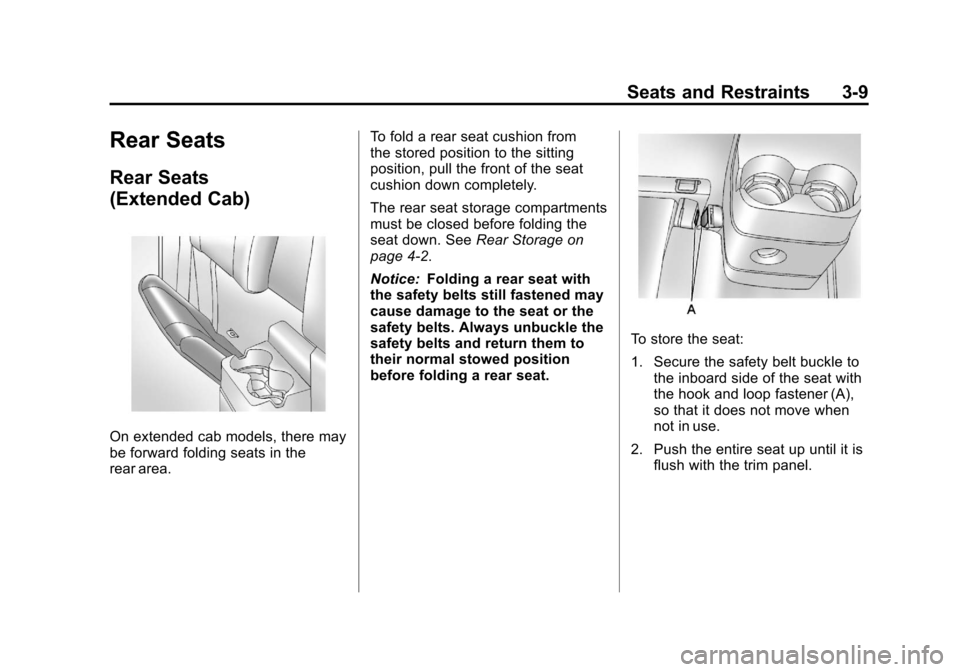
On extended cab models, there may
be forward folding seats in the
rear area.To fold a rear seat cushion from
the stored position to the sitting
position, pull the front of the seat
cushion down completely.
The rear seat storage compartments
must be closed before folding the
seat down. See
Rear Storage on
page 4‑2.
Notice: Folding a rear seat with
the safety belts still fastened may
cause damage to the seat or the
safety belts. Always unbuckle the
safety belts and return them to
their normal stowed position
before folding a rear seat.
To store the seat:
1. Secure the safety belt buckle to the inboard side of the seat with
the hook and loop fastener (A),
so that it does not move when
not in use.
2. Push the entire seat up until it is flush with the trim panel.
Page 55 of 392
Black plate (11,1)Chevrolet Colorado Owner Manual - 2011
Seats and Restraints 3-11
To return a seatback to the upright
position:
1. Lift the seatback up and push itrearward.
{WARNING
If either seatback is not locked, it
could move forward in a sudden
stop or crash. That could cause
injury to the person sitting there.
Always push and pull on the
seatbacks to be sure they are
locked.
2. Push and pull on the seatback to make sure it is locked in place.
{WARNING
A safety belt that is improperly
routed, not properly attached,
or twisted will not provide the
protection needed in a crash. The
person wearing the belt could be
seriously injured. After raising the
rear seatback, always check to be
sure that the safety belts are
properly routed and attached, and
are not twisted. 3. Reconnect the center safety belt
latch plate to the mini buckle.
Make sure the safety belt is not
twisted.
4. Push and pull on the latch plate to be sure it is secure.
When the seatback is not in use, it
should be kept in the upright, locked
position.
Page 64 of 392

Black plate (20,1)Chevrolet Colorado Owner Manual - 2011
3-20 Seats and Restraints
Pull up on the latch plate to
make sure it is secure. If the belt
is not long enough, seeSafety
Belt Extender on page 3‑24.
Position the release button on
the buckle so that the safety belt
could be quickly unbuckled if
necessary.
4. If equipped with a shoulder belt height adjuster, move it to the
height that is right for you. See
“Shoulder Belt Height Adjuster”
later in this section for
instructions on use and
important safety information.
5. To make the lap part tight, pullup on the shoulder belt.
It may be necessary to pull
stitching on the safety belt
through the latch plate to fully
tighten the lap belt on smaller
occupants.To unlatch the belt, push the button
on the buckle. The belt should
return to its stowed position. Slide
the latch plate up the safety belt
webbing when the safety belt is not
in use. The latch plate should rest
on the stitching on the safety belt,
near the guide loop on the side wall.
Before a door is closed, be sure the
belt is out of the way. If a door is
slammed against a safety belt,
damage can occur to both the belt
and the vehicle.
Page 68 of 392

Black plate (24,1)Chevrolet Colorado Owner Manual - 2011
3-24 Seats and Restraints
Lap Belt
This section is only for the lap belt.
To learn how to wear a lap-shoulder
belt, seeLap-Shoulder Belt on
page 3‑19.
The vehicle may have a center
seating position. When you sit in the
center front seating position, you
have a lap safety belt, which has no
retractor.
To make the belt longer, tilt the latch
plate and pull it along the belt. Buckle, position, and release it the
same way as the lap part of a
lap-shoulder belt.
To make the belt shorter, pull its free
end as shown until the belt is snug.
If the belt is not long enough, see
Safety Belt Extender on page 3‑24.
Make sure the release button on the
buckle is positioned so you would
be able to unbuckle the safety belt
quickly if necessary.
Safety Belt Extender
If the vehicle's safety belt will fasten
around you, you should use it.
But if a safety belt is not long
enough, your dealer will order you
an extender. When you go in to
order it, take the heaviest coat you
will wear, so the extender will be
long enough for you. To help avoid
personal injury, do not let someone
else use it, and use it only for the
seat it is made to fit. The extender
has been designed for adults. Never
use it for securing child seats. To
wear it, attach it to the regular safety
belt. For more information, see the
instruction sheet that comes with
the extender.
Safety System Check
Now and then, check that the safety
belt reminder light, safety belts,
buckles, latch plates, retractors, and
anchorages are working properly.
Look for any other loose or
damaged safety belt system parts
that might keep a safety belt system
Page 71 of 392

Black plate (27,1)Chevrolet Colorado Owner Manual - 2011
Seats and Restraints 3-27
WARNING (Continued)
close to the airbag, as you would
be if you were sitting on the edge
of your seat or leaning forward.
Safety belts help keep you in
position before and during a
crash. Always wear your safety
belt, even with airbags. The driver
should sit as far back as possible
while still maintaining control of
the vehicle.
Occupants should not lean on or
sleep against the door or side
windows in seating positions with
roof-rail airbags.
{WARNING
Children who are up against,
or very close to, any airbag when
it inflates can be seriously injured
or killed. Airbags plus(Continued)
WARNING (Continued)
lap-shoulder belts offer protection
for adults and older children, but
not for young children and infants.
Neither the vehicle's safety belt
system nor its airbag system is
designed for them. Young
children and infants need the
protection that a child restraint
system can provide. Always
secure children properly in your
vehicle. To read how, see Older
Children on page 3‑39 orInfants
and Young Children on
page 3‑41.
There is an airbag readiness light
on the instrument panel, which
shows the airbag symbol. The system checks the airbag
electrical system for malfunctions.
The light tells you if there is an
electrical problem. See
Airbag
Readiness Light on page 5‑10 for
more information.
Where Are the Airbags?
The driver's airbag is in the middle
of the steering wheel.