2011 CADILLAC SRX transmission
[x] Cancel search: transmissionPage 452 of 498

Black plate (4,1)Cadillac SRX Owner Manual - 2011
11-4 Service and Maintenance
.Restraint system component
check. SeeSafety System
Check on page 3‑29.
.Fuel system inspection for
damage or leaks.
.Exhaust system and nearby heat
shields inspection for loose or
damaged components.
Additional Required Services
Every 12 000 km/7,500 Miles
.Rotate tires. Tires should
be rotated every 12 000 km/
7,500 miles. See Tire Rotation
on page 10‑68. At Each Fuel Stop
.Engine oil level check.
See
Engine Oil on page 10‑10.
.Engine coolant level check.
SeeEngine Coolant on
page 10‑19.
.Windshield washer fluid level
check. See Washer Fluid on
page 10‑24.
Once a Month
.Tire inflation check. See Tire
Pressure on page 10‑61.
.Tire wear inspection. See Tire
Inspection on page 10‑68.
.Sunroof track and seal
inspection, if equipped.
See Sunroof on page 2‑28. Once a Year
.See
Starter Switch Check on
page 10‑29.
.See Automatic Transmission
Shift Lock Control Function
Check on page 10‑29.
.See Ignition Transmission Lock
Check on page 10‑30.
.See Park Brake and P (Park)
Mechanism Check on
page 10‑30.
.Accelerator pedal check for
damage, high effort, or binding.
Replace if needed.
.If the vehicle has a Tire Sealant
and Compressor Kit, check the
sealant expiration date printed
on the instruction label of the
kit. See Tire Sealant and
Compressor Kit on page 10‑79.
.Underbody flushing service.
Page 453 of 498
Black plate (5,1)Cadillac SRX Owner Manual - 2011
Service and Maintenance 11-5
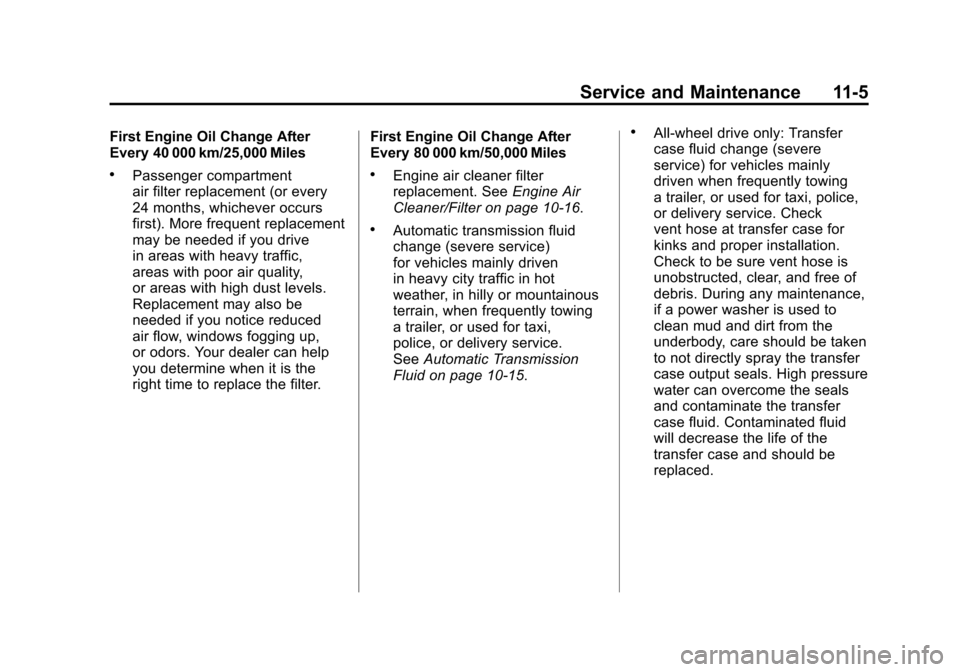
First Engine Oil Change After
Every 40 000 km/25,000 Miles
.Passenger compartment
air filter replacement (or every
24 months, whichever occurs
first). More frequent replacement
may be needed if you drive
in areas with heavy traffic,
areas with poor air quality,
or areas with high dust levels.
Replacement may also be
needed if you notice reduced
air flow, windows fogging up,
or odors. Your dealer can help
you determine when it is the
right time to replace the filter.First Engine Oil Change After
Every 80 000 km/50,000 Miles.Engine air cleaner filter
replacement. See
Engine Air
Cleaner/Filter on page 10‑16.
.Automatic transmission fluid
change (severe service)
for vehicles mainly driven
in heavy city traffic in hot
weather, in hilly or mountainous
terrain, when frequently towing
a trailer, or used for taxi,
police, or delivery service.
See Automatic Transmission
Fluid on page 10‑15.
.All‐wheel drive only: Transfer
case fluid change (severe
service) for vehicles mainly
driven when frequently towing
a trailer, or used for taxi, police,
or delivery service. Check
vent hose at transfer case for
kinks and proper installation.
Check to be sure vent hose is
unobstructed, clear, and free of
debris. During any maintenance,
if a power washer is used to
clean mud and dirt from the
underbody, care should be taken
to not directly spray the transfer
case output seals. High pressure
water can overcome the seals
and contaminate the transfer
case fluid. Contaminated fluid
will decrease the life of the
transfer case and should be
replaced.
Page 454 of 498

Black plate (6,1)Cadillac SRX Owner Manual - 2011
11-6 Service and Maintenance
.Evaporative control system
inspection. Check all fuel and
vapor lines and hoses for proper
hook‐up, routing, and condition.
Check that the purge valve,
if the vehicle has one, works
properly. Replace as needed.
An Emission Control Service.
The U.S. Environmental
Protection Agency or the
California Air Resources Board
has determined that the failure
to perform this maintenance
item will not nullify the emission
warranty or limit recall liability
prior to the completion of
the vehicle's useful life.
We, however, urge that all
recommended maintenance
services be performed at the
indicated intervals and the
maintenance be recorded.First Engine Oil Change After
Every 160 000 km/100,000 Miles
.Automatic transmission fluid
change (normal service).
See
Automatic Transmission
Fluid on page 10‑15.
.All‐wheel drive only: Transfer
case fluid change (normal
service). Check vent hose at
transfer case for kinks and
proper installation. Check to be
sure vent hose is unobstructed,
clear, and free of debris. During
any maintenance, if a power
washer is used to clean mud
and dirt from the underbody,
care should be taken to not
directly spray the transfer case
output seals. High pressure
water can overcome the seals
and contaminate the transfer
case fluid. Contaminated fluid
will decrease the life of the
transfer case and should be
replaced.
.Spark plug replacement and
spark plug wires inspection.
An Emission Control Service.
First Engine Oil Change After
Every 240 000 km/150,000 Miles
.Engine cooling system drain,
flush, and refill (or every
five years, whichever occurs
first). See Cooling System on
page 10‑18. An Emission
Control Service.
.Engine drive belts inspection
for fraying, excessive cracks,
or obvious damage (or every
10 years, whichever occurs
first). Replace, if needed.
Page 455 of 498

Black plate (7,1)Cadillac SRX Owner Manual - 2011
Service and Maintenance 11-7
Recommended Fluids, Lubricants, and Parts
Recommended Fluids and Lubricants
UsageFluid/Lubricant
Engine Oil The engine requires engine oil approved to the dexos™
specification. Oils
meeting this specification can be identified with the dexos™ certification
mark. Look for and use only an engine oil that displays the dexos™
certification mark of the proper viscosity grade. See Engine Oil on
page 10‑10.
Engine Coolant 50/50 mixture of clean, drinkable water and use only DEX-COOL Coolant.
See
Engine Coolant on page 10‑19.
Hydraulic Brake System DOT 3 Hydraulic Brake Fluid (GM Part No. 88863461,
in Canada 88863462).
Windshield Washer Optikleen
®Washer Solvent.
Hydraulic Power Steering System DEXRON
®-VI Automatic Transmission Fluid.
Automatic Transmission (3.0L V6 Engine) DEXRON
®-VI Automatic Transmission Fluid.
Page 456 of 498

Black plate (8,1)Cadillac SRX Owner Manual - 2011
11-8 Service and Maintenance
UsageFluid/Lubricant
Automatic Transmission (2.8L V6 Engine) AW‐1 Automatic Transmission Fluid (GM Part No. 19256039, in
Canada 19256040).
Chassis Lubrication Chassis Lubricant (GM Part No. 12377985, in Canada 88901242) or
lubricant meeting requirements of NLGI #2, Category LB or GC-LB.
Key Lock Cylinders Multi-Purpose Lubricant, Superlube (GM Part No. 12346241,
in Canada 10953474).
Hood Latch Assembly, Secondary Latch, Pivots, Spring Anchor, and Release Pawl Lubriplate Lubricant Aerosol (GM Part No. 12346293, in Canada 992723)
or lubricant meeting requirements of NLGI #2, Category LB or GC-LB.
Hood, Door, and Folding Seat Hinges Multi-Purpose Lubricant, Superlube (GM Part No. 12346241,
in Canada 10953474).
Power Liftgate Actuator Ball Joint Multi-Purpose Lubricant (GM Part No. 89021668, in Canada 89021674).
Weatherstrip Conditioning Weatherstrip Lubricant (GM Part No. 3634770, in Canada 10953518) or
Dielectric Silicone Grease (GM Part No. 12345579, in Canada 992887).
Page 463 of 498
Black plate (3,1)Cadillac SRX Owner Manual - 2011
Technical Data 12-3
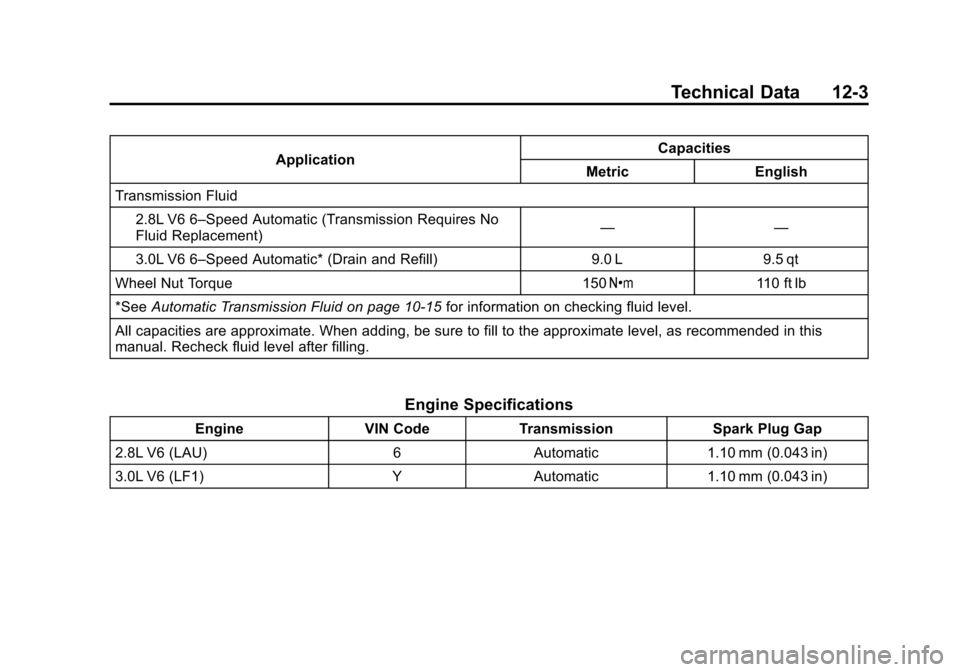
ApplicationCapacities
Metric English
Transmission Fluid
2.8L V6 6–Speed Automatic (Transmission Requires No
Fluid Replacement) — —
3.0L V6 6–Speed Automatic* (Drain and Refill) 9.0 L 9.5 qt
Wheel Nut Torque 150 Y110 ft lb
*See Automatic Transmission Fluid on page 10‑15 for information on checking fluid level.
All capacities are approximate. When adding, be sure to fill to the approximate level, as recommended in this
manual. Recheck fluid level after filling.
Engine Specifications
Engine VIN CodeTransmission Spark Plug Gap
2.8L V6 (LAU) 6Automatic 1.10 mm (0.043 in)
3.0L V6 (LF1) YAutomatic 1.10 mm (0.043 in)
Page 479 of 498

Black plate (15,1)Cadillac SRX Owner Manual - 2011
Customer Information 13-15
Managing the Vehicle Damage
Repair Process
In the event that your vehicle
requires damage repairs, GM
recommends that you take an
active role in its repair. If you
have a pre-determined repair
facility of choice, take your vehicle
there, or have it towed there.
Specify to the facility that any
required replacement collision parts
be original equipment parts, either
new Genuine GM parts or recycled
original GM parts. Remember,
recycled parts will not be covered
by your GM vehicle warranty.
Insurance pays the bill for the repair,
but you must live with the repair.
Depending on your policy limits,
your insurance company mayinitially value the repair using
aftermarket parts. Discuss this with
your repair professional, and insist
on Genuine GM parts. Remember,
if your vehicle is leased, you may
be obligated to have the vehicle
repaired with Genuine GM parts,
even if your insurance coverage
does not pay the full cost.
If another party's insurance
company is paying for the repairs,
you are not obligated to accept
a repair valuation based on that
insurance company's collision
policy repair limits, as you have no
contractual limits with that company.
In such cases, you can have control
of the repair and parts choices as
long as the cost stays within
reasonable limits.
Service Publications
Ordering Information
Service Manuals
Service Manuals have the diagnosis
and repair information on the
engines, transmission, axle,
suspension, brakes, electrical,
steering, body, etc.
Service Bulletins
Service Bulletins give additional
technical service information
needed to knowledgeably service
General Motors cars and trucks.
Each bulletin contains instructions
to assist in the diagnosis and
service of your vehicle.
Page 482 of 498

Black plate (18,1)Cadillac SRX Owner Manual - 2011
13-18 Customer Information
Vehicle Data
Recording and
Privacy
Your GM vehicle has a number of
sophisticated computers that record
information about the vehicle’s
performance and how it is driven.
For example, your vehicle uses
computer modules to monitor and
control engine and transmission
performance, to monitor the
conditions for airbag deployment
and deploy airbags in a crash, and,
if so equipped, to provide antilock
braking to help the driver control the
vehicle. These modules may store
data to help your dealer technician
service your vehicle. Some modules
may also store data about how you
operate the vehicle, such as rate of
fuel consumption or average speed.
These modules may also retain the
owner’s personal preferences, such
as radio pre-sets, seat positions,
and temperature settings.
Event Data Recorders
This vehicle has an Event Data
Recorder (EDR). The main purpose
of an EDR is to record, in certain
crash or near crash-like situations,
such as an airbag deployment or
hitting a road obstacle, data that
will assist in understanding how
a vehicle's systems performed.
The EDR is designed to record data
related to vehicle dynamics and
safety systems for a short period of
time, typically 30 seconds or less.
The EDR in this vehicle is designed
to record such data as:
.How various systems in your
vehicle were operating
.Whether or not the driver and
passenger safety belts were
buckled/fastened
.How far, if at all, the driver was
pressing the accelerator and/or
brake pedal
.How fast the vehicle was
traveling This data can help provide a better
understanding of the circumstances
in which crashes and injuries occur.
Important:
EDR data is recorded
by your vehicle only if a non-trivial
crash situation occurs; no data is
recorded by the EDR under normal
driving conditions and no personal
data (e.g., name, gender, age,
and crash location) is recorded.
However, other parties, such as
law enforcement, could combine
the EDR data with the type of
personally identifying data
routinely acquired during a
crash investigation.
To read data recorded by an EDR,
special equipment is required, and
access to the vehicle or the EDR is
needed. In addition to the vehicle
manufacturer, other parties, such
as law enforcement, that have the
special equipment, can read the
information if they have access to
the vehicle or the EDR.