2011 CADILLAC ESCALADE ESV service
[x] Cancel search: servicePage 466 of 548

Black plate (64,1)Cadillac Escalade/Escalade ESV Owner Manual - 2011
10-64 Vehicle Care Treadwear
The treadwear grade is a
comparative rating based on the
wear rate of the tire when tested
under controlled conditions on
a specified government test
course. For example, a tire
graded 150 would wear one and
a half (1½) times as well on the
government course as a tire
graded 100. The relative
performance of tires depends
upon the actual conditions of
their use, however, and may
depart significantly from the
norm due to variations in
driving habits, service practices
and differences in road
characteristics and climate. Traction – AA, A, B, C
The traction grades, from
highest to lowest, are AA, A, B,
and C. Those grades represent
the tire's ability to stop on wet
pavement as measured under
controlled conditions on
specified government test
surfaces of asphalt and
concrete. A tire marked C may
have poor traction performance.
Warning: The traction grade
assigned to this tire is based on
straight-ahead braking traction
tests, and does not include
acceleration, cornering,
hydroplaning, or peak traction
characteristics.
Temperature – A, B, C
The temperature grades
are A (the highest), B, and C,
representing the tire's resistance
to the generation of heat and
its ability to dissipate heat
when tested under controlled conditions on a specified indoor
laboratory test wheel. Sustained
high temperature can cause
the material of the tire to
degenerate and reduce tire life,
and excessive temperature
can lead to sudden tire failure.
The grade C corresponds to a
level of performance which all
passenger car tires must meet
under the Federal Motor Safety
Standard No. 109. Grades B
and A represent higher levels of
performance on the laboratory
test wheel than the minimum
required by law. Warning: The
temperature grade for this tire
is established for a tire that is
properly inflated and not
overloaded. Excessive speed,
underinflation, or excessive
loading, either separately or in
combination, can cause heat
buildup and possible tire failure.
Page 468 of 548

Black plate (66,1)Cadillac Escalade/Escalade ESV Owner Manual - 2011
10-66 Vehicle Care
Tire Chains
{ WARNINGDo not use tire chains. There is
not enough clearance. Tire chains
used on a vehicle without the
proper amount of clearance can
cause damage to the brakes,
suspension, or other vehicle
parts. The area damaged by the
tire chains could cause you to
lose control of the vehicle and
you or others may be injured
in a crash. Use another type
of traction device only if its
manufacturer recommends it for
use on the vehicle and tire size
combination and road conditions.
Follow that manufacturer's
instructions. To help avoid
damage to the vehicle, drive
slowly, re ‐ adjust or remove the
device if it is contacting the
vehicle, and do not spin the
(Continued) WARNING (Continued) wheels. If you do find traction
devices that will fit, install them on
the rear tires.
If a Tire Goes Flat It is unusual for a tire to blowout
while you are driving, especially if
you maintain your vehicle's tires
properly. If air goes out of a tire,
it is much more likely to leak out
slowly. But if you should ever have
a blowout, here are a few tips about
what to expect and what to do:
If a front tire fails, the flat tire
creates a drag that pulls the vehicle
toward that side. Take your foot off
the accelerator pedal and grip the
steering wheel firmly. Steer to
maintain lane position, and then
gently brake to a stop, well off the
road, if possible. A rear blowout, particularly on a
curve, acts much like a skid and
may require the same correction
you would use in a skid. In any rear
blowout remove your foot from the
accelerator pedal. Get the vehicle
under control by steering the way
you want the vehicle to go. It may
be very bumpy and noisy, but you
can still steer. Gently brake to a
stop, well off the road, if possible.
{ WARNINGDriving on a flat tire will cause
permanent damage to the tire.
Re-inflating a tire after it has
been driven on while severely
underinflated or flat may cause
a blowout and a serious crash.
Never attempt to re-inflate a tire
that has been driven on while
severely underinflated or flat.
Have your dealer or an authorized
tire service center repair or
replace the flat tire as soon as
possible.
Page 488 of 548
Black plate (86,1)Cadillac Escalade/Escalade ESV Owner Manual - 2011
10-86 Vehicle Care 11. Try to start the vehicle that
had the dead battery. If it will
not start after a few tries, it
probably needs service.
Notice: If the jumper cables are
connected or removed in the
wrong order, electrical shorting
may occur and damage the
vehicle. The repairs would not be
covered by the vehicle warranty.
Always connect and remove the
jumper cables in the correct
order, making sure that the
cables do not touch each other
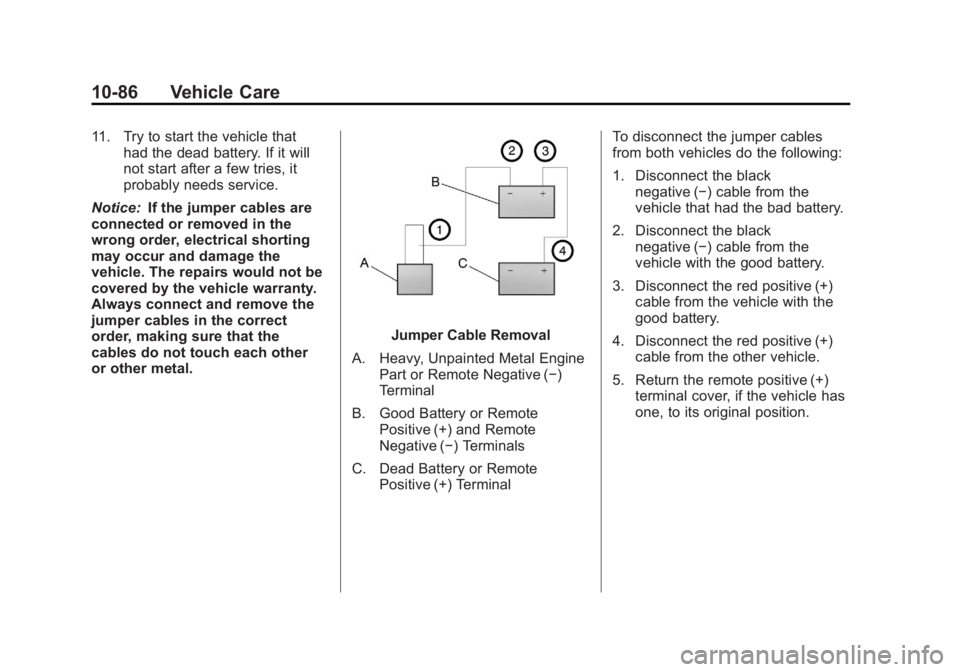
or other metal. Jumper Cable Removal
A. Heavy, Unpainted Metal Engine
Part or Remote Negative ( − )
Terminal
B. Good Battery or Remote
Positive (+) and Remote
Negative ( − ) Terminals
C. Dead Battery or Remote
Positive (+) Terminal To disconnect the jumper cables
from both vehicles do the following:
1. Disconnect the black
negative ( − ) cable from the
vehicle that had the bad battery.
2. Disconnect the black
negative ( − ) cable from the
vehicle with the good battery.
3. Disconnect the red positive (+)
cable from the vehicle with the
good battery.
4. Disconnect the red positive (+)
cable from the other vehicle.
5. Return the remote positive (+)
terminal cover, if the vehicle has
one, to its original position.
Page 489 of 548

Black plate (87,1)Cadillac Escalade/Escalade ESV Owner Manual - 2011
Vehicle Care 10-87
Towing Towing the Vehicle Notice: To avoid damage, the
disabled vehicle should be
towed with all four wheels off
the ground. Care must be taken
with vehicles that have low
ground clearance and/or special
equipment. Always flatbed on a
car carrier.
Consult your dealer or a
professional towing service if the
disabled vehicle must be towed.
See Roadside Service (U.S. and
Canada) on page 13 ‑ 7 or Roadside
Service (Mexico) on page 13 ‑ 10 .
To tow the vehicle behind another
vehicle for recreational purposes,
such as behind a motor home, see
“ Recreational Vehicle Towing ” in this
section. Recreational Vehicle
Towing If the vehicle is a hybrid, see
the hybrid supplement for more
information.
Recreational vehicle towing
means towing the vehicle behind
another vehicle – such as behind a
motorhome. The two most common
types of recreational vehicle towing
are known as “ dinghy towing ”
(towing the vehicle with all four
wheels on the ground) and “ dolly
towing ” (towing the vehicle with
two wheels on the ground and
two wheels up on a device known
as a “ dolly ” ). Here are some important things to
consider before recreational vehicle
towing: .
What is the towing capacity
of the towing vehicle? Be
sure to read the tow
vehicle manufacturer's
recommendations. .
What is the distance that will be
travelled? Some vehicles have
restrictions on how far and how
long they can tow. .
Is the proper towing equipment
going to be used? See your
dealer or trailering professional
for additional advice and
equipment recommendations. .
Is the vehicle ready to be
towed? Just as preparing the
vehicle for a long trip, make sure
the vehicle is prepared to be
towed.
Page 501 of 548

Black plate (1,1)Cadillac Escalade/Escalade ESV Owner Manual - 2011
Service and Maintenance 11-1
Service and
Maintenance General Information General Information . . . . . . . . . . 11-1
Scheduled Maintenance Scheduled Maintenance . . . . . 11-2
Recommended Fluids,
Lubricants, and Parts Recommended Fluids and
Lubricants . . . . . . . . . . . . . . . . . . 11-7
Maintenance Replacement
Parts . . . . . . . . . . . . . . . . . . . . . . . 11-9
Maintenance Records Maintenance Records . . . . . . 11-10 General Information Notice: Maintenance
intervals, checks, inspections,
recommended fluids, and
lubricants are necessary to
keep this vehicle in good working
condition. Damage caused by
failure to follow scheduled
maintenance might not be
covered by the vehicle warranty.
As the vehicle owner, you are
responsible for the scheduled
maintenance in this section. We
recommend having your dealer
perform these services. Proper
vehicle maintenance helps to
keep the vehicle in good working
condition, improves fuel economy,
and reduces vehicle emissions for
better air quality. Because of all the different ways
people use vehicles, maintenance
needs vary. The vehicle might need
more frequent checks and services.
Please read the information under
Scheduled Maintenance. To keep
the vehicle in good condition, see
your dealer.
The maintenance schedule is for
vehicles that: .
Carry passengers and cargo
within recommended limits on
the Tire and Loading Information
label. See Vehicle Load Limits
on page 9 ‑ 24 . .
Are driven on reasonable road
surfaces within legal driving
limits. .
Are driven off-road in the
recommended manner. See
Off-Road Driving on page 9 ‑ 7 . .
Use the recommended fuel. See
Recommended Fuel on
page 9 ‑ 64 .
Page 502 of 548

Black plate (2,1)Cadillac Escalade/Escalade ESV Owner Manual - 2011
11-2 Service and Maintenance
{ WARNINGPerforming maintenance work can
be dangerous. Some jobs can
cause serious injury. Perform
maintenance work only if you
have the required know-how and
the proper tools and equipment.
If in doubt, see your dealer to
have a qualified technician do the
work. See Doing Your Own
Service Work on page 10 ‑ 4 .
At your dealer, you can be
certain that you will receive the
highest level of service available.
Your dealer has specially trained
service technicians, uses genuine
replacement parts, as well as,
up ‐ to ‐ date tools and equipment
to ensure fast and accurate
diagnostics. The proper replacement parts,
fluids, and lubricants to use are
listed in Recommended Fluids and
Lubricants on page 11 ‑ 7 and
Maintenance Replacement Parts on
page 11 ‑ 9 . We recommend the use
of genuine parts from your dealer.
Rotation of New Tires
To maintain ride, handling, and
performance of the vehicle, it is
important that the first rotation
service for new tires be performed.
Tires should be rotated every
12 000 km/7,500 miles. See Tire
Rotation on page 10 ‑ 59 .Scheduled
Maintenance When the Change Engine Oil
Soon Message Displays Change engine oil and filter. See
Engine Oil on page 10 ‑ 7 . An
Emission Control Service.
When the CHANGE ENGINE OIL
SOON message displays, service is
required for the vehicle as soon as
possible, within the next 1 000 km/
600 miles. If driving under the best
conditions, the engine oil life system
might not indicate the need for
vehicle service for more than a year.
The engine oil and filter must be
changed at least once a year and
the oil life system must be reset.
Your dealer has trained service
technicians who will perform this
work and reset the system.
Page 503 of 548
Black plate (3,1)Cadillac Escalade/Escalade ESV Owner Manual - 2011
Service and Maintenance 11-3If the engine oil life system is reset
accidentally, service the vehicle
within 5 000 km/3,000 miles since
the last service. Reset the oil life
system whenever the oil is changed.
See Engine Oil Life System on
page 10 ‑ 10 .
When the Change Engine Oil Soon
message displays, certain services,
checks, and inspections are
required.
Every Engine Oil Change .
Change engine oil and filter.
See Engine Oil on page 10 ‑ 7 .
An Emission Control Service. .
Engine coolant level check. See
Engine Coolant on page 10 ‑ 16 . .
Engine cooling system
inspection. Visual inspection
of hoses, pipes, fittings, and
clamps and replacement,
if needed. .
Windshield washer fluid level
check. See Washer Fluid on
page 10 ‑ 24 . .
Windshield wiper blade
inspection for wear, cracking,
or contamination and windshield
and wiper blade cleaning,
if contaminated. See Exterior
Care on page 10 ‑ 90 . Worn or
damaged wiper blade
replacement. See Wiper Blade
Replacement on page 10 ‑ 32 ..
Tire inflation pressures check.
See Tire Pressure on
page 10 ‑ 52 . .
Tire wear inspection. See Tire
Inspection on page 10 ‑ 58 . .
Rotate tires if necessary. See
Tire Rotation on page 10 ‑ 59 . .
Fluids visual leak check (or
every 12 months, whichever
occurs first). A leak in any
system must be repaired and
the fluid level checked. .
Engine air cleaner filter
inspection. See Engine Air
Cleaner/Filter on page 10 ‑ 14 . .
Brake system inspection (or
every 12 months, whichever
occurs first). .
Lubricate the front suspension,
steering linkage, and parking
brake cable guides. Control arm
ball joints are maintenance ‐ free.
Page 504 of 548

Black plate (4,1)Cadillac Escalade/Escalade ESV Owner Manual - 2011
11-4 Service and Maintenance .
Steering and suspension
inspection. Visual inspection
for damaged, loose, or missing
parts or signs of wear. .
Body hinges and latches, key
lock cylinders, rear compartment
hinges, outer tailgate handle
pivot points, and folding seat
hardware lubrication. See
Recommended Fluids and
Lubricants on page 11 ‑ 7 . More
frequent lubrication may be
required when the vehicle is
exposed to a corrosive
environment. Applying silicone
grease on weatherstrips with a
clean cloth makes them last
longer, seal better, and not
stick or squeak. .
Restraint system component
check. See Safety System
Check on page 3 ‑ 34 . .
Fuel system inspection for
damage or leaks. .
Exhaust system and nearby heat
shields inspection for loose or
damaged components.
Additional Required Services Every 12 000 km/7,500 Miles .
Rotate tires. Tires should be
rotated every 12 000 km/
7,500 miles. See Tire Rotation
on page 10 ‑ 59 . At Each Fuel Stop .
Engine oil level check. See
Engine Oil on page 10 ‑ 7 . .
Engine coolant level check. See
Engine Coolant on page 10 ‑ 16 . .
Windshield washer fluid level
check. See Washer Fluid on
page 10 ‑ 24 .
Once a Month .
Tire inflation pressures check.
See Tire Pressure on
page 10 ‑ 52 . .
Tire wear inspection. See Tire
Inspection on page 10 ‑ 58 . .
Sunroof track and seal
inspection, if equipped. See
Sunroof on page 2 ‑ 22 .