2011 AUDI S8 brake
[x] Cancel search: brakePage 248 of 302

246 Tires and wheels
valve stem caps on all wheels are secure ly
mounted on the valve .
@ For the sake of the environment
Underinflated tires will also increase the
fue l consumption.
Tires and vehicle load limits
There are limits to the amount of load or
weight that any vehicle and any tire can carry.
A vehicle that is overloaded will not handle
well and is more difficult to stop. Overloading
can not only lead to loss of vehicle control, but can also damage important parts of the
vehicle and can lead to sudden tire failure, in
cluding a blowout and sudden deflation that
can cause the vehicle to crash.
Your safety and that of your passengers also
depends on making sure that load limits are
not exceeded. Vehicle load includes everybody
and everyth ing in and on the vehicle. These
l oad limits are techn ica lly referred to as the
vehicle's
Gross Vehicle Weight Rating
("GVWR").
The "GVWR" includes the we ight of the basic
vehicle, all factory installed accessories, a full
tank of fuel , oil, coo lant and other fluids plus
maximum load. The maximum load includes
the number of passengers that the vehicle is
intended to carry ("seating capacity") with an
assumed weight of 150 lbs (68 kg) for each
passenger at a des ignated seat ing pos ition
and the tota l we ight of any luggage in the ve
hicle. If you tow a trailer, the weight of the
trailer hitch and the tongue weight of the
l oaded trailer must be included as part of the
vehicle load.
The
Gross Axle Weight Rating ("GAWR") is
the maximum load that can be applied at each
of the vehicle's two axles.
The G ross Vehicle Weight Rating and the
Gross Axle Weight Rating are listed on the
safety compliance sticker labe l located on the
driver's side B-p illar. You r A udi has 5 seat ing
positions, 2 in the front and 3 in the rear for
total seating capacity of 5. Vehicles with pow- er individual rear seats* have
4 seating posi
tions,
2 in the front and 2 in the rear for total
seat ing capac ity of
4. Each seating position
has a safety belt¢
page 137, Safety belts.
The fact that there is an upper limit to your
vehicle's Gross Vehicle Weight Rating means
that the total weight of whatever is being car
ried in the vehicle (including the weight of a
trailer hitch and the tongue weight of the
loaded trailer) is lim ited . The more passen
gers in the vehicle or passengers who are
heavier than the standard we ights assumed
mean that less we ight can be carried as lug
gage.
The tire pressure label on your Audi also lists
the max imum combined weight of a ll of the
occupants and luggage or other cargo that
the vehicle can carry. For the location of the
label¢
page 242, fig. 184.
A WARNING ,___
Overloading a vehicle can cause loss of ve
h icl e contro l, a crash or other accident, se
rious personal injury, and even death.
- Carrying more weight than your vehicle
was designed to carry will prevent the
vehicle from handling properly and in
crease the risk of the loss of vehicle con
trol.
- The brakes on a vehicle that has been
overloaded may not be able to stop the
veh icle with in a safe distance.
- Tires on a vehicle that has been overload
ed can fail suddenly, including a blowout
and sudden deflation, causing loss of
control and a crash.
- Always make sure that the total load be
ing transported -including the weight of
a trailer hitch and the tongue we ight of a
loaded trailer -does not make the vehi
cle heavier than the vehicle's G ross Vehi
cle Weight Rating.
Page 251 of 302

A WARNING
Sudden tire failure can lead to loss of con
trol, a crash and serious personal injury!
- Never drive a vehicle when the tread on
any tire is worn down to the wear indica
tors.
- Worn tires are a safety hazard, they do
not grip well on wet roads and increase
your risk of "hydroplaning" and loss of
control.
- Always keep chemicals that can cause
tire damage, such as grease, oil, gasoline
and brake fluid away from t ires.
- Tires age even if they are not be ing used
and can fail suddenly, especially at high
speeds . Tir es that are more than 6 years
old can only be used in an emergency
and then with special care and at lower
speeds.
- Never mount used tires on your vehicle if
you are not sure of their" previous histo
ry ." Old used tires may have been dam
aged even though the damage cannot be
seen that can lead to sudden tire failure
and loss of vehicle control.
Tires and wheels 249
New tires and replacing tires and wheels
New tires and wheels have to be broken in .
Fig. 188 Tir e specificat ion codes on t he s idewall o f a
tire
No. Description
CD Passenger car tire (where applicable)
@ Nominal w idth of tire in millimeters
® Ratio of height to width (aspect ratio)
© Radial
® Rim diameter code
® Load index and speed rating
(f) U.S. DOT tire identification number
® Audi Origina l tire
® Sever snow conditions
@ T ire ply composition and materials
used
@ Maximum load rating
@ Treadwear, traction and temperature
grades
@ Maximum permissible inflation pres-
sure
The tires and rims are essential parts of the
vehicle's design . The tires and rims approved
by Audi are spec ially matched to the charac
teristics of the vehicle and can make a major .,.
•
Page 254 of 302
252 Tir es and whe els
Driving with different tires reduces vehi
cle handling and can lead to a loss of
control.
- If the spare tire is not the same as the
tires that are mounted on the veh icle -
for example with winter tires - only use
the spare tire for a short period of time
and dr ive with extra care . Refit the nor
ma l road wheel as soon as safely possi
ble.
- Never drive faster than the maximum
speed for which the tires on your veh icle
are rated because ti res that a re driven
faster than their rated speed can fail
sudden ly .
- Overloading t ires cause heat build- up,
sudden tire failure, including a blowout
and sudden deflation and loss of control.
- T emperature grades app ly to tires that
are properly inflated and not over o r un
derinflated .
- For technical reasons it is not a lways
possible to use wheels from other vehi
cles -in some cases not even whee ls
from the same vehicle model.
- If you install wheel trim discs on the ve
hicle whee ls, make sure that the air f low
to the brakes is not blocked. Reduced air
flow to the brakes can them to overheat, increasing stopping distances and caus
ing a collision .
- Run flat t ires may only be used on vehi
cles that were equipped with them at the
factory . The vehicle must have a chassis
designed for run flat tires . Incorrect use
of run flat tires can lead to vehicle dam
age or acc idents. Check with an a uthor
ized Audi dea le r or tire specialist to see if
yo ur vehicle can be equipped with run
flat tires. If run f lat tires are used, they
must be insta lled on all four wheels. Mix
ing t ire types is not permitted .
- Fo r technical reasons , it is not genera lly
possib le to use the whee l rims from oth
er vehicles. This can ho ld true for wheels
of the same veh icle type. - If the spare tire is different from the
tires that yo u have mounted on your ve
hicle (for example winter tires or wide
profile tires), then use the spare tire for a
short period of time only and drive w ith
extra care. Replace the flat tire w ith the
tire matching the others on your vehicle
as soon as possib le .
- Never drive without the valve stern cap .
The valves cou ld get damaged .
@) For the sake of the environment
Dispose of o ld tires in accordance with the
local requirements .
Uniform tire quality grading
-Tread wear
- Traction AA AB C
- Tempe ra tu re ABC
Quality grades can be found whe re applicab le
on the tire sid e wall betw een tr ead shou ld er
a nd maximum section width
c> page 249,
fig. 188 .
For ex ample: Tread wear 200 , Tract ion AA ,
Temperatur e A.
All passenger car t ires must conform to Feder
al Safety Requirements in add ition to these
grades.
Tread wear
T he tread wear grade is a comparative rating
based on the wear rate of the t ire when tes ted
u nder contro lled cond itions on a specified
government test course .
For example, a tire graded 150 would wear
one and one ha lf (11/2) times as well on the
government course as a tire graded 100.
T he relative performance of tires depends
upon the actual conditions of thei r use, how
ever, and may depa rt s ignificantly from the
norm due to va riations in driving hab its, se rv
ice practices and differences in road character -
istics and cl imat e. ..,.
Page 257 of 302

chains because t he vehicle will be ex
tremely low. If you do drive with snow
chains on while the vehicle is at this lev
el, the snow chains might severe ly dam
age the wheelhouse and other parts of
the veh icle.
@ Tips
Where snow cha ins are mandatory oncer
tain roads, this normally also applies to ve
hicles with All Wheel Drive.
Wheel bolts
Wheel bolts must always be tightened to the
correct torque .
The design of whee l bolts is matched to the
factory installed r ims. If different rims are fit
ted, the correct wheel bolts with the right length and correctly shaped bolt heads must
be used . This ensures that wheels are fitted
secure ly and that the brake system f unctions
correctly .
In certain circumstances, you may not use
wheel bolts from a d iffe rent vehicle -even if it
i s the same mode l
¢page 285.
A WARNING
Imprope rly tig hte ned or maintained whee l
bolts can be come loose causing loss of
contro l, a co llision and serious persona l in
jury .
- Alw ays keep the w heel bolts and the
th reads in the wheel hubs clea n so the
wheel bolts can turn easily and be prop
er ly tightened .
- Never grease or oil the wheel bo lts and
the threads in the w heel h ubs. They can
become loose wh ile driving if greased or
o iled, even if tightened to the specif ied
torque.
- Only use wheel bolts that belong to the
rim being installed.
- Never use different whee ls bolts on your
vehicle.
- Always maintai n the co rrect tightening
torq ue for the wheel bo lts to reduce the
Tire s an d wheel s 255
risk of a wheel loss. If the tightening tor
que of t he wheel bolts is too low, they
can loosen and come out when the vehi
cle is mov ing. If the tighte ning torque is
too h igh, the wheel bol ts and threads
can be damaged and the whee l can be
come loose.
(I) Note
The specified torque for the whee l bolts is
90 ft lb ( 120 Nm) wi th a tole rance of± 7,4
ft lb(± 10 Nm). Torq ue whee l bolts diago
nally. Afte r cha nging a whee l, the torq ue
must be checked as soon as possible wi th a
torque w rench -prefe rably by an au thor
ized Audi dealer or qualif ied workshop .
Low aspect ratio tires
Your Audi is facto ry-eq uipped with low aspect
ratio tires. These tires have been thoro ughly
tested and been se lected specifically for your
model for their superb performance, road fee l
and handling u nder a variety of driving cond i
tions . Ask your authorized Audi dealer for
more details.
The low aspect ratio of these t ires is ind icated
by a numeral of
55 or less in the tire's size
designation . The numeral rep resents the ratio
of the t ire's sidewall height in relation to its
t read width ex pressed in pe rce ntage. Conven
tiona l tires have a he igh t/w idth ratio of 60 or
more.
The performance of low-aspe ct-ratio tire s is
particularly sensitiv e to improper infla tion
pres sure. It is therefore important that low
a spect ratio tires are inflated to the specified
pre ssure and that the inflation pressure i s
regularly checked and maintained. Tire pre s·
sures should be checked at least once a
month and always befo re a long trip
¢ page 244, Checking tire pressure.
What you can d o to avoid tire and rim
damage
Low aspect ratio tires can be damaged more
easily by impact w it h potholes , curbs, gul lies ..,.
•
•
Page 264 of 302

262 What do I do now ?
-Loose items in the passenger compar t
ment can cause serious personal inj ury
during hard braking or in an acc ident.
- Never store the inflatable spa re tire or
jack and tools in the passenger com
partment .
- Always s to re a ll jack ing equipmen t,
too ls, and the inflatab le spa re tire in
the l uggage compa rtment .
- Tighten the kn ur led retaining screw for
the inflatable spare tire sec urely.
Spare wheel
Applies to vehicles: with spare wheel
The spare wheel is stored in the wheel well
underneath the floor panel in the luggage
compartment.
Fi g. 1 96 Lu ggage co mp artm ent: spare whee l
Taking out the spa re wh eel
.. Lift the cargo floor by the plastic handle
¢ fig. 196 .
.. Hook the hand le into the luggage compart
men t wea ther s trip.
.. Tu rn the l arge screw
¢ fig. 196 coun ter
clockwise .
.. Take out the spare tire .
.,. Unhook the ca rgo floor before clos ing the
rear lid .
Securing the replaced tire
.. Place the wheel with tire in the sp are wheel
well and secure the wheel with the large
sc rew .
.,. Unhoo k the ca rgo f loor before clos ing the
r ear lid.
A WARNING
-Loose items in the passenger compart-
ment can cause serious persona l injury
d uring hard b rak ing o r in an accident .
- Never store the spa re wheel or jack and
too ls in the passenger compartment .
- Always store all jack ing equipment,
tools, and the spare wheel in the luggage
compa rtment .
- Tighten the knurled retaining screw for
the spare wheel securely .
@ Tips
Check the inflation pressure of the spare
tire periodically to keep the t ire ready for
use.
Changing a wheel
Before changing a wheel
Observe the following precautions for your
own and your passenger's safety when chang
ing a wheel.
.,. After you experience a t ire failur e, pull the
car we ll away from mov ing traffic and try to
re ach
level ground before you stop ¢ .&,.
.. All passengers should lea ve th e car and
move to a safe location (for instance, b ehind
the guardrail) ¢
_A .
.. Engage the pa rking brake to prevent your
ve hicle from rolling uninten tionally ¢
_A .
.. Move selecto r le ver to pos ition P ¢ _A .
.,. If you are towing a tra iler, unhitch the trailer
from your ve hicle .
.,. Ta ke the
jack a nd the spare tire out of the
luggage compartmen t¢
page 260,
¢ page 261.
A WARNING
You o r your passengers could be i nju red
while changing a wheel if you do not fo l
l ow these sa fety precaut ions:
- If you have a flat tire, move a safe dis
tance off the road. Turn off the engine,
turn the eme rgency flashers on and use
-
Page 265 of 302

other warning devices to alert other mo
torists.
- Make sure that passengers wait in a safe
place away from the vehicle and well
away from the road and traffic.
- To help prevent the vehicle from moving
suddenly and possibly slipping off the
jack, always fully set the parking brake
and block the wheel diagonally opposite
the wheel being changed. When one
front wheel is lifted off the ground, plac
ing the Automatic Transmission in "P"
(Park) will
not prevent the vehicle from
moving.
- Before you change a wheel, be sure the
ground is level and firm. If necessary,
use a sturdy board under the jack.
- After installing the spare wheel, make
sure that you replace the flat tire/wheel
in its storage area properly and tighten
the knurled retaining screw securely.
@ Tips
Before changing the wheel, you must acti·
vate the jacking mode, so that the auto
matic controls for the Adaptive Air Sus
pension do not make it more difficult to
lift the vehicle with the jack ¢
page 265.
Changing a wheel
When you change a wheel, follow these
quence described below step-by-step and in
exactly that order.
1. Activate the vehicle jack mode
¢ page 265.
2. Remove the decorative wheel cover*. For
more details see also¢
page 264, Deco
rative wheel covers
or ¢ page 264,
Wheels with wheel bolt caps.
3 . Loosen the wheel bolts¢ page 264 .
4. Locate the proper mounting point for the
jack and align the jack below that point
¢page 265.
5. Raise the car with the jack¢ page 265.
6. Remove the wheel with the flat tire and
then install
the spare ¢ page 266.
What do I do now? 263
7. Tighten all wheel bolts lightly.
8.
Lower the vehicle with the jack.
9. Use the wheel bolt wrench and
firmly
tighten all wheel bolts¢ page 264.
10. Replace the decorative wheel cover*.
11. Deactivate the vehicle jack mode in the
MMI:
ICARI function button > Car systems
control button > Servicing & checks> Air
susp.: jack mode> Off .
The vehicle jack mode switches off automati
cally at speeds above 10 km/h .
A WARNING
Always read and follow all WARNINGS and
information¢ .&
in Raising the vehicle on
page 265
and ¢ page 267.
After changing a wheel
A wheel change is not complete without the
doing the following.
.. Store and secure the wheel you replaced in
the spare wheel well.
.. Replace the tools and the jack in their prop
er location.
.. Check the
tire pressure on the spare wheel
immediately after mounting it.
.. As soon as possible, have the
tightening
torques
on all wheel bolts checked with a
torque wrench. The correct tightening tor
que is 90
ft lb (120 Nm).
.. Have the flat tire
replaced as soon as possi
ble .
(D Tips
-If you notice that the wheel bolts a re
corroded and difficult to turn while
changing a tire, they should be replaced
before you check the tightening torque.
- Drive at reduced speed until you have the
tightening torques checked.
•
•
Page 267 of 302
@ Tips
-Never use the hexagonal socket in the
handle of the screwdriver to loosen or
tighten the wheel bolts.
- If a whee l bolt is very tight, you may find
it easier to loosen by carefully pushing
down on the end of the wheel bolt
wrench w ith
one foot only. As you do so,
hold on to the car to keep your ba lance
and take ca re not to slip.
Raising the vehicle
The vehicle must be li~ed with the jack first
before the wheel can be removed .
-itr·--
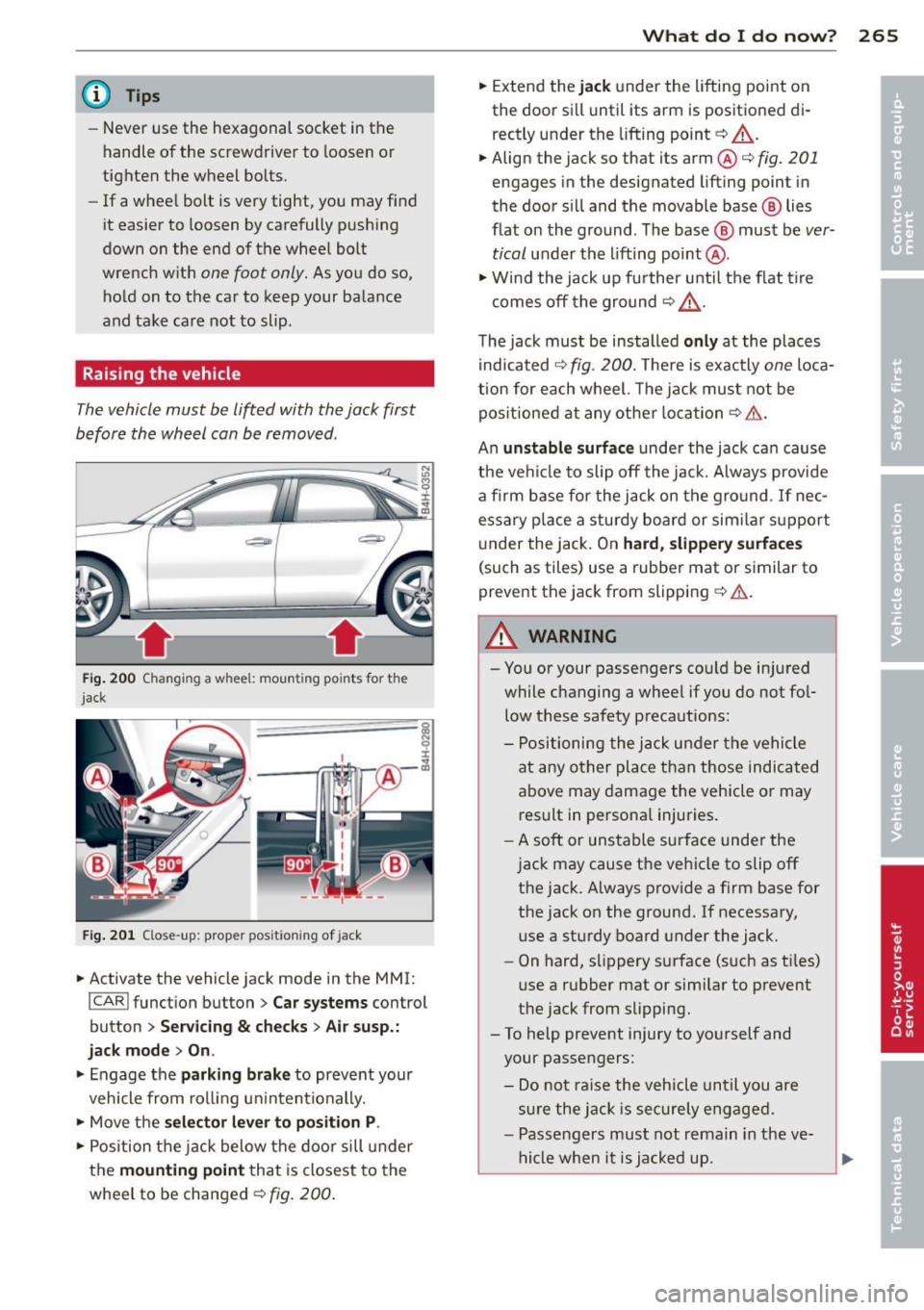
Fi g. 200 Changing a whee l: mou nting po ints fo r the
jack
F ig . 20 1 Close -up: proper positioning of jack
.. Activate the vehicle jack mode in the MMI:
I CAR I function button> Car systems control
button
> Servicing & ch ecks > Ai r susp.:
jack mod e> On.
.. Engage the parking brake to prevent your
vehicle from rol ling un intentionally.
.. Move the
se lector le ver to pos ition P.
.. Position the j ack below the door sill under
the
mounting point that is closest to the
whee l to be changed ¢
fig. 200 .
What do I d o now ? 265
.. Extend the jack under the lifting point on
the door sill until its arm is positio ned di
rectly under the lifting point ¢
A.
.. Align the jack so that its arm@¢ fig. 201
engages in the designated lifting point in
the doo r si ll and the movable base @ lies
flat o n the ground. The base @ must be
ver
tical
under th e lifting point @.
.. Wi nd the jack up fu rther until the flat t ire
comes off the gro und
¢ A_ .
The jack must be installed only at the places
i ndicated
¢ fig . 200. The re is exactly one loca
tion for each wheel. The j ack mus t not be
pos it ioned at any other location
¢ & .
An unstable surface under the jack ca n cause
the vehicle to slip off the jack. Always provide
a firm base for the jack on t he g ro und . If nec
essary p lace a sturdy board or sim ilar support
u nder the jack . On
hard, slipper y surface s
(such as tiles) use a rubbe r mat or similar to
prevent the jack from slipping
¢ & .
A WARNING
- You or your passengers co uld be in jured
while c hanging a wheel if you do not fo l
low these safety precautions:
- Positioning the j ack under the vehicle
at any o ther place than those indicated
above may damage the vehicle or may result in persona l injuries .
- A soft or uns table surf ace unde r the
j ac k may cause the vehicle to slip off
the jack. Always provide a f irm base for
the jack on the ground. If necessary, use a sturdy board under the jack.
- On hard, s lippery surface (such as ti les)
use a rubber mat or similar to prevent
the jack from slipping.
- To help prevent injury to yo urself and
your passengers:
- Do n ot ra ise the veh icle until you are
s ur e the jack is securely engaged .
- Passe ngers must not remain in the ve
h icle when i t is ja cked up.
Page 271 of 302
Fuse panel@ (brown)
No. Equ ipment
1 H eadlight contro l switch
I 2
Ignition lock (key identifica-
tion)
3
Rear door control mod ule
(driver's side)
5 Horn
6 Interior lights (head liner)
Steering column lever, mul-
8
tifunction steering wheel
controls, steering wheel
heating
10
Power steering column ad-
j ustment
11 Driver door control module
12
D iagnostic co nnector, light/
rain sensor
Power steering column ad-
justment
15
P ower stee ring, A/C com-
pr esso r
16 Brake booster (VS FSI)
Fuse panel © (black )
No. Equipment
1 F ront seat heating
2 Windshield wiper
3 Fr ont exterior lighting
4 Sun roof
5 Dr iver power window
6 Driver seat (pneumatic)
7 Panoramic sunroof
8 Dynamic steering
9 Fr
ont exterior lighting
I 10
Windshield/headlight *
washe r system
11
Rear power w indow (driver's
side)
12 Panoramic sunroof
Amp s
5
5
7,5 15
7,5
10/5
5
7,5 10
25
20
15
Amps
30 30
30
20
30
15
20 35
30
35
30
4 0
Fu se s and bulb s 269
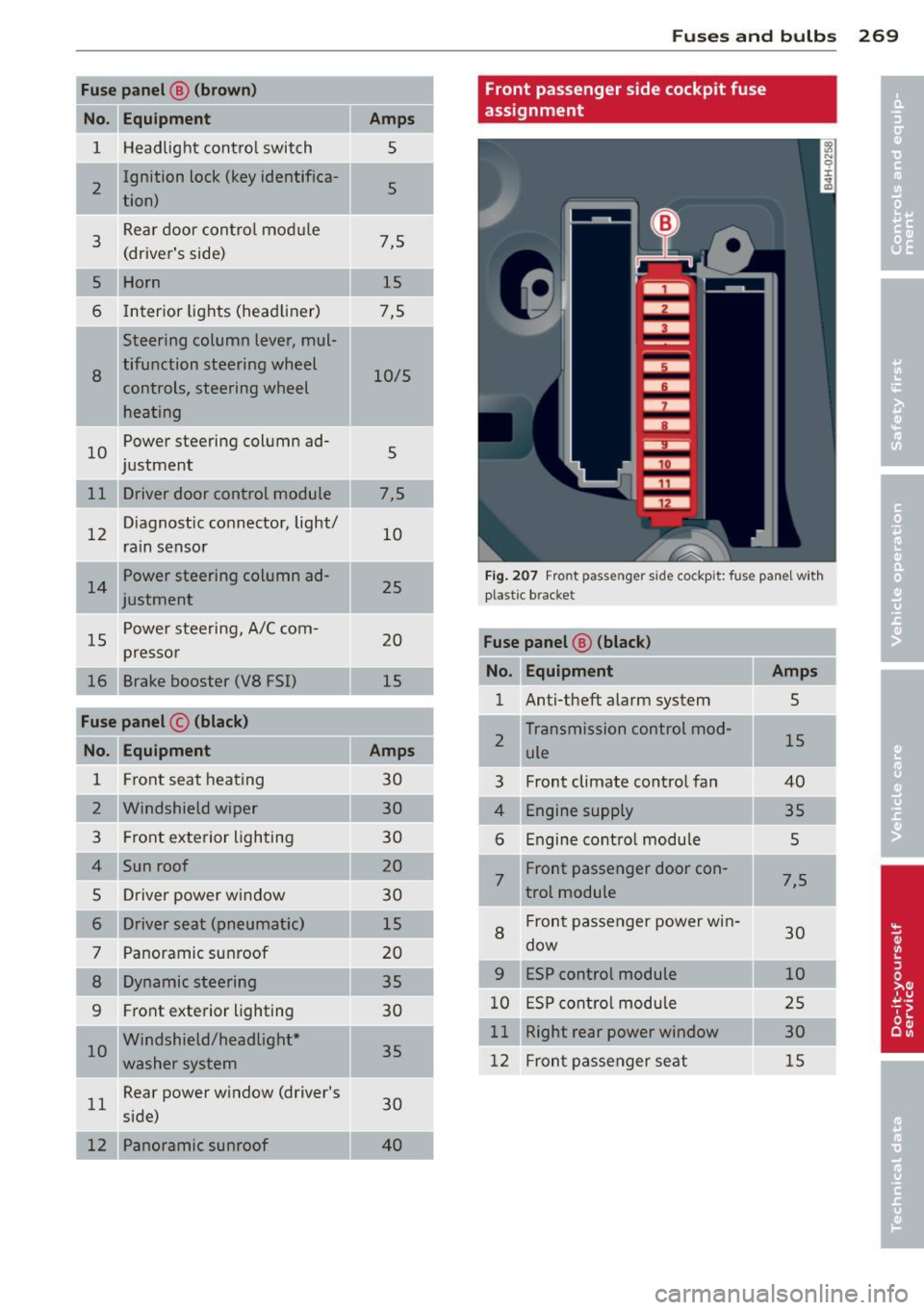
Front passenger side cockpit fuse
assignment
Fi g. 2 07 Fro nt passe nger s id e co ckpit: f use pa nel w it h
plast ic brac ket
Fuse panel ® (black)
No . Equipment Amps
1 Anti-theft alarm system 5
2
Transmission control mod-
15 ule
3 Front climate control fan 40
4
Engine supply 35
6
Engine cont ro l module 5
7
Front passenger door con-7,5
t rot module
8
Fron t passe nger power w in-
30 dow
9 ESP control module 10
1 0
E S P cont ro l modu le 2 5
11
Right rear power window 30
12
Fron t passe nger seat 15