2011 AUDI S8 brake light
[x] Cancel search: brake lightPage 213 of 302

A WARNING ,~
- Always read and heed all WAR NINGS and
other information
c:> pag e 206.
- The w indshield must not be treated with
water -repe llent materials. They can in
creas e glare under poor visibility condi
t ions such as wetness, darkness, or when
the sun is low on the horizon. In addi
ti on, they can cause the windshield wip
ers to cha tter.
(D Note
- Never use warm or hot water to remove
snow and ice from windows and m irrors.
This cou ld cause the g lass to c rack.
- To prevent damage to the wires of the
r ear defogger, do not place a ny ad hesive
stickers on the inside of the rear wi ndow
ove r the wires .
- To he lp prevent di rt from sc ratching the
window, always scr ape in a forw ard d i
rection - p ush ing the scraper away from
you - never back and fo rth.
Weatherstrips
Complete car care includes the weatherstrips
as well .
.,. Apply a suitab le rubber condi tioner to the
weathe rstrips from time to time.
To be able seal p roperly, the weatherstr ips
a round the hood, doors, rear lid, e tc. m ust re
main pliable . Spray the weatherstrips w ith sil
i cone or coat them with talcum powder or
g lycerine to retain the flexibility of the rubber
and to protect them against freezing in the
winter .
A WARNING
Always read and heed all WARNINGS and other information
c:> page 206.
Keep s ilicone sprays off the windsh ield to
avoid wiper smear in ra in.
Cleaning and protec tion
Cast (light) alloy wheels
Cast (light) alloy wheels require special care.
.,. Wash the wheels with a sponge or hose
brush every other week.
.,. For deep clean ing afterwards, use o nly a
ded icated acid-fr ee cast alloy wheel cleaner .
.,. Rub a coat of liquid wax onto the rims every
three month. Be sure to reach and treat all
pa rts of the rim.
To preserve the decorative appearance of the cast alloy wheels, som e special care is neces
sa ry. In addi tion to road d irt and salt, brake
dust is a lso co rrosive . If left on fo r too long,
brake d ust can cause pitt ing.
Use only spec ia l
acid-free cleaners formulated
fo r alloy r ims. Safe produc ts are ava ilab le at
yo ur Audi dealer. Never leave the cleane r on
the rims longer than specified on the label. If
not rinsed off prompt ly, the acid con tained in
some cleaners can attack the threads on the
whee l bolts .
Never use abrasive o r metal po lis hi ng clean
ing agents .
If the protective coating has been
c h ipped, e.g . by kicked up road dirt, to uch it
u p as soon as possible .
A WARNING
--Moisture and ice o n brakes may affect
brak ing eff ic iency
c:> page 192, General
information.
Test the brakes ca refully
each time you wash the vehicle.
- Always read and heed a ll WARNINGS and
other info rmation
¢ page 206.
Body cavity sealing
The body cavity sealing does not need to be
checked.
A ll body cavities which could be affected by
corros ion have been thorough ly protected at
the factory.
T his sealing does not require any inspection or
additional treatment. If any wax should seep
o ut of the cavity when the ambient
Iii>-
21 1
•
•
Page 224 of 302

222 Checking and filling
Checking and filling Engine hood
Releasing the engine hood
The engine hood is released from inside the
vehicle .
Fig. 175 Driver foo twell: release lever
AUD I
Fig. 176 Rocker switch un der the hood
Make sure the wiper arms are not raised up
from the windshield. Otherwise the paint
could be damaged.
.,. Pull the lever under the instrument panel in
the direction of the arrow
¢ fig. 175.
.,. Raise the hood slightly¢,&. .
... Press the rocker switch under the hood up
ward ~
fig. 176. This releases the catch.
... Open the hood.
&_ WARNING
Hot engine coolant can burn you.
- To reduce the risk of being burned, never
open the hood if you see or hear steam
or coolant escaping from the engine compartment . Wait until no steam or
coolant can be seen or heard before care
fully opening the hood .
' Working in the engine compartment
Be especially careful whenever you work in
the engine compartment.
Whenever you must perform any work in the
engine compartment, for example checking
and filling different fluids, there is a risk of injury, burns and accidents. To prevent per
sonal injury always observe the following
WARNINGS. The engine compartment of any
vehicle is a hazardous area
¢ ,&. .
/n.. WARNING
To help avoid injury, before you check any
thing under the hood:
- Turn off the engine.
- Switch off the ignition .
- Apply the parking brake.
- Move selector lever to "P" (Park) .
- Always let the engine cool down. Hot
components will burn skin on contact.
- To reduce the risk of being burned, never
open the hood if you see or hear steam
or coolant escaping from the engine
compartment. Wait until no steam or
coolant can be seen or heard before care
fully opening the hood.
- Keep children away from the engine com
partment.
- Never spill fluids on hot engine compo
nents . They can cause a fire .
- Never touch the radiator fan. The auxili
ary electric fan is temperature controlled
and can switch on suddenly .
- Never open the coolant reservoir cap
when the engine is still warm . The cool
ant system is pressurized and hot cool
ant could spray out.
- Protect your face, hands and arm from
steam or hot engine coolant by placing a
thick rag over the cap when you open the
coolant reservoir.
- If work on the fuel system or the electri
cal system is necessary:
- Always disconnect the battery.
Page 234 of 302

232 Checking and filling
Brake fluid
Checking brake fluid level
The brake fluid level can be checked with a
quick glance .
Fig. 181 Engine compartme nt: markings on the brake
flu id reservoir
Before you check anything in the engine com
partment,
always read and heed all WARN
INGS ¢ .&._ in Working in the engine compart
ment on page 222.
.. Read the brake fluid level from the brake
fluid reservoir ¢
fig. 181. The brake fluid
level must be between the "MIN" and
" MAX " markings .
The location of the brake fluid reservoir can be
seen in the engine compartment illustration
c:::,page224 .
The fluid level may drop slightly after some
time due to the automatic adjustment of the
brake pads . T hi s is not cause for alarm.
If the brake fluid level falls
considerably be
low the "MIN" mark, the brake warning/indi
cator light. (U.S. models)/ . (Canadian
models) will come on ¢
page 14. Do not con
tinue to operate the vehicle . The complete
brake system should be thoroughly checked
by an authorized Audi dealer or other quali
fied facility and the cause corrected.
If the
brake fluid level is too low, the brake warning/
indicator light will illuminate. Contact an au
thorized Audi dealer
immediately .
Changing brake fluid
Have the brake fluid changed by an experi
enced technician .
Brake fluid absorbs moisture from the air. If
t he water content in the brake fluid is too
high, corrosion in the brake system may result
after a period of time . The boiling point of the
brake fluid will also decrease considerably and
decrease braking performance.
Therefore, the brake fluid must be changed
every two years . Always use new brake fluid
which conforms to Federal Motor Vehicle
Standard "FMVSS 116 DOT 4".
The brake fluid reservoir can be difficult to reach, therefore, we recommend that you
have the brake fluid changed by your author
ized
Audi dealer. Your dealer has the correct
tools, the right brake fluid and the know-how
to do this for you .
A WARNING
-Brake fluid is poisonous. It must be stor
ed only in the closed original container
out of the reach of children!
- Brake failure can result from old or inap
propriate brake fluid. Observe these pre
cautions:
- Use only brake fluid that meets SAE
specification
J 1703 and conforms to
Federal Motor Vehicle Standard 116.
Always check with your authorized Audi
dealer to make sure you are using the
correct brake fluid. The correct type of brake fluid is also indicated on the
brake fluid reservoir.
- The brake fluid must be new. Heavy use
of the brakes can cause a vapor lock if
the brake fluid is left in the system too
long . This can seriously affect the effi
ciency of the brakes as well as your
safety. This could result in an accident.
(D Note
Brake fluid will damage the paint of your
vehicle.
Page 235 of 302

@ For the sake of the environment
Because of the problem of proper disposa l
of brake fl uid as we ll as the special tools
requ ired and the necessary expert ise, we
recommend that you have t he brake fluid
changed by your author ized Audi dealer .
Battery
General information
Under normal operating conditions, the bat
tery in your Audi does not need any mainte
nance. With
high outside temperatures or
long daily dr ive s we recommend that you have
the electro lyte level checked by a service fa
cility . The electrolyte level shou ld a lso be
checked each time the battery is charged
¢ page 235.
Have the battery checked when you take your
ve hicle in for service . Yo u are well adv ised to
replace a battery that is older than 5 yea rs .
W ith certa in types of a irbag deployment, t he
b attery is d isconnected from the vehicle elec
tr ica l system for safety reasons¢.&.
in Re
pair, care and disposal of the airbags on
page 159.
Disconnecting the battery terminals
Some vehicle functions (power w indow regu
lators , for example) are lost if the battery ter
m inals a re d isconnected. These func tions have
to be re lea rned after the batte ry term inals a re
connected agai n. T o prevent this , the bat tery
should only be d isconnec ted from the vehicle
e lec tric al system when absolu tely necessa ry
for repairs .
Vehicles not driven for long periods
If you do not drive you r vehicle over a period
of severa l days or weeks, elec trical compo
nen ts are gr adually cut b ack o r swi tched off .
This redu ces energy cons umption and main
tains starting capab ility over a longer per io d
¢ page 195.
Be aw are tha t when you unlock yo ur vehicle ,
some of the conven ien ce f unct ions may no t
Checkin g and fillin g 233
opera te , such as the Conven ience key*, the re
mote control or the power seat adjustment .
T he convenience functions will be ava ilab le
again when you switch on the ign ition and
start the eng ine.
Winter operat ion
D uring the w inte r mon ths, bat tery capacity
tends to dec rease as temperatures drop . This
is beca use more power is a lso consumed wh ile
starting, and the headlights, rear window de
fogger, etc., are used more often.
Avoid unnecessary powe r consum ptio n, pa r
ticu lar ly in city traffic or when traveling only
short distances. Let your autho riz ed Audi
dealer check the capacity of the vehicle bat
te ry before w inter sets in¢
page 235 . A well
c h arged battery will not on ly prevent s tarti ng
problems w hen the weather is cold, but wi ll
also last longer.
(D Tips
If you r vehicle is left s tandi ng for seve ral
weeks at extremely low temperatures, the
vehicle ba ttery s hould be removed an d
s to red w here i t w ill not fr eeze . T his w ill
p revent it from be in g damaged and having
to be replaced.
Working on the battery
Be especially careful when working on or near
the bat tery.
T he battery is lo cated in the l uggage compa rt
ment unde r the floo r. B efo re you che ck a ny
thi ng in the luggage com partmen t,
read and
heed all WARNINGS
¢ .&, .
Alw ays heed t he safety warning s, when work
ing on the vehicle b atte ry or the vehicle e lec -
t rical system to prevent i njury. .,..
•
•
Page 265 of 302

other warning devices to alert other mo
torists.
- Make sure that passengers wait in a safe
place away from the vehicle and well
away from the road and traffic.
- To help prevent the vehicle from moving
suddenly and possibly slipping off the
jack, always fully set the parking brake
and block the wheel diagonally opposite
the wheel being changed. When one
front wheel is lifted off the ground, plac
ing the Automatic Transmission in "P"
(Park) will
not prevent the vehicle from
moving.
- Before you change a wheel, be sure the
ground is level and firm. If necessary,
use a sturdy board under the jack.
- After installing the spare wheel, make
sure that you replace the flat tire/wheel
in its storage area properly and tighten
the knurled retaining screw securely.
@ Tips
Before changing the wheel, you must acti·
vate the jacking mode, so that the auto
matic controls for the Adaptive Air Sus
pension do not make it more difficult to
lift the vehicle with the jack ¢
page 265.
Changing a wheel
When you change a wheel, follow these
quence described below step-by-step and in
exactly that order.
1. Activate the vehicle jack mode
¢ page 265.
2. Remove the decorative wheel cover*. For
more details see also¢
page 264, Deco
rative wheel covers
or ¢ page 264,
Wheels with wheel bolt caps.
3 . Loosen the wheel bolts¢ page 264 .
4. Locate the proper mounting point for the
jack and align the jack below that point
¢page 265.
5. Raise the car with the jack¢ page 265.
6. Remove the wheel with the flat tire and
then install
the spare ¢ page 266.
What do I do now? 263
7. Tighten all wheel bolts lightly.
8.
Lower the vehicle with the jack.
9. Use the wheel bolt wrench and
firmly
tighten all wheel bolts¢ page 264.
10. Replace the decorative wheel cover*.
11. Deactivate the vehicle jack mode in the
MMI:
ICARI function button > Car systems
control button > Servicing & checks> Air
susp.: jack mode> Off .
The vehicle jack mode switches off automati
cally at speeds above 10 km/h .
A WARNING
Always read and follow all WARNINGS and
information¢ .&
in Raising the vehicle on
page 265
and ¢ page 267.
After changing a wheel
A wheel change is not complete without the
doing the following.
.. Store and secure the wheel you replaced in
the spare wheel well.
.. Replace the tools and the jack in their prop
er location.
.. Check the
tire pressure on the spare wheel
immediately after mounting it.
.. As soon as possible, have the
tightening
torques
on all wheel bolts checked with a
torque wrench. The correct tightening tor
que is 90
ft lb (120 Nm).
.. Have the flat tire
replaced as soon as possi
ble .
(D Tips
-If you notice that the wheel bolts a re
corroded and difficult to turn while
changing a tire, they should be replaced
before you check the tightening torque.
- Drive at reduced speed until you have the
tightening torques checked.
•
•
Page 271 of 302
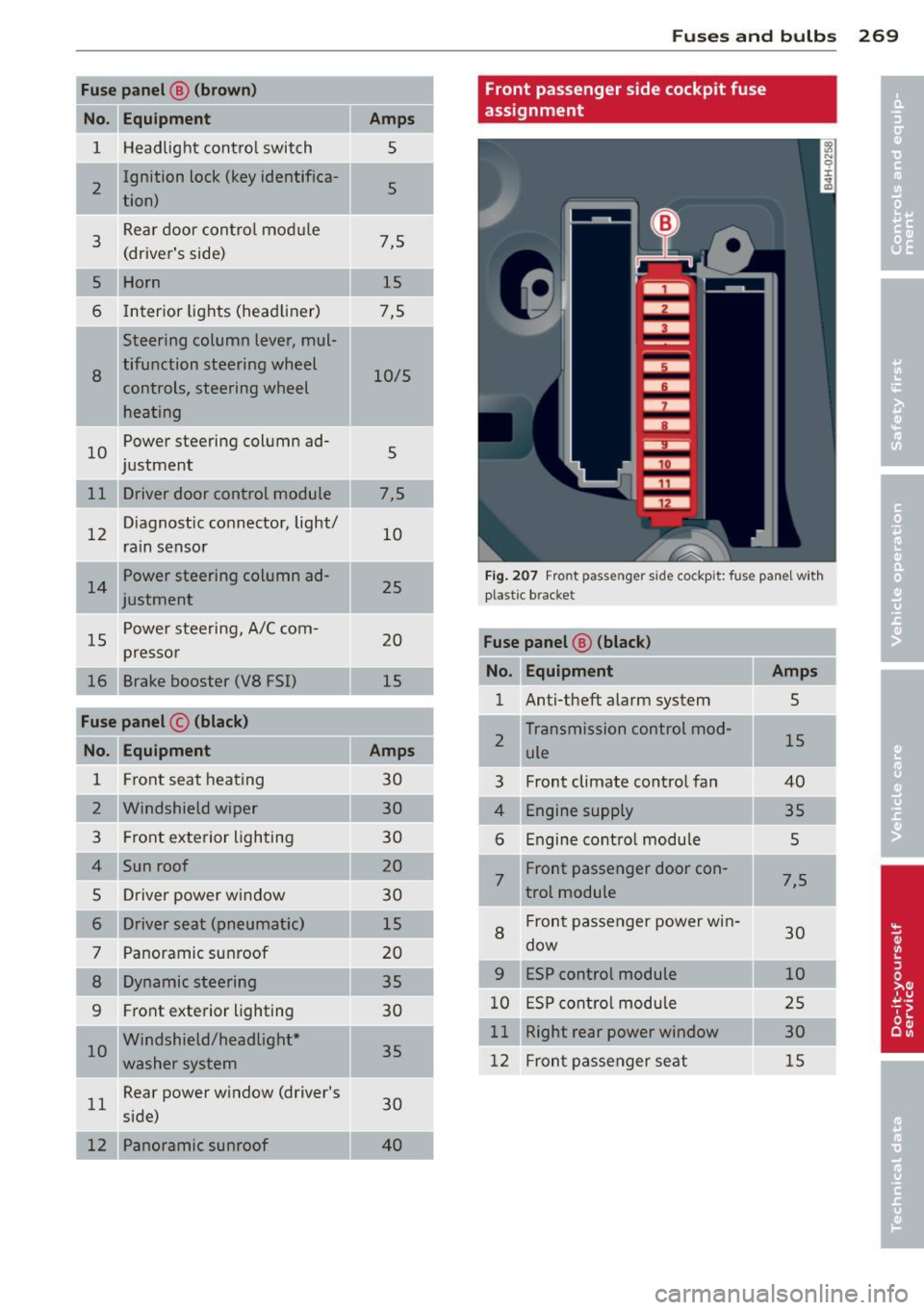
Fuse panel@ (brown)
No. Equ ipment
1 H eadlight contro l switch
I 2
Ignition lock (key identifica-
tion)
3
Rear door control mod ule
(driver's side)
5 Horn
6 Interior lights (head liner)
Steering column lever, mul-
8
tifunction steering wheel
controls, steering wheel
heating
10
Power steering column ad-
j ustment
11 Driver door control module
12
D iagnostic co nnector, light/
rain sensor
Power steering column ad-
justment
15
P ower stee ring, A/C com-
pr esso r
16 Brake booster (VS FSI)
Fuse panel © (black )
No. Equipment
1 F ront seat heating
2 Windshield wiper
3 Fr ont exterior lighting
4 Sun roof
5 Dr iver power window
6 Driver seat (pneumatic)
7 Panoramic sunroof
8 Dynamic steering
9 Fr
ont exterior lighting
I 10
Windshield/headlight *
washe r system
11
Rear power w indow (driver's
side)
12 Panoramic sunroof
Amp s
5
5
7,5 15
7,5
10/5
5
7,5 10
25
20
15
Amps
30 30
30
20
30
15
20 35
30
35
30
4 0
Fu se s and bulb s 269
Front passenger side cockpit fuse
assignment
Fi g. 2 07 Fro nt passe nger s id e co ckpit: f use pa nel w it h
plast ic brac ket
Fuse panel ® (black)
No . Equipment Amps
1 Anti-theft alarm system 5
2
Transmission control mod-
15 ule
3 Front climate control fan 40
4
Engine supply 35
6
Engine cont ro l module 5
7
Front passenger door con-7,5
t rot module
8
Fron t passe nger power w in-
30 dow
9 ESP control module 10
1 0
E S P cont ro l modu le 2 5
11
Right rear power window 30
12
Fron t passe nger seat 15
Page 272 of 302

2 70 Fu ses and bulb s
Luggage compartment fuse assignment
Fig. 208 Luggage co mpar tment: fuse panel with plastic b racket
Fu se pan el A (black ) Fuse panel
@ (b lac k)
I
No.
Equ ipment Amps No
. Equipment
Amps .
l!l button, data logger, diag-
1 nostic con
nector, adaptive
5 10
Rear seat heating, refrigera-
5 j tor, interior rearview mirror
lighting system 11 Dynam
ic steer ing 5
2 Networking gateway
5 12
Selector lever, BCM-2
5
3 adaptive air suspension
5 13 Audi side ass
ist 5
4 Parking system 5 14 Engine control module
5
5 Steering column
lever
5 1
5 Starter 40
I 6 Suspension control system
5
sensor left headlight/Headlight
'
16
10/5
range control system
.
7 Belt tensioners, airbag con-
5
trol module Fuse pan el@ (red)
No. Equipment Amps
Heated washer fluid nozzles,
Homelink (garage door
8 opener), night vision system
5
control module, sport differ- 1
left reversib
le be lt tens ioner
25
2 II
R_ight reversible belt ten-
25
s1oner
ential, ioniser 3
Starter diagnos
is
5
9
Electromechan ica l park ing
5
brake con tro l module 4 DC/DC converter
7,5
5 Adaptive cruise control 7,5
Page 273 of 302

Fuse panel@ (red)
No. Equipment
= '
I 6 Right headlight (headlight
with adaptive light)
I
7 ESP control module
8
9 Adaptive cruise control
Transmission control mod-
10 ule
11 Climate control system sen
sors
Fuse panel @ (brown)
No
. II Equipment
Electromechan ical parking
1 brake
2 Suspension control system
sensor
Right rear door control mod-
3 ule
4 Smart-Modul Tank
5 Front climate control system
controls
6 Rear climate control system
controls
7 Networking gateway
8 Refrigerator
Interface for spec ial func-
9 tions
12 Selector lever
13 Ambient lighting
14 Rear exterior lighting
15 Fuel pump
16 Electromechanical parking
brake
Fuse panel @ (black)
Equipment
3 Rear sockets*
5 adaptive air suspension
6 115-V socket
7 Electromechanical parking
brake
II
Amps
10
s
5
10
5
5
Amps
5
5
7,5 5
15
10 5
15
5
10
10
20
25
30
Amps
20
15
25
30
=
Fuses and bulbs 271
Fuse panel @ (black)
No. Equipment
8 Rear seat heating
9 Rear exterior lighting
10 Rear
climate control system
blower
Rear sun shade, closing aid,
11 luggage compartment lock,
keyless
go/entry, fuel filler
door
12 luggage compartment lid
control module
Fuse panel E (red)
No. Equipment
1 Rear
seat adjustment but-
tons
3 Left rear seat
(pneumatics)
5 Trailer hitch control modu le*
6 Left rear seat
7 Right rear seat
8 Trailer hitch control module*
9 Trailer hitch control module*
10 Right rear seat (pneumatics)
Fuse panel ® (brown)
No. Equipment
1 Radio receiver/sound ampli-
fier
Sound amplifier, Bang&
2 Olufsen Advanced Sound
System
Rear Seat Enterta inment, ra-
3 dio receiver/sound amplifier
Automatic dimming interior
5 rearview mirror, rearview
camera (parking aid)
6 DVD changer
7 TV tuner
8 MMI unit/drives
9
Instrument cluster, analog
clock
10 MMI Display
Amps
25
20
20
20
30
Amps
s
7,5
20
30
30
20
15
7,5
30
30 10
5
5
5
7,5
5
5
•
•
....