2011 AUDI S8 power steering
[x] Cancel search: power steeringPage 192 of 302

190 Intelligent technology
Intelligent technology Notice about data
recorded by vehicle
control modules
Your veh icle is not equipped with an Event Da
ta Recorder (EDR), installed by some manu
facture rs for the express purpose of capturing
data for retrieval after an accident or crash
event . EDR's are sometimes ca lled "crash re
corders".
Some state laws restrict the retr ieval or down
loading of data stored by EDR's that were in
stalled in a vehicle for the express purpose of
retrieving data after an accident or crash
event without the owner's consent.
A lthough your vehicle is not equipped with an
EDR, it is equipped with a number of electron
ic control modules for various vehicle systems
such as, for example, eng ine function, em is
sion control, as well as for the airbags and
safety belts.
These electronic contro l modules also record
vehicle-re lated data during normal vehicle op
eration for diagnostic and repair purposes.
The recording capacity of the electronic con
trol modules is limited to data (no sound is re
corded) and only a small amount of data is ac
tually recorded over a ve ry limited pe riod of
time and stored when a system fault or other
cond ition is sensed by a control unit. Some of
the data then stored may re late to vehicle
speed, direction, braking as we ll as restraint
system use and performance in the event of a
crash or other condition. Stored data can only
be read and downloaded with special equip
ment.
Electronic stabilization
program (ESP)
Description
ESP helps to improve road holding and vehicle
dynamics to help reduce the probability of
skidd ing and loss of veh icle control. It works
only when the engine is running. ESP detects certain difficult driving situat
ions, including
when the vehicle is beginning to spin (yaw) out of control and helps you to get the veh icle
back under control by se lectively braking the
wheels, and/or reducing engine power and
providing steer ing assistance to help hold the
vehicle on the driver's intended course. The in
dicator light
liJ in the instrument cluster
blinks when ESP is taking action to help you
control the vehicle.
ESP has limitations.
It is important to remem
ber that ESP cannot overcome the laws of
physics. It will not always be able to help out
under all conditions you may come up against.
For example, ESP may not always be able to
help you master situations where there is a
sudden change in the coefficient of friction of
the road surface. When there is a section of dry road that is suddenly covered w ith water,
slush or snow, ESP cannot perform the same
way it wou ld on the dry surface . If the vehicle
hydroplanes (rides on a cushion of water in
stead of the road surface), ESP will not be
able to help you steer the vehicle because con
tact with the pavement has been interrupted
and the vehicle cannot be braked or steered.
During fast cornering, particularly on winding
roads, ESP cannot always deal as effectively
with difficult driving situations than at lower
speeds. When towing a trailer, ESP is not able
to help you regain control as it would if you
were not tow ing a trailer.
Always adjust your speed and driving style to road, traffic; and weather condit ions. ESP can
not override the vehicle's physical limits, in
crease the available traction, or keep a ve hicle
on the road if road departure is a result of
driver inattention. Instead, ESP improves the
poss ibility of keeping the vehicle unde r con
trol and on the road during extreme maneu
vers by using the driver's steering inputs to
help keep the vehicle going in the intended di
rection . If you are traveling at a speed that
causes you to run off the road before ESP can
provide any assistance, you may not experi
ence the benefits of ESP .
Page 193 of 302
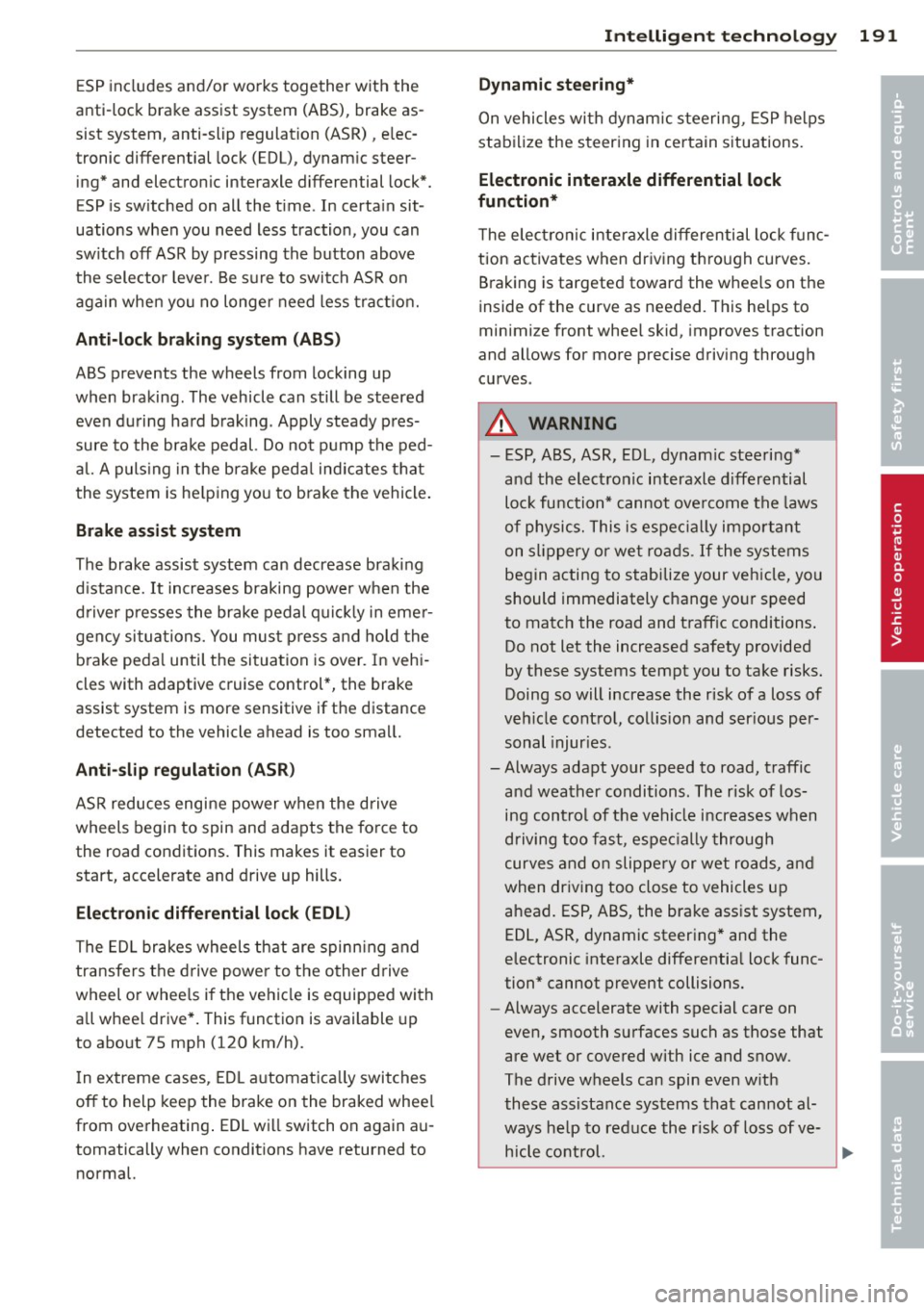
ESP includes and/or works together with the
anti-lock brake assist system (ABS), brake as
sist system, anti -slip regulation (ASR), elec
tronic differential lock (EDL), dynamic steer
ing* and electronic interaxle differential lock*.
ESP is switched on all the t ime . In certa in sit
uations when you need less traction, you can
sw itch
off ASR by pressing the button above
the selector lever. Be sure to switch ASR on
again when you no longer need less traction.
Anti-lock braking system (ABS)
ABS prevents the wheels from locking up
when braking. The vehicle can still be steered even during hard braking . Apply steady pres
sure to the brake pedal. Do not pump the ped
al. A puls ing in the brake pedal indicates that
the system is he lping you to brake the vehicle.
Brake assist system
The brake assist system can decrease brak ing
distance.
It increases braking power when the
driver presses the brake pedal quickly in emer
gency situations. You must press and hold the
brake pedal until the situation is over. In vehi
cles with adaptive cruise control*, the brake
assist system is more sensitive if the distance
detected to the vehicle ahead is too small.
Anti-slip regulation (ASR)
ASR reduces engine power when the drive
wheels begin to spin and adapts the force to
the road conditions. This makes it easier to
start, accelerate and drive up hills .
Electronic differential lock (EDL)
The EDL brakes wheels that are spinning and
transfers the drive power to the other drive
wheel or whee ls if the vehicle is equipped with
a ll whee l drive *. This function is available up
to about 75 mph (120 km/h).
I n extreme cases, EDL automatically switches
off to help keep the brake on the braked wheel
from overheating . EDL will switch on again au
tomatically when conditions have returned to
normal.
Intelligent technology 191
Dynamic steering*
On vehicles with dynamic steering, ESP helps
stabilize the steering in certain situations.
Electronic interaxle differential lock
function*
T he electronic interaxle differential lock func
tion activates when driving th ro ug h curves.
Braking is targeted toward the wheels on the
inside of the curve as needed. This he lps to
minimize front whee l skid, improves traction
and allows for more precise driving through
curves .
A WARNING
- ESP, ABS, ASR, EDL, dynamic steering*
a nd the electronic interaxle differential
loc k fu nction* cannot overcome the laws
of physics. This is especially impo rtant
on slippery or wet roads.
If the systems
begin acting to stabilize your vehicle, you
should immediately change yo ur speed
to match the road and traffic conditions .
Do not let the increased safety provided
by these systems tempt you to take risks.
Doing so will increase the risk of a loss of
veh icle contro l, collision and ser ious per
sonal injur ies.
- Always adapt your speed to road, traffic
and weather conditions. The risk of los
ing con trol of the vehicle increases when
driving too fast, espe cially through
curves and on slippery or wet roads, and
when dr iving too close to vehicles up
ahead. ESP, ABS, the brake assist system,
EDL, ASR, dynam ic steer ing* and the
electronic interaxle differentia l lock func
tion* cannot prevent collisions.
- Always accelerate with special care on
even, smooth surfaces such as those that
are wet or covered with ice and snow.
The drive wheels can spin even with
these assistance systems that cannot al
ways he lp to reduce the risk of loss of ve
hicle contro l.
-
•
•
Page 196 of 302

194 Intelligent technology
been damaged, the brake pedal must be
pressed considerably harder to make up
for the lack of booster assistance.
Servotronic ® -
advanced power
steering system
The power steering systems use the power of
the running engine to allow precise steering
with little effort .
The advanced Servotronic® power steering
system senses the road speed and e lectroni
cally adjusts power assistance to prov ide com
fortable and safe steering response exactly
matched to the veh icle speed.
Power steering w ill not work if the eng ine is
off . As a result, the steering whee l wi ll be hard
to turn.
The power steering fluid level is checked dur
ing the scheduled maintenance serv ices.
([) Note
If there is an electronic malfun ct ion, ser
votronic
w ill still f unction like a conven
tional power steer ing system, providing a
constant steering support force that is no
longer proportionate to the vehicle speed.
This is most noticeab le when turning the
steer ing whee l at low speeds (for examp le
when parking), - more effo rt will be re
qui red than usua l.
- Be aware of the different than usual
stee ring response and adjust yo ur stee r
i ng fo rce accord ingly.
- Have the p roblem checked and set rig ht
by an Aud i deale r as soon as possib le.
(D Tips
- When the engine is runn ing, never hold
t h e steer ing whee l turned all the way to
the right or to the left for longer than 15
se conds. The power steer ing p ump w ill
ove rhe at the hydr aulic flu id if you keep
ho ld ing the steering whee l turned all the way
. This is likely to damage the power
steering system .
- If the powe r steering system sho uld fai l
entirely, o r if the engine is not runn ing
(for examp le, whi le being towed), you
w ill sti ll be able to steer the veh icle.
However,
considerably more effort will
be required to do so.
- If the power steering system sho uld
have a leak, or is not functioning proper
ly, contact your author ized Audi dealer
immed iately.
- The power steering system requ ires a
specially fo rmu lated hydraulic fluid. The
powe r stee ring fluid reservoir is locat ed
in the engine compartment
Q page 224.
T he corre ct fl uid level i n the reservoir is
impo rta nt fo r proper fu nctioning of the
powe r stee ring .
Driving with your
quattro ®
With All Wheel Drive, all four wheels are driv
en .
Gen eral information
With A ll W heel Drive, power is distributed to
all four wheels. This happens automatically
depending on your driving style and the road
condit ions at the time. See also
Q page 190.
With the sport different ial*, powe r distribu
tion to the rear wheels is variable and can be
adjusted with Audi drive select*
Q page 106 .
Winter tires
When driving in the winter, yo ur vehicle with
All Wheel D rive has an advantage, even w ith
r egular tires . In wi nter road conditions it may
be advisable to mount winter tires (or all-sea
son tires) for improved driveability and brak
i ng : these tires must be mo unted o n
all four
wheel s. See also q page 253, Winter tires.
Tire chains
Where tire chains are mandatory on certa in
roads, this no rma lly also app lies to veh icles
with All Wheel D rive
q page 254, Snow
chains .
Page 226 of 302

224 Checking and filling
Engine compartment
Engine compartment overview
These are the most important items that you can check.
Fig . 177 Typ ical layout for conta iners a nd eng ine o il filler cap
(D W indshield/head light washer
t . (?::..) con
amer ~ .... ... . ... .. . 236
@ Jump start point(-) with hex
h ead screw, ................
235, 273
@ Jump start point(+) unde r a cov-
e r, . ...... .... ......... .. .
23 5, 273
© Eng ine oi l filler cap ('t::r.) . . . . . 227
® B rak e fluid reservo ir ((0)) . . . . . 232
® Coolant expansion tank (J-) . . . 229
0 Power steering reservoir . . . . . . 194
The engine oil filler neck (item@) may be lo
cated in a d ifferent area depending on the ver
sion of the engine .
A WARNING
Before you check anything in the engine
compartment, always read and heed all
WAR NINGS¢
A in Working in the engine
compartment on page 222.
Engine oil
Engine oil specifications
The engine oil used in your Audi needs the
right kind of oil.
T he eng ine in your Audi is a sophisticated
powerplant that was built to exacting specifi
cations . Th is engine needs the right k ind of
engine oil that meets specifications regarding
quality and v iscosity so that it can run
smoothly and reliab ly . Choosing th e right o il
and changi ng oil within the t ime and mileage
in tervals prin ted in you r vehicle's Warr anty
&
Maintenan ce booklet matte rs a lot more to
day tha n it did years ago . Audi has develope d
a spec ia l quality standard for engine oil that
will help assure that you r vehicle's engine w ill
get the lubr ication it needs for proper opera-
t ion. ..,.
Page 241 of 302

-Never mount used tires on yo ur vehicle if
you are not sure of their "previous histo
ry." Old used tires may have been dam
aged even though the damage cannot be
seen that can lead to sudden tire failure
and loss of vehicle control.
Glossary of tire and loading terminology
Accessory weight
means the comb ined weight (in excess of
those standard items wh ich may be rep laced)
of automa tic tra nsmission, power steering,
power br akes, power w indows, power sea ts,
radio, and heater, to the ex tent that these
items are avai lab le as factory -installed eq uip
ment (whether installed or not).
Aspect ratio
means the rat io of the height to the w idt h of
the tire in percent . Numbers of 55 o r lower in
d icate a low sidewall fo r improve d steer ing re
sponse and better overall handling on dry
pavement.
Bead
means the pa rt of the t ire t hat is made o f
s teel wires, wrapped o r reinforce d by ply cor ds
and that is shaped to fit the r im.
Bead separation
means a b reakdown of the bond between
com ponents in the bead .
Cord
means the strands forming the plies in the
tire .
Cold tire infl ation pres sure
means the tire pressure recommended by the
vehicle manufacturer for a t ire of a designated
size that has not been dr iven for more than a
couple of miles (kilometers) at low speeds in
the three hour period before the tire pressure
i s measu red or adjusted.
Tire s an d wheel s 239
-If you notice un usua l vibration or if the
veh icle pulls to one side when driv ing, a l
ways stop as soon as it is safe to do so and check the wheels and tires for dam
age.
Curb weight
mea ns the we ight of a motor ve hicle w it h
standard equipment in cl ud ing t he maximum
capacity of fuel, o il, and coolant, ai r cond i
tion ing and addi tional weig ht o f optiona l
equipment .
Extra load tire
means a t ire design to operate at h igher loads
and at higher inflation pressures than the cor
r espondi ng s tan dard tire. Extra load tires may
be identified as "X L", "xl", "EXTRA LOA D", o r
"R F" on the sidewall .
Gross Axle Weight Rating ("GAWR")
means the load-carry ing capac ity of a s ingle
axle system, measured at the tire-ground in
te rfaces .
Gross Vehicle Weight Rating ( "GVWR ")
mea ns the maximum total loaded we ight of
t h e ve hicle.
Groove
means the space between two adjacent tread
ribs.
Load rating (code )
means the maximum load tha t a t ire is rate d
to ca rry for a given inflation press ure. Yo u
may not find this information on all tires be
ca use it is not required by law.
Maximum load rating
me ans the loa d ra ting f or a t ire a t the maxi
mum pe rm issi ble inflat ion pressure for that
ti re .
•
•
...
Page 271 of 302
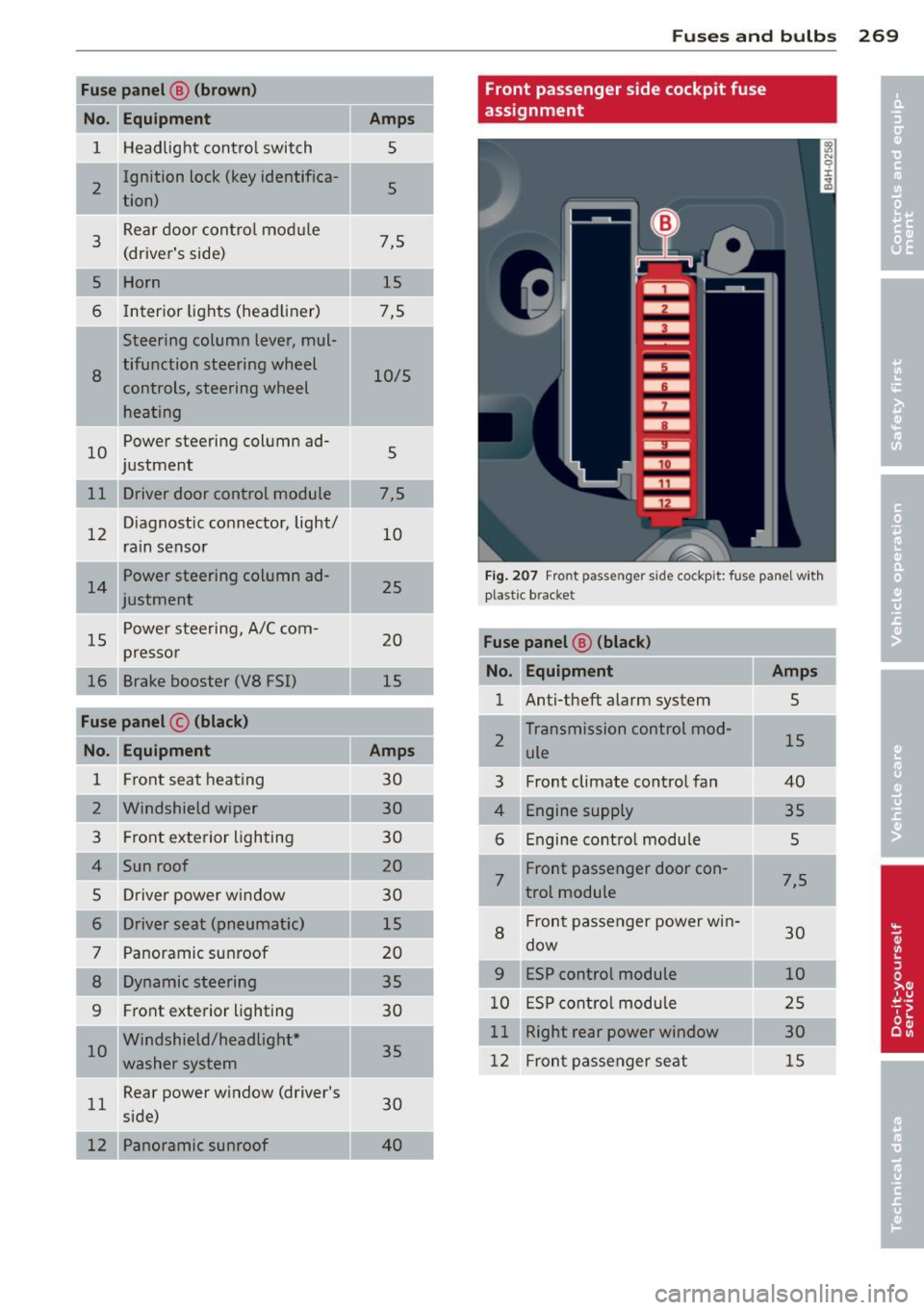
Fuse panel@ (brown)
No. Equ ipment
1 H eadlight contro l switch
I 2
Ignition lock (key identifica-
tion)
3
Rear door control mod ule
(driver's side)
5 Horn
6 Interior lights (head liner)
Steering column lever, mul-
8
tifunction steering wheel
controls, steering wheel
heating
10
Power steering column ad-
j ustment
11 Driver door control module
12
D iagnostic co nnector, light/
rain sensor
Power steering column ad-
justment
15
P ower stee ring, A/C com-
pr esso r
16 Brake booster (VS FSI)
Fuse panel © (black )
No. Equipment
1 F ront seat heating
2 Windshield wiper
3 Fr ont exterior lighting
4 Sun roof
5 Dr iver power window
6 Driver seat (pneumatic)
7 Panoramic sunroof
8 Dynamic steering
9 Fr
ont exterior lighting
I 10
Windshield/headlight *
washe r system
11
Rear power w indow (driver's
side)
12 Panoramic sunroof
Amp s
5
5
7,5 15
7,5
10/5
5
7,5 10
25
20
15
Amps
30 30
30
20
30
15
20 35
30
35
30
4 0
Fu se s and bulb s 269
Front passenger side cockpit fuse
assignment
Fi g. 2 07 Fro nt passe nger s id e co ckpit: f use pa nel w it h
plast ic brac ket
Fuse panel ® (black)
No . Equipment Amps
1 Anti-theft alarm system 5
2
Transmission control mod-
15 ule
3 Front climate control fan 40
4
Engine supply 35
6
Engine cont ro l module 5
7
Front passenger door con-7,5
t rot module
8
Fron t passe nger power w in-
30 dow
9 ESP control module 10
1 0
E S P cont ro l modu le 2 5
11
Right rear power window 30
12
Fron t passe nger seat 15
Page 292 of 302

290 Index .:..:..:..::....::.....:..._ ___________________________ _
Doors
M echanical child safety lock .. .... .. .. 38
Power child safety lock . . . . . . . . . . . . . . 38
Driver information system
CD/radio display . . . . . . . . . . . . . . . . . . . . 23
Door/r ear lid warning . . . . . . . . . . . . . . . 23
Efficiency program . . . . . . . . . . . . . . . . . . 25
Exterior temperature display ... .. .. .. 23
On-board computer . . . . . . . . . . . . . . . . . 24
Driver seating position ............... 128
drive select .................... ... . 106
adaptive air suspension/sport ........ 106
Adaptive dampers ........ .. .. .... . 106
Cornering light ......... .. .. .. .. .. . 106
Dynamic steering ......... .... .... . 106
Safety belt tensioner ....... .... ... . 106
Sport differential .......... ... .... . 106
Driv ing safely .............. ... .. .. . 127
Driving through water ............... 199
Driving tim e . . . . . . . . . . . . . . . . . . . . . . . . 24
Duplicate key . . . . . . . . . . . . . . . . . . . . . . . 29
Dynamic steering . . . . . . . . . . . . . . . 22, 106
E
Easy entry feature ............ .. .... .. 78
Efficiency program . . . . . . . . . . . . . . . . . . . 25
Fu el economy messages . . . . . . . . . . . . . 25
Other equipment . . . . . . . . . . . . . . . . . . . 25
Elect rical accessoires (sockets) . . . . . . . . . 63
Electrical accessories (sockets) . . . . . . . . . 69
Electromechanical parking brake
Emergency braking . . . . . . . . . . . . . . . . . 83
Operation ......................... 81
Parking .... ................ ..... .. 82
Releasing and closing ........... ... . 81
Starting assist ............ ... .... .. 82
Starting from rest ........ .. .. .... .. 82
Starting off with a trailer ..... .. .. .. . . 82
Warning/indicator lights ..... .. .... .. 15
Electronic differential lock (EDL) ... ... . 190
Warning/indicator lights ......... .. .. 19
E lectronic immobilizer . . . . . . . . . . . . 26, 30
Electronic power co ntrol (EPC)
warning/indicator light ..... .... ..... 20
Electronic speed limiter . . . . . . . . . . . . . . . 28 Electronic
stabilization program (ESP) . . 190
Warning/indicator lights ............. 18
Emergency actuation
Doors .. .. .. .. .. ............. .. .. . 3S
Parking lock ... .. ............. .... 116
Pow er sunroof ... .................. 41
R ea r lid ... .... .. ............. ..... 37
Emerg ency braking . ... .......... .. .. . 83
Emergency flasher .............. .. .. . 44
Warning/indicator lights ........ .. .. . 22
Emergency operation Panoramic sunroof ................ .. 42
Sun shade (roof) . ............... .. . 42
Emerg ency starting ... .......... .. .. 273
Emergency towing .................. 275
Emergency warning triangle ......... . 259
Energy management . ........... .. .. 195
Engine Compartment .. .. ... .......... .. .. 224
Coolant ......... .. .............. . 229
Data 282
starting ........................... 79
Start ing with jumper cables ......... 273
Stopping .. .. .. .. .. ........... .... . 80
E ngine compartment ............... . 224
Closing the hood ... ..... ........ .. 223
Opening the hood .......... ...... . 222
Safety instructions ............... .. 222
Working in the eng ine compartment .. 222
Engine coolant .. ................... 229
Adding coolant ... .. ..... ........ .. 230
Checking the engine coo lant level ..... 229
Expansion tank ................ .... 229
Malfunction symbol ............ .... . lS
Radiator fan ..... ................ . 231
Temp erature gauge ................ . 10
Engine oil ..... ... .. .............. . 224
Adding ... .. .. .. .. ........... .... 227
Additives .. .. .. .. ............. .. .. 227
Changing ..... .. ................. 228
Checking the engine oil leve l ......... 227
Indications and conditions requiring ex-
tra checking ..... ............. .... 227
Indicator light ... ... .......... .. .. . 17
Oil consumpt ion .. ............. .... 226
Oil grades ..... .................. . 224
Oil level symbol . . . . . . . . . . . . . . . . . . . . 20
Page 296 of 302

294 Index
Panoramic sunroof ........... .. .... .. 41
Sun shade . . . . . . . . . . . . . . . . . . . . . . . . . 42
Parking . .. .... ........... ........ .. 82
Valet park ing ............ .. .. .. .. .. 40
Park ing brake ... . ...... ... .. .. .. .. .. 81
also refer to Electromechanical park ing
brake .. .. .. ................ ... ... . 81
Parking lights ............. .... .... .. 43
Parking system
C leaning camera lens ............... 208
Parking system advanced
Adjust ing the display .......... .. .. . 122
Adjust ing the warning tones .. .. .. ... 122
Rear view camera -parking mode 1 .. . 121
Rear view camera -parking mode 2 . .. 121
Safety precautions ................ . 118
Switching on and off ....... .... ... . 120
Parts replacement ......... .... .... . 285
Pass-through with ski sack . . . . . . . . . . . . . 66
PASSENGER AIR BAG OFF light .... ... . 1S6
Passenger protection ........ ..... .. . 188
Passive safety system ......... .. .... . 127
Pedals .. .. .. ............. .. .. .. .. . 132
Physical principles of a frontal collision . 138
Polishing .... ................ ..... . 209
Pollutant filter (automatic A/C system) . . 7 4
Power locking system . . . . . . . . . . . . . . . . . 31
Locking/unlocking the vehicle from in-
side . .. .. .. ................ ... ... . 34
Rear lid .. .. ... .... ...... .. .. .. .. .. 35
Selective unlock feature . .. .. .. .. .. . . 32
Settings . . . . . . . . . . . . . . . . . . . . . . . . . . 32
Unlock ing and locking vehicle ... .. .. . . 32
Power seat adjustment Front seats . . . . . . . . . . . . . . . . . . . . . . . . S5
Rear seats .. ................ ... ... . S7
Power steering (servotronic) . .. .. .. .. . 194
Power windows . . . . . . . . . . . . . . . . . . . . . . 39
malfunction . . . . . . . . . . . . . . . . . . . . . . . 39
Pregnant women
Special considerations when wearing a
safety belt . . . . . . . . . . . . . . . . . . . . . . . 142
pre sense .. .. ... .. ..... ... .... .. .. . 188
Preventative passenger protection . . . . . 188
Programming the Homelink ® universal re-
mote control .............. .. .. .. .. . 124 Proper
occupant seating positions ... .. 128
Proper safety belt position ............ 141
Proper seating position Front passenger .. ............. .... 129
Occupants . .. .. .. .. .. ... ..... ... .. 128
Rear passengers .. ..... ........... . 130
Q
quattro ®
refer to All Wheel Drive . . . . . . . . . . . . . 194
Question What happens to unbelted occupants? 138
Why safety belts? ............. .... 137
R
Radiator fan ...... ................ . 231
Radio clock ... .. .. ............. .. .. . 26
Rain/light senso r
Headlights .. ...... ... ..... ... .. .. . 43
Intermittent (w indshield wipers) ...... 48
Sensor defective . . . . . . . . . . . . . . . . . . . . 21
Range (fuel level) . . . . . . . . . . . . . . . . . . . . 24
Reading lights ... .. ............. .. .. . 46
Rear fog lights .. .. ....... ...... .. .. . 43
Rear lid Automatic operation .............. .. 36
Emergency release ............... .. . 37
Escape handle . .. ............. .... 259
Opening and closing ..... ...... .. .. . 35
Rear light Defective . . . . . . . . . . . . . . . . . . . . . . . . . 21
Rear seats Adjusting individual seats ....... .... . 57
Entry assistance . . . . . . . . . . . . . . . . . . . . 60
Front passenger seat adjustment . . . . . . 60
Reclining rear seat ................ .. 59
Rear view camera
Reverse Parking .. ............. .. .. 121
Rear view mirror ... ....... ...... .. .. . 51
Rear window heating ................. 76
Recirculation mode (automat ic climate
control) .... .... ................... . 7S
Reclining rear seat . ... .. ....... ... .. . 59
Refrigerator
refer to Cooler . . . . . . . . . . . . . . . . . . . . 216
Refuelling .... .. .. .. ... ............ 220