2011 AUDI R8 SPYDER battery
[x] Cancel search: batteryPage 158 of 244

156 Intelligent technology
Dynamic energy management
While the veh icle is be ing driven , dynamic en
e rgy management distributes the energy gen
erated according to the needs of the individu
a l components . It regu lates consumption, so
that more electrical energy is not being used
than is being generated and ensures an opti mal state of charge for the battery .
(D Tips
- But even energy management cannot
negate the limits of physics. Consider
that the power and life of a battery are li mited .
- If starting ab ility is threatened, you are
i nformed by a warn ing
<=> page 156,
Driver notification in the instrument
cluster display .
What you should know
The highest priority is given to maintaining
starting capability.
The battery is severely taxed in short-distance
driving, in city traffic and during the cold time
of year. Abu ndant electr ical energy is re
qu ired, but only a little is generated . It is also
cr itical if the engine is not running and elect ri
cal components are turned on. In th is in
stance energy is being consumed but none is
being generated .
It is in precisely these situations that you w ill
notice energy management actively regulat
ing the distrib ution of energy .
Vehicle stands for an extended period
If you do not drive your vehicle over a period
of severa l days or weeks, elect rical compo
nents are gradually cut back o r switched off .
This reduces energy consumption and main
tains starting capabi lity over a longer period.
Take into considerat ion that when you un lock
your vehi cle, some convenience functions,
such as the remote key or power seat adjust
ment, may not be available. The convenience
functions will be available again when you
turn on the ignition and start the engine. With the
engine turned off
If you listen to the radio, for examp le, w ith
the engine turned off, the battery is being dis
charged.
If starting capability is jeopardized due to en
ergy consumption , a message appea rs in the
driver information display.
You have to start the engine to charge the batte ry.
With the engine running
Although electrical energy is generated when
the vehicle is being driven, the battery can be
come discharged. This happens mostly when
little energy is being gene rated and a great
deal consumed and the battery's state of
charge is not optimal.
To bring the energy balance back into equili
brium , consume rs which requ ire espec ially
large amounts of energy are temporar ily cut
back or sw itched off. Heating systems in par
ticu lar require a great deal of energy. If you
notice, for example, that the heated seats or
the heated rear window are not heating, they
have been temporarily cut back or switched
off . These systems will be available again as
soon as the ene rgy balance has been restored.
You wi ll also notice that engine id le speed has
been increased slightly . Th is is normal and not
a cause for concern. By increasing engine idle
speed the additional energy required is gene r
ated and the battery is charged .
Driver notification in the instrument
cluster display
If battery power drops into the range where it
can limit the ability of the engine to start, this
is shown in the instrument cluster display
with the following driver message:
(•i Low battery charge: battery will be
charged while driving
T h is not ificat io n r eminds you that the start ing
capability of the engine may be lim ited. As
soon as you start driving again, the battery .,..
Page 159 of 244

will be recharged and the notification will go
out.
Driver notification appears and goes out
again
If this driver notification appears after the ig
nition is turned on or while driv ing and it goes
out again after a wh ile, the battery has been
adequately recharged.
Driver notification appears and does not
go out again
If this driver notification appears after the ig
nition is turned on or while driv ing and does
not go out again, the battery's state of charge
is not in the optimal range. Starting ability is
restricted. Have the battery checked as soon
as poss ible by an author ized Audi dealer or
qualified workshop.
Dry sump lubrication
H igh lateral and long itud inal forces affect the
engine and the vehicle during sporty driving.
Dr y sump l ubr ica tion ensures that your engine
i s supplied w ith oil and properly lub ricated
even under these conditions.
I n a "normal" veh icle the o il pump sends the
oil from the oil pan to the lubrication points in
the engine. The oil then returns to the oil pan .
I n extreme situations, the oil pump may draw
in air, which results in insufficient oil pressure.
With dry sump lubrication, the oil is not in the
oil pan (it is "d ry"), but in a separate oi l tank.
While one pump supplies the engine with oi l,
a second pump suctions the oi l out of the en
g ine and returns it to the oil tank . Because the
oil tank is ta ll and narrow, o il pressure is con
stant even under extreme conditions.
In addition, the oil pan in vehicles with dry
sump lubrication is noticeably sha llower. Th is
allows the engine to be installed lower in the
vehicle, bringing down the center of gravity .
This improves your vehicle's handling .
Intelligent technology 157
•
•
Page 178 of 244
176 Checking and filling
thick rag over the cap when you open the coolant reservoir .
-If work on the fuel system or the electri
cal system is necessary:
- Always disconnect the battery .
- Never smoke or work near heaters or
open flames. Fluids in the engine com partment could start a fire .
- Keep an approved fire extinguisher im
mediately available.
- To avoid electrical shock and personal in
jury while the engine is running or being
started, never touch:
- Ignition cables
- Other components of the high voltage
electronic ignition system.
- If you must perform a check or repair
with the engine running:
- First, fully apply the parking brake,
move selector lever of R tronic to "N"
(Neutral); put manual transmission in
Neutral.
- Always use extreme caution to prevent
clothing, jewelry, or long hair from get
ting caught in the radiator fan, V-belts
or other moving parts, or from contact
ing hot parts . Tie back hair before
starting, and wear no clothing that will
hang or droop into the engine.
- Minimize exposure to emission and
chemical hazards~&. .
.&_ WARNING
California Proposition 65 Warning:
- Engine exhaust, some of its constituents,
and certain vehicle components contain
or emit chemicals known to the State of
California to cause cancer and birth de
fects and reproductive harm. In addition,
certain fluids contained in vehicles and
certain products of component wear con
tain or emit chemicals known to the
State of California to cause cancer and
birth defects or other reproductive harm .
- Battery posts, terminals and related ac cessories contain lead and lead com
pounds, chemicals known to the State of California to cause cancer and
reproduc
tive harms. Wash hands after handling.
@ Note
When adding fluids, always make sure that
they are poured into the proper container
or filler opening, otherwise serious dam
age to vehicle systems will occur.
@ For the sake of the environment
To detect leaks in time, inspect the vehicle
floor pan from underneath regularly. If
you see spots from oil or other vehicle flu
ids, have your vehicle inspected by an au
thorized Audi dealer.
Closing the engine compartment lid
... Make sure that the rear spoiler is retracted
~page 152.
""Pull the engine compartment lid down until
the pressure from the struts is reduced.
.., Press the engine compartment lid closed
c::>& .
A WARNING ,_
A engine compartment lid that is not com
pletely latched could fly up and block your
view while driving.
- When you close the engine compartment lid, check it to make sure the safety catch
has properly engaged . The engine com
partment lid should be flush with the
surrounding vehicle body parts .
- If you notice while driving that the en
gine compartment lid is not secured properly, stop at once and close it.
Page 186 of 244

184 Checking and filling
Brake fluid
Notice
Have the brake fluid changed by an experi
enc ed technician .
Brake fluid abso rbs moisture from t he a ir. If
the water content in the brake fluid is t oo
high, corrosion in the brake system may result
after a per iod of t ime . The bo iling po int of the
brake fluid w ill also decrease considerably and
dec rease b rak ing performance.
Therefore, the brake flu id must be changed
e ver y two y ear s. Always use new brake fluid
which confo rms to Fede ral Motor Vehicle
Standa rd "FMVSS 1 16 DO T 4".
Brake fluid is rep laced according to the Audi
maintena nce service schedule . Your author
ized Audi dealer is equipped with the necessa
ry special tools and rep lacement parts , has
the necessary expe rtise, and c an d ispose of
the used fluid .
& WARNING
-Brake fluid is po isonous. It must be sto r
ed on ly in the closed orig inal container
o ut o f the reach of children!
- Brake fa ilure can result from old or inap
propriate b rake fluid . Observe these pre
caut ions:
- Use only bra ke fluid that meets SAE
specifi cation
J 1 703 and co nfo rms to
F ederal Motor Vehicle St andard 116 .
A lways check with you r a uthorized Aud i
dea ler to make s ure you are using the
correct brake fl uid. T he correct type of
brake fluid is a lso indicated on the
brake fluid reservoir.
- The brake fluid must be new. Heavy use
of the brakes can cause a vapor lock if
the brake fl uid is left in the system too
long . This can ser ious ly affect the effi
cie ncy of the bra kes as well as yo ur
safety. This could result in an acc ident .
(D Note
Brake fluid will damage the paint of you r
vehicle .
@ For the sake of the environment
Because o f the prob lem of p rope r disposal
of brake fluid as well as the spec ial too ls
r equired and the necessary expertise, we
recommend that yo u have the brake fl uid
changed by yo ur authorized Aud i dea le r.
Battery
General information
All work on the battery requires technical
knowledge.
The battery is located behind the cover i n the
l uggage compa rtme nt. Remove the cover by
pushing it to the left and lift ing it o ut.
The battery is practically maintenance-free
and is checked as pa rt of your ve hicle's main
tenance se rv ices .
You are we ll advised to replace a battery that
is older than S years .
Disconnecting the battery terminal s
Some vehicle functions (power window reg u
lators, for example) are lost if the battery te r
mina ls are disconnected . T hese functions have
to be relearned after the battery termina ls are
connected again . To prevent th is, the battery
shou ld only be disco nnected from the ve hicle
electrica l system when abso lutely necessary
f o r repai rs.
Vehicles not driven for long periods
The battery becomes d ischarged due to quies
cent current consume rs even when the vehicle
i s not used . With extended pe riods of non-use
i n the
cold season, you should have the ve hi
cl e battery removed by an autho rized Aud i
de aler or qu alified workshop and stored in an
frost -free place. This preven ts the battery
from "freezing" and thereby being dest royed.
D uring the
warmer seasons it is eno ugh to liJ>
Page 187 of 244

disconnect the battery negative terminal. Oc
casionally charge a disconnected battery.
Winter operation
The cold time of year places a special strain on
the battery, resulting in reduced starting pow
er. So before the cold weather starts, have the battery inspected and charged as necessary.
A WARNING
- All work on the battery requires technical
knowledge. Please contact an authorized
Audi dealer or another authorized facility
for questions about the battery - danger of acid burns and explosion hazard!
- The battery must not be opened! Do not
try to change the battery's liquid level,
otherwise detonating gas will escape
from the battery - explosion hazard!
Working on the battery
Always wear eye protection.
Battery acid contains sulfuric
acid. Always wear gloves and eye
protection.
No
- sparks
- flames
- smoking.
When a battery is charged, it pro
duces hydrogen gas which is ex plosive and could cause personal
injury.
Always keep the battery well out
of reach of children.
The following WARNINGS are very important
when working on the battery:
A WARNING
Whenever working on the battery or on
the electrical system, there is the risk of
injury, accident and even fire. Read and
heed the following WARNINGS:
-
Checking and filling 185
- Always wear eye protection. Do not let
battery acid or any lead particles get on
your skin or clothing. Shield your eyes. Explosive gases can cause blindness or
other injury.
- Battery acid contains sulfuric acid. Sulfu
ric acid can cause blindness and severe
burns.
- Always wear gloves and eye protection.
Do not tilt the battery because acid
could leak out of the ventilation open
ings.
- If you get battery acid in your eyes or
on your skin, immediately rinse with
cold water for several minutes and get
medical attention.
- If you should ingest any battery acid,
seek medical attention immediately.
- Do not expose the battery to an open
flame, electric sparks or an open light.
- Do not smoke.
- Do not interchange the positive and neg- ative cables.
- When working on the battery, be sure
not to short-circuit the terminals with
tools or other metal objects. This would cause the battery to heat up very quickly,
which could lead to damage or explosion and personal injury.
- When a battery is charged, it produces
hydrogen gas which is explosive and
could cause personal injury.
- Always keep the battery well out of the
reach of children.
- Before work is done on the electrical sys
tem, disconnect the negative ground ca
ble.
- Before performing any work on the elec
trical system, switch off the engine and
ignition as well as any electrical equip
ment. The negative cable on the battery
must be disconnected.
If you are just go
ing to replace a light bulb, then it is
enough to switch off the lights.
- Before disconnecting the battery, switch
off the anti-theft alarm system! Other
wise you will set off the alarm. •
•
Page 188 of 244

186 Checking and filling
-When disconnecting the battery, first
disconnect the negative cable and then
the positive cable.
- Before reconnecting the battery, make
sure all electrical consumers are switch ed off. Reconnect the positive cable first
and then the negative cable. Never inter
change the cables -this could start a fire!
- Never charge a frozen or a thawed-out
battery. It could explode!
If a battery has
frozen, then it must be replaced. A dis
charged battery can freeze over at 32 °F
(0 °C).
-Make sure the vent hose is always attach
ed to the opening on the side of the bat
tery.
- Never use batteries which are damaged.
Danger of explosion! Always replace a
damaged battery .
.&, WARNING
California Proposition
65 Warning:
- Battery posts, terminals and related ac
cessories contain lead and lead com
pounds, chemicals known to the State of
California to cause cancer and reproduc
tive problems. Wash hands after han
dling.
(D Note
- Do not disconnect the vehicle battery
when the ignition is switched on or when
the engine is running, otherwise, you will
damage electronic components in the
electrical system.
- If your vehicle is going to stand for a
long period of time without being driven,
protect the battery from "freezing", oth
erwise it will be damaged and will then have to be replaced. Charging the battery
Connections for
charging the battery are lo
cated in the luggage compartment.
Fig. 147 L uggage compartment: battery cover
Fig. 148 Luggage compartment: connectors for a
charger and jump start cables
Do not connect the negative cable directly to
the negative terminal on the battery. Connect
it to a
jump start pin instead c:, fig. 148.
.,. Always read and heed all WARNINGS c:, A
in Working on the battery on page 185 and
¢ A -
... Switch off the ignition and all electrical con
sumers .
.,. Open the luggage compartment lid
c:>page42 .
.,. Remove the battery cover c:, fig. 147.
.,. Connect the terminal clamps from the
charger to the battery terminal (red= "posi
tive") and the jump start pin
c:, fig. 148
(black or brown= "negative") as specified.
.,. Only now plug the mains lead for the charg
ing equipment into the wall outlet and turn
it on .
.,. When the battery is fully charged: Turn the
charging equipment off and remove the
mains lead from the wall outlet .
.,. Now remove the clamps for the charging
equipment.
Page 189 of 244

~ Install the battery cover.
~ Close the luggage compartment lid
¢page 42.
When charging at low voltages (e.g. with a
trickle charger), the battery cables do not
have to be disconnected first. Before charging
at
high voltages, i.e. "fast charging", you
must disconnect both cables. In either case,
follow the instructions from the manufacturer
of the charger .
Fastcharging a battery is
dangerous ¢.&. in
Working on the battery on page 185 .
It re
quires special charging equipment and the knowledge to go with it. We recommend hav
ing your battery fast charged only by a quali
fied workshop.
A discharged battery can
freeze at tempera
tures of only 32 °F (0 °C) . Allow a frozen bat
tery to thaw completely before attempting to
charge it¢ ,&. . However, we recommend not
using a thawed battery again because the bat
tery casing can be cracked due to ice forma
tion and can leak battery acid.
Do not open the battery caps when charging
the battery.
_& WARNING
-
Charging a battery can be dangerous.
- Never charge a frozen battery .
It may ex
plode because of gas trapped in the ice.
Allow a frozen battery to thaw out first.
- Do not reuse batteries which were fro
zen. The battery housing may have
cracked and weakened when the battery
froze.
- Charge the battery in a well ventilated
area. Keep away from open flame or elec
trical spark. Do not smoke. Hydrogen gas
generated by the battery is explosive.
- To reduce the danger of explosion , never
connect or disconnect charger cables
while the charger is operating.
- Fast charging a battery is dangerous and
should only be attempted by a compe
tent technician with the proper equip ment.
Checking and filling 187
- Battery acid that may spill during charg
ing should be washed off with a solution
of warm water and baking soda to neu
tralize the acid .
@ Note
Never use a fast charger as a booster to
start the engine. This will seriously dam
age sensitive electronic components, such
as control units, relays, radio, etc ., as well
as the battery charger .
(D Tips
-The vehicle battery must not be charged
with a standard small charger that plugs
into the cigarette lighter or outlet .
- Only charge the battery through the con
nections in the luggage compartment.
Replacing the battery
The new battery must have the same specifi
cations as the old one.
Your vehicle is equipped with an intelligent
energy management system for distributing
electricity ¢
page 155. The battery charges
better in vehicles with the energy manage
ment system than in vehicles without the sys
tem. To ensure that the additional power is
available after replacing the battery , replacing
with the same type of battery from the same
manufacturer (like the battery that was deliv
ered with the vehicle) is recommended. An au
thori zed dealer mus t code the battery in the
energy management control module .
T he new battery must have the same capacity,
voltage (12 volts), current and design and it
must be sealed with plugs. The battery must
conform to the standards TL 825 06 (from Oc
tober 2006) and VW 7 50 73 (from August 2001).
Since the vehicle battery is difficult to reach,
we recommend having the battery replaced by
an authorized Audi R8 dealer or other quali-
fied workshop . ..,. •
•
Page 190 of 244
188 Checking and filling
(D Note
-Your vehicle is equipped with a specia l
battery. Installing a different type of
battery can cause prob lems in the vehi
cle electrical system. When replacing the
vehicle battery, always install one with
the same spec ificat ions as the original
batte ry .
- Make sure that the gas venting hose is
always connected to the o riginal open ing
on the battery side. Otherw ise gasses or
ba tte ry acid cou ld leak out .
- Battery ho lder and term inals a lways
have to be secured cor rectly.
- Read and follow the warnings under
9 page 185, Working on the battery be
fore performing any work on the batte ry.
@ For the sake of the environment
Because of the problem of proper disposal
of a battery, we recommend your author
ized Audi dealer change the batte ry for
you . Batter ies contain s ulf uric ac id and
lead and must always be disposed of prop
erly in compliance with all environmenta l
reg ulations. D isposing of vehicle batteries
improperly is very dangerous to the envi
ronment. Make sure that the removed bat
tery ca nnot overbalance, otherwise sulfu
r ic acid might escape!
Windshield washer
container
Fig. 149 Luggage co m pa rtment : W inds hield washer
fl uid reservo ir
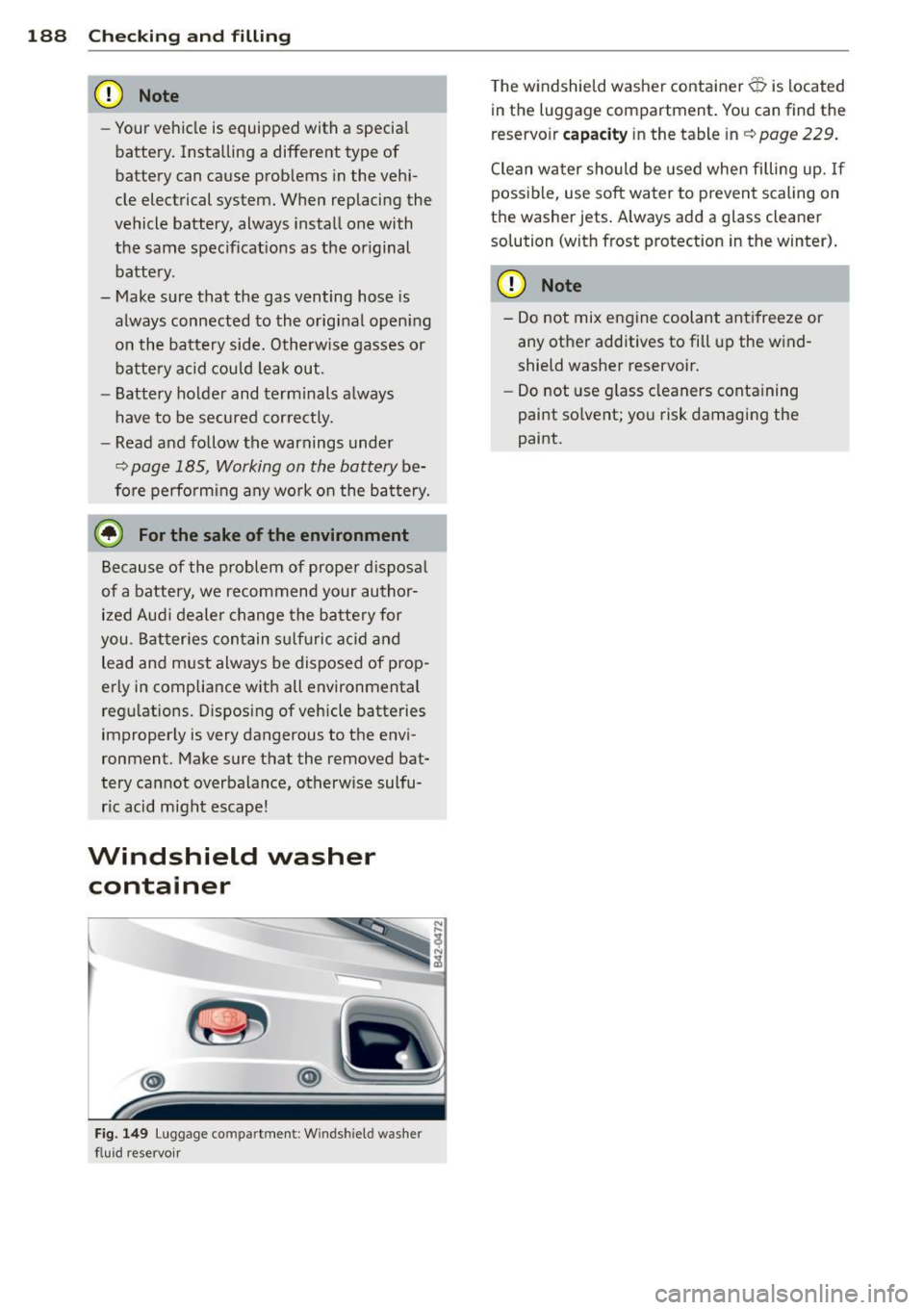
T he windshield washer container O is located
in the luggag e compartment. You can find the
reservo ir
c a pacit y in the table in c::> page 229.
Clean water should be used when filling up. If
possible, use soft water to prevent scaling on
the washer jets . Always add a glass cleaner
solution (with frost protection in the winter) .
(D Note
-Do not mix engine coolant antifreeze or
any other additives to fill up the wind
shield washer reservoir.
- Do not use g lass cleaners conta ining
pai nt so lvent; you risk damaging the
paint.